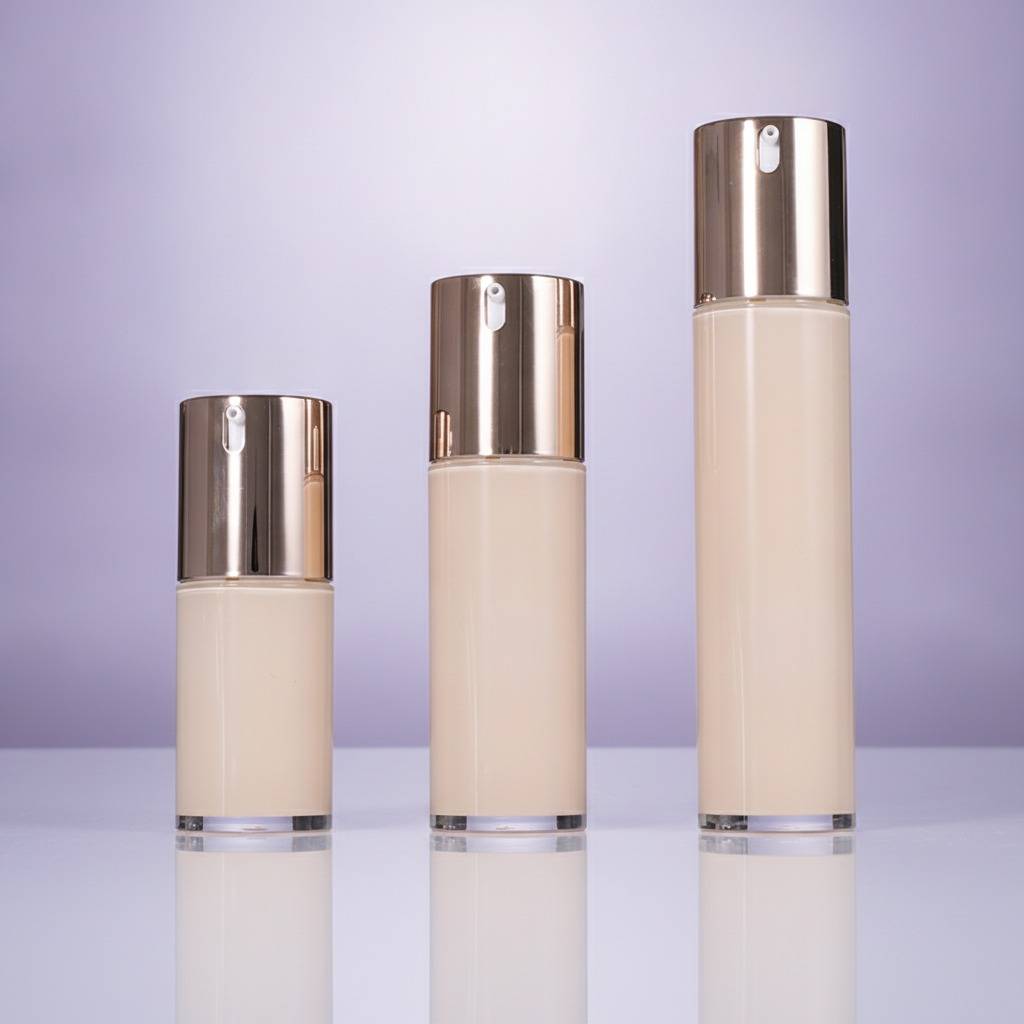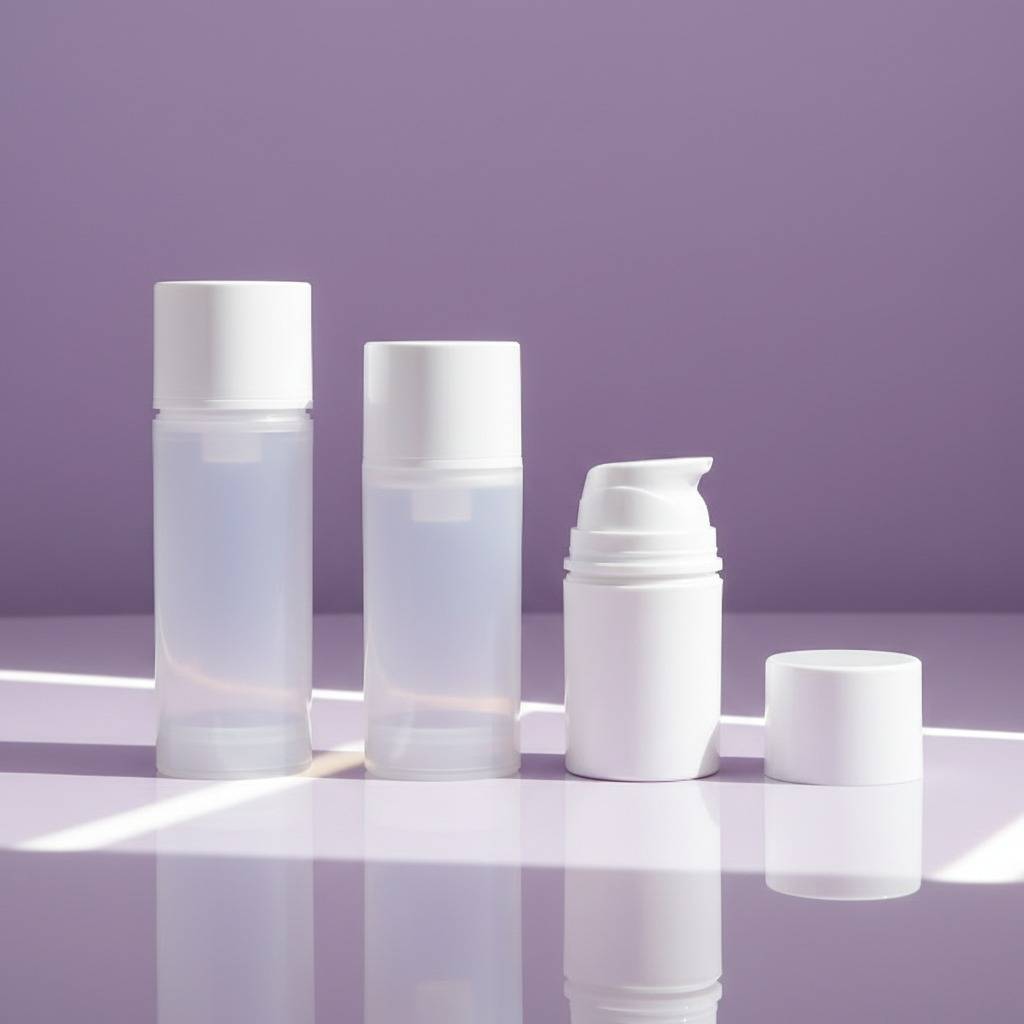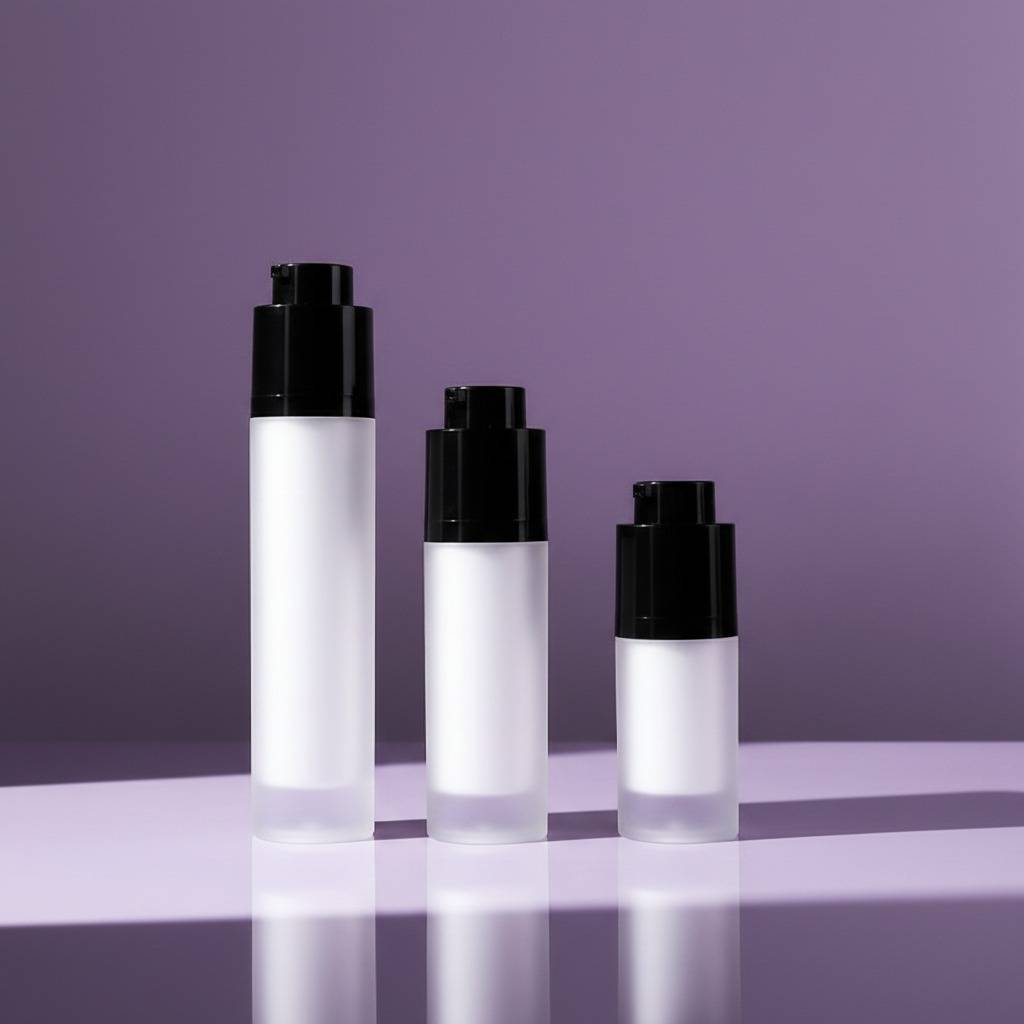

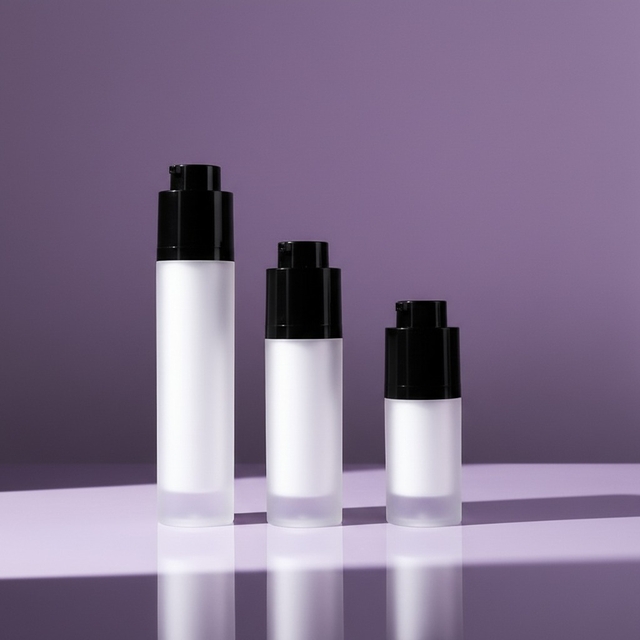
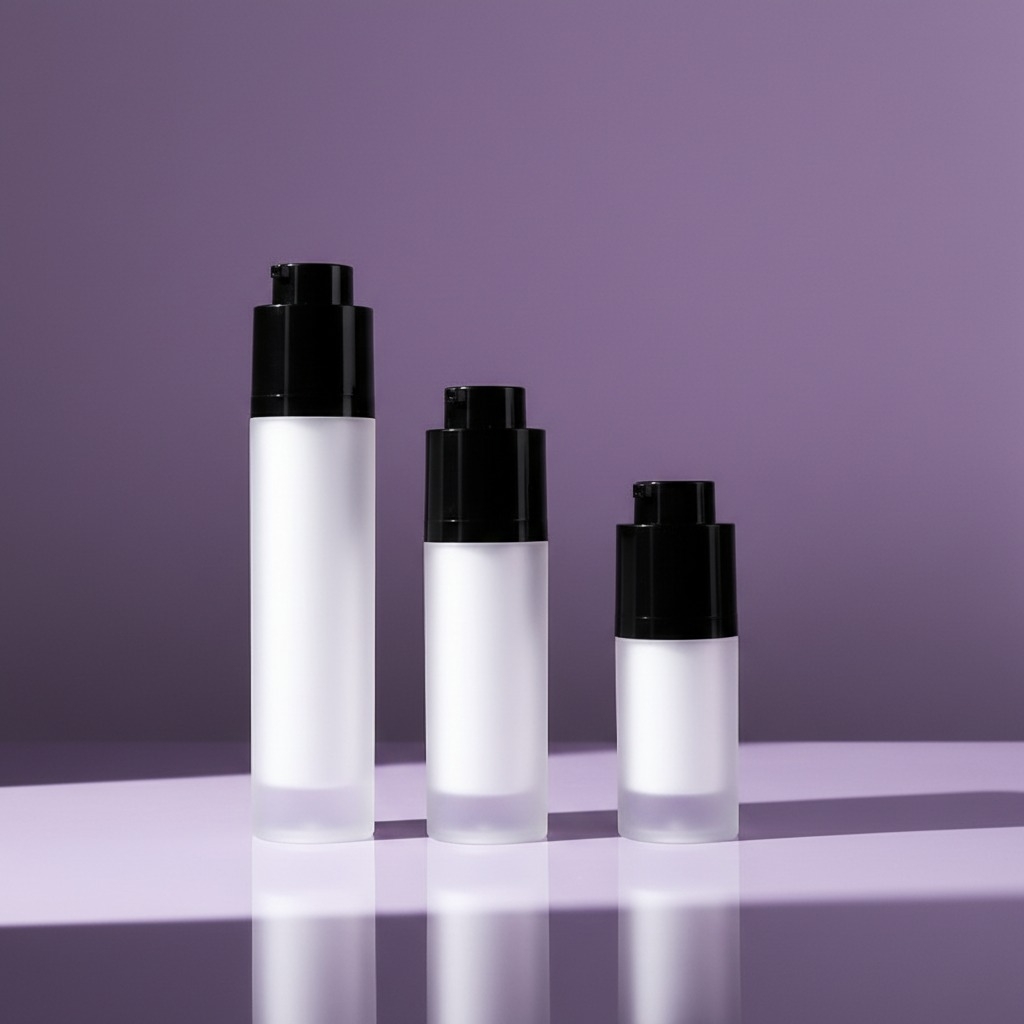
For cosmetic formulators and brand owners, preserving the potency of oxygen-sensitive actives while delivering a smooth consumer experience remains a constant packaging challenge. The airless pump bottle addresses this issue directly by eliminating interior dip tubes and head-space exposure, protecting delicate formulations from oxidation, moisture loss, and external contamination. Presented in a cohesive three-tiered height series, these containers feature pristine opaque white bodies accented by matte-to-satin black stepped closures, yielding a high-contrast, clean aesthetic engineered for contemporary beauty lines.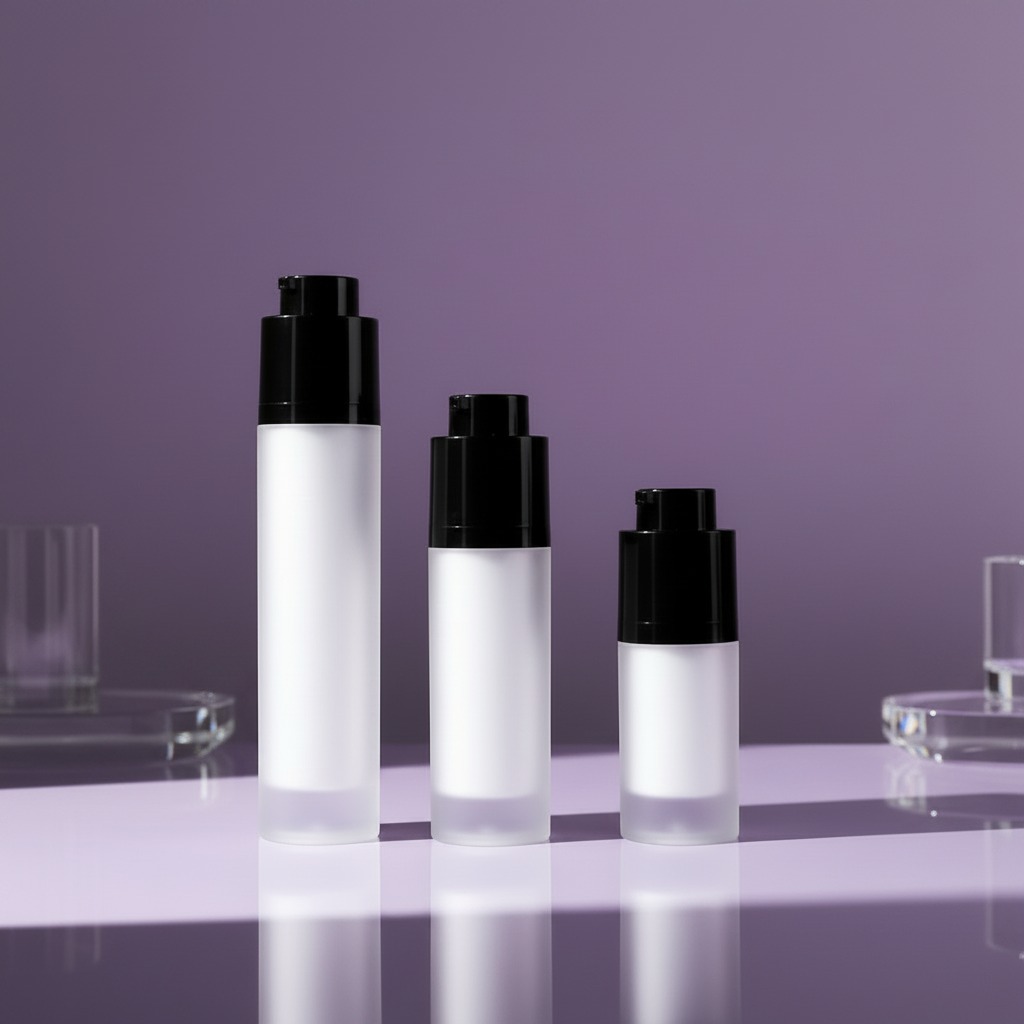
Product Form and Visual Profile
The packaging family exhibits a disciplined, minimalist geometry. Each cylindrical container rises along vertical, straight walls that soften into delicately radiused shoulders and matching rounded heel transitions. The opaque white surfaces yield a smooth, porcelain-like appearance that masks fill levels while shielding light-sensitive ingredients from ambient degradation.
Crowning each container is a multi-tiered black closure assembly. The lower collar matches the circumference of the vessel, grounding the silhouette before narrowing into an ergonomic finger pad. An integrated nozzle orifice provides clean product cutoff, reducing crusting around the dispensing point. Visual evaluation displays three distinct container heights within the same diameter envelope, allowing brands to establish uniform shelf presentation across multiple fill volumes, though precise physical dimensions and fluid capacities must be determined based on specific technical drawings.
Airless Dispensing Mechanics
Unlike traditional pump assemblies reliant on a submerged dip tube, an airless pump packaging format operates via pressure differential. As the user depresses the actuator, an internal piston disc rises from the base of the chamber, drawing viscous creams, emulsions, or gel solutions upward. This vacuum-driven travel prevents ambient air from backfilling the chamber.
For high-value formulations, choosing a vacuum pump bottle design provides several functional advantages:
- Near-total evacuation rates that minimize residual product waste inside the base.
- Precise stroke dosing that prevents user over-application.
- Consistent 360-degree dispensing, enabling evacuation even when held horizontally or inverted.
- Protection of delicate botanical extracts, vitamin blends, and unstable peptides from air-driven degradation.
While the external hardware exhibits the characteristics of an airless dispenser bottle, internal stroke volumes, piston seal tolerances, and specific output-per-stroke metrics depend on the interior mechanical engine selected during tooling integration.
Material Selections and Production Pathways
Achieving the structural clarity and smooth wall integrity shown in these bottles typically involves precision polymer processing. While the exact substrate cannot be confirmed solely through visual inspection, high-density polyethylene (HDPE), polypropylene (PP), and polyolefin blends are industry-standard choices for opaque white bottles due to their balance of rigidity, chemical inertness, and impact resistance. For luxury weight and glass-like wall thickness, acrylic (PMMA) outers over PP inner reservoirs are frequently specified.
Manufacturing generally follows a multi-stage approach. The primary reservoirs are fabricated using injection blow molding (IBM) or injection stretch blow molding (ISBM) to maintain dimensional accuracy across neck threads and interior piston glide paths. The multi-component black airless pump dispenser closures—consisting of the actuator, collar, spring mechanism, and internal valve chamber—are molded via high-cavitation injection tooling before automated assembly and seal testing.
Application Scenarios across Product Lines
Because this packaging system presents an adaptable, gender-neutral visual identity, it integrates naturally across clinical, professional, and prestige retail markets.
High-Potency Facial Serums and Treatments
As a dedicated skincare airless pump bottle, the non-vented chamber provides the barrier environment required by formulations featuring ascorbic acid, retinol, or active enzyme systems. The clean pump delivery avoids finger-dipping contamination common to traditional wide-mouth cosmetic jars.
Daily Hydration and Body Care
In taller body formats, the system transitions effectively into an airless lotion bottle or vacuum lotion dispenser. Thicker face creams, lightweight daily lotions, and soothing barrier creams maintain stable viscosity without drying out within the nozzle passage between uses.
Complexion and Color Cosmetics
Operating as a makeup airless pump bottle, the sealed package holds liquid foundations, tinted moisturizers, and silicone-based primers. The regulated output prevents sudden splattering, providing consistent dot-by-dot application during cosmetic routines.
Procurement, Quality Control, and Validation
Procurement managers sourcing an airless cosmetic bottle series should establish comprehensive testing protocols prior to commercial volume filling. Because formulation viscosities, solvents, and oil contents vary dramatically, packaging engineers should conduct standardized factory trials, including:
- Vacuum Chamber Leak Testing: Evaluating seal integrity under negative pressure to confirm no air infiltration around the piston gasket or closure fitment.
- Torque and Actuation Force Mapping: Measuring the downward force required to engage the airless cosmetic bottles to verify smooth travel for end-consumers.
- Chemical Compatibility and Immersion: Storing filled vessels across elevated temperatures to test against formula migration, stress cracking, or discoloration of the white body wall.
- Restitution and Priming Count: Recording how many initial strokes are necessary to establish product flow, as well as checking cutoff cleanliness at the nozzle tip.
Customization and Brand Personalization
While the monochrome white-and-black contrast provides a modern stock appearance, the cylindrical canvas supports extensive decorative treatments for custom collections. The flat exterior surfaces facilitate automated multi-pass UV screen printing, high-resolution pad printing, or metallic foil hot-stamping for ingredient decks and regulatory markings. Surface textures can be adjusted via mold finishing to achieve high-gloss, soft-touch matte, or satin tactile effects.
For technical specifications, volume capacities, and sample requests to validate your bulk bulk formulation compatibility, contact our packaging specialists to review engineering drawings and production minimums.