
Product Overview
Refillable Jars are a practical choice for brands that need compact skincare packaging with a reusable structure, clear product presentation, and a simple refill workflow. For buyers, the main problem this format solves is packaging waste and reordering friction: instead of replacing the full container every time, the jar can be designed for reuse, refill, or product rotation. That makes it especially useful for creams, balms, gels, and other personal-care formulas that are dispensed from a wide-mouth container.
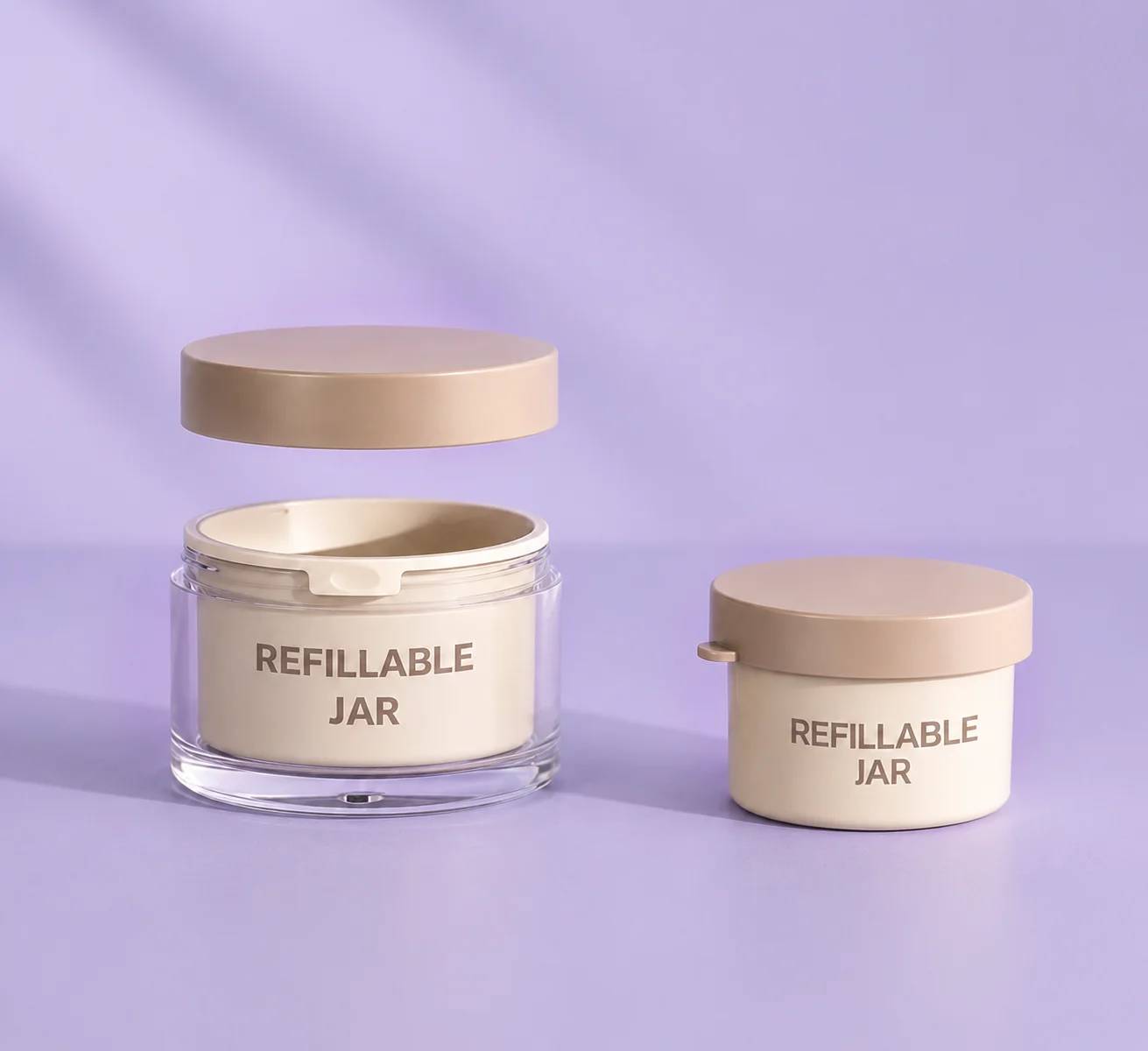
The version shown here appears to be a cylindrical cosmetic jar with a matching flat lid. One assembled version is shown in an opaque beige finish, while the exploded view suggests a clear outer shell, a beige inner cup, and a separate lid. Based on the visible structure, it is best understood as a refillable cosmetic jar or cream pot intended for skincare packaging, private-label launches, travel-size formats, and sample presentation. Exact capacity, dimensions, sealing performance, and resin type are not visible and should be confirmed during sampling.
Visible Structure and Design Notes
Wide-mouth access for viscous formulas
The jar has a short, broad cylindrical shape with straight sidewalls and a wide opening. This geometry is common in cosmetic packaging because it allows easy finger access, spatula use, and straightforward filling on the production line. Products such as face creams, body balms, sleeping masks, and gel-based treatments often benefit from this format because the formula can be dispensed without pumps or narrow-neck bottles.
Multi-component construction
The exploded view indicates a layered build rather than a single monolithic body. The visible parts include a transparent outer shell, an inner insert or cup in beige, and a separate lid. That arrangement can support several practical goals: product visibility through the clear shell, a cleaner inner contact surface, and a more premium visual contrast between the outer body and lid. The assembled version also appears to include a small side tab or lug near the rim, which may help with alignment or opening assistance, although that should be verified on a physical sample.
Simple profile for branding
Because the exterior form is clean and minimal, the jar gives space to printed labels, sleeve decoration, hot stamping, or direct brand marking. The flat lid area is particularly useful when a brand wants a strong front-facing presentation on retail shelves or in e-commerce photography.
Materials and Finish Options
From the image, the product appears to be plastic, but the exact resin is not confirmed. In cosmetic packaging, refillable jars of this style are commonly made from materials selected for clarity, stiffness, appearance, and compatibility with the intended formula. Buyers often choose between transparent, translucent, and opaque appearances depending on the brand concept and the need to show the product color.
The visible finishes suggest a smooth surface with a glossy or semi-gloss clear body and a matte or satin beige look on the lid and inner cup. That combination can create a balanced premium effect without using complex ornamentation. For many private-label brands, finish matters as much as shape because it influences how the jar reads on shelf, how it photographs, and how fingerprints or scuffs appear during handling.
Possible finish directions for a project like this may include clear, frosted, opaque, or color-matched parts, but those choices should be based on sample approval rather than assumptions. If the outer shell is intended to show the formula or layered decoration, clarity and tint control become important. If the goal is a more protective or understated look, an opaque body may be the better route.
Manufacturing and Assembly
This type of cosmetic packaging is likely produced through injection molding, although that cannot be confirmed from the image alone. Injection molding is widely used for jars because it supports repeatable geometry, smooth surfaces, and efficient production of lids, cups, and outer shells. For a refillable design, multiple molded parts are often assembled into a final unit that balances appearance with usability.
The visible exploded view suggests a structure that may involve separate tooling for the outer body, the inner insert, and the lid. That approach gives the manufacturer more control over color separation, wall design, and brand styling. It also makes it easier to adjust one component without redesigning the entire package. For example, a brand could keep the same outer shell while changing the inner cup color for seasonal collections or product variants.
In production, key steps usually include mold validation, dimensional checks, visual inspection, component fit testing, and closure verification. For refillable jars, assembly consistency matters because the user experience depends on how neatly the parts align and how the lid sits on the body. If the package is meant for repeated opening and closing, the interface between the lid and jar should feel stable and predictable.
Typical Applications
Refillable Jars are a strong fit for several personal-care categories. They work well for skincare creams, night balms, facial masks, eye creams, body butters, exfoliating gels, and other semi-solid formulas. The wide mouth is especially useful for thicker products that are not suited to tubes or pumps.
They are also a practical choice for travel-size packaging, promotional samples, and starter kits. A brand launching a new moisturizer line may use this format to give customers a compact unit that is easy to open, inspect, and reuse. In retail or salon settings, the jar can support refills or back-bar applications where the same container is repeatedly replenished.
Because the structure is visually straightforward, it can also support private-label programs that need a neutral base with room for custom graphics. For example, a brand might use a clear outer shell for visibility in one collection and an opaque version for a more controlled color palette in another.
Quality Control Considerations
When evaluating this jar style, buyers should focus on practical packaging checks rather than broad marketing claims. The most important points usually include fit between the lid and body, smoothness of the molded surfaces, consistency of color between parts, and whether the inner cup sits securely within the outer shell. If the package is intended for repeated use, the opening feel and alignment should remain consistent across multiple cycles.
Other common inspection points include visual defects such as sink marks, warpage, flash, scratches, and contamination from molding or handling. For clear components, optical clarity and surface haze are worth reviewing under good lighting. For opaque parts, color uniformity and finish consistency should be checked from batch to batch.
If the formula is sensitive, buyers should also evaluate compatibility testing with the intended product. This is a standard packaging step because creams, balms, and gels can interact differently with plastics, decorative inks, and liners. Since seal strength and airtightness are not visible here, those aspects should be tested rather than assumed.
Customization Guidance for Buyers
For brands sourcing refillable cosmetic packaging, the most useful customization decisions usually start with the end user experience. Ask whether the product should feel premium, travel-friendly, eco-conscious, or display-oriented. That answer will influence the choice of transparent versus opaque walls, lid color, surface finish, and any labeling method.
Common customization options for a jar like this may include body tint, lid color matching, logo printing, embossing or debossing, label placement, and packaging inserts for retail presentation. If the clear outer shell is part of the concept, buyers should confirm how the internal cup, formula color, and branding will appear together once assembled. Visual harmony matters, especially for skincare lines that rely on shelf appeal and social-media photography.
It is also wise to confirm refill workflow early. If the jar is marketed as refillable, the brand should decide whether the refill will be sold as a separate inner unit, a pouch, a bulk fill, or a replacement cartridge. The packaging should support that business model without creating confusion for end users.
Buyer Decision Factors
Before placing an order, compare the jar against your formula, channel, and brand position. A thick balm may need a different liner or opening behavior than a light cream. A prestige brand may want a heavier visual presence and more controlled color blocking. A travel kit may prioritize compactness and low weight. Because the image does not reveal exact dimensions or performance data, a sample should be requested before committing to a production run.
Useful questions to ask include: Is the jar suitable for your fill method? Does the lid align cleanly after repeated use? Can the decoration survive handling and shipment? Does the clear section show the formula in a way that supports your branding? Are the material and finish compatible with your intended texture and storage conditions? These questions help reduce risk and keep the packaging decision tied to real use rather than appearance alone.
Request Samples or Production Support
If you are evaluating Refillable Jars for a skincare line, start with a sample review and confirm the exact construction, material, and decoration options before moving into production. A well-chosen jar can support refill programs, improve shelf presentation, and make the product easier to use every day. Share your formula type, branding goals, and preferred finish so the packaging can be matched to the project instead of forcing the product into a one-size-fits-all container.