
TL;DR: Reliable cosmetic tube suppliers should be evaluated through material specifications, tube-body construction, shoulder and closure compatibility, filling-line performance, quality records, and repeat-order consistency. Buyers should compare approved technical drawings, representative samples, defect-control procedures, and commercial terms before selecting a supplier. A lower quotation does not necessarily provide better value when packaging failures and supply interruptions are considered.
For skincare brands developing facial cleansers, sunscreens, moisturizers, and personal-care products, sourcing cosmetic tubes can appear straightforward. A supplier presents attractive samples, offers a competitive quotation, and promises customization.
However, two visually similar tubes can perform differently because of material composition, body construction, closure interfaces, printing processes, or manufacturing variation.
A common sourcing mistake is assuming that an approved appearance sample demonstrates production readiness. In reality, packaging suitability depends on engineering specifications, formulation compatibility, manufacturing controls, and the ability to reproduce the approved configuration.
This guide explains the technical principles behind cosmetic tube production, the factors that influence product quality, and the practical checks buyers should use when qualifying suppliers for long-term production.
Why Trust This Cosmetic Tube Supplier Evaluation Guide?
The recommendations in this guide combine publicly available information about COSME Packaging's manufacturing capabilities with established packaging engineering and supplier-quality practices.
COSME Packaging, operated by Zhejiang Cosme Industry Co., Ltd., was established in 2015 and provides cosmetic packaging development, customization, manufacturing, and quality management services.
Its Cosmetic Soft Tubes collection includes PBL, ABL, PCR, and other soft-tube packaging categories.
For quality-system planning, ISO 2859-1:2026 provides sampling schemes for inspection by attributes. ASTM F88/F88M-23 addresses seal-strength measurement for suitable flexible barrier materials.
These standards provide useful technical references, but they do not certify a supplier automatically.
This article is a buyer qualification framework, not an independent factory audit or a report of unpublished COSME test results. Actual material specifications, testing procedures, manufacturing responsibilities, and production capabilities should be confirmed for each project.
How Are Cosmetic Tubes Manufactured, and Why Does the Process Matter?
Cosmetic tube manufacturing involves several interconnected operations. The method used to produce the tube body influences material properties, appearance, dimensional consistency, and downstream filling requirements.
Extruded Plastic Tube Production
Extruded plastic tubes are commonly manufactured from polyethylene-based materials.
Resin is processed into a flexible tubular sleeve, which is subsequently combined with a shoulder, dispensing neck, and closure.
The body may use a single-layer or multilayer construction depending on the packaging requirements.
A supplier should be able to explain the proposed material structure and identify the critical manufacturing stages.
Laminated Tube Production
Laminated tubes are generally manufactured from prepared multilayer webs that are formed into cylindrical sleeves.
These may include Plastic Barrier Laminate (PBL) or Aluminum Barrier Laminate (ABL) constructions.
The longitudinal seam and the integrity of the laminate are important considerations because defects may affect the finished package.
Shoulder and Closure Assembly
The shoulder connects the flexible tube body to the dispensing opening.
Its construction must provide suitable attachment, dimensional stability, and compatibility with the intended cap.
A visually correct closure is not sufficient if the mating surfaces or thread dimensions are unsuitable.
Decoration and Final Preparation
Printing and decoration help brands establish recognizable retail packaging.
Depending on the design, production may involve surface printing, coating, or other suitable finishing operations.
Empty tubes are often supplied with an open tail for filling and sealing by the cosmetic manufacturer or contract packer.
Key engineering insight: The tube body, shoulder, closure, and filled-end seal form one packaging system. Supplier qualification should evaluate the interfaces between these components, rather than treating them as independent items.
Which Technical Specifications Determine Cosmetic Tube Quality?
Technical specifications define the measurable characteristics that suppliers must maintain during production.
Without approved specifications, cosmetic tube suppliers may provide products that look similar but differ in important functional details.
Critical Cosmetic Tube Specification Table
| Parameter | Buyer verification | Potential risk |
|---|---|---|
| Tube diameter | Approved drawing and dimensional inspection | Filling equipment incompatibility |
| Tube length | Dimensional tolerance and fill requirements | Incorrect capacity or filling allowance |
| Material construction | Resin or laminate specification | Formula compatibility or barrier mismatch |
| Wall construction | Agreed structure and relevant thickness characteristics | Deformation or inconsistent performance |
| Shoulder geometry | Engineering drawing and attachment requirements | Separation or leakage |
| Closure interface | Thread and sealing dimensions | Poor fit or unintended product escape |
| Dispensing opening | Defined orifice geometry | Difficult or uncontrolled dispensing |
| Printing position | Approved artwork and appearance reference | Visual inconsistencies |
| Tail-sealing compatibility | Material and filling-process requirements | Weak or incomplete filled-end seals |
Why Critical Dimensions Need Different Levels of Control
Not every tube dimension creates the same level of risk.
A small cosmetic difference in a nonfunctional surface may have little effect on packaging performance.
However, variation in the shoulder, closure interface, or filling dimensions can affect assembly and production.
Buyers should identify critical-to-quality characteristics and establish appropriate acceptance tolerances with the supplier.
Do not apply arbitrary universal tolerances to every tube design. Requirements should reflect the selected material, manufacturing method, and filling equipment.
How Should Buyers Compare Specification Quality?
| Evaluation level | Documentation available | Purchasing implication |
|---|---|---|
| Basic | Product images and general descriptions | Suitable only for preliminary screening |
| Documented | Drawings, material information, component details | Supports technical comparison |
| Production-ready | Approved samples, controlled specifications, relevant validation | Supports a formal production-approval decision |
This table represents procurement review levels rather than certified supplier grades.
A supplier should move toward production approval only after relevant technical requirements have been verified.
Why Do Cosmetic Tubes Develop Leakage, Closure, and Appearance Defects?
Packaging failures often arise from interactions between components and production processes.
Identifying potential causes helps buyers request the right tests and corrective actions.
Shoulder and Closure Mismatch
A cap may appear compatible but differ in its sealing interface or mechanical engagement.
Possible consequences include inconsistent tightening, poor sealing, or closure damage.
Reviewing drawings and testing the assembled package can reveal issues that photographs cannot.
Material or Laminate Variation
Changes in resin grade, laminate composition, or processing conditions may influence flexibility, appearance, or compatibility.
For multilayer structures, the buyer should also consider the integrity of the layers and longitudinal seam.
Tail-Sealing Problems
Tail sealing is typically completed after the tube is filled.
A poorly controlled process may produce incomplete bonding, distorted seams, or leakage.
Because filling conditions influence sealing performance, buyers should coordinate requirements between the empty-tube supplier and filling partner.
Printing and Decoration Defects
Common concerns include inconsistent colors, printing misalignment, surface damage, and insufficient adhesion.
Premium skincare brands may be particularly sensitive to visible differences between production batches.
Cosmetic Tube Failure-Mode Matrix
| Failure mode | Possible contributing factor | Recommended verification |
|---|---|---|
| Closure leakage | Incorrect interface or damaged sealing surface | Assembly and filled-package testing |
| Shoulder separation | Attachment or material issue | Relevant mechanical evaluation |
| Tail leakage | Sealing conditions or contamination | Seal-strength and integrity checks |
| Tube deformation | Material or dimensional variation | Physical inspection and compatibility studies |
| Printing inconsistency | Decoration or process variation | Approved color and appearance standards |
| Formula interaction | Incompatible product-contact material | Formula-specific compatibility testing |
The underlying cause must be investigated before selecting corrective action. Increasing inspection frequency alone may not resolve recurring manufacturing defects.
How Do Professional Cosmetic Tube Suppliers Control Quality?
A useful supplier evaluation should examine how quality is managed before, during, and after manufacturing.
Step 1: Verify Incoming Materials
The supplier should confirm the identity and applicable specifications of critical incoming materials and components.
For customized packaging, buyers may request material declarations, component identification, and relevant traceability information.
The actual documentation requirements should be agreed in advance.
Step 2: Inspect Critical Production Characteristics
During manufacturing, suitable inspection points may include tube dimensions, shoulder attachment, body appearance, closure fit, and decoration.
The buyer should ask which characteristics are monitored and how deviations are handled.
Step 3: Approve Representative Samples
Samples should reflect the intended production configuration.
Where relevant, evaluate the tubes using the actual cosmetic formula and filling equipment.
A pre-production reference should include approved specifications, artwork, and relevant acceptance criteria.
Step 4: Establish Batch Acceptance Procedures
For repeat orders, lot inspection should follow an agreed sampling and acceptance plan.
ISO 2859-1:2026 provides a framework for attribute-based acceptance sampling.
However, an accepted sample does not prove that every unit in a production lot is defect-free.
Critical functional risks may require additional validation beyond routine visual sampling.
Step 5: Control Engineering Changes
A supplier should communicate changes that could affect product quality.
Examples include changes to material grades, tooling, closures, printing processes, or critical production locations.
Buyers should define which changes require written approval and new testing.
Step 6: Maintain Corrective-Action Records
When defects occur, suppliers should investigate the affected batches, identify the root cause, implement corrective actions, and verify effectiveness.
A documented corrective-action process helps prevent the same problem from recurring in later orders.
Which Cosmetic Tube Materials Are Suitable for Different Skincare Products?
Different cosmetic tube structures serve different formulation and branding requirements.
Material selection should consider the intended formula, barrier requirements, dispensing experience, and production process.
Cosmetic Tube Material Comparison
| Tube structure | General characteristics | Relevant applications | Supplier documentation |
|---|---|---|---|
| PE tube | Flexible plastic construction | Creams, cleansers, lotions | Resin specifications and compatibility information |
| Multilayer PE tube | Multiple polymer layers | Selected skincare formulations | Layer structure and material details |
| PBL tube | Plastic laminate, potentially with specialized barriers | Products requiring defined barrier performance | Laminate composition and relevant barrier data |
| ABL tube | Aluminum-containing barrier laminate | Formulas requiring suitable high-barrier packaging | Foil structure and laminate integrity information |
| PCR-containing tube | Includes post-consumer recycled material | Recycled-content packaging projects | PCR percentage, source and suitability documentation |
These are general industry characteristics, not confirmed technical performance values for every COSME model.
When Are PBL and ABL Tubes Appropriate?
The decision should be based on formulation requirements rather than category labels.
A buyer should ask:
-
Does the formulation require specific oxygen or moisture protection?
-
What is the documented laminate composition?
-
Which components contact the finished product?
-
Has the proposed packaging been evaluated with the actual formula?
-
Can the selected structure be processed on the intended filling line?
The barrier properties of the tube body alone do not establish the performance of the complete filled package.
For brands exploring alternative structures, COSME lists PBL Cosmetic Tubes and ABL Cosmetic Tubes within its product catalog. Specific production availability and technical data must be confirmed through inquiry.
How Can Buyers Validate Tube Samples Before Bulk Production?
A reliable sample validation process should move from appearance review to functional testing.
Step 1: Confirm the Proposed Configuration
Identify the tube material, dimensions, shoulder, closure, decoration, and filling requirements.
Verify that the supplier and buyer are evaluating the same specification revision.
Step 2: Review Physical Samples
Inspect representative samples for appearance, dimensions, component fit, and relevant manufacturing features.
Record any differences from the approved reference.
Step 3: Conduct Formula Compatibility Evaluation
Test the proposed packaging with the intended cosmetic formulation under an appropriate study plan.
Watch for material changes, swelling, cracking, appearance deterioration, or other relevant interactions.
Step 4: Run a Filling-Line Trial
Confirm that the tube can be filled, handled, and sealed using the proposed production equipment.
Evaluate filling accuracy, finished appearance, closure function, and relevant package-integrity characteristics.
Step 5: Approve the Production Reference
The final approved sample should be linked to technical drawings, artwork, material information, and quality criteria.
This reduces ambiguity when commercial production begins.
For a practical packaging example, COSME's Custom Empty Cosmetic Tube with Flip-Top Cap shows a flexible tube and closure combination that buyers can use as a starting point for technical discussions.
Application Scenario: Selecting Suppliers for a Three-Product Skincare Collection
The following is an illustrative sourcing scenario, not a documented COSME customer case or measured production result.
Buyer Challenge
A growing skincare brand is preparing a product collection containing a facial cleanser, moisturizing cream, and sunscreen.
The brand needs coordinated packaging artwork, compatible tube closures, and reliable supply for recurring manufacturing orders.
Two potential suppliers offer visually similar products.
One provides a lower initial quotation but limited technical documentation. The other provides more complete specifications and a defined sample approval process.
Supplier Evaluation Approach
The purchasing team compares the suppliers in five areas:
-
Material information and suitability for each formulation.
-
Closure and shoulder compatibility.
-
Filling-line sample availability.
-
Inspection procedures and batch records.
-
Change-control and repeat-order arrangements.
The team does not approve a supplier solely on the basis of quoted price.
Instead, it identifies missing documents and requests representative samples for the relevant tests.
Decision Framework
| Evaluation factor | Supplier with limited documentation | Supplier with documented controls |
|---|---|---|
| Product appearance | Preliminary samples available | Preliminary samples available |
| Material verification | Further evidence required | Relevant specifications available |
| Filling compatibility | Not yet demonstrated | Trial process can be agreed |
| Batch inspection | Criteria unclear | Proposed inspection plan available |
| Change control | Not established | Review process can be documented |
| Purchasing decision | Hold pending verification | Proceed to validation, not automatic approval |
Expected Procurement Outcome
The objective is to identify a supplier whose packaging meets the actual project requirements and whose quality processes can support repeat orders.
A documented supplier may justify further qualification even if its initial quotation is higher.
However, the final decision should depend on approved samples, test results, commercial terms, and verified production capability.
No cost-saving percentage or defect-rate improvement can be claimed without actual project records.
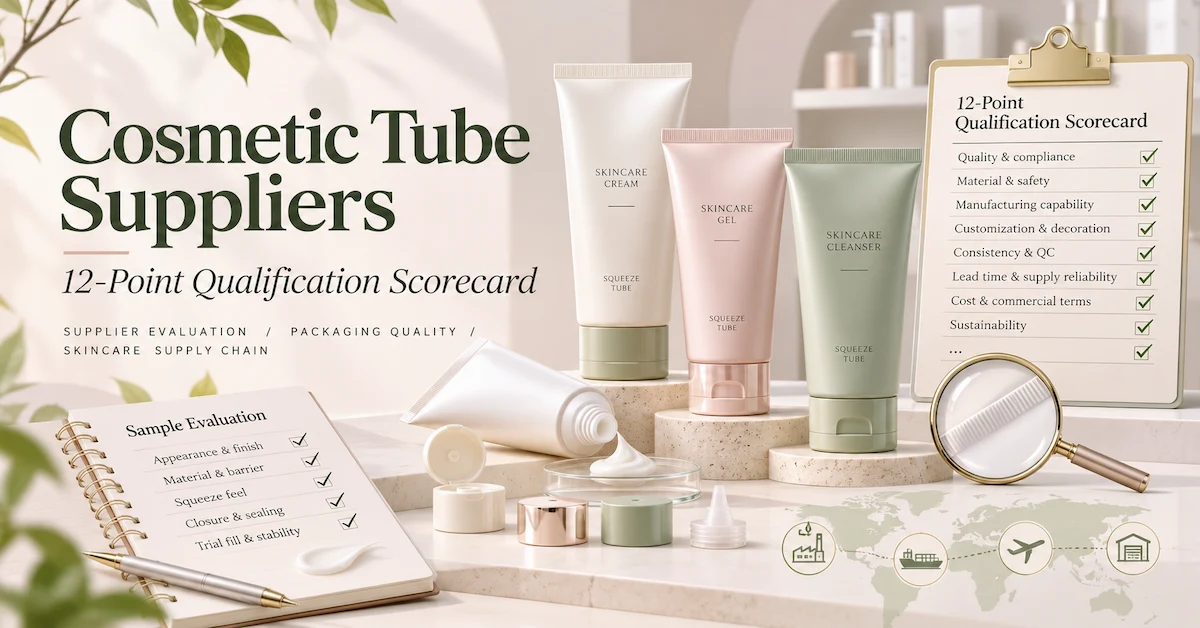
How Can Buyers Compare Cosmetic Tube Suppliers Using a 12-Point Scorecard?
A weighted scorecard helps purchasing teams compare evidence consistently.
The following model is a proposed internal procurement tool, not an industry certification.
| Evaluation criterion | Weight |
|---|---|
| Product and formulation suitability | 12 |
| Material and component traceability | 10 |
| Filling compatibility | 12 |
| Quality inspection and lot release | 12 |
| Dimensional and decoration consistency | 8 |
| Manufacturing capability and transparency | 10 |
| Engineering change control | 8 |
| Capacity and delivery planning | 8 |
| MOQ and quotation transparency | 6 |
| Corrective-action management | 6 |
| Export packing and shipping readiness | 4 |
| Repeat-order documentation | 4 |
| Total | 100 |
Each supplier should be scored using the same evidence requirements.
Missing evidence should be identified explicitly, rather than treated as proof of satisfactory performance.
For critical failures involving product compatibility, package integrity, or safety, formal approval should be withheld regardless of the overall score.
Why Repeat-Order Reliability Matters
A supplier relationship should continue beyond the first approved batch.
Buyers should maintain:
-
Current drawings and packaging specifications.
-
Approved material and closure information.
-
Artwork and appearance references.
-
Lot identification and quality records.
-
Reorder schedules and forecast information.
-
Procedures for reviewing changes and complaints.
This documentation creates a more reliable foundation for future purchases.
Why Consider COSME Packaging for Cosmetic Tube Sourcing?
COSME Packaging is operated by Zhejiang Cosme Industry Co., Ltd., a China-based cosmetic packaging company established in 2015.
According to its published company information, COSME operates an approximately 15,000-square-meter facility with around 200 employees.
Its business includes cosmetic bottles, jars, airless packaging, soft tubes, mold development, and OEM/ODM customization.
Relevant capabilities described by the company include:
-
Packaging research and product-development support.
-
Mold development and prototype preparation.
-
Plastic manufacturing operations.
-
Color matching, printing, and decorative customization.
-
Material inspection, manufacturing checks, and production traceability practices.
COSME's published quality-control descriptions focus substantially on cosmetic bottles. Buyers should therefore request confirmation of the tube-specific manufacturing processes, inspection methods, and technical documentation applicable to their selected product.
For further evaluation, review the Cosmetic Soft Tube Packaging for Cream, Gel, and Skincare product page.
What Should You Send With a Cosmetic Tube RFQ?
To support a more accurate technical review and quotation, prepare the following information:
| RFQ information | Buyer input |
|---|---|
| Product application | Cleanser, sunscreen, cream, gel, or other formulation |
| Formula information | Relevant ingredients, viscosity, filling conditions |
| Tube construction | Preferred material or required performance |
| Target capacity | Intended fill volume |
| Dimensions | Preferred diameter and length |
| Closure | Cap type and dispensing requirements |
| Decoration | Artwork, colors, and surface finish |
| Estimated quantity | Initial order and expected repeat demand |
| Required testing | Compatibility, filling, sealing, and quality requirements |
| Delivery | Destination and target schedule |
For project-specific discussions, contact COSME Packaging with your product specifications and sourcing requirements to review suitable tube options, samples, customization, and commercial terms.
Frequently Asked Questions About Cosmetic Tube Suppliers
1. How do I know whether a cosmetic tube supplier is reliable?
Evaluate the supplier's manufacturing responsibilities, technical documentation, representative samples, inspection procedures, and repeat-order controls. Reliability should be demonstrated through evidence rather than marketing claims alone.
2. What is the difference between PE, PBL, and ABL cosmetic tubes?
PE tubes use polyethylene-based structures. PBL tubes use plastic laminate constructions that may include specialized barriers, while ABL tubes contain an aluminum barrier layer. The correct selection depends on the specific formulation and required performance.
3. What documents should cosmetic tube suppliers provide?
Relevant documents may include drawings, material information, closure specifications, approved artwork, inspection criteria, sample references, and available quality records.
4. How can I verify tube and closure compatibility?
Review the relevant dimensions and assembly requirements, then test representative samples. Visual similarity alone does not establish correct fit or sealing performance.
5. Is a sample approval enough before mass production?
Not always. A complete approval process may require material verification, dimensional inspection, filling trials, formula compatibility testing, and agreement on production acceptance criteria.
6. What is the typical MOQ for custom cosmetic tubes?
MOQ depends on material structure, tube size, closure, decoration, and tooling requirements. COSME does not publish one universal MOQ for every tube configuration. Buyers should request a project-specific quotation.
7. How should cosmetic tube tail seals be tested?
The applicable test method depends on the material, sealing process, and finished package. Where appropriate, seal-strength testing can be supported by ASTM F88/F88M-23, while separate integrity evaluation may be necessary.
8. How do I prevent quality differences between repeat orders?
Maintain controlled specifications, approved samples, component identification, inspection records, and engineering change procedures. Revalidate changes that may affect packaging performance.
9. Should the supplier provide certifications?
Suppliers should provide evidence for any certifications they claim. A management-system certificate does not replace product-specific compatibility, dimensional, or functional verification.
10. What should I send COSME to request cosmetic tube samples?
Provide your intended application, tube material preference, target capacity, closure requirements, decoration details, expected order quantity, and any specific compatibility or filling needs.
Conclusion
Selecting dependable cosmetic tube suppliers requires more than comparing prices, product photographs, or general descriptions of manufacturing capability.
For skincare brands, cosmetic OEM/ODM manufacturers, and packaging distributors, successful qualification depends on understanding how tubes are manufactured, which dimensions and interfaces matter, why defects occur, and how suppliers control quality across repeated production batches.
A structured process that combines technical documentation, material verification, representative samples, filling compatibility, quality inspection, and change management helps buyers make more informed sourcing decisions.
The 12-point qualification scorecard provides a practical way to compare suppliers consistently while keeping critical packaging performance requirements at the center of the decision.
With its published cosmetic packaging product range, manufacturing capabilities, R&D services, and OEM/ODM customization, COSME Packaging is a potential sourcing partner for international skincare and personal-care projects.
If you are developing custom cosmetic tubes for cleansers, creams, sunscreens, gels, or private-label skincare collections, contact COSME Packaging with your packaging specifications, sample requirements, and purchasing plans to discuss suitable products and request a project-specific quotation.