
TL;DR: When purchasing cosmetic jars wholesale, buyers should confirm the difference between nominal jar capacity, usable filling volume, and the finished cream's net weight. They should also compare complete jar assemblies rather than jar bodies alone, verify material compatibility, and establish MOQ, sample approval, packing, and quality requirements before bulk production. These steps help reduce packaging mismatches and unexpected purchasing costs.
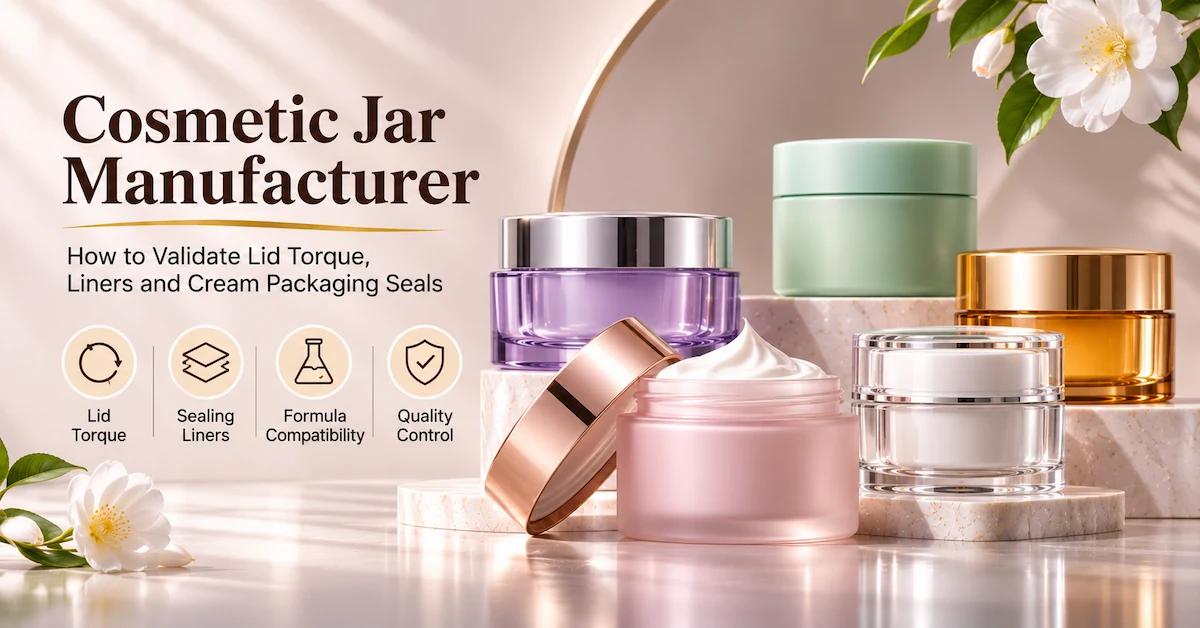
For skincare brands developing moisturizers, night creams, body butters, facial masks, and cosmetic balms, jars remain a practical packaging option.
They provide convenient access to viscous formulations and can support a wide range of retail designs, from simple polypropylene containers to premium multi-component packaging.
However, bulk purchasing introduces questions that are not always obvious during initial sample selection.
A jar described as 50 mL may not be suitable for every cream marketed at 50 g. A double-wall jar may contain less usable product volume than its exterior dimensions suggest. A low quotation may exclude lids, inner cups, decoration, or assembly.
For brands ordering thousands of packaging units, these differences can affect filling operations, product costs, and launch schedules.
The most effective wholesale purchasing strategy is to specify usable capacity, complete packaging components, material requirements, and production quantities before comparing supplier quotations.
COSME Packaging, operated by Zhejiang Cosme Industry Co., Ltd., provides cosmetic packaging development, mold manufacturing, customization, and quality-control services for international beauty and personal-care brands.
This guide explains how to make more accurate wholesale cosmetic jar purchasing decisions.
Key Takeaways: What Should Buyers Check Before Ordering Cosmetic Jars?
| Purchasing priority | Common problem | Recommended action |
|---|---|---|
| Jar capacity | Nominal size differs from usable fill | Validate actual filling volume |
| Net weight | Cream mass confused with container volume | Confirm formulation density |
| Jar construction | Hidden inner cups or extra components | Review the complete BOM |
| Material selection | Unsuitable product-contact material | Test formula compatibility |
| MOQ | Separate minimums for colors and components | Request SKU-specific MOQ |
| Bulk pricing | Jar body quoted without lid or insert | Compare complete-kit costs |
| Packing | Scratched or damaged empty jars | Approve shipping specifications |
| Refill options | Incompatible replacement cups | Validate refill interfaces |
Core procurement principle: Compare cosmetic jars based on the complete filled-product requirements, not simply their advertised capacity or empty-container price.
1. What Types of Cosmetic Jars Are Available for Wholesale Purchasing?
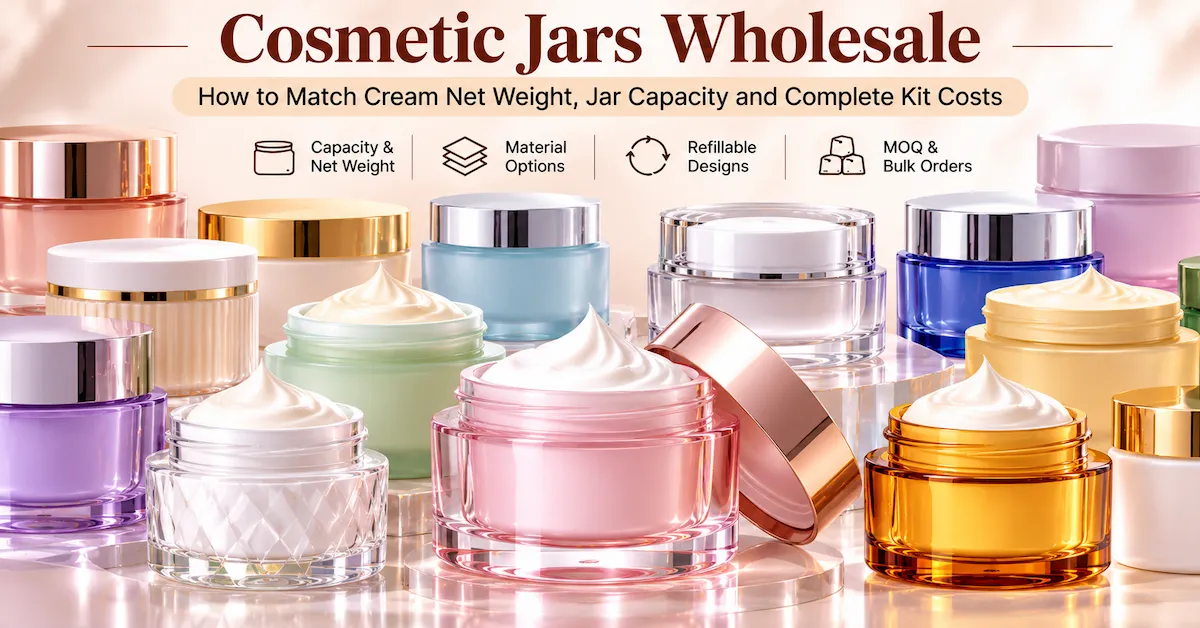
Wholesale cosmetic jars vary in material, appearance, structure, and intended application.
The correct selection depends on the formulation, brand positioning, filling process, and purchasing requirements.
Cosmetic Jar Construction Comparison
| Jar type | Typical applications | Main purchasing advantage | Key consideration |
|---|---|---|---|
| Single-wall plastic jar | Creams, gels, body care | Relatively simple construction | Material and wall design |
| Double-wall plastic jar | Premium skincare | Decorative exterior | Inner capacity and assembly |
| PETG cosmetic jar | Selected premium packaging | Transparent design possibilities | Chemical compatibility |
| Acrylic cosmetic jar | Luxury creams and masks | High-clarity exterior presentation | Product-contact components |
| Glass cosmetic jar | Premium skincare and balms | Rigid, substantial presentation | Weight and breakage |
| Refillable cosmetic jar | Refill-oriented skincare | Reusable outer packaging concept | Replacement component fit |
| Airless pump jar | Selected cream formulations | Controlled dispensing architecture | Pump and filling compatibility |
These are general packaging directions, not guaranteed specifications for every COSME product.
Buyers can explore the COSME Cosmetic Jars collection to review its published product categories.
Which Jar Is Best for a New Skincare Brand?
A startup may benefit from an existing jar design with customized colors and printing.
An established premium brand may prefer a distinctive double-wall or refillable structure.
A contract manufacturer may prioritize consistent dimensions and compatibility with existing filling equipment.
There is no universal best choice.
The most appropriate jar is the one that meets the formulation, branding, production, and commercial requirements.
2. What Is the Difference Between Jar Capacity and Cream Net Weight?
One of the most important issues in cosmetic jars wholesale purchasing is understanding the relationship between container volume and product weight.
These measurements are not interchangeable.
Nominal Capacity
Nominal capacity is the capacity designation used to identify a particular packaging size.
However, the manufacturer must clarify how the designation is defined.
Overflow Capacity
Overflow capacity generally refers to the maximum internal volume the jar can contain when filled to the brim under defined conditions.
It does not represent the recommended commercial filling quantity.
Usable Filling Volume
Usable filling volume is the amount of product that can be accommodated while meeting the required headspace, closure, and production conditions.
Net Product Weight
Net weight is the actual mass of the cosmetic formulation placed inside the container.
For creams, the relationship between mass and volume depends on density.
Basic Fill Calculation
Required fill volume = Target net mass ÷ Formula density
For example, consider a hypothetical cream with:
-
Target net mass: 50 g
-
Measured density: 0.95 g/mL
The theoretical product volume is:
50 ÷ 0.95 = approximately 52.6 mL
The container must accommodate this product volume plus any necessary filling allowance and headspace.
This example is illustrative. Actual capacity must be validated using the finished formula and intended production conditions.
Why This Matters for U.S. Cosmetics
The U.S. FDA's Cosmetics Labeling Guide explains the rules governing cosmetic net-content declarations.
For products marketed in the United States, solid, semisolid, and viscous cosmetics are generally declared by weight, while liquids are generally declared by fluid measure, subject to applicable rules and exceptions.
A jar's advertised capacity should therefore not be used automatically as the finished product's net-content declaration.
Buyer recommendation: Confirm net weight, formula density, usable capacity, and applicable labeling requirements before approving jar dimensions or artwork.
3. How Should You Choose Between PP, PETG, Acrylic and Glass Cosmetic Jars?
Material selection affects manufacturing, appearance, transportation, and the performance of the complete package.
For wholesale purchasing, both the outer housing and the product-contact material should be identified.
Cosmetic Jar Material Comparison
| Material | General characteristics | Main wholesale concern |
|---|---|---|
| PP | Lightweight, moldable plastic | Grade, stiffness and compatibility |
| PETG | Clear copolyester appearance | Chemical resistance and processing |
| Acrylic / PMMA | Premium transparent appearance | Stress and chemical compatibility |
| Glass | Rigid and visually substantial | Shipping weight and breakage |
| Aluminum | Metallic appearance | Inner lining and product compatibility |
| Multi-component construction | Separate outer housing and inner cup | Assembly, material identification |
A premium-looking outer shell may not be the component that directly contacts the cream.
For example, a decorative acrylic housing may contain a separate plastic inner cup.
That distinction matters because formula compatibility should be evaluated using the actual product-contact components.
Should You Buy the Lowest-Cost Material?
Not necessarily.
A lower material cost may be offset by increased packing requirements, additional components, or compatibility risks.
Similarly, a premium appearance does not justify an expensive material when it provides no meaningful benefit for the intended product.
Material choice should follow the formula and intended packaging function before decorative preferences.
4. Single-Wall vs. Double-Wall vs. Refillable Cosmetic Jars
Jar construction can have a substantial effect on unit cost, usable capacity, and purchasing complexity.
Single-Wall Jars
Single-wall containers generally use a relatively simple body construction.
They may suit skincare brands that prioritize practical filling, cost control, and straightforward packaging.
Double-Wall Jars
A double-wall design may combine a decorative exterior with a separate inner structure.
This can help achieve a premium appearance, but buyers should verify the internal usable volume rather than judge capacity by external dimensions.
Refillable Cosmetic Jars
Refillable packaging may use a reusable outer housing with a replaceable inner cup.
The design creates additional requirements for replacement compatibility and future component supply.
Construction Comparison
| Factor | Single-wall | Double-wall | Refillable |
|---|---|---|---|
| Component complexity | Generally lower | Depends on construction | Multiple replaceable components |
| Appearance options | Material-dependent | Supports layered designs | Reusable exterior design |
| Capacity planning | Review internal volume | Inner capacity may differ from appearance | Confirm refill-cup volume |
| Procurement | Body and closure | Body, inner components, closure | Initial kit and future refills |
| Key risk | Material and dimensional suitability | Assembly and usable capacity | Refill compatibility |
COSME's Refillable Jars for Skincare and Cream Packaging product page shows a design direction with an outer shell, an inner cup, and a separate lid.
The published images do not establish exact materials, capacities, or sealing performance. These must be confirmed through technical review and sampling.
5. Why Should Wholesale Buyers Request a Complete Jar Bill of Materials?
A complete Bill of Materials (BOM) identifies the components included in the finished packaging.
This helps buyers compare quotations accurately and prevent missing components.
Cosmetic Jar BOM Checklist
| Component | Function | Purchasing requirement |
|---|---|---|
| Jar body | Holds or supports the product | Material, dimensions, quantity |
| Inner cup | Contains product in applicable designs | Material, usable capacity |
| Lid | Closes the jar | Fit and component specification |
| Protective insert | Provides an intended protective function | Inclusion and compatibility |
| Liner or gasket | Supports sealing where required | Material and fit |
| Decorative shell | Creates exterior appearance | Finish and assembly |
| Printing | Displays branding | Artwork and color approval |
| Export packing | Protects the shipment | Packing specification |
Not every jar requires every component.
Why Complete-Kit Quantities Matter
Consider an illustrative order containing:
| Component | Accepted quantity |
|---|---|
| Jar bodies | 10,000 |
| Lids | 10,000 |
| Required inner cups | 9,950 |
Only 9,950 complete assemblies are available until additional compatible cups are obtained.
This is a hypothetical example, not an actual COSME production result.
Buyers should compare accepted complete assemblies rather than count jar bodies alone.
6. How Do MOQ and Customization Affect Wholesale Cosmetic Jar Pricing?
MOQ, or Minimum Order Quantity, may depend on the material, jar structure, color, decorative finish, and tooling requirements.
A supplier may have different minimums for jar bodies, caps, inserts, and custom decoration.
Common Customization Options
COSME publishes packaging customization capabilities including:
-
Color matching.
-
Logo printing.
-
Silk-screen decoration.
-
Hot stamping.
-
Mold development.
-
Selected packaging structural customization.
The availability of individual processes must be confirmed for the proposed material and design.
Existing Designs vs. Custom Tooling
| Purchasing option | Main consideration | Suitable project |
|---|---|---|
| Existing jar design | Confirm available configurations | Initial launches |
| Existing design with custom decoration | Check artwork and production MOQ | Private-label skincare |
| New structural mold | Tooling and engineering investment | Distinctive long-term product ranges |
| Refillable packaging development | Multiple components and validation | Refill-oriented product programs |
Compare Complete Packaging Costs
Wholesale quotations should identify the jar body, lid, inner cup, decoration, tooling, assembly, and export packing where applicable.
A useful calculation is:
Cost per accepted complete jar = Total relevant purchasing cost ÷ Accepted complete assemblies
This provides a more meaningful comparison than empty jar-body unit price alone.
7. How Should You Plan Wholesale Cream Jar Orders Across Multiple SKUs?
A skincare collection may include different formulations with different net weights and packaging requirements.
Each configuration should be identified separately.
Illustrative Multi-SKU Jar Purchasing Plan
| Product | Packaging direction | Main purchasing check |
|---|---|---|
| Daily moisturizer | Standard cream jar | Capacity and filling |
| Night cream | Premium double-wall jar | Usable volume and appearance |
| Eye cream | Small-format jar | Filling accuracy and component fit |
| Body butter | Wide-mouth jar | Formula and structural compatibility |
| Refillable face cream | Outer housing and inner cup | Complete-kit and refill quantities |
A single supplier may coordinate these packaging directions, but the available specifications and production minimums must be verified individually.
Standardize Where Appropriate
Brands may simplify purchasing through consistent colors, decorative finishes, or compatible component designs.
However, jars with similar exterior appearances should not automatically be treated as interchangeable.
Each product configuration must meet its own filling and functional requirements.
8. What Should Wholesale Buyers Check About Refillable Jar Supply?
Refillable packaging changes the purchasing model.
Instead of buying a complete new container for every future refill, the brand may purchase replacement inner cups while retaining the exterior housing.
This creates additional supplier-management requirements.
Refillable Packaging Procurement Checklist
| Requirement | Buyer verification |
|---|---|
| Outer housing | Intended service life and appearance |
| Inner cup | Material, dimensions, capacity |
| Replacement mechanism | Fit and ease of intended replacement |
| Closure | Compatibility with the installed cup |
| Initial order | Complete packaging kit quantities |
| Refill order | Replacement-component quantities |
| Change control | Compatibility across future orders |
How Does Refillable Design Affect Recycling?
Refillability and recyclability are different characteristics.
The British Plastics Federation's Recyclability by Design guidance emphasizes material compatibility, simplified material combinations, and removable closures and labels.
For refillable cosmetic jars, buyers should assess whether components can be separated appropriately and whether the proposed materials are compatible with relevant recycling systems.
A refillable structure does not automatically guarantee a lower environmental impact or universal recyclability.
Claims should be supported by appropriate evidence for the actual package and intended market.
9. How Should Wholesale Cosmetic Jars Be Packed for Export?
Packing requirements differ according to jar material, dimensions, and decorative finish.
Glass jars may need greater protection against impact.
Plastic jars with decorative surfaces may require protection from abrasion.
Multi-component jars also require suitable component identification and packing.
Export Packing Considerations
| Jar type | Main transport concern | Packing consideration |
|---|---|---|
| PP jar | Deformation and surface marks | Appropriate carton arrangement |
| PETG jar | Scuffs and appearance | Surface protection |
| Acrylic jar | Scratches or component damage | Protective separation |
| Glass jar | Impact and breakage | Cushioning and dividers |
| Refillable jar | Missing or damaged inner components | Component count and identification |
Before shipment, confirm carton dimensions, gross weight, packing quantities, and protective materials.
The packing configuration should be approved for the actual product rather than selected solely for freight efficiency.
10. What Quality Checks Matter for Wholesale Cosmetic Jar Orders?
Bulk cosmetic jar purchasing requires consistent specifications across production and repeat orders.
Wholesale Jar Quality Inspection Matrix
| Inspection area | Recommended verification |
|---|---|
| Material | Approved body and contact materials |
| Capacity | Intended usable filling volume |
| Dimensions | Critical jar and component measurements |
| Assembly | Compatible body, lid and insert |
| Appearance | Color, scratches, molding defects |
| Decoration | Approved printing and finish |
| Function | Relevant completed-package requirements |
| Packing | Carton protection and quantities |
| Traceability | Batch and component identification |
COSME describes company-level quality checks involving incoming materials, dimensional inspection, surface appearance, leakage evaluation, printing, and batch records.
Buyers should request the specific inspection methods applicable to their chosen cosmetic jars.
Golden Sample Approval
An approved reference sample should be supported by material information, relevant drawings, artwork, and acceptance criteria.
A visual reference alone cannot establish every critical functional requirement.
Repeat Orders
Before placing subsequent orders, confirm that the supplier will use the approved materials, components, and specifications.
Significant changes should be reviewed before commercial supply.
11. Application Example: Purchasing 10,000 Cream Jars for a Skincare Launch
The following is a hypothetical procurement example, not a documented COSME customer project.
Buyer Requirements
A skincare brand plans to launch a facial moisturizer labeled with a target net weight of 50 g.
It needs 10,000 complete retail jars with matching lids and custom decoration.
Main Purchasing Challenge
The brand initially considers a jar advertised as 50 mL.
However, the actual formulation density and required filling allowance have not been confirmed.
Recommended Evaluation
The purchasing team should:
-
Measure the finished cream's density.
-
Calculate the corresponding filling volume.
-
Confirm usable jar capacity and headspace.
-
Evaluate the selected jar and lid assembly.
-
Approve decorated, production-representative samples.
-
Obtain complete-kit pricing and MOQ.
-
Confirm export packing and delivery arrangements.
Procurement Lesson
The buyer should not authorize the full order based only on the container's nominal capacity.
Approving actual fill requirements and complete components first can reduce avoidable specification mismatches.
No specific savings or production results are claimed in this example.
12. Why Consider COSME Packaging for Cosmetic Jars Wholesale?
COSME Packaging, operated by Zhejiang Cosme Industry Co., Ltd., is a China-based cosmetic packaging company established in 2015.
According to its official company profile, COSME operates an approximately 15,000-square-meter facility with around 200 employees.
Its published capabilities include:
-
Packaging research and development.
-
3D drawings and CNC sampling.
-
Mold development.
-
Plastic injection- and blow-molding operations.
-
OEM/ODM customization.
-
Color matching and decorative finishing.
-
Material and production quality inspections.
COSME's catalog includes PP, PETG, acrylic, glass, aluminum, airless pump, and refillable cosmetic jar categories.
These categories represent published packaging directions. Specific capacities, materials, MOQ, available stock, and production requirements must be confirmed for each project.
Buyers can review COSME's manufacturing capabilities and its Cosmetic Jars collection before submitting a wholesale inquiry.
13. What Should You Include in a Cosmetic Jars Wholesale RFQ?
A complete RFQ helps suppliers provide a meaningful technical and commercial proposal.
Wholesale Cosmetic Jar RFQ Checklist
| Requirement | Buyer information |
|---|---|
| Product application | Face cream, eye cream, mask, balm |
| Target net weight | Required commercial fill mass |
| Formula density | Available measurement information |
| Jar capacity | Required usable volume |
| Material | PP, PETG, acrylic, glass or other |
| Structure | Single-wall, double-wall, refillable |
| Components | Jar body, lid, inner cup, inserts |
| Decoration | Color, logo, printing, finish |
| Initial quantity | Required complete assemblies |
| Reorder forecast | Expected future demand |
| Quality requirements | Samples, drawings and inspection |
| Export packing | Carton and component protection |
| Delivery | Destination and target schedule |
Request a Complete Wholesale Packaging Proposal
A useful quotation should identify the complete packaging configuration, available materials, applicable MOQ, customization requirements, sample arrangements, and delivery terms.
For refillable projects, request separate quotations for initial complete jars and replacement inner cups.
If you are sourcing cream jars for a skincare launch, private-label collection, or wholesale distribution program, contact COSME Packaging with your net fill requirements, preferred jar structure, customization details, and purchasing quantity to discuss suitable options and request a tailored quotation.
Frequently Asked Questions About Cosmetic Jars Wholesale
1. What is the MOQ for cosmetic jars wholesale?
MOQ depends on jar materials, dimensions, components, decoration, and tooling requirements. COSME does not publish one universal MOQ for all cosmetic jar configurations. Request an item-specific quotation.
2. Is a 50 mL cosmetic jar suitable for 50 g of cream?
Not necessarily. Required filling volume depends on formulation density, usable jar capacity, and necessary headspace. Validate the actual finished formula before selecting a jar.
3. Which material is best for wholesale face cream jars?
PP, PETG, acrylic, glass, and other suitable materials may support different cosmetic jar designs. Selection should consider formula compatibility, appearance, manufacturing, weight, and cost.
4. Can I order cosmetic jars with custom colors and logos?
COSME publishes OEM/ODM capabilities including color matching, printing, decoration, and mold development. Specific available options depend on the selected jar configuration.
5. Are lids included in wholesale cosmetic jar prices?
Not necessarily. Quotations may include different component scopes. Confirm whether the price covers the jar body, lid, inner cup, protective insert, decoration, and assembly.
6. What is the difference between single-wall and double-wall cosmetic jars?
Single-wall jars use a comparatively simple body construction. Double-wall designs include additional structural or decorative layers. Buyers should compare actual usable capacity and component requirements.
7. Can refillable cosmetic jars reduce packaging purchases?
A suitable refill system may allow reuse of an outer housing while purchasing replacement inner cups. Commercial and environmental benefits depend on the actual design, consumer use, and refill supply model.
8. What should I inspect before accepting a bulk cosmetic jar shipment?
Check material and component identification, quantities, critical dimensions, appearance, assembly, decoration, packing condition, and relevant quality documentation.
9. How do I compare cosmetic jars wholesale quotations?
Compare equivalent complete packaging configurations, including materials, components, decoration, tooling, samples, quality requirements, packing, and delivery terms. Avoid comparing jar-body prices with complete-kit prices.
10. How can I request wholesale cosmetic jar samples from COSME?
Provide the intended formulation, target net weight, preferred materials, jar construction, customization requirements, and estimated purchasing quantity. COSME can then discuss suitable packaging directions and sample availability.
Conclusion
Successful cosmetic jars wholesale purchasing requires more than selecting an attractive container or negotiating a competitive unit price.
For skincare brands, cosmetic OEM/ODM manufacturers, and packaging distributors, the most important objective is to obtain complete packaging assemblies that match the intended formulation, net fill requirements, brand design, and production schedule.
Nominal jar capacity should not be confused with usable filling volume or finished product weight. Material selection, structural components, refill options, decoration, and quality requirements should also be evaluated as part of one purchasing decision.
By confirming these specifications before production, buyers can reduce avoidable packaging mismatches, improve quotation accuracy, and establish more consistent wholesale supply arrangements.
With its published capabilities in cosmetic packaging R&D, mold development, plastic manufacturing, customization, and quality management, COSME Packaging offers a potential partner for international cosmetic jar sourcing projects.
Whether you are buying wholesale face cream jars, developing premium double-wall packaging, or exploring refillable skincare containers, contact COSME Packaging with your product specifications, net fill requirements, and estimated order quantity to discuss suitable packaging options and request a project-specific quotation.