
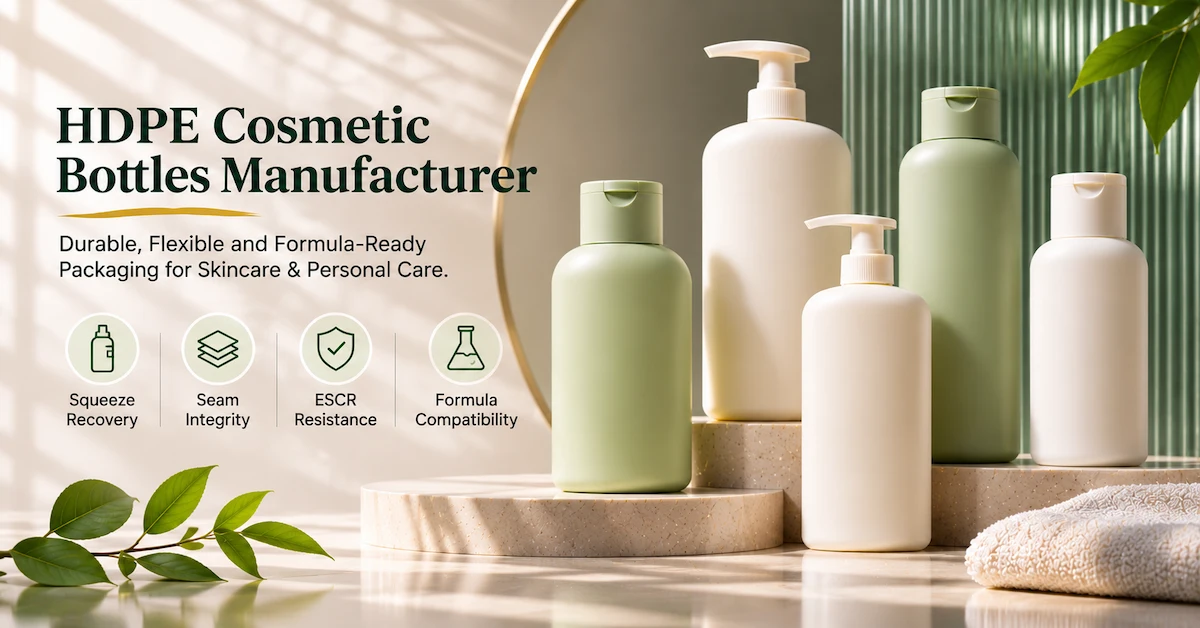
TL;DR: A reliable HDPE cosmetic bottles manufacturer should help skincare brands evaluate resin-grade suitability, squeeze recovery, wall-thickness distribution, blow-molded pinch-off integrity, and environmental stress-crack resistance before mass production. HDPE can provide a useful combination of toughness and flexibility, but actual performance depends on bottle geometry, manufacturing conditions, formulation compatibility, and closure design.
For skincare brands developing body lotions, facial cleansers, shampoos, conditioners, and other personal-care products, selecting a plastic bottle involves more than comparing appearance and price.
A bottle may perform well during initial sample evaluation but develop problems after repeated squeezing, prolonged formula contact, or transportation.
Some containers remain permanently deformed after compression. Others develop cracks near stressed areas or leakage around manufacturing seams. Inconsistent wall distribution can also influence strength and consumer handling.
These problems become particularly expensive when packaging is produced in large quantities.
The most effective sourcing approach is to validate the complete HDPE bottle under realistic filling, storage, handling, and consumer-use conditions before approving commercial production.
COSME Packaging, operated by Zhejiang Cosme Industry Co., Ltd., provides cosmetic packaging research and development, mold development, plastic molding, OEM/ODM customization, and quality-control services for international beauty and personal-care brands.
This guide explains the important engineering considerations for HDPE packaging, common failure mechanisms, relevant testing methods, and practical requirements for sourcing custom cosmetic bottles.
Key Takeaways: What Should Buyers Check Before Approving HDPE Bottles?
| Engineering factor | Potential problem | Recommended validation |
|---|---|---|
| Resin grade | Unsuitable stiffness or crack resistance | Review the actual HDPE grade |
| Squeeze recovery | Permanent body deformation | Test compression and recovery |
| Wall distribution | Localized weak or thin sections | Inspect critical wall thickness |
| Pinch-off integrity | Weak seam or leakage | Evaluate applicable blow-molded seams |
| Environmental stress cracking | Cracks after chemical exposure and stress | Conduct relevant ESCR evaluation |
| Neck and closure | Leakage or assembly problems | Verify complete component fit |
| Formula compatibility | Material or performance changes | Test the finished formulation |
| Production consistency | Variation across batches | Establish inspection and change controls |
Core engineering principle: HDPE bottle performance is determined by the interaction between material, geometry, manufacturing process, and the formulation—not by the polymer name alone.
1. Why Choose HDPE for Cosmetic Bottle Manufacturing?
High-density polyethylene (HDPE) is a thermoplastic polymer commonly used in rigid and semi-rigid packaging.
Depending on the resin grade and bottle design, HDPE can offer toughness, controlled flexibility, and suitability for selected personal-care applications.
It is often considered where brands require practical handling, an opaque or translucent appearance, and packaging that can tolerate everyday use.
Common HDPE Packaging Applications
| Application | Packaging requirement | Main selection consideration |
|---|---|---|
| Body lotion | Convenient dispensing | Bottle rigidity and pump compatibility |
| Facial cleanser | Reliable containment | Formula compatibility and closure |
| Shampoo | Handling in wet environments | Grip, body strength, dispensing |
| Hair conditioner | Controlled product release | Squeeze behavior and viscosity |
| Body wash | Repeated handling and storage | Structural integrity and sealing |
| Hand-care products | Portable and practical packaging | Closure and transport performance |
These represent general application possibilities, not confirmed specifications for individual COSME products.
When HDPE May Not Be Suitable
HDPE is not automatically appropriate for every skincare formulation.
A brand requiring high transparency may prefer a different material.
Certain formulations may require additional barrier performance, specific appearance characteristics, or compatibility properties that must be established through testing.
Before selecting HDPE, buyers should define the intended formula, dispensing system, storage conditions, and expected consumer-use behavior.
2. Which HDPE Resin Properties Affect Bottle Performance?
HDPE is a material family rather than one standardized packaging grade.
Different grades can have different processing and mechanical characteristics.
A cosmetic bottle manufacturer should identify the actual resin proposed for the project.
Important HDPE Material Characteristics
| Material characteristic | Why it matters | Buyer verification |
|---|---|---|
| Density | Influences material characteristics | Approved resin specification |
| Melt-flow properties | Affect processing suitability | Grade-specific technical data |
| Molecular structure | Influences mechanical and crack-resistance behavior | Supplier material documentation |
| Stiffness | Affects bottle deformation | Relevant mechanical evaluation |
| Impact resistance | Influences handling performance | Product-specific testing |
| ESCR performance | Relevant to stress and chemical exposure | Appropriate container testing |
| Color and additives | Affect appearance and processing | Approved material formulation |
Why Resin Selection Cannot Be Based on Density Alone
A higher-density polyethylene grade is not automatically the best choice for every cosmetic bottle.
Stiffness, processability, impact behavior, and environmental stress-crack resistance may involve trade-offs.
The appropriate grade depends on the bottle's intended design and performance requirements.
Does a Flexible Bottle Need a Softer Material?
Not necessarily.
Squeeze behavior also depends on wall thickness, geometry, ribbing, and other design features.
A manufacturer may be able to adjust bottle flexibility through structural design, but any modification must be validated against functional and production requirements.
Material choice and bottle geometry should be evaluated together.
3. How Does Squeeze Recovery Affect Cosmetic Bottle Usability?
Squeeze recovery describes how a container responds after being compressed and released.
For cosmetic bottles intended to be squeezed by consumers, this characteristic directly influences the user experience.
A bottle that becomes permanently flattened may be inconvenient to handle or visually unattractive.
However, recovery behavior depends on more than material flexibility.
What Influences Squeeze Recovery?
Potential factors include:
-
HDPE resin grade.
-
Wall thickness and distribution.
-
Bottle shape.
-
Ribbing and structural features.
-
Amount of product remaining.
-
Internal pressure and closure conditions.
-
Temperature and repeated use.
Recommended Squeeze Recovery Test
A practical development test can follow these steps:
-
Prepare representative bottles under defined conditions.
-
Fill them to specified levels using an appropriate medium.
-
Apply a controlled compression force or displacement.
-
Release the bottle.
-
Record its recovery behavior.
-
Inspect for permanent deformation.
-
Repeat at agreed stages of product use.
The test should specify sample conditioning, loading method, compression duration, and acceptance criteria.
Squeeze Performance Evaluation
| Test characteristic | Evaluation objective |
|---|---|
| Initial compression | Assess required squeezing effort |
| Body deformation | Measure response to applied loading |
| Recovery after release | Evaluate shape restoration |
| Repeated squeezing | Identify changes after repeated use |
| Near-empty condition | Evaluate performance as product volume decreases |
| Post-storage condition | Check behavior after relevant environmental exposure |
There is no universal squeeze-recovery time that guarantees suitability for all cosmetic bottles.
Acceptance criteria should be established for the actual product and desired consumer experience.
A bottle should be evaluated throughout its intended use, not only when completely full.
4. How Does Blow Molding Affect HDPE Bottle Quality?
Extrusion blow molding is an established method for manufacturing many hollow polyethylene containers.
However, not every HDPE cosmetic bottle is necessarily produced using the same manufacturing process.
Buyers should confirm the proposed production route with their supplier.
How Extrusion Blow Molding Works
In a typical extrusion blow-molding process, heated polymer is formed into a hollow tube called a parison.
The mold closes around the parison, and air pressure expands the material against the mold cavity.
After cooling, the bottle is removed and relevant excess material is trimmed.
The resulting wall distribution and structural features depend on material behavior, mold design, and processing conditions.
Why Parison Control Matters
The parison's geometry influences how material is distributed during bottle formation.
Poor material distribution may produce excessively thin regions or unwanted variation in bottle strength.
Why Mold Cooling Matters
Cooling influences the final dimensions and properties of molded polyethylene.
Inconsistent cooling may affect shrinkage, deformation, and production repeatability.
Formosa Plastics discusses these issues in its Polyethylene and Polypropylene Extrusion Blow Molding Process Guide.
The guide covers parison formation, wall distribution, pinch-off defects, and other process-related problems.
Its recommendations provide engineering context but must be adapted to the actual resin, machinery, and bottle design. They do not establish the production settings used by COSME.
5. Why Is Pinch-Off Seam Integrity Important?
For applicable extrusion blow-molded bottles, the mold closes around the parison and forms sealed or joined sections at designated locations.
The resulting pinch-off region can be an important structural feature.
A poorly formed pinch-off may contribute to weakness or leakage.
Potential Pinch-Off Defects
| Defect | Possible contributing factor | Recommended evaluation |
|---|---|---|
| Weak pinch-off | Inadequate material joining | Seam integrity inspection |
| Thin seam region | Insufficient material distribution | Wall and seam measurement |
| Excessive flash | Tooling or processing variation | Visual and dimensional inspection |
| Poor seam alignment | Mold mismatch | Tooling and sample review |
| Localized cracking | Mechanical stress or structural weakness | Relevant integrity testing |
| Leakage | Defective seam or another interface | Finished-package leakage test |
Not all HDPE bottle manufacturing methods create the same type of pinch-off seam.
This inspection is particularly relevant when the selected production method uses such a feature.
Why Bottle Weight Alone Is Not Enough
A bottle may meet its specified total weight but still have poor local material distribution.
Weight measurement should therefore be supplemented by inspection of important structural areas.
How Should Pinch-Off Quality Be Approved?
The buyer and manufacturer should define the relevant seam characteristics, allowable appearance, and applicable integrity requirements.
Representative molded samples should be inspected before commercial production.
A weak seam should be investigated through the actual material, mold, and processing conditions rather than corrected by arbitrary changes to bottle weight.
6. What Is Environmental Stress Cracking in HDPE Bottles?
Environmental stress cracking occurs when certain polymers develop cracks under particular combinations of mechanical stress and environmental exposure.
For HDPE packaging, this can be especially relevant when the contents include substances capable of promoting stress cracking.
Some surfactant-containing or detergent-like formulations may require particular attention.
Why Can a Bottle Crack Without Severe Mechanical Loading?
A container may experience mechanical stresses from its manufacturing process, geometry, assembly, or normal handling.
Exposure to certain chemicals can reduce its resistance to cracking under those stresses.
This means the formulation and the bottle must be evaluated together.
ASTM D2561 for Blow-Molded Polyethylene Containers
ASTM D2561-17(2023) — Standard Test Method for Environmental Stress-Crack Resistance of Blow-Molded Polyethylene Containers provides procedures for evaluating the environmental stress-crack resistance of relevant polyethylene containers.
The standard recognizes that container design, resin selection, blow-molding conditions, and other factors influence performance.
Its results depend on the actual testing conditions and are not universal lifetime guarantees.
Important limitation: ASTM D2561 is not designed specifically to determine stress cracking at bottle necks subjected to controlled assembly strain.
Neck-related concerns may require separate component and assembly evaluations.
Why ESCR Is Important for Skincare Brands
Environmental stress cracking can develop after initial sample inspection.
A bottle that looks acceptable when empty may behave differently after contact with a filled formulation during storage.
Therefore, buyers should include relevant filled-product testing in the approval plan.
7. How Should HDPE Formula Compatibility Be Tested?
A general claim that HDPE has chemical resistance is insufficient for commercial cosmetic packaging approval.
Actual performance depends on the resin grade, the finished formula, mechanical stress, and storage conditions.
Important Formulation Considerations
Potentially relevant ingredients include surfactants, fragrance components, solvents, oils, and other substances present in personal-care products.
These components should be evaluated according to their actual concentrations and their interaction with the proposed package.
Suggested Compatibility Testing Matrix
| Evaluation | Main objective |
|---|---|
| Initial bottle inspection | Establish appearance and dimensions |
| Material identification | Confirm the approved resin |
| Filled-product storage | Assess relevant formula interactions |
| Stress-crack evaluation | Identify cracking under defined conditions |
| Temperature conditioning | Review relevant environmental effects |
| Closure compatibility | Check the completed assembly |
| Post-storage dispensing | Verify continued function |
| Final appearance | Identify deformation or damage |
The formulation manufacturer should define suitable exposure conditions and acceptance limits.
Why Testing Empty Bottles Is Insufficient
An empty bottle test can evaluate geometry, handling, or certain mechanical properties.
It cannot fully represent the effects of long-term contact with a cosmetic formula.
Final packaging qualification should include representative filled assemblies and relevant storage conditions.
8. How Should Neck Finishes, Pumps and Caps Be Verified?
The bottle neck and dispensing assembly are important functional interfaces.
A suitable HDPE bottle must accommodate the intended pump, cap, or other closure.
Critical Closure Specifications
| Parameter | Buyer requirement |
|---|---|
| Neck finish | Approved interface dimensions |
| Thread geometry | Compatible closure engagement |
| Sealing surface | Relevant containment requirements |
| Closure material | Approved component specification |
| Assembly torque | Defined installation requirements |
| Pump compatibility | Formula and dispensing suitability |
| Dip tube | Appropriate dimensions where applicable |
Why Assembly Stress Matters
Excessive tightening or incompatible component geometry can introduce mechanical stress at the bottle neck.
A completed package should be evaluated using the intended assembly procedure.
Does a Standard Neck Design Guarantee Compatibility?
No.
Nominal neck designations do not replace dimensional verification and assembly testing.
The bottle, closure, and relevant sealing components should be approved as one packaging system.
9. What Quality Controls Should an HDPE Bottle Manufacturer Provide?
A production-ready quality plan should address materials, dimensions, appearance, functionality, and traceability.
HDPE Bottle Quality-Control Checklist
| Inspection area | Recommended verification |
|---|---|
| Resin grade | Approved material specification |
| Bottle weight | Agreed weight range |
| Wall distribution | Critical wall-thickness inspection |
| Pinch-off region | Relevant seam integrity |
| Neck dimensions | Approved drawings |
| Appearance | Deformation, defects and color |
| Closure fit | Complete assembly testing |
| Leakage | Defined finished-package test |
| Formula compatibility | Relevant filled-product evaluation |
| Batch traceability | Material and production records |
Incoming Quality Control
Relevant materials and components should be verified before manufacturing.
In-Process Inspection
Critical bottle dimensions, wall distribution, and appearance should be monitored during production.
Final Quality Control
Finished products should be assessed against the agreed acceptance criteria.
For production-lot inspection, ISO 2859-1:2026 provides a framework for acceptance sampling by attributes.
However, acceptance sampling does not replace formula compatibility or environmental stress-crack validation.
Engineering Change Control
Material substitutions, tooling modifications, closure changes, and significant processing changes should be reviewed before they affect approved commercial production.
10. Application Example: Validating an HDPE Facial Cleanser Bottle
The following is a hypothetical engineering scenario, not a documented COSME customer case.
Project Background
A skincare brand plans to introduce a facial cleanser using an opaque HDPE bottle.
The package must be easy to handle and remain suitable during storage and transportation.
Initial Engineering Concerns
The brand needs to evaluate:
-
Bottle rigidity and handling.
-
Compatibility with the cleanser formulation.
-
Neck and cap sealing.
-
Wall-thickness consistency.
-
Resistance to relevant stress-cracking conditions.
Recommended Validation
The packaging team should first define the target bottle specifications and approve representative samples.
Next, the proposed bottle should be evaluated using the actual formula.
Where appropriate, the team should include ESCR-related testing, structural inspection, and relevant transport conditioning.
Procurement Decision
The design should proceed to commercial production only after the specified packaging and quality requirements have been satisfied.
This example illustrates a decision process. It does not represent actual COSME test results or verified performance improvements.
11. How Do HDPE Resin, Wall Thickness and Tooling Affect Costs?
HDPE packaging costs depend on the complete design and manufacturing requirements.
Important factors may include resin grade, material consumption, bottle geometry, tooling, decoration, closure components, inspection, and order quantity.
HDPE Bottle Cost Considerations
| Cost factor | Commercial consideration |
|---|---|
| HDPE resin | Grade suitability and material price |
| Bottle weight | Material consumption |
| Wall design | Structural and process requirements |
| Mold development | Tooling and engineering investment |
| Closures | Caps, pumps and related components |
| Decoration | Colors, printing and finishing |
| Validation | Compatibility and functional testing |
| Order quantity | Production planning and setup costs |
| Export packing | Carton protection and freight |
Why Lightweighting Requires Validation
Reducing bottle weight may reduce material consumption.
However, excessive reduction can affect wall distribution, structural strength, or consumer handling.
The manufacturer should evaluate lightweighting against agreed performance requirements.
What About MOQ and Production Lead Time?
MOQ and production schedules depend on the specific design, materials, colors, tooling requirements, and order quantity.
COSME does not publish verified universal MOQ or delivery commitments for HDPE cosmetic bottle models.
Buyers should request a project-specific quotation rather than rely on generic assumptions.
12. Why Consider COSME Packaging for HDPE Cosmetic Bottle Development?
COSME Packaging, operated by Zhejiang Cosme Industry Co., Ltd., is a China-based cosmetic packaging manufacturer established in 2015.
According to its official company information, COSME operates an approximately 15,000-square-meter facility with around 200 employees.
Its published capabilities include:
-
Packaging R&D and product development.
-
3D drawings, prototypes and mold development.
-
Plastic injection and blow molding.
-
OEM/ODM cosmetic packaging customization.
-
Color matching, printing and decoration.
-
Dimensional, wall-thickness and appearance inspection.
-
Finished-product leakage checks and batch records.
The company lists PE among its packaging material directions and offers broader plastic cosmetic bottle development services.
However, its website does not currently establish a verified independent catalog of HDPE cosmetic bottle models, resin grades, dimensions, ESCR results, or stock availability.
Buyers should confirm the proposed material and manufacturing process before assuming a specific HDPE bottle configuration is available.
For additional information, review COSME's manufacturing capabilities and its Cosmetic Bottles product collection.
For general comparisons involving PET, PETG, HDPE, and PP, see COSME's Plastic Cosmetic Bottles Wholesale Material Guide.
13. What Should You Include in an HDPE Cosmetic Bottle RFQ?
A detailed Request for Quotation helps the manufacturer evaluate design feasibility, material suitability, and commercial requirements.
HDPE Cosmetic Bottle RFQ Checklist
| Requirement | Information to provide |
|---|---|
| Product application | Cleanser, lotion, body wash or other |
| Formula details | Relevant ingredients and physical characteristics |
| Target capacity | Intended fill volume |
| Material | HDPE grade or required properties |
| Bottle geometry | Shape, dimensions, design references |
| Wall requirements | Structural and squeeze expectations |
| Closure | Pump, cap or other dispensing system |
| ESCR requirements | Relevant chemical and stress exposure |
| Quality testing | Squeeze recovery, integrity, compatibility |
| Decoration | Colors, logos and finishes |
| Initial quantity | Expected first commercial order |
| Repeat forecast | Anticipated future purchasing |
| Delivery | Destination and project schedule |
Request a Technical HDPE Packaging Evaluation
A useful inquiry should identify the actual formula, intended dispensing behavior, preferred bottle geometry, and critical quality requirements.
Ask the manufacturer to confirm whether the proposed design can be developed using an appropriate HDPE grade and which validation activities are required.
If you are developing custom HDPE cosmetic bottles, contact COSME Packaging with your design references, formulation information, expected quantities, and functional requirements to discuss manufacturing feasibility, samples, and a project-specific quotation.
Frequently Asked Questions About HDPE Cosmetic Bottle Manufacturing
1. What are HDPE cosmetic bottles commonly used for?
HDPE bottles are commonly considered for selected lotions, cleansers, shampoos, body washes, and personal-care formulations. Suitability depends on the resin grade, bottle design, closure, and finished formula.
2. Are HDPE bottles suitable for squeeze packaging?
Certain HDPE bottle designs can support squeeze dispensing. Performance depends on resin stiffness, wall geometry, thickness, and other factors. Representative filled bottles should be tested.
3. What causes environmental stress cracking in HDPE bottles?
Environmental stress cracking may result from the interaction of mechanical stress, susceptible material characteristics, chemical exposure, and processing or design factors.
4. Which standard is relevant to HDPE bottle ESCR testing?
ASTM D2561-17(2023) provides procedures for environmental stress-crack resistance of relevant blow-molded polyethylene containers. Its scope and limitations must be reviewed for the actual packaging.
5. Why are pinch-off seams important in blow-molded HDPE bottles?
A pinch-off region may be a critical part of the bottle structure in applicable extrusion blow-molding processes. Poorly formed seams can contribute to structural or leakage problems.
6. Is HDPE better than PET for skincare packaging?
Neither material is universally better. HDPE and PET have different appearance, processing, and mechanical characteristics. The correct choice depends on formulation compatibility, packaging design, and commercial requirements.
7. Can HDPE bottles contain recycled plastic?
Certain HDPE packaging designs may incorporate recycled material when the grade and application are suitable. Buyers should verify recycled content, material traceability, formulation compatibility, and relevant product-contact requirements.
8. What is the MOQ for custom HDPE cosmetic bottles?
MOQ depends on the proposed bottle design, resin, tooling, decoration, and order quantity. COSME does not publish one universal MOQ for all HDPE bottle configurations.
9. What tests should be completed before HDPE bottle mass production?
Relevant tests may include material verification, squeeze recovery, critical dimensions, wall distribution, leakage, formula compatibility, environmental stress-crack resistance, and transport performance.
10. How can I request HDPE bottle development support from COSME?
Provide your product application, formula information, required capacity, bottle design, closure requirements, functional expectations, and estimated order quantity. COSME can then discuss technical feasibility and suitable development options.
Conclusion
Choosing a reliable HDPE cosmetic bottles manufacturer requires more than selecting a plastic material or approving an attractive bottle design.
For skincare brands, cosmetic OEM/ODM manufacturers, and packaging engineers, the most important objective is ensuring that the proposed HDPE bottle performs consistently under realistic filling, storage, transportation, and consumer-use conditions.
Squeeze recovery, wall distribution, pinch-off integrity, environmental stress-crack resistance, and formulation compatibility should be evaluated as connected engineering requirements.
A successful development process begins with clear material and design specifications, continues through production-representative testing, and concludes with controlled manufacturing requirements and documented sample approval.
With its published capabilities in cosmetic packaging R&D, mold development, plastic manufacturing, OEM/ODM customization, and quality management, COSME Packaging offers a potential partner for discussing customized HDPE packaging projects.
Whether you are developing an HDPE cleanser bottle, sourcing packaging for a body-care collection, or evaluating alternative squeeze-bottle designs, contact COSME Packaging with your technical specifications, formulation details, and purchasing plans to discuss feasible packaging solutions and request a tailored quotation.