
TL;DR: Successful OEM deodorant packaging begins with a controlled design brief and a clear decision about whether to customize an existing container or develop new tooling. Before commercial production, personal care brands should approve component specifications, artwork, colors, materials, representative samples, and inspection requirements. A documented approval process helps prevent costly redesigns, inconsistent decoration, and supply problems during repeat orders.
Launching a deodorant brand involves much more than developing an effective formulation. Packaging must communicate the brand's identity, support the intended consumer experience, and remain suitable throughout manufacturing, distribution, and use.
For personal care brands and contract manufacturers, customized packaging introduces several decisions.
Should the brand use an existing container with personalized colors? Does the design require a new mold? Who approves the artwork? Who owns the tooling? Which samples must be accepted before production begins?
These questions become particularly important when launching multiple deodorant variants or developing distinctive retail packaging.
The most effective OEM packaging strategy is to coordinate structural design, branding, manufacturing feasibility, and quality approval before committing to commercial production.
COSME Packaging, operated by Zhejiang Cosme Industry Co., Ltd., provides packaging R&D, mold development, plastic manufacturing, decorative finishing, and OEM/ODM customization services for international beauty and personal-care brands.
This guide explains how to develop custom deodorant packaging from initial design requirements through production approval and long-term brand consistency.
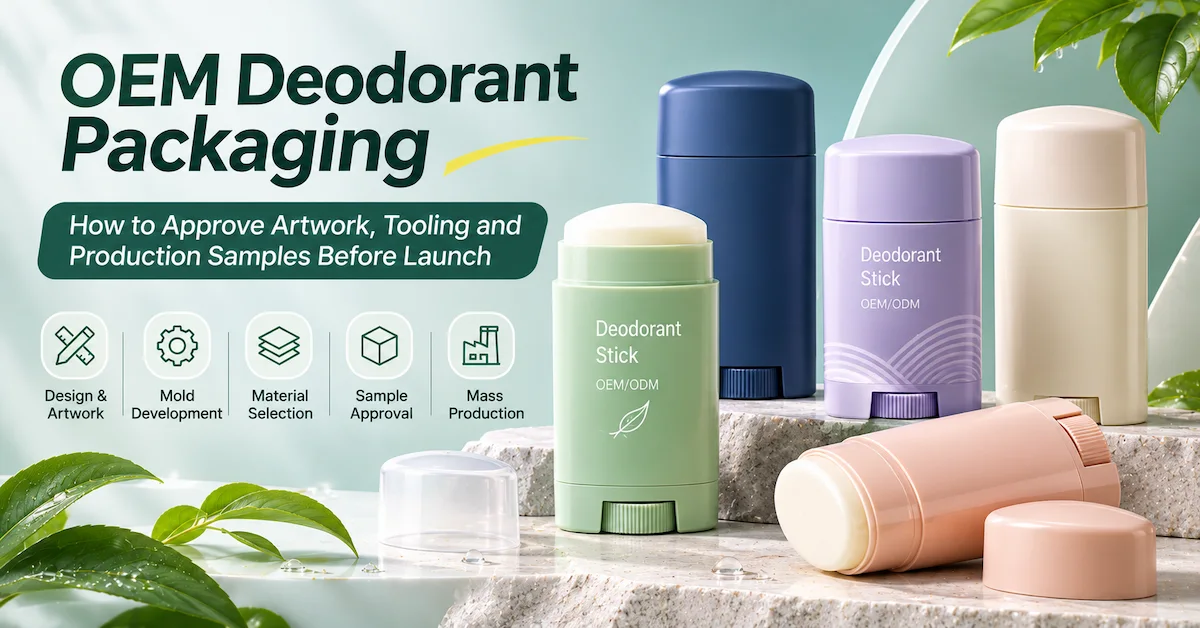
Key Takeaways: What Should Brands Approve Before OEM Production?
| Project requirement | Potential risk | Recommended approval |
|---|---|---|
| Packaging structure | Unsuitable design or component fit | Approved technical configuration |
| Custom colors | Inconsistent appearance | Physical color references |
| Branding artwork | Printing position or readability problems | Approved artwork and decoration samples |
| Material selection | Formula or processing incompatibility | Material specifications and testing |
| New mold development | Tooling errors and redesign costs | Controlled drawings and trial samples |
| Product samples | Prototype differs from production | Representative pre-production approval |
| Manufacturing changes | Inconsistent repeat orders | Engineering change-control agreement |
| Export packing | Scratches or damaged decoration | Approved packing specification |
Core development principle: Design approval, technical approval, and production approval are different milestones. All three should be documented before the packaging is released for bulk manufacturing.
1. What Is OEM Deodorant Packaging?
OEM deodorant packaging generally refers to primary packaging manufactured according to a customer's agreed design, specifications, branding, and commercial requirements.
Customization may include the container's shape, material, color, logo, decorative finish, closure, or selected mechanical components.
However, OEM packaging manufacturing is different from finished deodorant formulation manufacturing.
A packaging supplier may manufacture empty stick containers without developing the deodorant formula, filling the product, or supplying finished deodorant units.
Brands should clarify these responsibilities before starting development.
OEM vs. ODM Deodorant Packaging
| Business model | Typical responsibility | Suitable buyer |
|---|---|---|
| Existing packaging with custom decoration | Customize an available design | Emerging brands |
| OEM packaging | Manufacture to approved customer requirements | Brands with defined packaging specifications |
| ODM packaging | Supplier participates in packaging design development | Brands requiring design support |
| Fully custom structural development | Develop a new geometry or mechanism | Established brands seeking distinctive packaging |
In practice, OEM and ODM responsibilities vary by supplier and commercial agreement.
The important distinction is who controls the design, tooling, technical specification, and final approval.
2. Which OEM Customization Level Is Right for Your Brand?
Not every private-label deodorant project needs a completely new container.
The appropriate customization level depends on the intended product positioning, budget, expected sales volume, and functional requirements.
Level 1: Existing Container With Custom Branding
An existing packaging design may support changes to color, logo, and selected decoration.
This approach can be useful when a brand wants a distinctive appearance without redesigning the internal dispensing structure.
However, available colors, decoration methods, and minimum quantities depend on the selected container.
Level 2: Customized External Components
Some projects may require changes to decorative caps, outer housings, or other external features.
These modifications can provide greater differentiation but may introduce additional tooling and assembly requirements.
Level 3: New Structural Development
A proprietary shape or dispensing system may require new engineering drawings, prototypes, tooling, and technical validation.
This route can support a unique visual identity but involves additional development responsibilities.
OEM Packaging Customization Comparison
| Development route | Customization scope | Main cost driver | Key purchasing consideration |
|---|---|---|---|
| Existing design | Color and logo | Decoration and order quantity | Confirm available options |
| Existing design with component changes | Caps and selected external elements | Component tooling and assembly | Validate compatibility |
| New body tooling | Original container shape | Mold development | Approve dimensions and manufacturability |
| New dispensing mechanism | Functional structural development | Engineering and tooling | Validate movement and durability |
| Refillable design | Reusable housing and replacement components | Multiple-part development | Confirm long-term refill compatibility |
Buyer recommendation: Begin by determining whether an existing packaging architecture can meet the brand's functional and visual requirements.
New tooling should solve a defined design problem rather than be treated as a mandatory step for premium branding.
3. What Should Be Included in an OEM Deodorant Packaging Design Brief?
A design brief connects the marketing team's visual objectives with the engineering team's manufacturing requirements.
Without one, suppliers may interpret the same packaging concept differently.
OEM Deodorant Packaging Design Brief
| Design requirement | Information to provide | Why it matters |
|---|---|---|
| Product application | Solid deodorant, balm, or another format | Defines functional requirements |
| Container structure | Twist-up, push-up, refillable, or custom | Establishes packaging architecture |
| Target net fill | Intended finished product weight | Supports capacity planning |
| Material preference | Proposed resin or performance requirement | Guides material selection |
| Exterior geometry | Shape, dimensions, reference design | Influences mold development |
| Dispensing mechanism | Desired consumer operation | Determines component requirements |
| Brand colors | Physical references or defined color values | Supports color matching |
| Artwork | Logo, graphics, instructions, required text | Establishes decoration requirements |
| Surface finish | Matte, glossy, or selected finish | Affects appearance and processing |
| Order forecast | Initial quantity and repeat demand | Supports manufacturing planning |
| Target market | Intended sales countries | Identifies relevant documentation needs |
| Launch schedule | Desired approval and delivery milestones | Supports project coordination |
Why Brand References Are Not Technical Drawings
A photograph or digital rendering is useful for communicating style.
However, it cannot fully establish container dimensions, internal geometry, material requirements, or dispensing behavior.
The manufacturer should translate the approved concept into controlled engineering information.
For projects involving original tooling, technical drawings and physical prototypes are essential development references.
4. How Should Brand Artwork and Decoration Be Approved?
Brand appearance is one of the primary reasons businesses invest in custom packaging.
However, the final printed result can differ from digital artwork.
Plastic material, surface geometry, printing technology, and finishing conditions can affect the appearance of logos and graphics.
Cosmetic Packaging Decoration Options
| Decoration option | Branding objective | Approval requirement |
|---|---|---|
| Molded color | Establish a consistent container color | Physical material reference |
| Silk-screen printing | Display logos and graphics | Print position and adhesion |
| Hot stamping | Create selected metallic accents | Surface and finish compatibility |
| Matte or glossy finish | Establish the desired visual texture | Representative finished sample |
| Decorative cap | Coordinate packaging appearance | Color and component fit |
| Multi-component design | Create a premium visual structure | Assembly and appearance approval |
COSME publishes capabilities in color matching, silk-screen printing, hot stamping, and decorative customization.
The suitability of each process must be confirmed for the proposed deodorant container material and geometry.
Artwork Approval Checklist
Before approving production, buyers should verify:
-
Correct logo and product-name spelling.
-
Artwork position and orientation.
-
Printed area dimensions.
-
Text size and legibility.
-
Color references.
-
Decorative finish.
-
Appearance after normal handling.
-
Required market-specific packaging information.
Why Screen Colors Can Be Misleading
Digital previews do not always represent the final color of printed or molded plastic.
Material opacity, surface texture, pigments, and lighting may influence visual appearance.
A physical decorated sample is therefore more useful than relying on a screen rendering alone.
The final approval should identify the artwork revision and the physical appearance reference used for production.
5. How Does OEM Deodorant Mold Development Work?
A new container structure may require customized molding tools.
Tooling development should begin after the proposed geometry and functional requirements have been reviewed for manufacturing feasibility.
COSME's published OEM/ODM process includes design confirmation, 3D drawings, CNC samples, mold opening, T1/T2 samples, mass production, and delivery.
Custom Tooling Development Workflow
| Stage | Main activity | Buyer approval requirement |
|---|---|---|
| 1. Concept confirmation | Define design and function | Approved design brief |
| 2. Engineering drawing | Develop component geometry | Approved technical drawings |
| 3. Prototype preparation | Evaluate physical design | Prototype review |
| 4. DFM review | Assess manufacturability | Engineering feedback |
| 5. Mold development | Manufacture approved tooling | Tooling scope confirmation |
| 6. T1/T2 trial samples | Evaluate molded components | Dimensional and functional testing |
| 7. Production validation | Review representative assemblies | Approved production reference |
| 8. Mass production | Manufacture and inspect packaging | Agreed batch requirements |
Why Design for Manufacturability Matters
A container that looks attractive in a rendering may be difficult to produce consistently.
Complex geometry, uneven wall sections, and challenging component interfaces can affect tooling and molding.
A DFM review helps identify potential problems before tooling is finalized.
Establish a Design Freeze
A design freeze is a controlled approval point after which changes require formal review.
Relevant frozen information may include:
-
Approved component drawings.
-
Materials and finishes.
-
Critical dimensions.
-
Dispensing interface.
-
Artwork and color references.
-
Technical acceptance criteria.
Late modifications may affect tooling costs, sample requirements, and project schedules.
Brands should avoid authorizing irreversible tooling work before critical design requirements are approved.
6. Who Owns the Custom Design, Mold and Technical Drawings?
Tooling ownership and intellectual-property arrangements should be discussed before a brand invests in custom packaging development.
These responsibilities are not automatically determined by the term "OEM."
A project agreement should clearly address:
-
Ownership of original design files.
-
Ownership and permitted use of production molds.
-
Confidentiality of technical drawings.
-
Rights to use or modify the design.
-
Mold storage and maintenance.
-
Procedures for transferring tooling where applicable.
-
Conditions for future production with other suppliers.
Why Confidentiality Agreements Matter
The World Intellectual Property Organization explains in its Trade Secrets guidance that confidential commercial or technical information may qualify for trade-secret protection when relevant conditions are satisfied, including reasonable efforts to maintain secrecy.
For OEM packaging projects, proprietary drawings, production methods, and unreleased product designs may contain commercially sensitive information.
Confidentiality agreements and controlled document access can help manage those risks.
However, an NDA alone does not guarantee ownership of a design, mold, or intellectual-property right.
Buyer recommendation: Record design ownership, confidentiality, tooling rights, and permitted future use in the relevant commercial contracts. Obtain legal advice appropriate to the governing jurisdiction when necessary.
7. How Should Materials and Filling Requirements Be Validated?
OEM customization must not compromise the packaging's functional suitability.
A deodorant container may contain different materials for its body, cap, internal platform, or dispensing mechanism.
These components should be evaluated according to the actual formulation and filling process.
Material Considerations
PP and PE are among the materials commonly considered for selected personal-care packaging components.
COSME also publishes PCR packaging directions.
However, the correct material depends on the specific resin grade, structural design, and application.
Why Filling Compatibility Matters
Some solid deodorant formulations are filled at elevated temperatures and subsequently cooled.
Others use different manufacturing conditions.
The packaging should be evaluated for the actual intended process.
Relevant checks may include container deformation, component movement, formulation shrinkage, and post-filling operation.
For a more detailed discussion of these technical issues, see COSME's Deodorant Container Hot-Fill Validation Guide.
Formula and Packaging Compatibility
The material selection process should identify relevant product-contact components.
Testing should use the intended formula and appropriate storage conditions.
A customized color or exterior design does not establish that the container is suitable for every deodorant formulation.
8. What Samples Should Be Approved Before OEM Mass Production?
A successful OEM project should use several sample stages rather than rely on one attractive prototype.
Four-Stage Sample Approval Matrix
| Sample stage | Main objective | Approval evidence |
|---|---|---|
| Appearance sample | Confirm shape, color and visual design | Physical appearance approval |
| Engineering sample | Evaluate dimensions and component fit | Technical review |
| Filled-product sample | Confirm formula and filling compatibility | Relevant functional testing |
| Pre-production sample | Confirm the commercial configuration | Approved reference and specifications |
Appearance Samples
These help evaluate the packaging's visual identity.
However, appearance approval does not guarantee dimensional or functional performance.
Engineering Samples
These are used to check the proposed structural design and relevant component interfaces.
Filled-Product Samples
Representative filled samples help determine whether the packaging remains suitable after filling, storage, and use.
Pre-Production Samples
These should represent the proposed materials, decoration, components, and manufacturing configuration.
The final approved reference should be linked to controlled technical specifications.
An OEM packaging project should not proceed to commercial production solely because the first visual prototype has been approved.
9. How Can Brands Maintain Consistent Packaging Across Product Variants?
Personal care brands often launch several deodorant variants using a shared container family.
For example, a brand may offer different fragrances, formulas, or market-specific versions.
A coordinated packaging system can create consistent shelf presentation.
However, variations in color, artwork, and components require clear identification.
Multi-Variant Packaging Approval Matrix
| Packaging element | Shared or individual approval? |
|---|---|
| Container body geometry | Shared if the configuration is identical |
| Dispensing mechanism | Shared only when compatibility is validated |
| Material specification | Controlled for each applicable configuration |
| Body color | Approved separately by variant |
| Cap color | Approved separately where different |
| Logo placement | Shared if geometry and design are consistent |
| Product information | Approved for each applicable variant |
| Finished assembly | Validated for the relevant formula |
Why SKU-Level Control Matters
Two products may share the same exterior container but use different formulas.
Those formulas may require separate compatibility and filling validation.
Likewise, a new color or decorative finish should be reviewed against the approved appearance specification.
A common brand design does not eliminate the need for individual SKU control.
10. How Should OEM Packaging Production Quality Be Controlled?
Customized packaging requires repeatable dimensions, materials, assembly, and decoration.
Quality requirements should be established before mass production.
OEM Deodorant Packaging Quality Checklist
| Quality area | Recommended verification |
|---|---|
| Material identity | Approved component materials |
| Molded dimensions | Critical drawings and tolerances |
| Container appearance | Visible defects and color consistency |
| Cap and body fit | Correct assembly |
| Dispensing mechanism | Relevant functional performance |
| Decoration | Printing, color and finish |
| Filled-product suitability | Formula-specific validation |
| Batch identification | Production traceability |
| Export packing | Protection and carton requirements |
Why Change Control Is Important
A supplier may need to modify materials, tooling, or critical components during a long-term packaging program.
Such changes may affect the approved product.
Buyers should establish a procedure requiring relevant changes to be reviewed before production.
Export Transport Validation
Custom decoration and molded components may be vulnerable to scratching, deformation, or handling damage during shipping.
ASTM D4169-23e1 — Standard Practice for Performance Testing of Shipping Containers and Systems provides a framework for evaluating packaging systems under representative distribution hazards.
A project-specific transport plan may use its principles to evaluate the complete shipping configuration.
However, this standard does not automatically verify the functional performance of an individual deodorant dispensing mechanism.
The actual testing scope and acceptance criteria should be agreed for the project.
11. What Determines OEM Deodorant Packaging Cost and Lead Time?
Custom packaging costs depend on the complete production scope.
The final quotation may include components, decoration, tooling, samples, inspection, and shipping arrangements.
OEM Packaging Cost Breakdown
| Cost factor | Main consideration |
|---|---|
| Existing container design | Available dimensions and components |
| New tooling | Engineering and mold development |
| Custom colors | Material and production setup |
| Logo printing | Artwork and decoration requirements |
| Special components | Additional tooling or sourcing |
| Sample approval | Development and validation |
| Testing | Functional and compatibility requirements |
| Order quantity | MOQ and production scheduling |
| Export packing | Protection and shipping preparation |
Existing Design vs. New Mold Cost
An existing suitable container may avoid some structural tooling costs.
A new mold can support distinctive geometry but usually introduces additional development and validation requirements.
Neither route guarantees a particular project cost or lead time.
What Affects Development Schedules?
Relevant factors may include:
-
Design revisions.
-
Material and component availability.
-
Prototype approval.
-
Tooling development.
-
Trial-sample corrections.
-
Artwork approval.
-
Filled-product testing.
-
Commercial production scheduling.
COSME's website describes a typical production period of approximately 40–50 days, depending on customization complexity. This should not be interpreted as a universal timeline for design development, new tooling, filling validation, or international shipping.
The buyer should request a milestone-based project schedule rather than relying on one general delivery estimate.
12. Application Example: Developing an OEM Deodorant Product Collection
The following is a hypothetical project scenario, not a documented COSME customer case.
Brand Requirements
A personal care brand plans to develop three deodorant variants with coordinated packaging.
The brand wants a consistent container shape, different product colors, and premium-looking decoration.
Main Challenge
The design team prepares digital artwork before the technical packaging configuration has been fully approved.
The packaging supplier must determine whether the proposed appearance can be achieved using an existing container or requires additional tooling.
Recommended Project Approach
The team should:
-
Define the shared container architecture.
-
Confirm the required dispensing mechanism.
-
Review available materials and customization options.
-
Approve the engineering drawings.
-
Validate the actual product formulations.
-
Approve physical color and artwork samples.
-
Establish production-reference samples for each variant.
-
Confirm component quantities, MOQ, and production schedules.
Procurement Lesson
The project should maintain separate design, technical, and commercial approval records.
This helps prevent later disputes about which artwork, material, or component version was authorized.
No cost savings, production improvement, or specific customer results are assumed in this illustrative scenario.
13. Why Consider COSME Packaging for OEM Deodorant Packaging?
COSME Packaging, operated by Zhejiang Cosme Industry Co., Ltd., is a China-based cosmetic packaging manufacturer established in 2015.
According to its published company information, COSME operates an approximately 15,000-square-meter facility with around 200 employees.
Its general packaging capabilities include:
-
Packaging R&D: Product concepts and development support.
-
3D Design and Mold Development: Engineering drawings, prototypes, tooling and trial samples.
-
Plastic Manufacturing: Injection- and blow-molding operations.
-
OEM/ODM Customization: Colors, printing, selected structures and decoration.
-
Quality Control: Incoming material checks, dimensional inspection, appearance evaluation and production records.
COSME's Deodorant Containers category lists plastic deodorant containers, refillable deodorant packaging, and PCR packaging directions.
However, the category currently does not display verified individual product SKUs.
Therefore, specific container availability, manufacturing responsibilities, materials, decoration feasibility, tooling requirements, and order minimums must be confirmed through project inquiry.
The company-level capabilities should not be interpreted as proof that every deodorant mechanism is manufactured in-house or that all proposed designs have been validated.
Buyers can review COSME's manufacturing and customization capabilities before discussing a specific OEM project.
14. What Should You Include in an OEM Deodorant Packaging RFQ?
A detailed Request for Quotation can help a packaging supplier understand the complete design and production requirements.
OEM Deodorant Packaging RFQ Checklist
| Information | What to provide |
|---|---|
| Brand and product | Deodorant type and intended application |
| Packaging format | Twist-up, push-up, refillable or custom |
| Target net fill | Product weight and relevant formula data |
| Design concept | Reference images or technical sketches |
| Materials | Preferred materials or performance requirements |
| Components | Body, cap, platform, dispensing mechanism |
| Customization | Colors, logo, artwork and finishes |
| Tooling | Existing design or new mold requirements |
| Intellectual property | Design and tooling ownership expectations |
| Samples | Appearance, engineering and filled-product samples |
| Quality | Inspection and functional acceptance requirements |
| Initial quantity | Expected launch order |
| Repeat demand | Anticipated annual purchasing volume |
| Delivery | Destination and desired project milestones |
Request an OEM Packaging Development Review
An effective inquiry should identify both the visual concept and the technical requirements.
If a new mold is required, clarify the proposed tooling scope, responsibilities, sample process, and approval stages.
If the project uses existing packaging, confirm which colors, decorations, and components are available.
Developing a deodorant brand and need custom primary packaging?
Contact COSME Packaging with your brand concept, packaging design references, intended formula, customization requirements, and purchasing forecast to discuss available OEM/ODM options, development feasibility, samples, and a project-specific quotation.
Frequently Asked Questions About OEM Deodorant Packaging
1. What is OEM deodorant packaging?
OEM deodorant packaging involves producing primary packaging according to agreed customer specifications. This may include existing designs with custom branding or more extensive structural customization, depending on the supplier and project.
2. Is OEM deodorant packaging the same as private-label deodorant manufacturing?
No. OEM packaging manufacturing focuses on packaging components. Private-label deodorant manufacturing may include formulation, filling, labeling, and finished-product supply. Buyers should confirm which services are included.
3. Can I customize deodorant packaging without developing a new mold?
Potentially, yes. Existing packaging designs may support selected colors, printing, and decoration. Structural modifications may require new tooling or additional validation.
4. What is the difference between OEM and ODM deodorant packaging?
OEM generally involves production according to customer-defined requirements, while ODM may involve more supplier participation in packaging design. Actual responsibilities depend on the contract.
5. Who owns a custom deodorant packaging mold?
Tooling ownership depends on the commercial agreement. Buyers should document ownership, storage, maintenance, permitted use, and transfer conditions before authorizing development.
6. How should custom packaging artwork be approved?
Approve the correct artwork revision, printed dimensions, color references, decorative finish, and physical production-representative samples. Digital renderings alone do not establish final production appearance.
7. What is the MOQ for OEM deodorant packaging?
MOQ depends on the selected container design, materials, colors, decoration, tooling, and order requirements. COSME does not publish one universal MOQ for every deodorant packaging configuration.
8. What samples should be approved before bulk production?
Relevant samples may include appearance prototypes, engineering samples, filled-product test samples, and production-representative decorated assemblies. Requirements depend on the project.
9. Can OEM deodorant packaging use PCR materials?
Selected packaging components may incorporate PCR materials when suitable grades and configurations are available. Recycled-content percentages, formula compatibility, appearance, and supporting documentation should be verified.
10. How can I start an OEM deodorant packaging project with COSME?
Prepare your design concept, target fill weight, preferred container format, material requirements, artwork, expected quantities, and desired project milestones. Submit these details through COSME's contact page for a technical and commercial discussion.
Conclusion
Successful OEM deodorant packaging requires more than applying a brand logo to an existing container.
For personal care brands, private-label developers, and cosmetic OEM/ODM procurement teams, the most important objective is transforming an approved packaging concept into a repeatable, functional, and commercially viable product.
Design requirements, customization scope, material selection, artwork, mold development, component specifications, sample approval, and quality controls should be coordinated before commercial production begins.
A structured development process helps identify design risks early, reduces ambiguity between the brand and manufacturer, and supports consistency across product variants and repeat orders.
It is equally important to establish clear agreements covering tooling ownership, confidential information, production changes, and the responsibilities of each project participant.
With its published capabilities in packaging R&D, mold development, plastic manufacturing, decorative customization, and quality management, COSME Packaging offers a potential partner for discussing OEM personal-care packaging projects.
Whether you are launching a new deodorant brand, refreshing an existing packaging design, or developing custom containers for a coordinated product collection, contact COSME Packaging with your design references, technical specifications, and purchasing requirements to explore feasible packaging solutions and request a tailored quotation.