
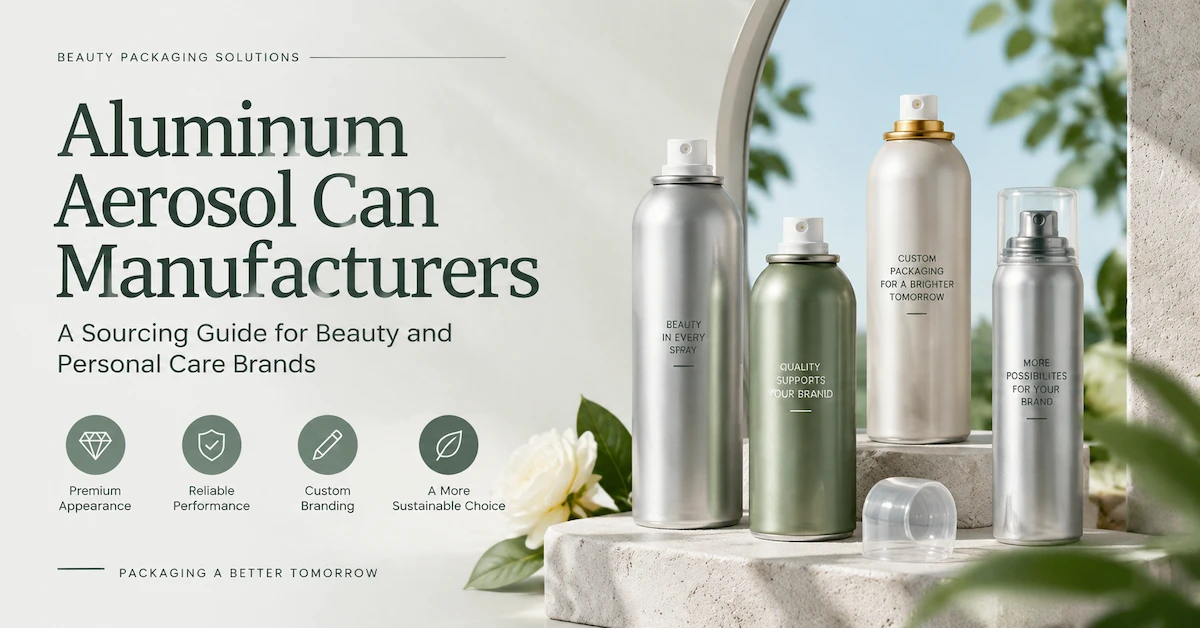
What Should Buyers Expect From Aluminum Aerosol Can Manufacturers?
Professional aluminum aerosol can manufacturers should provide more than an empty metal container. For beauty, personal care, hair care, deodorant, body spray, and other aerosol projects, the can has to work as part of a complete packaging system that also includes the formula, propellant or dispensing system, valve, actuator, filling process, decoration, transportation conditions, and target-market requirements.
This means the right sourcing decision starts with the application rather than with a request such as “I need a 150 ml aluminum can.” Two cans with a similar nominal capacity can differ in diameter, height, shoulder shape, valve interface, internal coating, decoration process, pressure requirements, and compatibility with the product being filled. Buyers should therefore compare suppliers according to the complete project specification, not only the visible appearance or quotation.
Brands reviewing different packaging formats can first explore available cosmetic packaging products and then determine whether an aerosol format is suitable for the intended formula and dispensing experience.
Which Buyers Typically Source Aluminum Aerosol Cans?
The search for aluminum aerosol can manufacturers usually comes from buyers with a defined commercial application rather than consumers purchasing individual containers. Typical customers include beauty brands, personal care companies, cosmetic OEM/ODM factories, contract fillers, private-label businesses, distributors, packaging sourcing companies, and brand groups developing multiple product lines.
Beauty and Personal Care Brands
These buyers often place strong emphasis on package appearance, tactile quality, decoration consistency, color control, shelf differentiation, and the ability to reproduce the same design across repeat orders. An aluminum aerosol can may be considered for products such as body sprays, deodorants, facial or body mists, shaving products, hair products, and selected cosmetic spray applications.
Contract Manufacturers and Filling Companies
Contract manufacturers tend to focus more heavily on technical integration. They need to know whether the can, valve, actuator, product formula, filling equipment, propellant system, and filling conditions can work together reliably. For these buyers, a visually attractive package that creates filling or compatibility problems is not an acceptable solution.
Private-Label and Emerging Brands
New brands may prioritize manageable development risk, existing packaging platforms, decoration flexibility, sample evaluation, and a realistic MOQ. A fully custom structure may create unnecessary tooling, sampling, validation, and inventory costs when an existing can platform can already achieve the required market positioning.
When Aluminum Aerosol Packaging May Not Be the Best Choice
An aerosol package is not automatically the best solution for every cosmetic or personal care product. If the formula can be delivered effectively through a lotion pump, mist sprayer, dropper, airless system, jar, or conventional bottle, buyers should compare those options before committing to an aerosol format. Packaging selection should follow the dispensing requirement, product compatibility, target user experience, regulatory environment, logistics, and commercial positioning.
Why Is Aluminum Used for Aerosol Packaging?
Aluminum aerosol containers are typically valued for their lightweight structure, metallic appearance, decoration potential, corrosion-management options through appropriate internal coatings, and ability to be formed into seamless container bodies. Many designs use a monobloc construction in which the body is produced as one continuous aluminum container rather than a body assembled from a longitudinal seam.
For premium beauty and personal care packaging, aluminum can also provide a clean surface for coatings, printing, and decorative finishes. However, material choice alone does not determine package performance. The suitability of an aluminum aerosol can depends on the complete system, especially the product formulation, internal coating, valve assembly, filling conditions, and required pressure performance.
How Are Aluminum Aerosol Cans Manufactured?
Understanding the manufacturing sequence helps procurement teams ask better questions when comparing aluminum aerosol can manufacturers.
Impact Extrusion and Body Formation
A typical aluminum aerosol container begins with an aluminum slug. Through impact extrusion, the material is formed into a cylindrical body. The exact forming process, alloy choice, wall profile, and dimensional controls depend on the can design and manufacturing system.
After forming, the body is trimmed to establish controlled dimensions before moving into cleaning and finishing processes.
Cleaning and Internal Protection
The inside of the container must be prepared for the intended product. Depending on the formulation and package specification, an internal lacquer or coating may be required to reduce direct interaction between the contents and the aluminum surface.
This is an area where buyers should avoid generic assumptions. A statement such as “the can has an internal coating” does not prove compatibility with every cosmetic, alcohol-based, water-based, oil-based, or chemically active formula. Compatibility should be evaluated for the actual product.
External Coating and Decoration
The outer surface may receive base coating, printing, color decoration, or other finishes according to the required design. Packaging buyers should define acceptable color tolerance, artwork version, print position, surface defects, and visual inspection criteria before mass production.
Shoulder and Neck Formation
The upper section of the can is shaped to create the required shoulder and valve interface. Dimensional consistency in this area is important because the can has to integrate correctly with the valve and downstream filling or crimping process.
Inspection and Testing
Production control may include dimensional inspection, visual inspection, coating checks, pressure-related testing, leak-related evaluation, and other model-specific controls. Buyers should request the applicable inspection plan for the actual can rather than assuming every factory uses exactly the same test sequence or acceptance limits.
What Specifications Should You Send Before Requesting a Quote?
A vague RFQ produces a vague quotation. Buyers approaching aluminum aerosol can manufacturers should prepare a controlled requirement sheet so competing quotations refer to the same product definition.
| Requirement Area | Information the Buyer Should Provide | Why It Matters |
|---|---|---|
| Product application | Deodorant, body spray, hair care, facial mist, shaving product, etc. | Establishes the intended use |
| Formula information | Relevant chemical and compatibility characteristics | Supports coating and compatibility review |
| Capacity | Required nominal and relevant fill capacity | Influences can selection |
| Dimensions | Diameter, height, space limitations | Determines filling and packaging integration |
| Shoulder/profile | Standard or specific appearance requirement | Affects aesthetics and components |
| Valve interface | Required valve system or filling-line requirement | Critical for assembly compatibility |
| Internal coating | Formula-dependent requirement | Helps protect package/product compatibility |
| Decoration | Color, printing, coating, artwork, finish | Controls branding and cost |
| Target market | Destination countries or regions | Influences documentation requirements |
| Quantity | Sample, pilot order, first order, annual forecast | Affects commercial planning |
| Packing method | Export carton/pallet requirements | Influences logistics protection |
| Project timing | Sample and production milestones | Prevents unrealistic lead-time expectations |
Do not approve a quotation based only on capacity and price. The final purchase specification should define the version actually being ordered.
How Should Buyers Evaluate Formula and Internal Coating Compatibility?
Formula compatibility is one of the most important technical questions in aerosol packaging. The product may contain water, alcohol, fragrances, oils, salts, active ingredients, solvents, or other substances that influence the container, coating, valve components, or dispensing system.
A buyer should therefore ask what internal coating options are available for the selected container and whether compatibility evaluation is required for the actual formulation. The safest development route is to evaluate the finished packaging system rather than judging the can separately.
Why a Generic Compatibility Claim Is Not Enough
Saying that a can is “suitable for cosmetics” is too broad. Cosmetics and personal care formulas can behave very differently. A packaging configuration suitable for one body spray may not automatically be suitable for another formulation.
The relevant question is:
Has this specific can, internal coating, valve, formula, and filling configuration been evaluated together?
That question is far more useful than asking whether the supplier “makes cosmetic cans.”
How Do Aluminum Aerosol Can Applications Differ?
Different applications create different sourcing priorities. This is why experienced buyers do not use one specification for every project.
| Application | Common Buyer Priorities | Items to Confirm |
|---|---|---|
| Deodorant spray | Portable size, decoration, dispensing consistency | Formula, valve, actuator, internal coating |
| Body spray | Premium appearance, comfortable handling | Capacity, spray system, artwork, finish |
| Hair spray | Filling compatibility and reliable dispensing | Formula, propellant system, valve configuration |
| Facial/body mist | Fine user experience and brand presentation | Dispensing requirement and formula compatibility |
| Shaving/personal care | Functional dispensing and package durability | Product-system compatibility and component selection |
| Private-label programs | Repeatability across multiple SKUs | Color control, artwork versions, MOQ and lead time |
This application-based approach helps buyers avoid selecting a can only because its appearance matches a reference image.
Standard Can or Fully Custom Can: Which Is Better?
A standard production platform is often the lower-risk choice when the available diameter, height, shoulder style, and valve configuration already satisfy the project. It can reduce development complexity and may simplify sampling and commercial launch.
A fully customized package is more appropriate when brand differentiation cannot be achieved through standard dimensions, decoration, colors, or component selection.
Choose an Existing Platform When
The project requires faster development, moderate quantities, a proven package structure, or branding changes mainly through printing, coating, and decoration.
Consider Deeper Customization When
The brand requires a distinctive profile, unique dimensional constraints, a proprietary product family, or a packaging structure that cannot be achieved using an existing platform.
Buyers can review the wider CosmeBottle product range before deciding whether a new package structure is commercially necessary.
What Quality Controls Matter When Comparing Manufacturers?
Price comparisons are easy to make. Quality-system comparisons require more work. Before approving aluminum aerosol can manufacturers, buyers should determine which characteristics are controlled during production and which acceptance standards apply to their project.
Dimensional Consistency
Important dimensions can affect filling-line setup, valve assembly, secondary packaging, and overall appearance. Buyers should identify critical dimensions in the approved specification rather than leaving them as undefined expectations.
Surface and Decoration Quality
Agree on inspection criteria for scratches, dents, color variation, print registration, contamination, coating defects, and other visible conditions. The approved sample should represent an identified version, not an informal reference passed between departments.
Internal Coating Control
If the project requires an internal coating, buyers should understand how the specified coating system is controlled in production and whether changes require review.
Pressure and Leak-Related Controls
Aerosol containers operate as part of a pressurized packaging system. The applicable test method and acceptance criteria should therefore be confirmed for the selected can and intended filling conditions. Avoid substituting a generic supplier statement for project-specific technical approval.
Traceability and Change Control
Repeat orders are safer when the supplier can identify production batches and control changes to relevant materials, coatings, dimensions, artwork, or processes. An unannounced “equivalent” change may create problems even if the container still looks similar.
How Should Samples Be Approved Before Mass Production?
A sample should represent a defined project revision. Buyers should record the can specification, dimensions, internal coating, external finish, artwork version, valve/component configuration where applicable, and sample date or revision.
If the design changes after approval, the revised version should receive a new identification. This prevents purchasing, brand, quality, and production teams from referring to different samples as “the approved sample.”
For formulation-based projects, package evaluation should also consider the actual product and filling system wherever practical. Visual approval alone cannot demonstrate formula compatibility or performance under real-use conditions.
How Much Do Aluminum Aerosol Cans Cost?
There is no useful universal price for a custom aluminum aerosol can because the cost depends on the specific package and commercial conditions. When comparing quotations from aluminum aerosol can manufacturers, buyers should separate base-container cost from customization and project costs.
Key variables include can dimensions, material usage, internal coating, external coating, printing complexity, color count, decoration requirements, custom forming or tooling requirements, order quantity, packaging method, sample work, quality requirements, and logistics.
A lower unit price may not create a lower total procurement cost if it introduces additional sampling, rejected decoration, filling-line adjustment, inconsistent repeat orders, or rework. B2B buyers should compare total project risk and repeatability, not only the first quotation.
MOQ and Lead Time Should Be Evaluated Together
MOQ depends on the selected platform, decoration, production setup, and supplier's manufacturing conditions. For this reason, buyers should not publish or rely on a universal MOQ unless it has been confirmed for the exact project.
Lead time should also be separated into stages:
Existing Can Selection
Confirm an available platform and basic specification.
Decoration Sampling
Confirm artwork, colors, coating, and appearance.
Technical Validation
Evaluate the relevant can, component, filling, and formula requirements.
Production Approval
Freeze the approved version before bulk production.
Mass Production and Export Packing
Produce, inspect, pack, and prepare the order according to the agreed specification.
Managing lead time this way makes delays easier to identify than using one undefined promise such as “delivery in X days.”
OEM and Custom Aluminum Aerosol Packaging Projects
OEM projects may involve customized printing, colors, finishes, artwork, component coordination, or other project-specific packaging requirements. More complex projects may require structural development or additional validation.
Brands should define the scope before development begins. Clarify which aspects are standard, which are customized, who supplies the artwork, who approves samples, what changes require reapproval, and what documentation will control repeat orders.
You can review CosmeBottle company information and available electronic catalogs and packaging resources when preparing a packaging sourcing project. Model-specific availability, customization scope, MOQ, testing, and compliance should still be confirmed for the actual inquiry.
What Are the Biggest Sourcing Risks?
One common risk is approving appearance before technical compatibility has been established. A can can look correct while still being unsuitable for the formula, valve system, or filling conditions.
Another risk is comparing quotations built around different specifications. One supplier may quote a standard can and simple print, while another includes a particular coating or more complex decoration. Comparing only the unit price can therefore produce a misleading result.
A third risk is weak revision control. Packaging projects often pass through multiple artwork, color, component, and specification revisions. If the final purchase order does not clearly identify the approved version, repeatability becomes difficult.
The best way to reduce these risks is to maintain one controlled specification covering the package, decoration, components, approved sample, inspection requirements, and revision status.
What Should You Send an Aluminum Aerosol Can Supplier for Evaluation?
A useful RFQ should include the intended product, formula category, target capacity, preferred can dimensions, reference images or drawings, target finish, artwork, valve or dispensing requirements, target market, expected quantity, annual forecast, desired sampling timeline, and expected production schedule.
If you already have an existing can, provide photographs and dimensional information. If you are replacing a current supplier because of a problem, describe the problem clearly—such as decoration inconsistency, leakage concerns, compatibility issues, delivery instability, or dimensional variation. This allows the supplier to evaluate the actual sourcing problem rather than simply reproduce the previous package.
For a project-specific review, submit these requirements through the CosmeBottle contact page.
Frequently Asked Questions About Aluminum Aerosol Can Manufacturers
1. What should I include in an RFQ for aluminum aerosol cans?
Include the application, formula category, required capacity, dimensions, decoration, internal coating requirements if known, valve or component requirements, quantity forecast, target market, packaging method, and project schedule. Clear requirements make supplier comparisons more meaningful.
2. How should I compare aluminum aerosol can manufacturers?
Compare manufacturing and technical support, dimensional control, coating options, decoration capability, quality procedures, change control, sampling process, communication, MOQ, lead time, and repeat-order consistency. Unit price should be one part of the decision rather than the only criterion.
3. Do all aluminum aerosol cans need the same internal coating?
No. The appropriate internal surface system depends on the container specification and product formulation. Buyers should confirm compatibility for the actual package and formula rather than assuming one coating works for every product.
4. Can aluminum aerosol cans be customized with brand colors and printing?
Customization can commonly involve exterior colors, coatings, printing, artwork, and decorative finishes, but available processes and limitations depend on the selected production platform. Confirm artwork requirements and approval standards before ordering.
5. What is the MOQ for custom aluminum aerosol cans?
There is no single MOQ that applies to every project. It depends on the container platform, decoration, setup requirements, customization depth, and supplier production conditions. Request a project-specific MOQ.
6. Should I approve the can before testing my formula?
Visual approval and technical approval are different. When formula compatibility is relevant, the complete packaging system should be evaluated before commercial production rather than relying only on appearance samples.
7. What tests should I ask an aluminum aerosol can manufacturer about?
Ask which dimensional, appearance, coating, pressure-related, leak-related, and production inspections apply to the selected model. Test conditions and acceptance criteria should be confirmed for the actual project rather than assumed from general factory capability.
8. Can I use the same aerosol can for different cosmetic formulas?
Possibly, but the same external can does not automatically mean the same package configuration is suitable for every formula. Different formulations may require different compatibility evaluations, coatings, valves, actuators, or filling conditions.
9. How can I reduce lead time for a new aerosol packaging project?
Start with a clearly defined application, use an existing production platform when it meets the requirements, finalize artwork early, provide formula and component information promptly, and separate sample approval from bulk-production timing.
10. How can I reduce repeat-order risk?
Create a controlled specification tied to the approved sample, artwork version, can dimensions, internal and external finish, relevant components, packing method, inspection requirements, and revision status. Require review before important specifications are changed.
Conclusion
Selecting aluminum aerosol can manufacturers is a packaging-engineering and supply-chain decision, not simply a search for the lowest can price. Beauty brands, personal care companies, contract manufacturers, and private-label buyers should evaluate the complete package: application, formula compatibility, internal coating, dimensions, valve integration, decoration, quality controls, sampling, commercial terms, and repeat-order consistency.
The strongest sourcing process starts with a detailed requirement specification, evaluates the actual packaging system, controls approved revisions, and compares suppliers using both technical and commercial criteria. Buyers considering aluminum aerosol packaging or alternative cosmetic containers can explore CosmeBottle packaging products and submit application, capacity, decoration, quantity, target market, and project requirements through Contact Us for project-specific evaluation.