
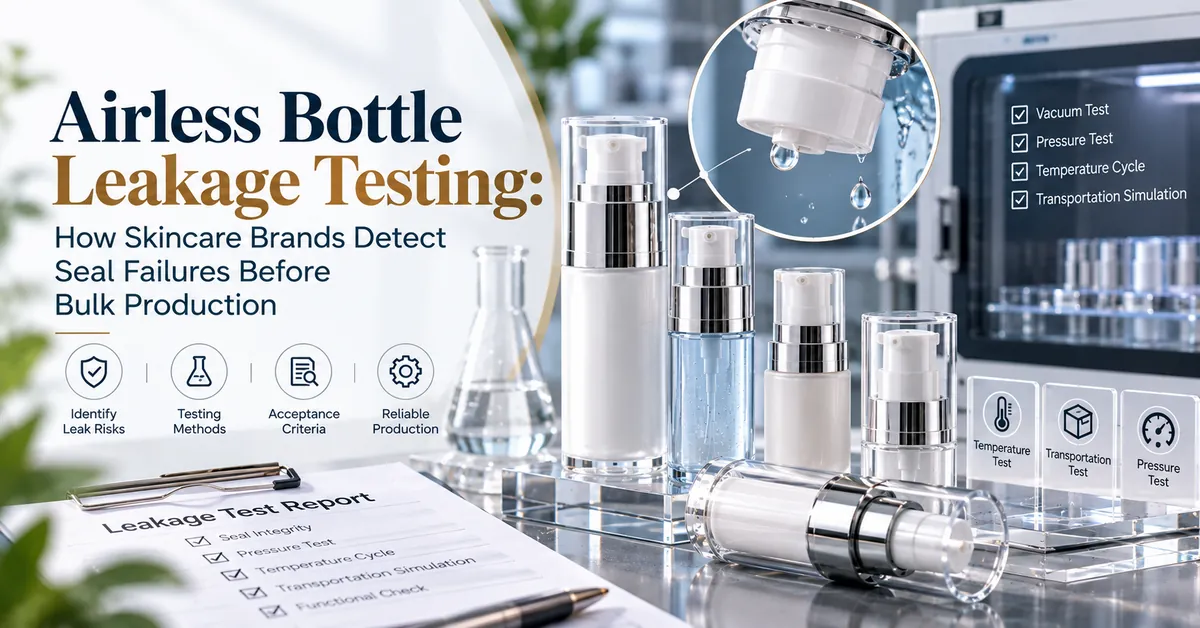
An airless bottle may look flawless during sample approval but begin leaking after filling, transportation, or repeated consumer use. For skincare brands, cosmetic OEM/ODM manufacturers, and packaging procurement teams, these failures can lead to wasted formulations, damaged cartons, customer complaints, and expensive replacement orders.
The challenge is that leakage does not always come from the bottle body. It may originate from the pump assembly, actuator outlet, sealing interface, internal reservoir, piston, or incorrectly assembled components.
Airless bottle leakage testing should therefore evaluate the complete filled packaging system under defined storage, pressure, handling, and dispensing conditions—not simply check whether an empty bottle holds water.
A reliable testing strategy combines structural inspection, sealing verification, functional testing, environmental conditioning, and production quality control.
COSME Packaging, operated by Zhejiang Cosme Industry Co., Ltd., manufactures cosmetic packaging and provides OEM/ODM customization, mold development, plastic molding, and quality inspection services for international beauty and personal-care brands.
This guide explains how packaging engineers and B2B buyers can identify leakage risks, select appropriate testing methods, establish acceptance criteria, and prepare airless bottles for reliable commercial production.
1. Quick Answer: How Do You Test an Airless Bottle for Leakage?
Airless bottle leakage testing involves filling representative packaging, inspecting critical sealing points, exposing the assembled bottle to defined conditions, and checking for unintended product escape or loss of package integrity.
A practical validation process includes six steps:
-
Inspect the components: Examine the bottle body, pump assembly, seals, and internal reservoir for damage or dimensional problems.
-
Fill representative samples: Use the intended cosmetic formula or a justified test medium.
-
Check sealing performance: Evaluate the assembled package in selected upright, horizontal, and inverted orientations.
-
Apply relevant environmental conditions: Assess temperature, pressure differential, handling, and transportation risks.
-
Verify dispensing after conditioning: Confirm that the pump still primes and operates without unintended leakage.
-
Record and evaluate results: Compare observations against agreed acceptance criteria and investigate failures.
The required methods depend on the bottle structure, formula, distribution route, and intended use.
No single test can establish complete reliability under every condition.
2. Where Do Airless Bottles Commonly Leak?
Understanding the failure location is the first step toward selecting a useful test method.
An airless package may contain a product reservoir, dispensing pump, sealing components, decorative housing, and either a moving piston or another internal dispensing architecture.
Each interface can create different failure risks.
Airless Bottle Leakage Failure-Point Matrix
| Potential leakage location | Possible cause | Recommended inspection |
|---|---|---|
| Pump-to-bottle interface | Incorrect fit, damaged seal, assembly variation | Dimensional and assembly inspection |
| Actuator outlet | Residual product, valve malfunction, unintended discharge | Post-dispensing observation |
| Pump housing | Component defect or sealing failure | Pump assembly inspection |
| Piston interface | Damaged sealing surface or dimensional inconsistency | Internal structure and functional checks |
| Collapsible pouch connection | Weak connection or reservoir damage | Reservoir integrity testing |
| Bottle body | Cracks, molding defects, insufficient structural integrity | Visual and appropriate integrity testing |
| Refillable cartridge interface | Incomplete engagement or damaged connector | Repeated assembly and sealing evaluation |
These are potential failure mechanisms, not evidence that a particular COSME product has experienced them.
Is Product Around the Pump Always a Leak?
Not necessarily.
A small amount of residual serum at the dispensing outlet after normal use may be caused by the pump's dispensing behavior rather than a failed reservoir seal.
However, repeated dripping, product escape while the pump is inactive, or unexpected discharge during storage may indicate a functional problem.
Testing should distinguish between:
-
Unintended product loss from a sealed interface.
-
Residual product remaining at the nozzle after dispensing.
-
Accidental pump activation during transportation.
-
Internal air ingress that affects dispensing but produces no visible external leakage.
These failures require different corrective actions.
3. How Does Airless Bottle Construction Affect Leakage Risk?
Different airless designs create different sealing challenges.
Piston-Based Airless Bottles
A piston-based bottle typically uses a movable piston to compensate for product dispensed from the reservoir.
Its performance depends on piston geometry, sealing contact, reservoir dimensions, and pump integration.
Potential leakage-related risks include damage to the piston seal, dimensional inconsistency, and problems at the pump connection.
Collapsible Pouch Systems
A collapsible reservoir contracts as product is dispensed.
For this architecture, the pouch material, welded or bonded areas where applicable, and connection to the dispensing system require particular attention.
A package may need both reservoir integrity testing and completed assembly testing.
Refillable Airless Systems
Refillable packaging introduces another interface between reusable and replaceable components.
The system should be evaluated after the intended number of replacement cycles, not only when the components are new.
Comparing Airless Packaging Structures
| Packaging structure | Main sealing concern | Recommended validation focus |
|---|---|---|
| Piston-based airless bottle | Piston and pump interfaces | Reservoir sealing, movement, leakage |
| Collapsible pouch system | Pouch integrity and connection | Reservoir integrity and completed assembly |
| Refillable airless bottle | Cartridge connection and pump interface | Repeated assembly and leakage |
| Conventional lotion pump bottle | Closure, dip tube, pump assembly | Closure integrity and dispensing |
Buyers should verify the actual internal construction before applying an airless-specific testing procedure.
COSME offers several design directions through its airless bottle product collection. The internal mechanism and available specifications must be confirmed for the selected product.
4. Which Airless Bottle Leakage Testing Methods Should Buyers Use?
There is no universal testing method suitable for every airless bottle.
The method should be selected according to the packaging architecture, intended formula, likely failure modes, and the information the buyer needs.
Airless Bottle Leakage Test Method Comparison
| Test method | Primary objective | Main advantage | Important limitation |
|---|---|---|---|
| Visual leakage inspection | Identify visible product escape | Simple and useful for screening | Cannot detect every small or hidden leak |
| Orientation and storage test | Evaluate leakage in different positions | Reflects relevant storage situations | Requires defined duration and conditions |
| Vacuum decay testing | Detect pressure changes associated with leakage | Can be nondestructive when suitably validated | Requires compatible test fixtures and method validation |
| Pressure-differential exposure | Evaluate response to pressure changes | Relevant to some transport conditions | Does not automatically establish normal-use reliability |
| Temperature conditioning | Reveal temperature-related sealing changes | Useful for storage risk assessment | Not a complete leakage test by itself |
| Distribution simulation | Assess packaged products during shipping hazards | Evaluates the shipping system | Must represent the intended distribution route |
| Repeated-use testing | Identify leakage after pump operation | Evaluates functional durability | Requires defined actuation and inspection conditions |
Method 1: Visual and Orientation Testing
This is often a practical starting point for completed cosmetic packaging.
Representative filled bottles are conditioned and inspected in selected orientations, such as upright, horizontal, or inverted.
The test procedure should specify fill quantity, temperature, duration, closure condition, and inspection criteria.
Products should be evaluated for unexpected wetness, visible escape of contents, and any change in dispensing behavior.
Passing a short upright storage test does not demonstrate that the bottle will remain leak-free during transport.
Method 2: Vacuum Decay Testing
Vacuum decay testing measures pressure changes in an evacuated chamber containing the test package.
ASTM F2338-24 describes nondestructive leak detection using this principle for specified packaging types.
However, suitability for a particular airless bottle must be established through method and fixture validation.
Some airless systems contain designed ventilation pathways outside the sealed product reservoir. Those pathways must be understood so that normal design behavior is not confused with a product leak.
The test should also account for the formula, package geometry, sealing construction, and detection sensitivity.
Method 3: Pressure-Differential Testing
Pressure changes can occur during air transportation or travel through high-altitude regions.
A completed airless package may experience conditions different from normal storage.
ASTM D4991-25 describes vacuum leakage testing of empty rigid containers under differential-pressure conditions.
Its scope should not be confused with automatic validation of a filled cosmetic airless pump system.
For commercial skincare packaging, buyers should select a procedure appropriate to the complete filled assembly and its actual shipping conditions.
Method 4: Distribution Testing
Transportation may involve vibration, shock, compression, and changes in orientation.
ASTM D4169-23e1 provides a framework for laboratory evaluation of shipping containers and systems against relevant distribution hazards.
For skincare brands, the evaluation should consider the complete shipping unit, including bottles, protective components, cartons, and packing arrangement.
The key question is whether the filled product reaches its destination with acceptable package integrity.
5. How Do You Build an Airless Bottle Leakage Testing Protocol?
A useful test protocol must produce results that are repeatable and meaningful.
It should define the samples, conditions, methods, and acceptance criteria before testing begins.
Recommended Testing Protocol
| Parameter | What to specify | Why it matters |
|---|---|---|
| Bottle identification | Model, drawing revision, production lot | Supports traceability |
| Airless architecture | Piston, pouch, or confirmed alternative | Determines relevant failure points |
| Test formula | Actual formula or justified representative medium | Affects validity of results |
| Filling quantity | Defined fill level and permitted variation | Influences pressure and leakage behavior |
| Sample preparation | Filling, assembly, priming and conditioning | Ensures repeatability |
| Test orientation | Upright, side, inverted or relevant positions | Evaluates different leak paths |
| Temperature | Agreed storage and test conditions | Influences materials and formulation |
| Pressure conditions | Appropriate differential or vacuum exposure | Evaluates defined transport risks |
| Test duration | Specified exposure and observation period | Establishes comparable results |
| Acceptance criteria | Permitted or prohibited observations | Provides an objective decision |
| Sample quantity | Agreed engineering or inspection sample plan | Defines evaluation coverage |
| Records | Measurements, photographs and observations | Enables failure investigation |
Use Production-Representative Samples
Early prototypes are useful for design development, but they may not represent the final production process.
Whenever possible, final qualification should use bottles with representative materials, molded components, pump assemblies, decoration, and filling conditions.
Otherwise, a successful prototype test may not predict commercial production performance.
Include Passing and Failing References
Where appropriate, a validated leak detection procedure should demonstrate that it can distinguish acceptable packaging from relevant known defects.
This is particularly important for instrument-based testing.
Without suitable method validation, a test may produce misleading results even when the equipment appears to function correctly.
6. What Causes Airless Bottles to Leak During Shipping?
A bottle that performs acceptably on a laboratory bench can still encounter problems during distribution.
Transportation introduces mechanical and environmental stresses that may affect sealing interfaces.
Pressure Changes
Pressure differences between the inside and outside of a package may affect flexible components, reservoirs, or closures.
The actual effect depends on the construction and filling conditions.
Temperature Fluctuations
Changes in temperature can affect formulation viscosity, material dimensions, and pressure conditions.
An assembly that remains stable under one temperature may behave differently after thermal conditioning.
Vibration and Impact
Repeated movement can expose weaknesses in component fit or protective packaging.
Impact may damage the housing, actuator, or other vulnerable parts.
Accidental Dispensing
A pump that is unintentionally activated during transportation may release product even when the primary reservoir is properly sealed.
A protective cap or transport-lock arrangement may be relevant, depending on the design.
Practical Shipping Validation Checklist
Before approving airless packaging for overseas distribution, consider whether the testing plan addresses:
-
The completed filled bottle and assembled pump.
-
Protective cap or locking arrangement.
-
Primary bottle orientation.
-
Protective carton and internal packaging.
-
Relevant pressure and temperature exposure.
-
Handling, vibration, and impact hazards.
-
Leakage and pump functionality after testing.
For export-oriented skincare brands, transportation performance should be discussed before finalizing both bottle specifications and secondary packaging.
7. How Do Cosmetic Formulations Affect Leakage Performance?
The same packaging design may behave differently with two cosmetic formulations.
A water-based serum, oil-rich treatment, and thick emulsion may impose different requirements on the dispensing system.
Formula-Related Leakage Risks
| Formulation characteristic | Potential packaging effect | Recommended evaluation |
|---|---|---|
| Low viscosity | Easier movement through small openings | Evaluate sealing and unwanted dispensing |
| High viscosity | Increased dispensing resistance | Test pump function and compatibility |
| Fragrance or solvent ingredients | Possible interaction with contact materials | Conduct formula-material compatibility studies |
| Oil-rich composition | Potential effects on certain seals and plastics | Test completed packaging after storage |
| Temperature-sensitive viscosity | Changes in flow and dispensing | Evaluate relevant temperature conditions |
| Formula separation | Possible changes in pump operation | Review stability and dispensing performance |
These effects depend on the actual formula and materials, not merely the marketed serum category.
Why Testing With Water Alone Is Insufficient
Water may be appropriate for certain initial engineering checks, but it does not automatically represent a commercial cosmetic formulation.
A different viscosity, surface behavior, or chemical composition can change how the product interacts with the packaging.
For final approval, testing should use the intended formula or a justified test medium, with confirmation using the finished product when required.
Packaging compatibility and leakage resistance must be evaluated together.
A seal may pass an initial test but change after prolonged contact with the formulation.
8. How Do You Set Acceptance Criteria for Leakage Testing?
A test result is useful only when both the buyer and manufacturer understand what qualifies as a pass or failure.
Acceptance criteria should reflect the intended product, failure severity, and validated method.
Example Acceptance Framework
| Inspection category | Example acceptance objective | Required agreement |
|---|---|---|
| Visible external leakage | No unintended product escape under defined conditions | Test method, orientation and duration |
| Pump assembly integrity | No functional sealing failure | Inspection points and criteria |
| Bottle structural integrity | No cracks or damage affecting containment | Defect definitions |
| Vacuum decay result | Result within validated acceptance limits | Fixture, controls and threshold |
| Post-transport condition | Package remains functional and meets agreed integrity criteria | Shipping test sequence |
| Repeated-use performance | No unacceptable leakage during intended operation | Actuation conditions and endpoint |
These are suggested purchasing objectives, not universal pass limits or published COSME model specifications.
Does a Successful Leakage Test Guarantee Zero Leaks?
No test can establish absolute zero leakage risk under every possible circumstance.
Results are limited to the samples, conditions, detection capability, and acceptance criteria used.
A professional test report should identify these limitations instead of making unsupported claims about permanent or universal leakage resistance.
9. What Should Buyers Do When an Airless Bottle Fails Testing?
An observed failure should trigger structured investigation rather than immediate assumptions about the cause.
A practical response includes:
-
Record the bottle model, production lot, test condition, and failure location.
-
Preserve representative passing and failing samples.
-
Inspect the pump, seals, housing, reservoir, and relevant dimensions.
-
Review assembly and filling conditions.
-
Determine whether the failure is repeatable.
-
Identify and verify the underlying cause.
-
Implement an appropriate corrective action.
-
Repeat the relevant validation before approving production.
Possible corrective measures may involve dimensional adjustments, assembly changes, component replacement, material review, or filling-process modifications.
However, changes should be supported by evidence.
A supplier should not simply increase inspection frequency without addressing a recurring underlying defect.
10. How Should Leakage Testing Be Managed During Mass Production?
Passing a development test is only the beginning.
Commercial production introduces variations in material batches, molding conditions, component dimensions, and assembly operations.
These variations should be controlled through defined quality procedures.
Incoming Quality Control
Verify relevant raw materials and purchased components before they enter production.
For airless bottles, critical incoming components may include pumps, seals, pistons, reservoirs, and closure assemblies.
In-Process Quality Control
Monitor selected dimensions, molding appearance, and assembly conditions during manufacturing.
Critical interfaces should receive appropriate attention because a small dimensional variation may influence sealing performance.
Finished-Product Inspection
Perform agreed visual, functional, and leakage checks on representative finished assemblies.
Testing methods and sampling requirements should reflect the importance of the failure mode.
Batch Traceability
Inspection records should identify the relevant production lot, testing conditions, and results.
This helps buyers and manufacturers investigate defects and manage future repeat orders.
COSME states that its quality control process covers incoming materials, dimensional and appearance inspections, finished-product leakage checks, printing inspections, and batch records.
These are published company-level capabilities. Buyers should still request confirmation of the specific leakage tests, sampling procedures, and results applicable to their proposed airless bottle.
11. Why Consider COSME Packaging for Airless Bottle Manufacturing?
COSME Packaging, operated by Zhejiang Cosme Industry Co., Ltd., is a China-based cosmetic packaging manufacturer established in 2015.
According to its published company profile, COSME provides packaging R&D, mold development, plastic molding, decoration, and quality inspection services.
Its reported manufacturing resources include an approximately 15,000-square-meter factory and more than 50 injection molding machines.
Relevant capabilities include:
-
Mold development: 3D design, CNC prototypes, tooling development, and trial samples.
-
Plastic manufacturing: Injection and blow-molding processes.
-
OEM/ODM customization: Packaging appearance, selected components, colors, and decoration.
-
Quality control: Incoming inspection, dimensional checks, surface inspection, leakage testing, and traceability records.
-
Packaging solutions: Airless bottles, cosmetic bottles, jars, and other primary cosmetic packaging categories.
These capabilities can support discussions about airless packaging manufacturing and quality requirements.
However, specific leakage resistance values, test equipment, certified methods, available capacities, and other technical performance claims must be confirmed for each product.
Buyers can review COSME's company and manufacturing capabilities and its airless bottle product range before requesting samples.
For a practical example of a bottle format, see the Airless Bottle for Skincare and Cosmetic Dispensing. Its internal dispensing architecture should be verified rather than inferred from its exterior appearance.
12. What Information Should You Include in an Airless Bottle Testing RFQ?
For skincare brands and cosmetic manufacturers, a clear technical inquiry helps the supplier understand the intended packaging performance.
Include:
-
Intended skincare or cosmetic formula.
-
Nominal fill volume and preferred bottle type.
-
Verified or required airless mechanism.
-
Relevant formulation viscosity and compatibility information.
-
Proposed pump and closure configuration.
-
Distribution markets and shipping requirements.
-
Required leakage and functional testing.
-
Expected order volume and repeat purchasing forecast.
-
Decoration and OEM/ODM requirements.
-
Sample approval and documentation expectations.
Where possible, provide a draft test specification outlining the intended methods and acceptance criteria.
A detailed inquiry makes it easier to compare technical proposals and identify potential issues before committing to production.
To discuss packaging selection, quality requirements, and available samples, contact COSME Packaging with your project details and request a configuration-specific quotation.
13. Frequently Asked Questions About Airless Bottle Leakage Testing
1. What is the most reliable way to test an airless bottle for leaks?
The most appropriate method depends on the packaging design and the failure being investigated. A robust assessment may combine filled-package inspection, orientation testing, validated integrity testing, and relevant environmental or transport exposure.
2. Can an airless pump bottle leak even if it has a piston mechanism?
Yes. A piston-based airless system still contains sealing interfaces, a pump assembly, and manufactured components. Problems with these areas can cause leakage or other functional failures.
3. Is vacuum testing suitable for every airless bottle?
No. The suitability of vacuum-based methods depends on the package architecture, designed ventilation pathways, materials, test fixture, and intended detection objective. The method must be validated for the specific configuration.
4. Why does an airless bottle leak during air transportation?
Pressure differences, temperature changes, component defects, and accidental pump activation may contribute. Testing should reproduce relevant distribution conditions rather than assume one universal cause.
5. Can I perform airless bottle leakage testing using water?
Water may be useful for certain preliminary checks. However, it may not represent the viscosity, surface behavior, or chemical compatibility of the finished skincare formula. Final validation should account for the actual product.
6. What is the difference between air leakage and liquid leakage?
Air leakage involves unintended movement of gas through an interface, while liquid leakage involves escape of the formulation. A package may exhibit one without an immediately visible sign of the other. Testing requirements should specify which condition is being evaluated.
7. Should airless bottles be tested after repeated pump use?
Yes, when relevant to the intended consumer-use period. Repeated operation can reveal changes in pump function, assembly performance, and leakage behavior that may not appear during initial testing.
8. Do all cosmetic packaging manufacturers use the same leakage test?
No. Methods, equipment, sample quantities, and acceptance criteria vary. Buyers should confirm the actual testing procedure rather than assume a particular method is universally applied.
9. What should I request if an airless bottle sample fails a leakage test?
Request a documented investigation identifying the failure location, test conditions, likely cause, corrective action, and verification results. Approval should depend on evidence that the relevant issue has been addressed.
10. What quality documents should I request before buying airless bottles in bulk?
Request relevant product specifications, drawings, material information, approved samples, functional test requirements, leakage inspection criteria, and available production quality records. The exact documentation should match the intended application and purchasing agreement.
14. Conclusion
Airless bottle leakage testing is an essential part of developing reliable skincare and cosmetic packaging.
For beauty brands, OEM/ODM manufacturers, packaging engineers, and international distributors, the challenge is not simply determining whether a sample leaks during a brief inspection. It is understanding where failures may occur, how the actual formulation interacts with the packaging, and whether the completed bottle can withstand relevant storage, dispensing, and distribution conditions.
A reliable testing strategy combines structural inspection, formula compatibility, suitable integrity methods, transportation evaluation, and clear production acceptance criteria.
By defining these requirements before bulk purchasing, brands can reduce avoidable packaging defects, improve supplier communication, and make better-informed manufacturing decisions.
COSME Packaging provides cosmetic packaging development, manufacturing, customization, and published quality control capabilities that can support discussions about airless bottle selection and validation.
If you are sourcing airless bottles for serums, creams, lotions, or other skincare formulations, contact COSME Packaging with your packaging specifications, testing requirements, and order plans to discuss suitable products, sample evaluation, and a project-specific quotation.