
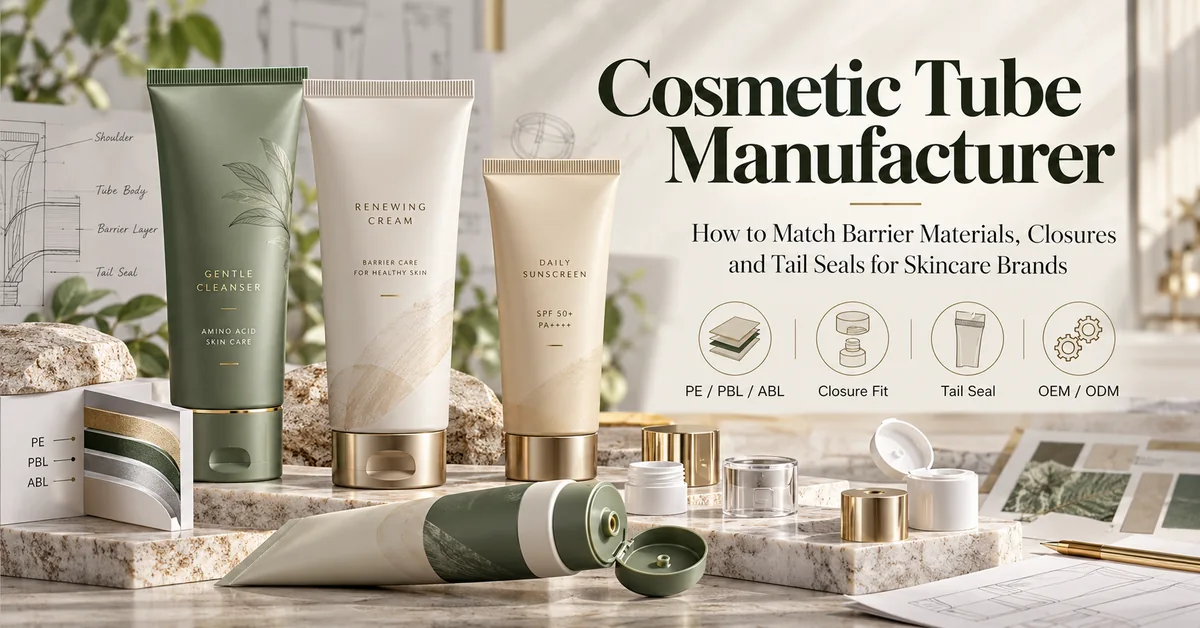
Choosing the right cosmetic tube manufacturer is an important decision for skincare brands developing creams, facial cleansers, sunscreens, gels, and personal-care products.
Although cosmetic tubes appear relatively simple, their performance depends on several interconnected factors: tube-wall construction, barrier properties, closure compatibility, dispensing behavior, filling conditions, and tail-sealing quality.
A tube that looks attractive in a product catalog may not provide sufficient protection for a particular formula. An incorrectly matched cap can cause leakage, while unsuitable tail-sealing conditions can create packaging failures during transportation.
The most effective sourcing approach is to evaluate the complete cosmetic tube system—including its materials, shoulder, dispensing opening, closure, and filled-end seal—before approving bulk production.
COSME Packaging, operated by Zhejiang Cosme Industry Co., Ltd., provides cosmetic packaging manufacturing, product development, mold customization, and OEM/ODM packaging services for international beauty and personal-care brands.
This guide explains how to choose suitable cosmetic tube structures, assess manufacturing requirements, reduce packaging failures, and prepare a technically complete inquiry for custom production.
1. What Should Buyers Expect From a Cosmetic Tube Manufacturer?
A professional cosmetic tube manufacturer should help buyers evaluate packaging suitability rather than simply provide empty tubes at a quoted price.
For skincare and personal-care applications, the purchasing decision should address six requirements:
-
Material selection: Identify a tube-wall structure compatible with the formulation.
-
Barrier performance: Determine whether protection against oxygen, moisture, or other factors is necessary.
-
Closure compatibility: Select a suitable cap, dispensing orifice, and shoulder structure.
-
Filling and sealing: Confirm compatibility with the intended filling equipment and tail-sealing process.
-
Quality assurance: Establish measurable requirements for dimensions, sealing, decoration, and finished packaging.
-
Customization: Define branding, printing, colors, tooling, and production quantities.
The appropriate packaging depends on the product's formulation, target market, positioning, and intended consumer experience.
Brands can review the COSME Cosmetic Soft Tubes collection to explore available packaging directions before requesting detailed specifications.
2. PE vs. PBL vs. ABL Cosmetic Tubes: Which Structure Should You Choose?
One of the most important technical decisions is selecting the tube-wall construction.
Different structures provide different combinations of flexibility, barrier performance, appearance, and manufacturing requirements.
PE Cosmetic Tubes
Polyethylene (PE) is widely used in flexible squeeze packaging.
PE tubes can be manufactured using different resin grades and single-layer or multilayer structures.
Their characteristics depend on the material formulation and wall construction.
They are commonly considered for:
-
Hand creams and body lotions.
-
Facial cleansers.
-
Moisturizing gels.
-
Hair-care products.
-
General personal-care applications.
A simple PE structure may be suitable when the formulation does not require additional specialized barrier protection.
However, material suitability must still be verified through formula compatibility testing.
PBL Cosmetic Tubes
PBL stands for Plastic Barrier Laminate.
PBL tubes use laminated plastic layers and may incorporate a specialized barrier layer, such as EVOH, depending on their construction.
This approach can provide a combination of flexible packaging, printable surfaces, and selected barrier characteristics.
PBL tubes may be considered for formulations requiring a carefully defined balance of product protection, decoration, and squeezing behavior.
However, not every PBL structure provides the same barrier properties.
Buyers should request the actual layer composition and supporting technical data.
ABL Cosmetic Tubes
ABL stands for Aluminum Barrier Laminate.
These tubes incorporate an aluminum barrier layer within a laminated structure.
ABL may be relevant when a formulation requires a more demanding barrier specification.
The aluminum layer can significantly influence oxygen, light, and moisture transmission, but the performance of the finished package also depends on seams, closures, material integrity, and manufacturing quality.
Cosmetic Tube Material Comparison
| Tube structure | General characteristics | Potential applications | Critical buyer checks |
|---|---|---|---|
| Single-layer PE | Flexible plastic structure | Creams, cleansers, general skincare | Formula compatibility, wall design |
| Multilayer PE | Multiple polymer layers | Selected skincare and personal-care products | Exact resin composition |
| PBL | Laminated plastic construction | Skincare requiring specified barrier performance | Layer structure, oxygen barrier, side seam |
| ABL | Aluminum-containing laminate | Products requiring stronger barrier consideration | Foil integrity, compatibility, laminate seals |
| PCR-containing plastic tube | Incorporates recycled plastic content | Brands pursuing recycled-material packaging | PCR percentage, material suitability, traceability |
These comparisons describe general packaging structures, not guaranteed performance specifications for every COSME product.
The correct material should be selected according to the formula's actual protection requirements, not simply because one structure is marketed as premium.
3. How Do Barrier Materials Affect Cosmetic Formula Stability?
Barrier performance describes a material's resistance to the transmission of substances such as oxygen or water vapor.
Different formulations have different sensitivities.
A basic cleansing gel may have different packaging requirements from a cream containing ingredients sensitive to environmental exposure.
Understanding OTR and WVTR
Two commonly discussed material measurements are:
Oxygen Transmission Rate (OTR)
OTR measures the rate at which oxygen passes through a material under defined conditions.
It can help evaluate packaging materials when oxygen exposure is relevant to formulation stability.
Water Vapor Transmission Rate (WVTR)
WVTR describes moisture transmission through a material.
It may be relevant when moisture gain or loss could affect product characteristics during storage.
However, OTR and WVTR results depend on test conditions, including temperature, humidity, material thickness, and construction.
Why Barrier Data Alone Is Insufficient
A tube may use a barrier material but still experience problems at the shoulder, cap, side seam, or tail seal.
Therefore, brands should evaluate the complete filled packaging system.
For formulations containing sensitive ingredients, the product-development team should establish suitable stability and compatibility testing requirements.
A barrier layer does not guarantee that a skincare formula will remain stable throughout its intended shelf life.
4. How Should Cosmetic Tube Closures Be Selected?
The closure system affects dispensing convenience, leakage resistance, consumer experience, and overall appearance.
Different formulations may require different opening sizes and cap structures.
Cosmetic Tube Closure Comparison
| Closure type | Typical use | Main advantage | Technical consideration |
|---|---|---|---|
| Flip-top cap | Cleansers, lotions, creams | Convenient repeated opening | Hinge performance, sealing |
| Screw cap | Creams, gels, selected treatments | Secure threaded closure | Thread fit, sealing interface |
| Small-orifice nozzle | Targeted skincare applications | More controlled product placement | Flow rate, clogging |
| Specialized applicator | Selected beauty or treatment products | Application-specific dispensing | Formula and applicator compatibility |
A thick cream may require a different dispensing opening from a lightweight gel.
An opening that is too small can make dispensing difficult, while an unsuitable opening may allow excessive product release.
Why Cap and Shoulder Compatibility Matters
The tube shoulder connects the flexible body to the dispensing neck.
Its dimensions and sealing interface must match the closure.
Potential problems include:
-
Incorrect thread engagement.
-
Inconsistent closure fit.
-
Leakage around the neck.
-
Damage caused by excessive assembly force.
-
Difficulty opening or closing the cap.
Buyers should request drawings or physical samples when confirming custom closures.
COSME's custom cosmetic tube with flip-top cap provides an example of a packaging direction combining a flexible tube body with a flip-top closure.
Exact available dimensions and component specifications should be confirmed before production.
5. Why Is Tail Sealing Critical in Cosmetic Tube Manufacturing?
Tail sealing is among the most important quality-control points for squeeze tubes.
Many cosmetic tubes are supplied with an open filling end.
After the formulation is introduced, the filling operation closes the tail using a sealing process appropriate to the tube material and equipment.
If this process is not correctly controlled, the finished package may leak during handling, squeezing, or transportation.
Common Tail-Sealing Problems
| Potential defect | Possible contributing factor | Recommended verification |
|---|---|---|
| Weak tail seal | Unsuitable sealing conditions | Seal-strength evaluation |
| Incomplete seal | Misalignment or insufficient bonding | Visual and integrity inspection |
| Burned or distorted tail | Excessive thermal exposure | Sealing-process adjustment |
| Uneven sealing | Equipment alignment or material variation | Dimensional and appearance checks |
| Formula contamination at seal | Product entering the sealing area | Review filling process |
| Leakage after squeezing | Seal weakness or excessive internal stress | Filled-tube functional testing |
Heat Sealing and Ultrasonic Sealing
Different tube constructions and filling equipment may use different sealing technologies.
Heat-based methods rely on controlled thermal energy and pressure to bond compatible materials.
Ultrasonic systems use mechanical energy to create localized heat at suitable sealing interfaces.
The correct method depends on the laminate construction, sealant material, tube geometry, and filling process.
A sealing method should not be selected solely because it is faster.
How Should Seal Strength Be Evaluated?
ASTM F88/F88M-23, Standard Test Method for Seal Strength of Flexible Barrier Materials, provides a recognized approach to measuring the strength of suitable flexible-material seals.
Where the material and test geometry permit, this method may help develop a seal-strength evaluation procedure.
However, seal strength and leakage resistance are not identical measurements.
A strong seal can still contain localized defects, so a complete assessment may require additional integrity and functional checks.
Buyers should agree on the applicable procedure and acceptance criteria before production.
6. How Do Filling Conditions Affect Cosmetic Tube Performance?
A cosmetic tube must be compatible with the product and the filling equipment.
Problems often arise when packaging is selected without considering the actual filling process.
Key Filling Compatibility Factors
Formula viscosity: Thick creams and gels may require different filling settings from lightweight lotions.
Filling temperature: Some formulations are filled at temperatures different from normal storage conditions. The tube materials and sealing process must tolerate the intended operation.
Tube dimensions: Tube diameter and length influence filling equipment compatibility, handling, and finished presentation.
Tail-sealing area: The filling process should avoid contamination of surfaces intended for sealing.
Filling accuracy: The intended fill quantity must be compatible with the tube's usable capacity and required sealing allowance.
Why Production Trials Matter
A tube that performs acceptably during manual filling may behave differently on an automated production line.
Before large-volume purchasing, skincare brands and contract manufacturers should consider production-representative filling trials.
These trials can help verify filling accuracy, closure performance, tail sealing, leakage resistance, and finished appearance.
7. Custom Cosmetic Tube Design: Printing, Colors, and OEM Options
For beauty brands, the tube body is an important communication surface.
Custom printing and finishing can help distinguish product types, create coordinated packaging collections, and improve brand recognition.
Common customization directions include:
-
Brand color matching.
-
Logo and product information printing.
-
Matte or glossy finishes.
-
Selected metallic decorative effects.
-
Tube diameter and length variations.
-
Closure color and style selection.
The suitability of each option depends on the material and manufacturing process.
Extruded vs. Laminated Tube Decoration
Extruded plastic tubes and laminated tubes may use different decoration workflows.
For laminated tubes, graphics may be printed on the web before it is formed into the tube body.
Other tube formats may be decorated after forming.
The manufacturer should confirm the actual production process and artwork requirements.
Why Artwork Approval Is Essential
Brands should verify:
-
Artwork dimensions and positioning.
-
Text readability on curved surfaces.
-
Color consistency.
-
Printing adhesion.
-
Surface abrasion resistance.
-
Alignment between tube body and cap.
COSME's cosmetic soft tube packaging examples illustrate different visual styles and closure directions for skincare and personal-care applications.
A production sample should be approved before bulk manufacturing.
8. Cosmetic Tube Quality Control: What Should Buyers Inspect?
A cosmetic tube manufacturer should establish quality requirements for both individual components and finished packaging.
The relevant testing depends on the material, formulation, and filling process.
Cosmetic Tube Quality Inspection Matrix
| Inspection area | Recommended check | Risk addressed |
|---|---|---|
| Material identity | Verify declared material construction | Incorrect packaging material |
| Tube dimensions | Check diameter, length, and critical tolerances | Filling-line incompatibility |
| Tube wall | Evaluate consistency and visible defects | Mechanical or appearance problems |
| Shoulder connection | Inspect bonding and component fit | Leakage or separation |
| Closure | Check fit, sealing, and operation | Product leakage |
| Tail seal | Evaluate strength and integrity | Filled-end leakage |
| Formula compatibility | Test the finished formulation with the package | Swelling, deterioration, instability |
| Decoration | Inspect artwork, color, and adhesion | Poor retail appearance |
| Transport packaging | Evaluate finished shipping units | Damage during distribution |
For distribution evaluation, ASTM D4169-23e1 provides a recognized framework for performance testing of shipping containers and systems.
The appropriate test sequence should reflect the actual shipping environment.
These standards are technical references for developing quality plans. They do not indicate that every COSME tube has been tested or certified under them.
9. How Do Material and Design Choices Affect Cosmetic Tube Pricing?
The final cost of cosmetic tubes depends on the complete packaging configuration.
Unit pricing should be evaluated alongside technical performance and production requirements.
Main Cost Factors
| Cost factor | Purchasing implication |
|---|---|
| Tube material | Different resins and laminate structures affect material cost |
| Barrier requirements | Specialized layers may increase complexity |
| Tube dimensions | Diameter, length, and material consumption affect cost |
| Closure system | Standard and custom components have different costs |
| Decoration | Printing processes and color requirements affect production |
| Tooling | New structural components may require development investment |
| Order quantity | Production setup and material procurement affect pricing |
| Quality requirements | Additional validation may influence project cost |
Existing Packaging vs. Custom Development
Using an existing tube design with personalized printing may avoid some new tooling costs.
A fully customized structure can require additional engineering, sampling, and tooling.
For brands introducing multiple products, standardizing compatible tube families may help simplify packaging management.
However, standardization should not compromise formula compatibility or dispensing performance.
The lowest quoted unit price is not always the lowest total packaging cost.
10. What Should You Ask a Cosmetic Tube Manufacturer Before Ordering?
A clear technical inquiry helps prevent quotation differences and unnecessary development delays.
Cosmetic Tube RFQ Specification Checklist
| RFQ field | Information to provide |
|---|---|
| Application | Hand cream, facial cleanser, sunscreen, lotion, or other product |
| Formula characteristics | Viscosity, relevant ingredients, filling conditions |
| Target capacity | Required fill quantity |
| Tube material | PE, PBL, ABL, or performance-based requirement |
| Barrier requirements | Relevant oxygen, moisture, or other protection needs |
| Tube dimensions | Diameter, length, preferred shape |
| Closure | Flip-top, screw cap, dispensing opening |
| Decoration | Artwork, colors, printing, finish |
| Filling process | Equipment and sealing requirements |
| Order quantity | Initial demand and expected repeat orders |
| Quality requirements | Samples, compatibility, seal, leakage tests |
| Delivery | Destination and project schedule |
Buyers should also ask whether the manufacturer can provide material specifications, drawings, samples, and relevant inspection documentation.
A complete inquiry allows both parties to discuss production feasibility before finalizing commercial terms.
11. Why Consider COSME Packaging as Your Cosmetic Tube Manufacturer?
COSME Packaging is operated by Zhejiang Cosme Industry Co., Ltd., a China-based cosmetic packaging manufacturer established in 2015.
The company provides packaging research and development, mold development, plastic manufacturing, decorative finishing, and OEM/ODM customization services.
According to its published company information, COSME operates an approximately 15,000-square-meter facility with molding equipment and quality inspection processes.
Its product categories include Cosmetic Soft Tubes, PBL Cosmetic Tubes, ABL Cosmetic Tubes, PCR Cosmetic Tubes, and Biodegradable Cosmetic Tubes.
These categories represent packaging directions. Specific material structures, production availability, sizes, MOQ, and barrier performance must be confirmed for each proposed project.
Relevant company-level capabilities include:
-
Packaging R&D: Product design and technical development.
-
Mold development: Engineering drawings, prototypes, and tooling support.
-
OEM/ODM customization: Colors, logos, printing, and selected packaging structures.
-
Quality management: Incoming material checks, production inspection, finished-product checks, and batch records.
For additional information, explore COSME's manufacturing capabilities and its cosmetic tube product selection.
For a project-specific quotation, provide your formulation requirements, intended tube structure, closure preference, artwork, and purchasing quantity through the COSME Packaging contact page.
12. Frequently Asked Questions About Cosmetic Tube Manufacturing
1. What is the difference between PE, PBL, and ABL cosmetic tubes?
PE tubes use polyethylene-based structures, while PBL tubes use laminated plastic layers that may incorporate specialized barriers. ABL tubes include an aluminum barrier layer. The correct choice depends on formula compatibility, barrier requirements, appearance, and manufacturing conditions.
2. Which cosmetic tube material is best for skincare creams?
There is no universal best material. Many creams can use suitable PE structures, while other formulations may require more specialized barriers. Material selection should be confirmed through technical review and formula compatibility testing.
3. Can a cosmetic tube manufacturer provide custom printing and logos?
Yes, cosmetic tube customization may include colors, logos, printed graphics, and selected finishes. The available processes depend on the tube material, construction, artwork, and manufacturing requirements.
4. What is the typical MOQ for custom cosmetic tubes?
MOQ depends on tube dimensions, material construction, decoration, closure selection, and tooling requirements. COSME does not publish one universal MOQ for every tube type. Request a quotation based on your specifications.
5. Are PBL tubes always better than PE tubes?
No. PBL and PE structures serve different requirements. Some PE tubes are suitable for general skincare applications, while selected PBL constructions provide additional barrier properties. The formula and project requirements determine the appropriate choice.
6. How can I prevent cosmetic tube tail-seal leakage?
Select a compatible tube material and sealing method, control filling and sealing conditions, prevent contamination of the sealing area, and validate representative filled tubes. Seal-strength measurements and package integrity testing may both be necessary.
7. Can cosmetic tubes be used for sunscreen packaging?
Yes, appropriate cosmetic tubes may be used for sunscreen formulations. However, compatibility with the specific formula, filling process, and intended storage conditions must be verified. Packaging must not be assumed to provide sufficient light protection based only on its general material category.
8. Are PCR cosmetic tubes suitable for sustainable skincare packaging?
PCR-containing tubes may support recycled-material packaging objectives. Buyers should confirm recycled-content percentage, material traceability, formulation compatibility, and suitability for the relevant recycling system. PCR content alone does not guarantee that the finished tube is recyclable.
9. What testing should be completed before placing a bulk cosmetic tube order?
Relevant evaluations include dimensional inspection, closure fit, formula compatibility, tail-seal strength, leakage resistance, decoration quality, and transport performance. The precise requirements should be agreed before production approval.
10. How do I request cosmetic tube samples from a manufacturer?
Provide your product type, target capacity, material preference, dispensing requirements, artwork, filling conditions, and estimated purchase quantity. The supplier can then discuss suitable packaging options and sample availability.
13. Conclusion
Choosing the right cosmetic tube manufacturer requires balancing packaging appearance, material performance, dispensing functionality, manufacturing feasibility, and total procurement cost.
For skincare brands and cosmetic OEM/ODM manufacturers, the most important decision is not simply whether a tube is made from PE, PBL, or ABL. It is whether the complete packaging structure is compatible with the intended formulation, filling process, closure system, and commercial distribution requirements.
Barrier materials, cap fit, shoulder construction, and tail-sealing performance should be evaluated together before bulk production.
By preparing clear technical specifications, validating representative samples, and establishing appropriate quality criteria, buyers can reduce packaging failures and improve long-term supply consistency.
With its published capabilities in cosmetic packaging development, customization, manufacturing, and quality control, COSME Packaging provides a potential manufacturing partner for international skincare and personal-care brands.
Whether you need custom cosmetic squeeze tubes for creams, cleansers, sunscreens, gels, or private-label skincare products, contact COSME Packaging with your product specifications, target quantity, and customization requirements to discuss suitable tube packaging solutions and request a project-specific quotation.