
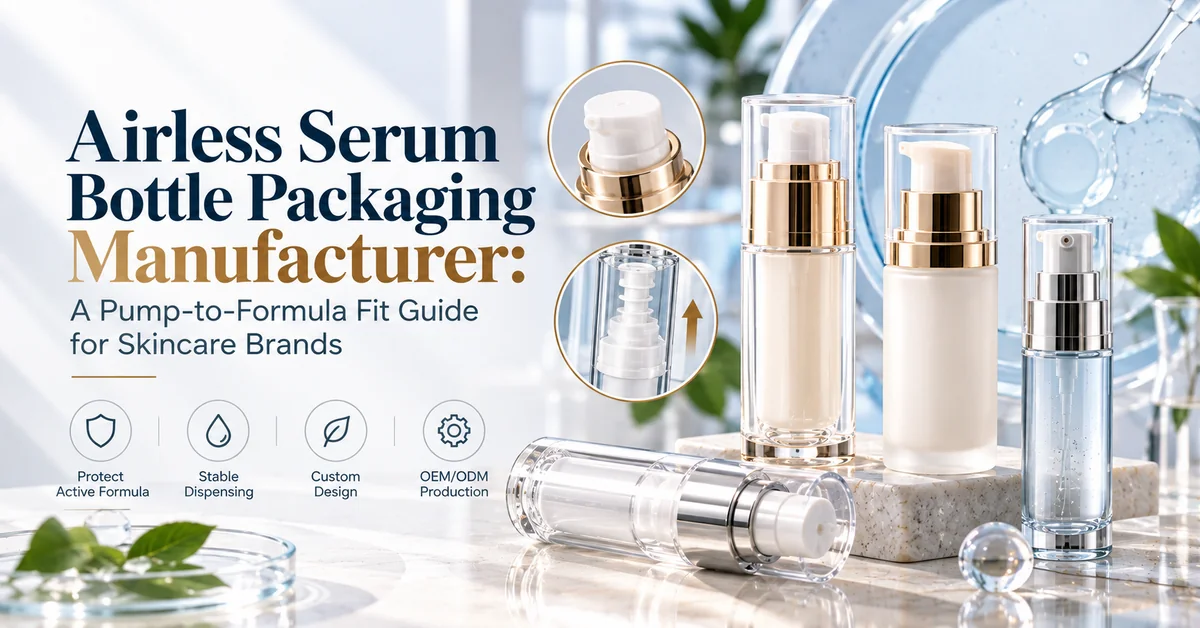
Choosing the right airless serum bottle packaging manufacturer is not simply about finding an elegant container with a premium pump. For skincare brands, cosmetic OEM/ODM companies, and packaging procurement teams, the challenge is ensuring that the bottle works reliably with the actual serum formulation.
Two airless bottles may look nearly identical but behave differently during filling, priming, dispensing, storage, and transportation. A lightweight serum may flow smoothly through one pump, while a thicker gel serum may produce inconsistent output or leave excessive product inside the reservoir.
These differences directly affect consumer experience, manufacturing efficiency, and packaging costs.
The most reliable sourcing approach is to match the complete airless dispensing system to the serum's formulation, viscosity, desired dose, filling process, and stability requirements before approving bulk production.
COSME Packaging, operated by Zhejiang Cosme Industry Co., Ltd., provides cosmetic packaging manufacturing, mold development, and OEM/ODM customization for international beauty and personal-care brands.
This guide explains how to evaluate airless serum packaging from technical selection through sample validation and commercial production.
1. What Should Skincare Brands Expect From an Airless Serum Bottle Packaging Manufacturer?
An airless serum bottle packaging manufacturer should provide more than visually appealing bottles. The supplier should help buyers identify suitable packaging configurations and establish requirements for functional validation.
For serum applications, six factors deserve particular attention:
-
Verified airless dispensing structure: Confirm how the mechanism limits replacement air entering the product reservoir.
-
Formula compatibility: Evaluate the actual serum against all relevant product-contact materials.
-
Pump dispensing performance: Measure priming, output consistency, and operation throughout product use.
-
Filling compatibility: Confirm whether the system can be filled and assembled using the intended production process.
-
Quality control: Define leakage, appearance, dimensional, and functional acceptance criteria.
-
OEM/ODM feasibility: Clarify available customization, tooling requirements, component sourcing, and commercial terms.
For professional buyers, these requirements are more important than the appearance of a product photograph.
A manufacturer may offer attractive packaging designs, but performance should be verified using production-representative samples.
Brands can begin exploring different packaging formats through COSME's airless bottle product collection.
2. How Do Airless Serum Bottles Actually Work?
Airless packaging is designed to dispense product while reducing the need for outside air to replace the volume removed from the product reservoir.
Unlike many conventional pump bottles, which use a dip tube and allow replacement air into the container, certain airless systems use a moving piston or collapsible internal reservoir.
However, airless packaging is not a single standardized mechanism.
Piston-Based Airless Bottles
A piston-based design contains a movable piston beneath the formulation.
As the pump dispenses serum, the piston advances to compensate for the volume removed.
This mechanism can limit repeated air exchange inside the product chamber when correctly designed and assembled.
Important engineering considerations include piston fit, reservoir dimensions, sealing performance, and movement resistance.
Collapsible Pouch Systems
Some airless packages contain a flexible internal pouch.
As serum is dispensed, the pouch contracts while an external structure maintains the package's overall shape.
This architecture creates different material and filling requirements from a piston-based system.
Its performance depends on pouch construction, pump integration, compatibility, and controlled collapse.
Airless vs. Conventional Serum Packaging
| Packaging system | Dispensing principle | Potential benefit | Main technical concern |
|---|---|---|---|
| Piston airless bottle | Moving piston reduces reservoir volume | Limits replacement air entry during use | Piston movement and sealing |
| Collapsible pouch system | Flexible reservoir contracts during dispensing | Separates product reservoir from outer housing | Pouch compatibility and collapse |
| Conventional pump bottle | Dip tube draws serum from a rigid bottle | Familiar, convenient dispensing | Air exchange and pump compatibility |
| Dropper bottle | Pipette and bulb withdraw liquid | Adjustable small-volume application | Repeated opening, sealing, dose variability |
These are general packaging architectures, not confirmed specifications for every COSME product.
Airless does not mean oxygen-free, sterile, or preservative-free.
Air can be present during manufacturing and filling, while material permeability and dispensing-system design may influence subsequent exposure.
The packaging must therefore be evaluated as part of the finished product's stability and preservation strategy.
3. Which Serum Formulations Are Suitable for Airless Packaging?
Different cosmetic serums have different flow behaviors, ingredient sensitivities, and dispensing requirements.
A packaging system suitable for one formula may not be suitable for another.
Airless Packaging Selection by Serum Type
| Serum application | Packaging objective | Critical validation |
|---|---|---|
| Lightweight hydrating serum | Smooth, controlled dispensing | Priming and dose consistency |
| Gel-based serum | Reliable flow through the pump | Viscosity and pump recovery |
| Vitamin C serum | Manage relevant environmental exposure | Formula-specific stability and compatibility |
| Retinol skincare serum | Support the formulation's protection strategy | Light exposure, stability, and material interaction |
| Oil-rich facial serum | Compatible materials and dispensing | Oil-related swelling, sealing, and leakage |
| Emulsion serum | Consistent delivery of the formulated product | Rheology, separation, and dispensing |
| Premium treatment serum | Controlled application and retail presentation | Dose repeatability and finished appearance |
Why viscosity alone is not enough
Viscosity describes resistance to flow, but many cosmetic formulations behave differently under different shear conditions.
A gel serum may appear relatively thick at rest but flow more readily when subjected to mechanical force.
Other formulations may exhibit structural recovery after pumping.
Therefore, a single viscosity number does not always predict dispensing performance.
Where available, buyers should provide viscosity data together with the measurement temperature, test conditions, and relevant formulation characteristics.
What about sensitive active ingredients?
Airless packaging may help reduce repeated air entry during normal dispensing, but it cannot guarantee the stability of vitamin C, retinoids, or other active ingredients.
Formulation composition, oxygen exposure during filling, light, temperature, pH, and packaging materials may all affect stability.
For sensitive formulations, the selected airless bottle must be assessed through product-specific studies.
4. Technical Specifications to Confirm Before Ordering Airless Serum Bottles
A professional packaging inquiry should define the functional requirements of the complete bottle system.
The following table can serve as a technical specification template.
Airless Serum Bottle Technical Specification Checklist
| Parameter | Requirement to define | Why it matters |
|---|---|---|
| Nominal fill volume | Required commercial fill quantity | Determines packaging selection |
| Usable capacity | Effective product-containing volume | Supports filling and dosing |
| Airless mechanism | Piston, pouch, or other verified structure | Establishes dispensing principle |
| Pump output | Target dose per actuation | Influences application experience |
| Priming behavior | Acceptable initial actuations | Affects first-use performance |
| Formula viscosity | Relevant flow characteristics | Determines pump suitability |
| Product-contact materials | Reservoir, seals, pump components | Supports compatibility testing |
| Evacuation performance | Acceptable residual product | Influences usable product recovery |
| Sealing performance | Leakage acceptance criteria | Supports storage and transportation |
| Filling method | Required equipment and sequence | Determines production feasibility |
| Bottle dimensions | Height, diameter, critical interfaces | Supports filling-line compatibility |
| Decoration | Color, printing, finish, logo | Establishes brand appearance |
Specific numeric limits should be agreed for the selected project. COSME's public product descriptions do not establish universal pump output, capacity, or evacuation values for every available airless design.
Why pump output matters
Pump output refers to the amount of product delivered during a dispensing actuation.
A serum intended for precise facial application may require a different dispensing experience from a thicker moisturizer.
The desired amount should be defined by the brand's product-development team and validated through testing.
It should not be assumed that all visually similar airless pumps deliver the same quantity.
5. How Should Airless Serum Pump Performance Be Tested?
Pump testing is one of the most important approval stages when sourcing airless serum packaging.
Testing should use the intended formulation or a technically justified representative material, with final confirmation using the commercial formula.
Pump Priming
Priming measures how the dispenser begins delivering product.
For example, an engineering team may record the number of actuations required before consistent dispensing begins.
A pump that requires excessive priming may create a poor first-use experience.
Test conditions should define the filling procedure, storage orientation, temperature, and acceptable priming behavior.
Dose Consistency
Pump output should be evaluated across repeated actuations and representative samples.
One practical approach is to collect a specified number of doses and measure the total dispensed mass.
The average delivered mass is calculated as:
Average dose mass = Total collected serum mass ÷ Number of measured actuations
Where volume is required, conversion must account for the product's density under the relevant conditions.
Measurements should be taken after priming and at defined stages during the package's usable life.
Product Evacuation
Evacuation testing evaluates how much product can be dispensed before the system reaches its functional endpoint.
Residual serum can affect consumer perception of product value.
A useful evaluation records the original filled quantity, the amount dispensed, and the remaining product.
The actual calculation method and treatment of product losses should be agreed in advance.
Actuation Reliability
Repeated-use testing examines whether the pump maintains acceptable operation throughout the intended dispensing cycle.
Watch for changes in actuation force, inconsistent output, delayed pump recovery, or loss of prime.
A single successful pump stroke does not demonstrate full-life dispensing performance.
For more general supplier qualification and factory inspection considerations, review COSME's airless bottle manufacturing quality control guide.
6. Why Filling-Line Compatibility Must Be Verified Early
An airless serum bottle can perform well during manual sample testing yet create difficulties during automated filling.
The filling procedure depends on the internal mechanism and the manufacturer's specified assembly method.
Important considerations include:
-
Filling orientation and nozzle positioning.
-
Required fill quantity and permitted variation.
-
Air entrapment and foaming behavior.
-
Filling speed and pressure.
-
Product temperature during filling.
-
Pump or piston assembly sequence.
-
Line handling and bottle stability.
Air Entrapment and Priming Problems
Entrapped air may affect how the product is initially dispensed.
Some formulations are more prone to foaming or air incorporation during transfer.
The packaging engineer and filling partner should evaluate whether the selected bottle design requires special filling or assembly procedures.
Filling Temperature
Temperature can affect serum viscosity and dispensing behavior.
If the filling process operates at a different temperature from normal consumer use, compatibility should be assessed under relevant conditions.
The same applies to formulas whose properties change significantly during cooling or storage.
Production-Line Trial
Before commercial launch, consider a representative filling trial using the proposed packaging and finished formula.
The trial should verify filling accuracy, assembly, leakage, line handling, and dispensing behavior after filling.
It is generally less costly to resolve these issues during development than after a large packaging order has been manufactured.
7. Formula Stability and Packaging Compatibility
A packaging material may appear suitable in a generic compatibility chart but behave differently when exposed to a particular finished serum.
Potential interactions can include:
-
Changes in material appearance or dimensions.
-
Swelling or deterioration of seals.
-
Changes in product color, odor, or consistency.
-
Adsorption or migration of formulation components.
-
Product loss through leakage or permeation.
-
Changes in pump operation after storage.
Testing should include the complete packaging assembly rather than only the bottle body.
Stability Testing Guidance
ISO/TR 18811:2018, Cosmetics — Guidelines on the Stability Testing of Cosmetic Products, provides a technical framework for selecting stability evaluation methods.
It does not establish one universal stability protocol for all cosmetic products.
Instead, the responsible product manufacturer should define and justify test conditions appropriate to the formulation and intended distribution environment.
For airless serum packaging, this may involve evaluating the filled product under relevant storage conditions while monitoring both formulation stability and dispenser functionality.
The selected package should continue to function acceptably after storage—not only immediately after filling.
Packaging Is Not a Substitute for Product Safety
Reduced air entry does not eliminate the need for suitable preservation, microbiological evaluation, or finished-product safety assessment.
These requirements remain the responsibility of the relevant product-development and compliance teams.
8. Common Airless Serum Packaging Problems and How to Prevent Them
Understanding failure modes helps buyers develop better testing criteria before approving production.
| Potential problem | Possible contributing factor | Recommended buyer action |
|---|---|---|
| Inconsistent serum output | Pump and formula mismatch | Evaluate dose variation with actual serum |
| Difficult priming | Air entrapment or filling issues | Review filling and priming procedures |
| Excessive residual product | Incomplete piston or pouch movement | Conduct full-life evacuation testing |
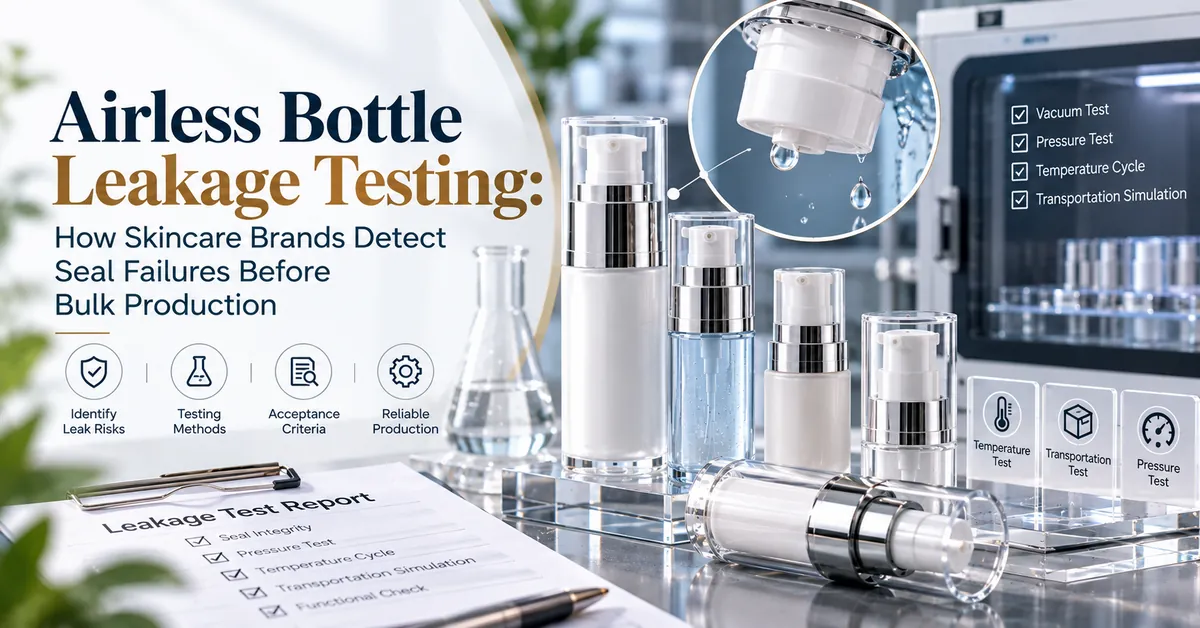
| Leakage during shipping | Seal or assembly problems | Test complete filled packages |
| Pump blockage | Formula texture or narrow flow path | Verify dispensing over time |
| Piston sticking | Friction, dimensional variation, incompatibility | Inspect components and functional samples |
| Appearance defects | Molding or decoration inconsistency | Approve visual standards and inspection limits |
| Stability changes | Formula-packaging interaction | Conduct compatibility and stability studies |
These are possible engineering causes, not diagnoses of any specific COSME product.
A structured failure analysis should compare passing and failing samples, record the test conditions, and identify the actual cause before implementing corrective action.
9. Materials, Decoration, and OEM Airless Serum Packaging Design
Skincare brands often want packaging that communicates product quality while creating a consistent brand identity.
COSME offers packaging development, material options, color matching, printing, and decorative finishing services.
However, the exterior appearance and functional inner reservoir may involve different materials.
For example, a premium-looking outer housing should not automatically be treated as the product-contact component.
Buyers should distinguish between:
-
Primary reservoir: The part that contains the serum.
-
Dispensing components: Pump, seals, valves, and related mechanisms.
-
External housing: Components contributing to appearance and handling.
-
Decoration: Color, logo, surface finish, and visual details.
This distinction matters when discussing material compatibility, recycled content, and customization.
Existing Design vs. Custom Development
| Development route | Main benefit | Key consideration |
|---|---|---|
| Existing airless bottle design | Potentially avoids new bottle tooling | Confirm available mechanism and specifications |
| Custom color and decoration | Creates differentiated branding | Verify finishing compatibility and MOQ |
| Customized external components | Supports distinctive appearance | Check assembly and functional interfaces |
| New structural tooling | Supports an original packaging concept | Additional development and validation |
COSME's published OEM/ODM process includes 3D design, CNC sampling, mold development, trial samples, and commercial manufacturing.
Explore the company's airless serum and skincare bottle options to identify suitable design directions.
10. What Quality Documents Should Buyers Request?
Before confirming bulk manufacturing, buyers should establish an approval package containing the relevant technical and commercial records.
Recommended documents include:
-
Approved bottle and pump specifications.
-
Product-contact material information.
-
Relevant engineering drawings.
-
Confirmed filling and assembly instructions.
-
Approved decorated reference samples.
-
Functional and leakage test requirements.
-
Applicable inspection and acceptance criteria.
-
Batch identification and traceability expectations.
ISO 2859-1:2026 provides an established framework for attribute-based acceptance sampling. Buyers and suppliers can use an appropriate agreed sampling plan when developing lot inspection requirements.
However, applying a sampling framework does not replace compatibility or functional testing.
The inspection plan should reflect the actual risks of the product and packaging system.
11. Why Consider COSME Packaging for Airless Serum Bottles?
COSME Packaging, operated by Zhejiang Cosme Industry Co., Ltd., is a China-based cosmetic packaging manufacturer established in 2015.
According to its published company information, COSME operates an approximately 15,000-square-meter factory and provides packaging R&D, mold development, plastic molding, decoration, and quality inspection services.
Its documented capabilities include:
-
Packaging research and product-development support.
-
3D drawings, CNC prototypes, and mold development.
-
Injection- and blow-molding processes.
-
Color matching, silk-screen printing, and decorative finishing.
-
Incoming material, dimensional, leakage, and printing inspections.
-
Batch-related quality records.
These capabilities are relevant to customized cosmetic packaging projects.
However, the exact airless pump architecture, materials, dispensing performance, available capacities, MOQ, and lead time must be confirmed for the selected packaging configuration.
Buyers can review COSME's manufacturing and quality control information before discussing project-specific requirements.
12. What Affects Airless Serum Bottle Packaging Cost?
The total cost of airless serum packaging depends on the complete assembled system rather than the outer bottle alone.
Key factors include pump complexity, reservoir materials, component count, decoration, tooling, quality requirements, and order quantity.
For example, a customized exterior finish may increase decoration costs, while a new structural design may require tooling development and additional validation.
Some projects can use existing packaging designs. Others require engineering changes to achieve specific dispensing or branding requirements.
Buyers should request an itemized quotation covering applicable components, samples, tooling, decoration, testing, production quantities, and shipping terms.
Prepare a Serum-Specific Packaging Inquiry
For a more effective technical discussion, provide:
-
Serum type and relevant formulation characteristics.
-
Target fill volume and desired dispensing behavior.
-
Viscosity information and filling conditions.
-
Preferred materials and external appearance.
-
Requirements for pump output, leakage, and evacuation.
-
Initial order quantity and annual demand forecast.
-
Destination market and planned launch schedule.
-
Required samples and validation documentation.
A detailed inquiry allows the supplier to assess the proposed packaging against the intended application instead of providing only a generic product price.
If you are developing a skincare serum and need airless packaging, contact COSME Packaging to discuss available designs, customization requirements, samples, and a project-specific quotation.
13. Frequently Asked Questions About Airless Serum Bottle Packaging
1. What is the advantage of an airless pump bottle for serum?
A properly designed airless system can reduce the need for replacement air to enter the product reservoir during dispensing. It may also support convenient, controlled product application. The actual benefit depends on the formula and packaging design.
2. Are airless serum bottles suitable for vitamin C products?
They may be suitable for certain vitamin C formulations, but airless dispensing does not guarantee chemical stability. Evaluate the finished formulation for compatibility, oxygen-related changes, light sensitivity, and storage performance.
3. Can thick gel serums be packaged in airless bottles?
Potentially, yes. The pump must be compatible with the formula's viscosity and flow behavior. Testing should cover priming, dose consistency, pump recovery, and product evacuation.
4. What pump output should I choose for a facial serum?
The appropriate output depends on the intended application amount and user experience. There is no universal dose suitable for all serums. Establish a target with the product-development team and verify it through representative testing.
5. What is the typical MOQ for custom airless serum bottles?
MOQ varies by bottle design, components, material, color, decoration, and tooling requirements. COSME does not publish one universal MOQ for every airless bottle configuration. Request a project-specific quotation.
6. Can an airless serum bottle be customized with my brand logo?
Many cosmetic packaging projects can incorporate custom colors, logo printing, and selected decorative finishes. Available options depend on the bottle material, geometry, and manufacturing requirements.
7. How can I tell whether a serum bottle is genuinely airless?
Request confirmation of the internal dispensing mechanism, ideally through technical drawings and representative functional samples. A pump-shaped exterior or premium appearance alone does not establish airless operation.
8. Why does an airless pump sometimes stop dispensing before the bottle is empty?
Possible causes include incomplete priming, mechanism limitations, piston or pouch movement issues, formula incompatibility, or residual product that cannot be evacuated. Proper diagnosis requires testing the exact filled packaging system.
9. What testing should be completed before ordering airless serum bottles in bulk?
Relevant testing may include formula compatibility, pump priming, output consistency, leakage, product evacuation, storage stability, and filling-line trials. The specific acceptance criteria should be documented before mass production approval.
10. How do I request samples from an airless serum bottle packaging manufacturer?
Provide the intended serum application, target volume, formula characteristics, desired dispensing performance, packaging appearance, and expected purchasing quantity. The supplier can then discuss suitable configurations and sample arrangements.
14. Conclusion
Choosing the right airless serum bottle packaging manufacturer requires a clear understanding of the relationship between the serum formulation, dispensing mechanism, filling process, and finished packaging quality.
For skincare brands and cosmetic OEM/ODM manufacturers, the most important decision is not simply whether a bottle is marketed as airless. It is whether the complete packaging system can dispense the intended formula consistently, maintain acceptable performance after storage, support production filling, and meet agreed quality requirements.
Pump output, priming, material compatibility, leakage resistance, and product evacuation should be evaluated before committing to bulk production.
With its published capabilities in cosmetic packaging development, mold manufacturing, decoration, and quality control, COSME Packaging provides a potential partner for customized airless skincare packaging projects.
Whether you are developing a lightweight hydrating serum, a premium treatment formulation, or a new private-label skincare range, contact COSME Packaging with your formulation requirements, target capacity, desired dispensing performance, and purchasing plans to discuss suitable airless bottle solutions and request a quotation.