
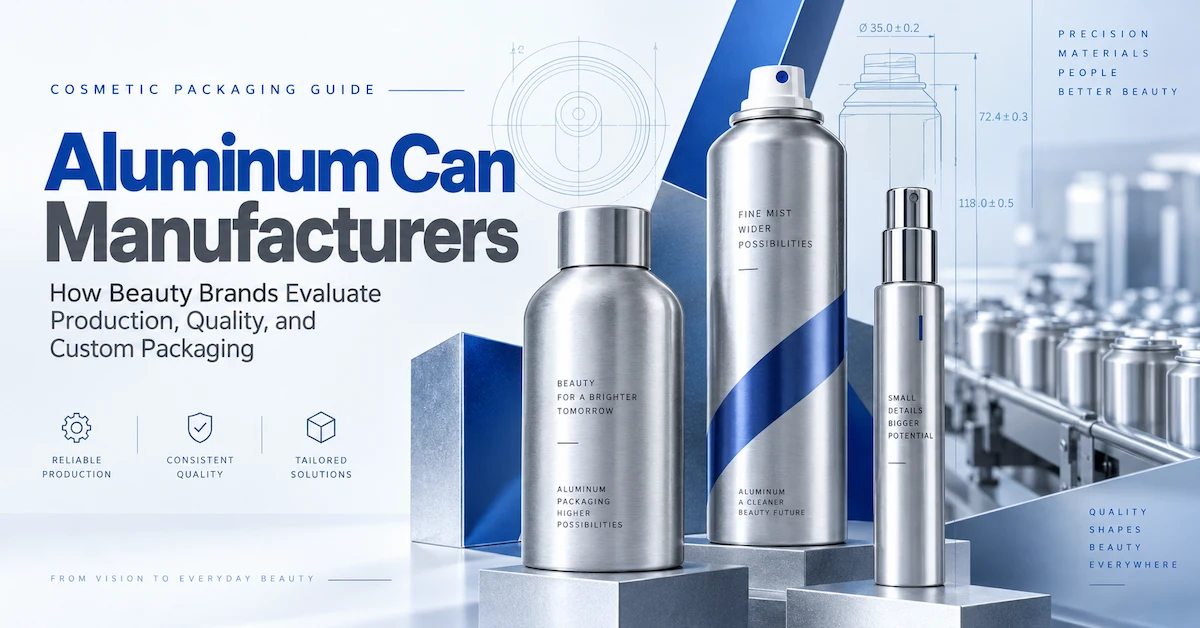
What Should Buyers Expect From Aluminum Can Manufacturers?
Professional aluminum can manufacturers should do more than provide a metallic container in the requested capacity. For beauty, personal care, fragrance, deodorant, aerosol, and other consumer packaging projects, the manufacturer needs to translate an application requirement into a controlled package that can be sampled, decorated, inspected, reproduced, packed, and supplied consistently across repeat orders.
That means the sourcing process should start with the finished product rather than with a question such as “How much is a 100 ml aluminum can?” Capacity alone does not define the package. Buyers may also need to specify diameter, height, neck or valve interface, dispensing component, internal surface requirements, exterior finish, artwork, filling method, target market, packing method, and expected annual volume.
CosmeBottle's Aluminum Bottles category currently organizes several relevant packaging directions, including aluminum cosmetic bottles, aluminum perfume atomizers, aluminum aerosol cans, and aluminum beverage bottles. Buyers should use these categories as starting points and confirm model-specific availability and technical requirements before production.
Which Buyers Typically Work With Aluminum Can Manufacturers?
Different customers evaluate aluminum can manufacturers for different reasons. A premium skincare brand may care most about exterior finish and brand consistency, while a contract filler may place greater emphasis on dimensions, closures, compatibility, and filling-line behavior.
Beauty and Skincare Brands
Beauty companies often use metallic packaging to create a clean, modern, or premium presentation. Their sourcing priorities may include consistent color, decoration quality, tactile finish, coordinated packaging families, and dependable repeat orders.
For these buyers, aluminum packaging may be considered for:
- Facial and body care products
- Skincare liquids
- Mist or spray products
- Travel-size cosmetics
- Premium cosmetic collections
- Selected airless or pump packaging concepts
Brands can compare these directions with the wider cosmetic packaging product range before deciding whether aluminum is the most suitable material.
Personal Care and Deodorant Brands
Personal care companies may evaluate aluminum for deodorants, body sprays, hair care products, shaving products, or other spray-based applications. In these projects, packaging aesthetics need to be evaluated together with the dispensing and filling system.
Fragrance Companies
Portable atomizers and metallic fragrance formats can be relevant where compact dimensions, spray performance, exterior decoration, and premium presentation are important. The final configuration should still be reviewed according to the fragrance formulation, dispensing system, and filling process.
Private-Label Companies and Contract Manufacturers
These buyers usually handle multiple customer projects and therefore need controlled specifications, repeatable decoration, manageable lead times, traceable revisions, and predictable supply.
For them, the best manufacturer is rarely the company offering the largest number of shapes. It is the one that can reproduce the approved package reliably after the first order.
Start With the Application Before Choosing an Aluminum Can
One of the most useful sourcing principles is simple: choose the packaging around the product, not the product around an available container.
A buyer should first define what the package needs to do. Does the product require a standard cap, lotion pump, fine-mist sprayer, atomizer, aerosol valve, or another dispensing system? Will the formulation contact aluminum directly, or is an internal protective system required? Will the product be filled on an existing line with fixed dimensional limitations?
These questions determine whether an aluminum cosmetic bottle, atomizer, aerosol can, or another format makes sense.
Aluminum Cosmetic Bottles
These are relevant when the brand requires a conventional cosmetic bottle format with an aluminum appearance or aluminum structure, depending on the design.
Important questions include:
- Required capacity
- Closure or pump type
- Neck finish
- Formula compatibility
- Surface decoration
- Packing protection
Aluminum Aerosol Cans
Aerosol packaging should be treated as a complete pressurized packaging system rather than merely an aluminum cylinder. Can design, internal surface, valve, actuator, formulation, propellant or filling method, and filling conditions need to work together.
Aluminum Perfume Atomizers
Portable fragrance formats emphasize dispensing quality, sealing, dimensions, surface appearance, and repeated daily use.
Other Aluminum Bottle Formats
Some projects may require packaging for daily-use products, beverages, or other applications. The manufacturer's category range should therefore be evaluated against the actual market and filling requirements rather than treated as interchangeable.
What Specifications Should You Send to Aluminum Can Manufacturers?
A clear RFQ helps different aluminum can manufacturers quote the same project instead of interpreting it differently.
| Requirement Area | What the Buyer Should Define | Why It Matters |
|---|---|---|
| Application | Skincare, fragrance, deodorant, aerosol, personal care, etc. | Determines package direction |
| Formula | Relevant formula characteristics | Supports compatibility review |
| Capacity | Required fill or nominal volume | Narrows available platforms |
| Dimensions | Diameter, height, space limits | Affects filling and packing |
| Dispensing system | Pump, cap, sprayer, valve, atomizer | Controls component integration |
| Internal requirement | Coating or liner if applicable | Important for product contact |
| Exterior finish | Matte, gloss, metallic, color coating | Defines appearance |
| Decoration | Logo, printing, artwork, color matching | Defines brand customization |
| Target market | Country or region | Supports documentation review |
| Quantity | Sample, first order, annual forecast | Influences commercial planning |
| Packing | Export carton, divider, pallet, etc. | Reduces handling risk |
| Timeline | Sample and production milestones | Supports realistic scheduling |
The RFQ should distinguish between mandatory requirements, preferred requirements, and items that remain open to the manufacturer's recommendation. This makes technical communication much clearer.
How Should Buyers Evaluate Manufacturing Capability?
When sourcing from aluminum can manufacturers, the question “How big is your factory?” is less useful than “How will my approved specification be transferred into repeatable production?”
CosmeBottle states that Zhejiang Cosme Industry Co., Ltd. was founded in 2015 and operates as a full-chain cosmetic packaging company with a 15,000-square-meter factory, around 200 employees, molding equipment, printing capability, mold development, R&D, and OEM/ODM support. Buyers can review these company-level capabilities on the About Us page.
However, company-level capability should not automatically be interpreted as a confirmed specification for every aluminum product. For an individual aluminum packaging project, buyers should separately confirm the manufacturing route, tooling, finishing processes, inspection criteria, capacity allocation, MOQ, sample cycle, and production lead time.
What Matters More Than Factory Size?
For procurement teams, useful questions include:
- Who controls the approved drawings and specifications?
- How are raw materials inspected?
- How are dimensions monitored during production?
- How is decoration consistency checked?
- How are rejected units handled?
- How is the approved sample identified?
- Can batches be traced?
- What changes require buyer approval?
- How is repeat-order consistency maintained?
These questions reveal much more about manufacturing reliability than general factory marketing statements.
How Does Aluminum Packaging Production Affect Buyer Decisions?
Manufacturing routes vary according to the package structure, which is why buyers should avoid assuming every aluminum container follows exactly the same production process.
The production sequence may involve forming, trimming, surface preparation, internal treatment where required, exterior coating or decoration, neck or opening formation, component assembly, inspection, and packing. The exact sequence should be confirmed for the selected package.
Internal Surface Requirements
The inside of the package deserves particular attention because beauty and personal care formulas can contain water, alcohol, fragrance ingredients, oils, salts, active ingredients, or other substances.
An aluminum can manufacturer should not simply state that a container is “suitable for cosmetics.” Buyers should confirm whether the selected package and its internal surface system have been evaluated for the intended formulation.
Exterior Decoration
The exterior may involve color coating, printing, logo decoration, metallic finishes, matte effects, or other processes depending on the package.
Brands should define physical appearance standards before mass production rather than approving only a digital rendering.
How Should Formula Compatibility Be Evaluated?
Formula compatibility is a system question.
The buyer needs to consider:
Formula + container + internal surface + closure or valve + dispensing component + filling conditions + storage conditions.
A visually correct aluminum can can still become a poor commercial solution if the package interacts unexpectedly with the contents or if the selected dispensing system does not perform consistently.
A Better Question to Ask the Manufacturer
Instead of asking:
“Can this aluminum bottle hold cosmetics?”
Ask:
“Can this specific package configuration be evaluated for our actual formula, filling method, dispensing component, and intended storage conditions?”
That wording produces a much more useful technical discussion.
How Should Buyers Compare Aluminum, Plastic, and Glass Packaging?
Material selection should follow the application and brand strategy.
| Factor | Aluminum | Plastic | Glass |
|---|---|---|---|
| Visual positioning | Metallic, modern, premium | Highly flexible | Premium, substantial |
| Weight | Relatively lightweight | Usually lightweight | Generally heavier |
| Shape flexibility | Depends on forming platform | Very flexible | Depends on molding process |
| Decoration | Strong metallic and coated effects | Wide decoration options | Wide premium decoration options |
| Formula considerations | Internal system may need evaluation | Polymer compatibility matters | Formula and closure compatibility matter |
| Transport | Lower weight can be advantageous | Generally efficient | Higher breakage/weight considerations |
| Typical brand use | Premium, modern or metallic concepts | Broad market coverage | Premium skincare/fragrance |
The point is not that one material is universally better. The correct material is the one that meets product protection, dispensing, production, logistics, visual positioning, and commercial requirements.
Buyers can compare aluminum with other Cosmetic Bottles before fixing the project specification.
What Quality Control Should Aluminum Can Manufacturers Provide?
Quality control should be linked to the approved product definition.
CosmeBottle states that its general packaging QC system includes incoming raw-material inspection, dimensional and surface inspection during molding processes, finished-product leakage evaluation where applicable, printing adhesion and color checks, record keeping, and batch traceability. The exact controls for an individual aluminum product should still be confirmed during project approval.
Dimensional Control
Critical dimensions can affect:
- Filling equipment
- Cap or valve assembly
- Secondary packaging
- Retail appearance
- Component fit
Buyers should therefore define which dimensions are critical instead of leaving the requirement as “size must be accurate.”
Surface Quality
For beauty packaging, visual defects can be commercially significant.
Inspection standards may need to address:
- Scratches
- Dents
- Uneven color
- Print misalignment
- Coating defects
- Contamination
- Surface marks
Decoration Consistency
The same artwork can look different if color, registration, coating thickness, gloss level, or surface preparation changes. The approved production sample should therefore represent a clearly identified revision.
Traceability
Traceability becomes particularly useful when a problem appears after filling or delivery. Buyers should understand how the manufacturer identifies production batches and connects them to quality records.
Why Is Sample Approval More Important Than a Sales Sample?
A sales sample demonstrates what a manufacturer has produced before. A production approval sample defines what the buyer expects to receive.
That difference is critical.
The approved version should identify:
- Product code
- Dimensions
- Capacity
- Material or structure
- Internal requirement where relevant
- Closure or dispensing component
- Surface finish
- Color
- Artwork revision
- Printing position
- Packaging method
- Approval date or revision
If any significant detail changes, the new version should be reviewed rather than silently replacing the approved sample.
Standard Aluminum Can or Custom Development?
Custom development is not automatically better.
Use an Existing Platform When
An existing package already meets the required dimensions, capacity, closure, appearance, and functional requirements. This approach can reduce development complexity and may allow the brand to concentrate customization on color, printing, logo, and surface treatment.
Consider Custom Development When
A brand requires a unique profile, proprietary dimensions, distinctive structural features, a coordinated packaging family, or a format that existing platforms cannot provide.
CosmeBottle describes two general customization paths: development involving tooling and an existing-style process where buyers confirm style, capacity, colors, printing, quotation, order, pre-production sample, mass production, and delivery. Buyers can review the current process and packaging range from the CosmeBottle homepage.
How Does OEM/ODM Aluminum Packaging Development Work?
A practical OEM/ODM project should follow controlled stages.
Step 1: Define Product Requirements
Confirm:
- Application
- Formula
- Filling method
- Capacity
- Dispensing system
- Target market
- Brand positioning
- Forecast quantity
Step 2: Select an Existing Platform or Develop a New One
The manufacturer should determine whether an existing aluminum package can satisfy the project before recommending tooling.
Step 3: Confirm Structure and Decoration
Agree on:
- Dimensions
- Components
- Color
- Finish
- Logo
- Artwork
- Printing
- Packaging
Step 4: Produce Samples
Samples should be reviewed for the specific project requirements rather than appearance alone.
Step 5: Complete Technical and Commercial Approval
Close unresolved compatibility, quality, artwork, MOQ, packing, price, and lead-time questions.
Step 6: Approve Pre-Production Configuration
The buyer and manufacturer should identify one controlled version as the production reference.
Step 7: Release Mass Production
Bulk production should reproduce the approved specification rather than an early quotation sample.
How Should Buyers Compare MOQ and Lead Time?
MOQ cannot be evaluated separately from customization.
A standard package with simple decoration may have different setup requirements from a unique color, complex printing, specialized component combination, or newly developed structure.
Similarly, lead time should be divided into stages:
Packaging Selection
Confirm an existing style or development route.
Design and Artwork
Finalize decoration and graphics.
Sample Preparation
Produce the physical reference.
Compatibility and Technical Review
Resolve application-specific questions.
Pre-Production Approval
Freeze the production version.
Mass Production
Manufacture according to the approved specification.
Inspection and Export Packing
Verify and prepare the order for shipment.
Breaking the project into stages makes supplier comparison more transparent.
What Determines the Cost of Custom Aluminum Packaging?
Unit price is only one part of total project cost.
Typical cost drivers can include:
- Container dimensions
- Aluminum usage
- Structure
- Interior requirements
- Exterior coating
- Printing complexity
- Number of colors
- Components
- New tooling where required
- Sample development
- Order quantity
- Inspection requirements
- Export packaging
- Logistics
The cheapest quotation is not necessarily the lowest-cost project.
If a lower-priced package produces excessive rework, unstable decoration, component problems, filling delays, or rejected goods, the financial impact can exceed the initial price difference.
What Are the Biggest Risks When Choosing Aluminum Can Manufacturers?
Risk 1: Comparing Different Specifications
Two quotations may look similar but include different finishes, components, internal systems, inspection criteria, or packaging methods.
Risk 2: Approving Appearance Before Technical Compatibility
A beautiful sample may still be unsuitable for the actual formula or filling process.
Risk 3: Uncontrolled Artwork Revisions
Old and new files can easily enter production if the approved artwork revision is not identified.
Risk 4: Assuming Company Certifications Apply to Every Product
Company-level certificates or manufacturing claims should not automatically be treated as product-specific certification.
Risk 5: No Repeat-Order Change Control
An apparently minor change in component, finish, material, or production method may influence the finished package.
A strong purchasing process converts these risks into controlled specification items before the purchase order is released.
What Information Should You Send for an Aluminum Can Quote?
To obtain a useful quotation from aluminum can manufacturers, provide the manufacturer with:
- Final product application
- Formula category
- Preferred aluminum packaging format
- Required capacity
- Dimension restrictions
- Closure, pump, atomizer, or valve requirements
- Finish and color
- Artwork
- Target market
- Sample quantity
- Initial order quantity
- Annual forecast
- Desired launch schedule
- Existing packaging problems, if replacing another supplier
If you already have a reference container, include photos, drawings, measurements, and details of what you want to improve.
Buyers can review the broader product range and submit project information through Contact Us for application-specific evaluation.
Frequently Asked Questions About Aluminum Can Manufacturers
1. How do I choose between aluminum can manufacturers?
Compare application experience, available package formats, customization capability, quality control, sample management, formula and component evaluation, MOQ, lead time, traceability, change control, and repeat-order consistency. Do not make the decision on unit price alone.
2. What aluminum packaging formats are suitable for beauty products?
Possible directions include aluminum cosmetic bottles, aerosol cans, perfume atomizers, aluminum airless-style packaging, and other metallic containers depending on the product. Start with the dispensing requirement and formula rather than selecting by appearance only.
3. Can aluminum packaging be customized with my brand colors and logo?
Customization can include colors, printing, logo decoration, surface finishes, and other appearance requirements depending on the product and process. Buyers should approve a physical production reference when color consistency is commercially important.
4. Does an aluminum can need an internal coating?
That depends on the container construction, formula, filling conditions, and intended use. Buyers should confirm the internal contact system for the actual product rather than assuming one configuration works for every cosmetic formula.
5. What is the MOQ for custom aluminum cans?
There is no single MOQ for every aluminum project. MOQ can vary according to the container platform, decoration, components, production setup, new tooling, and customization depth. Request a model-specific quotation.
6. How long does an OEM aluminum packaging project take?
The timeline depends on whether an existing platform is used, the amount of customization, artwork approval, sample preparation, compatibility evaluation, tooling where required, quantity, and factory schedule. Separate development lead time from mass-production lead time.
7. Should I request samples before bulk production?
Yes. Samples should be used to confirm structure, dimensions, components, color, decoration, fit, and other agreed requirements. Where formula compatibility is important, additional evaluation may be required.
8. What QC documents should I discuss with the manufacturer?
Discuss the approved specification, inspection items, acceptance criteria, batch identification, sample reference, packaging requirements, and available inspection or traceability records for your project.
9. How can I reduce repeat-order quality changes?
Create a controlled product specification tied to an approved sample and require review before changing important materials, components, artwork, dimensions, finishes, or production processes.
10. How do I start an aluminum packaging project with CosmeBottle?
Review the available Aluminum Bottles, define the product application, formula, capacity, dispensing system, finish, artwork, quantity, and target market, then submit those requirements through Contact Us for project-specific discussion.
Conclusion
Choosing aluminum can manufacturers is not simply a matter of finding a factory that can produce a metallic container. For beauty brands, personal care companies, fragrance businesses, private-label companies, and contract manufacturers, the real sourcing decision involves application fit, formula compatibility, dispensing components, manufacturing control, decoration, quality inspection, sample approval, commercial terms, and repeat-order consistency.
A stronger sourcing process starts with a controlled specification, compares suppliers against the same requirements, validates the actual packaging configuration, and freezes the approved version before mass production. Buyers exploring aluminum packaging can review the Aluminum Bottles category, compare the wider Cosmetic Packaging range, learn more about CosmeBottle's manufacturing and quality capabilities, and submit application details through Contact Us for project-specific evaluation.