
What Should a B2B Buyer Expect From an Aluminum Can Supplier?
A professional aluminum can supplier should help a buyer define the right packaging configuration instead of simply quoting an aluminum container by capacity. For beauty, personal care, fragrance, deodorant, aerosol, and related packaging projects, the final result depends on the interaction between the aluminum body, product formula, closure or dispensing system, internal surface requirements, decoration, filling process, transportation conditions, and target market.
This distinction matters because “aluminum can” can describe several very different commercial packaging formats. A fragrance atomizer, cosmetic bottle, aerosol can, and beverage-style aluminum bottle may use the same broad material family but require different neck structures, dispensing components, finishing processes, compatibility evaluations, and filling conditions.
Buyers beginning an aluminum packaging project can first review the available Aluminum Bottles category to understand the main format directions before requesting a project-specific quotation.
Which Aluminum Packaging Format Fits Your Product?
The first sourcing question should not be “Who offers the lowest aluminum can price?” It should be “Which aluminum packaging structure fits my formula, dispensing method, positioning, and filling process?”
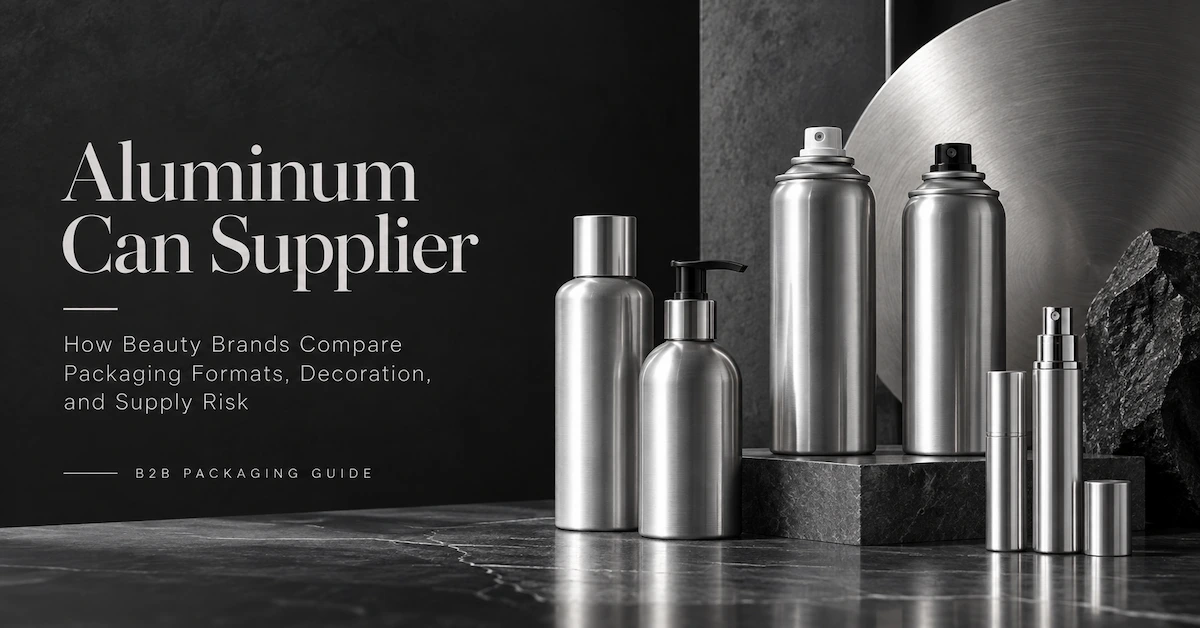
CosmeBottle currently organizes its aluminum packaging range into aluminum cosmetic bottles, aluminum perfume atomizers, aluminum aerosol cans, and aluminum beverage bottle categories. These categories provide useful starting points, but availability, size, component configuration, decoration, and customization scope should still be confirmed for the actual project.
| Aluminum Packaging Format | Typical Project Direction | Main Buyer Questions |
|---|---|---|
| Aluminum cosmetic bottle | Skincare, personal care, cosmetic liquids | Closure, formula compatibility, decoration, capacity |
| Aluminum aerosol can | Deodorant, body spray, hair or personal care aerosol | Valve interface, coating, filling system, pressure requirements |
| Aluminum perfume atomizer | Fragrance and portable spray applications | Spray system, sealing, finish, portability |
| Aluminum beverage bottle | Beverage or related liquid packaging projects | Closure, lining, filling compatibility, target-market requirements |
The Aluminum Cosmetic Bottles, Aluminum Aerosol Cans, and Aluminum Perfume Atomizers category pages can be used to narrow the project direction before technical confirmation.
Who Typically Searches for an Aluminum Can Supplier?
An aluminum can supplier usually serves business buyers with very different procurement priorities. Understanding those differences is important because a solution suitable for a large contract filler may not be the best choice for a new beauty brand.
Beauty and Skincare Brands
Beauty brands often prioritize appearance, color consistency, tactile finish, decoration quality, shelf differentiation, and the ability to repeat the same presentation across several production batches. Their purchasing team may also need multiple capacities or related packaging formats for a coordinated product family.
Personal Care and Deodorant Brands
These buyers may need aluminum aerosol packaging or other dispensing formats for deodorants, body sprays, hair products, shaving products, or daily personal care products. Technical integration with the filling and dispensing system often matters as much as appearance.
Fragrance Brands
Fragrance buyers may consider compact aluminum atomizers or other metallic packaging where portability, spray quality, exterior finishing, and premium presentation are important.
Private-Label Companies and Contract Manufacturers
These buyers usually manage multiple customer projects and therefore value clear specifications, repeatable quality, dependable lead times, decoration flexibility, and controlled revisions. They may prefer an existing platform when it reduces development risk and improves launch speed.
What Specifications Should You Send to an Aluminum Can Supplier?
One of the biggest causes of quotation errors is an incomplete RFQ. Asking for “100 ml custom aluminum cans” does not provide enough information to compare suppliers accurately.
A good RFQ should describe the application first, then define the package.
| Requirement | Information to Confirm | Why It Matters |
|---|---|---|
| Product application | Skincare, deodorant, fragrance, aerosol, personal care, beverage, etc. | Determines package direction |
| Product formula | Relevant chemical and compatibility information | Influences internal contact requirements |
| Nominal capacity | Required volume | Narrows available formats |
| Dimensions | Diameter, height, space limitation | Affects filling and secondary packaging |
| Neck/closure | Pump, spray, valve, cap or closure requirement | Determines component compatibility |
| Internal surface | Liner/coating requirement where applicable | Important for formula compatibility |
| Exterior finish | Matte, glossy, metallic, color coating, etc. | Determines appearance and cost |
| Decoration | Printing, logo, color matching, artwork | Defines branding scope |
| Target market | Country or region of sale | Influences documentation review |
| Quantity | Sample, first order, annual forecast | Influences MOQ and planning |
| Packing method | Carton, divider, pallet requirements | Helps reduce transit damage |
| Project timing | Sample date and mass-production target | Supports realistic scheduling |
A detailed specification allows an aluminum can supplier to identify what is standard, what requires customization, and which technical questions remain unresolved before quotation.
How Important Is Formula Compatibility in Aluminum Packaging?
Formula compatibility should be treated as a technical requirement rather than a marketing claim. Aluminum containers may hold very different products, and those products can vary in water content, alcohol content, fragrance oils, active ingredients, pH, solvents, salts, or other characteristics.
Depending on the application, the inside of the container may require a suitable protective system. Buyers should confirm what internal surface treatment or coating is used and whether it is appropriate for the intended formulation and filling conditions.
Do Not Approve a Package Based Only on Appearance
A visually approved container is not automatically a technically approved package. The bottle or can may look correct while the formula, valve, closure, actuator, liner, or filling process remains unvalidated.
The more useful question for an aluminum can supplier is not simply:
“Can this container be used for cosmetics?”
It is:
“Has this specific container, internal surface, component system, product formula, and filling configuration been reviewed together?”
That question reduces ambiguity during product development.
How Should Buyers Compare Aluminum and Plastic Packaging?
Aluminum and plastic are not interchangeable solutions. Each material serves different product, branding, manufacturing, and cost objectives.
| Decision Factor | Aluminum Packaging | Plastic Packaging |
|---|---|---|
| Visual character | Metallic, clean, premium appearance | Broad shape, transparency and color flexibility |
| Weight | Lightweight relative to many rigid premium materials | Generally lightweight |
| Decoration | Coating, printing and metallic visual effects | Broad printing and molding options |
| Formula contact | May require application-specific internal protection | Depends on polymer and formula |
| Structural customization | Depends on aluminum forming platform | Injection/blow molding enables varied structures |
| Brand positioning | Often used for metallic or premium concepts | Suitable from mass market to premium |
| Development decision | Consider filling and internal system together | Consider resin, barrier and component compatibility |
Buyers comparing materials can review the wider Cosmetic Packaging Products range rather than selecting aluminum simply because it appears more premium.
What Decoration Options Should Buyers Evaluate?
Decoration is one of the main reasons brands choose aluminum packaging, but appearance specifications must be controlled if a design is expected to remain consistent during mass production.
A buyer should define the desired base color, surface finish, logo location, artwork version, acceptable color range, print registration, gloss or matte effect, and any decorative detail that is commercially important.
Color Matching
A digital rendering should not be treated as the final color standard. Brands should approve a physical reference or clearly defined color requirement before production.
Printing and Branding
Artwork approval should identify the exact file revision. Even a minor change to text position, logo size, print orientation, or regulatory wording should be revision-controlled.
Surface Appearance
Scratches, dents, contamination, inconsistent coating, printing defects, and handling marks may affect shelf presentation. The buyer and supplier should agree on visual acceptance criteria rather than relying on the vague instruction “premium quality.”
How Should You Evaluate Quality Control?
The right aluminum can supplier should be able to explain how requirements move from approved sample to repeatable production. Buyers should therefore ask about controls rather than accepting general statements such as “strict QC.”
Relevant areas can include incoming material review, dimensional inspection, wall or structural checks where applicable, surface appearance, decoration adhesion, color consistency, sealing or leakage evaluation for relevant configurations, packing inspection, batch identification, and traceability.
CosmeBottle provides company-level manufacturing and quality information on its About Us page. For an aluminum project, buyers should still confirm exactly which inspection items, sampling standards, testing conditions, and acceptance limits apply to the selected package.
The Approved Sample Must Be Controlled
A sample should have a project number, specification revision, decoration version, date, and approval status. If a color, dimension, component, or artwork changes later, the revised sample should not continue to share the same informal identity as the original.
This simple discipline helps prevent a common sourcing problem: purchasing, quality, design, and production teams all referring to different versions as “the approved sample.”
Standard Aluminum Packaging or Custom Development?
Not every project needs a new structure. In many cases, an existing aluminum package combined with custom color, printing, logo decoration, or component selection may achieve the desired commercial effect without creating unnecessary development work.
Use an Existing Platform When
The available capacity, dimensions, closure system, and general package style already satisfy the product requirement. This route can reduce tooling exposure, shorten development steps, and simplify repeat ordering.
Consider Custom Development When
A brand requires a differentiated shape, special dimensions, proprietary architecture, coordinated packaging family, or functional configuration that cannot be achieved using an existing platform.
The broader custom cosmetic packaging range can help buyers compare existing formats before deciding whether deeper OEM/ODM development is necessary.
How Does an OEM or ODM Aluminum Packaging Project Work?
A structured development process usually begins with product and packaging requirements rather than artwork alone.
Step 1: Define the Application
Confirm the formula category, filling method, target capacity, dispensing system, market positioning, sales region, and expected annual volume.
Step 2: Compare Existing Packaging Platforms
Review suitable aluminum packaging and determine whether an existing structure can meet the project.
Step 3: Freeze the Initial Specification
Document dimensions, components, internal requirements, finish, decoration, color, packing, testing, and target market.
Step 4: Prepare and Review Samples
Evaluate appearance, fit, dispensing configuration, formula compatibility where required, and any project-specific performance criteria.
Step 5: Approve the Production Version
Identify the final artwork, specification revision, approved sample, packaging method, and inspection requirements.
Step 6: Release Mass Production
Bulk production should follow the approved definition rather than an earlier quotation sample or obsolete artwork.
For projects requiring new structures or deeper customization, the company's About Us information provides an overview of its packaging development and manufacturing capabilities.
How Should Buyers Think About MOQ and Lead Time?
There is no useful universal MOQ for every aluminum package. MOQ may depend on the selected container, decoration process, color requirement, components, tooling, production setup, and order structure.
The same principle applies to lead time. Buyers should separate the schedule into development stages rather than asking only, “How many days does production take?”
A realistic timeline may include package selection, technical review, artwork confirmation, color or decoration sampling, compatibility evaluation where required, pre-production approval, mass production, inspection, and export packing.
An experienced aluminum can supplier should be able to identify which stages depend on the buyer and which depend on manufacturing. This makes schedule management more useful than one headline delivery promise.
Why the Lowest Aluminum Can Price May Cost More
Unit price is important, but it is only one element of sourcing cost. A low quotation can become expensive if the project later encounters color variation, incompatible components, filling-line problems, high rejection rates, late delivery, transit damage, or inconsistent repeat batches.
Buyers should compare total project cost, including sampling, tooling where applicable, decoration setup, internal coating or treatment, components, inspection, packing, logistics, inventory, rework risk, and future order consistency.
The biggest commercial risk is often not a slightly higher unit price. It is an undefined specification.
When two suppliers are quoting different technical configurations, their prices are not truly comparable.
How Can Buyers Reduce Repeat-Order Risk?
Repeat-order consistency begins before the first mass-production order. Build a controlled package specification containing the product code, drawing or dimensions, material, internal requirement, closure or dispensing component, color, artwork revision, printing position, acceptance criteria, approved sample, packing method, and change-control requirement.
If a relevant material, decoration process, component, dimension, or production method changes, the impact should be reviewed before the new version enters production.
This is particularly important for brands selling the same SKU for several years. A reliable aluminum can supplier should help protect the approved product definition instead of treating every reorder as a new interpretation of the original inquiry.
What Should You Send When Requesting an Aluminum Can Quote?
A useful inquiry should contain more than the target quantity. Send the product application, formula category, preferred aluminum packaging type, capacity, dimensions or size restrictions, closure or dispensing requirement, color, finish, artwork, target market, expected quantity, annual forecast, desired sampling date, and required commercial launch schedule.
If you already use an existing package, provide photos, drawings, dimensions, and details of any problems you want the new supplier to solve. Problems such as leakage, scratches, color inconsistency, unstable spraying, decoration failure, delivery delays, or high rejection rates give the supplier valuable context.
You can also review the E-Catalog before submitting your requirements through Contact Us.
Frequently Asked Questions
1. What should I look for in an aluminum can supplier?
Evaluate relevant packaging experience, available aluminum formats, customization scope, formula and component review, decoration control, quality procedures, sampling, MOQ, lead time, batch consistency, traceability, and communication. The best fit depends on your application rather than on factory size or price alone.
2. What types of aluminum packaging can beauty brands source?
Common project directions include aluminum cosmetic bottles, aerosol cans, perfume atomizers, deodorant-related packaging, and other aluminum bottle formats. Buyers can compare the Aluminum Bottles category before confirming a specific project.
3. Can an aluminum can be customized with my logo and color?
Customization may include color, exterior finish, printing, logo decoration, and other appearance requirements depending on the selected container and production process. Confirm feasibility, MOQ, artwork requirements, and sampling before placing a bulk order.
4. Does every cosmetic formula work with the same aluminum container?
No. Formula characteristics, internal surface requirements, closure or valve materials, filling conditions, and intended storage can affect compatibility. The actual package and formula should be evaluated together where compatibility is relevant.
5. What is the MOQ for custom aluminum cans?
MOQ varies by container platform, decoration, color, component requirements, production setup, and customization depth. A project-specific quotation is more reliable than a universal MOQ claim.
6. How long does custom aluminum packaging take to produce?
The timeline depends on whether an existing package is used, the extent of decoration or structural customization, sample approvals, compatibility work, order quantity, and production schedule. Separate development lead time from mass-production lead time.
7. Aluminum cosmetic bottle or aerosol can: which should I choose?
Choose according to dispensing requirements. A conventional cosmetic bottle may use a pump, sprayer, or closure, while an aerosol can forms part of a pressurized dispensing system. The formula, user experience, filling process, and components should determine the selection.
8. How can I compare quotes from two aluminum packaging suppliers?
Make sure both quotations refer to the same capacity, dimensions, internal requirements, finish, decoration, components, inspection criteria, packing method, quantity, and Incoterm or delivery scope. Otherwise the unit prices may represent different products.
9. Should I request samples before mass production?
Yes. Samples help verify appearance, dimensions, components, decoration, fit, and other project requirements. Where formula compatibility or dispensing behavior matters, additional evaluation may be necessary before mass production.
10. How do I start a custom aluminum packaging project?
Prepare your application, formula category, desired format, capacity, dimensions, dispensing system, decoration, artwork, target market, quantity, and schedule. Then use Contact Us to submit the project for packaging evaluation.
Conclusion
Choosing an aluminum can supplier is ultimately a packaging-development and supply-chain decision. Beauty brands, personal care companies, fragrance businesses, private-label buyers, and contract manufacturers should evaluate more than unit price: the selected aluminum format, formula compatibility, internal requirements, dispensing components, decoration, quality control, MOQ, lead time, packing, and repeat-order consistency all affect the commercial result.
The safest sourcing process starts with a clear application, converts that application into a controlled specification, validates the selected package, records the approved version, and manages changes before repeat production. Buyers exploring aluminum packaging can compare the Aluminum Bottles range, review additional Cosmetic Packaging Products, and submit application details through Contact Us for project-specific evaluation.