
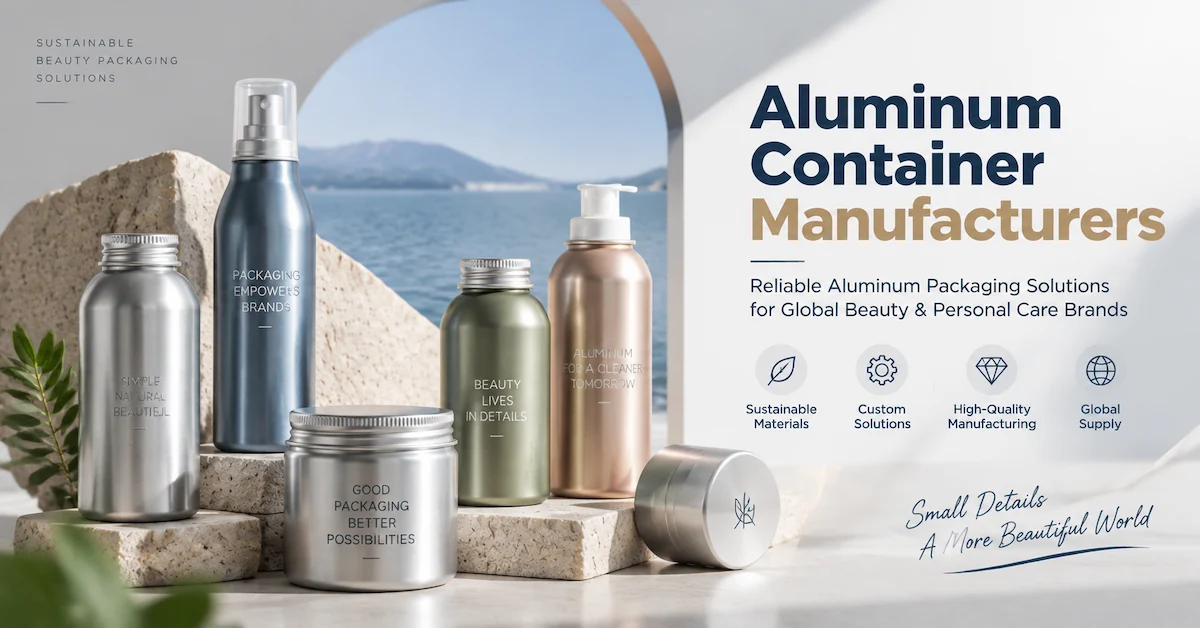
What Should Buyers Know About Aluminum Container Manufacturers?
For beauty, skincare, fragrance, and personal care companies, packaging selection directly influences product protection, brand presentation, customer experience, and supply chain performance.
Professional aluminum container manufacturers do not simply produce metal containers. They help brands develop packaging solutions that match product requirements, market positioning, filling conditions, decoration expectations, and long-term production needs.
Aluminum containers are widely considered for applications that require:
- Lightweight packaging
- Premium metallic appearance
- Strong durability
- Custom surface finishing
- Brand differentiation
However, choosing a suitable supplier requires more than selecting an attractive container design. Buyers need to evaluate manufacturing capability, customization support, quality control, and the supplier's ability to maintain consistent production.
Brands exploring aluminum packaging options can review CosmeBottle's Aluminum Bottles category to understand available packaging directions.
Who Needs Aluminum Container Manufacturers?
Different industries evaluate aluminum packaging based on different business goals.
Understanding the buyer's requirements helps companies select suppliers more effectively.
Beauty and Skincare Brands
Beauty brands often choose aluminum containers because they want packaging that supports:
- Premium positioning
- Product differentiation
- Modern appearance
- Durable daily use
Typical applications include:
- Skincare products
- Body care products
- Facial sprays
- Travel-size cosmetics
- Premium beauty collections
These buyers usually evaluate:
- Visual design
- Surface quality
- Formula compatibility
- Customization options
- Repeat-order consistency
Personal Care Companies
Personal care companies may use aluminum containers for:
- Body care products
- Hair care products
- Spray products
- Daily-use cosmetics
Their priorities often include:
- Functional design
- Reliable supply
- Production efficiency
- Cost control
Private Label Brands
Private-label businesses need suppliers that can support:
- Custom branding
- Multiple product lines
- Flexible development
- Market launch requirements
For these companies, the ability to support customization and stable production is often more valuable than simply offering the lowest price.
Packaging Distributors
Distributors usually focus on:
- Product variety
- Supplier reliability
- Export capability
- Delivery stability
- Long-term cooperation
Why Do Brands Choose Aluminum Containers?
Material selection affects both product performance and brand perception.
Aluminum containers are often considered because they provide a balance between lightweight structure, premium appearance, and customization potential.
| Advantage | Value for Brands |
|---|---|
| Lightweight structure | Helps reduce transportation impact |
| Metallic appearance | Creates premium visual positioning |
| Durable material | Suitable for repeated daily use |
| Decoration flexibility | Supports branding requirements |
| Modern appearance | Helps products stand out |
However, aluminum is not automatically suitable for every product.
The final selection depends on:
- Product formula
- Application
- Dispensing method
- Storage requirements
- Target customers
- Brand positioning
Buyers can compare different Cosmetic Packaging Products before selecting the most suitable format.
What Types of Aluminum Containers Can Brands Use?
When evaluating aluminum container manufacturers, buyers should first define the product application.
Aluminum Cosmetic Containers
Suitable for brands looking for:
- Skincare packaging
- Personal care packaging
- Premium cosmetic presentation
Important considerations include:
- Capacity
- Closure type
- Surface finish
- Product compatibility
Aluminum Aerosol Containers
Suitable for:
- Deodorants
- Body sprays
- Hair products
- Mist products
Key evaluation factors include:
- Valve compatibility
- Internal protection
- Spray performance
- Filling requirements
Brands can review Aluminum Aerosol Cans for aerosol packaging options.
Aluminum Perfume Containers
For fragrance brands, important factors include:
- Spray quality
- Premium appearance
- Portability
- Decoration effect
CosmeBottle also provides Aluminum Perfume Atomizers for fragrance-related packaging applications.
How Should Buyers Evaluate Aluminum Container Manufacturers?
A reliable supplier evaluation should consider technical, commercial, and production factors.
1. Manufacturing Capability
Buyers should understand:
- Product experience
- Production process
- Customization ability
- Quality management
- Delivery capability
The important question is not only:
“Can this supplier make aluminum containers?”
It is:
“Can this supplier consistently manufacture the approved packaging specification?”
2. Customization Capability
Many brands require customized packaging.
Customization may include:
- Size adjustment
- Color selection
- Surface finishing
- Printing
- Logo decoration
- Packaging combinations
Before starting a project, buyers should confirm:
- Custom options
- Sample process
- Development timeline
- Production requirements
3. Quality Control Capability
Packaging quality directly affects brand reputation.
Important inspection areas include:
- Material quality
- Dimensional accuracy
- Surface appearance
- Decoration consistency
- Batch control
CosmeBottle provides company and manufacturing information through its About Us page.
What Information Should Buyers Prepare Before Requesting a Quote?
A detailed inquiry allows aluminum container manufacturers to provide more accurate solutions.
| Information | Why It Matters |
|---|---|
| Product type | Defines packaging application |
| Formula characteristics | Supports compatibility evaluation |
| Capacity | Determines suitable container options |
| Dimensions | Ensures product requirements |
| Closure system | Determines component selection |
| Decoration needs | Defines customization scope |
| Quantity | Influences pricing and production |
| Target market | Supports project requirements |
| Timeline | Helps schedule development |
A complete specification reduces communication problems and avoids unnecessary revisions.
How Are Aluminum Containers Manufactured?
Understanding production processes helps buyers evaluate suppliers more professionally.
Material Preparation
Manufacturers begin with aluminum materials suitable for the required container structure.
Important factors include:
- Material consistency
- Surface quality
- Production requirements
Container Forming
The aluminum material is shaped according to the required design.
Manufacturing control focuses on:
- Dimensions
- Shape consistency
- Structural stability
Surface Treatment
The external appearance is developed through finishing processes.
Common options include:
- Coating
- Printing
- Color finishing
- Decorative treatment
For beauty packaging, surface quality is an important part of brand communication.
Inspection and Packing
Before shipment, manufacturers should verify:
- Product appearance
- Packaging condition
- Production consistency
The exact inspection requirements should be confirmed according to each project.
Why Is Product Compatibility Important for Aluminum Containers?
A common mistake is selecting packaging only based on appearance.
The container should be evaluated together with:
- Product formula
- Internal surface
- Closure system
- Storage environment
Different products may contain:
- Alcohol
- Oils
- Fragrance ingredients
- Active ingredients
Therefore, buyers should confirm whether the selected aluminum container is suitable for the intended application.
Custom OEM Aluminum Container Development
Many brands choose OEM packaging because they need stronger differentiation.
A custom aluminum container project may involve:
- Unique design
- Brand printing
- Special finishing
- Customized capacity
- Packaging combinations
OEM Development Process
Step 1: Requirement Analysis
Confirm:
- Product category
- Packaging goals
- Quantity
- Target market
Step 2: Design Confirmation
Review:
- Container structure
- Appearance
- Decoration
- Components
Step 3: Sample Approval
Evaluate:
- Design effect
- Functional requirements
- Quality expectations
Step 4: Mass Production
Manufacture according to the approved specification.
Brands looking for customized packaging support can review CosmeBottle's OEM and packaging solutions and contact the team through Contact Us.
How Much Do Aluminum Containers Cost?
The cost of aluminum containers depends on several factors.
| Cost Factor | Influence |
|---|---|
| Material usage | Affects basic cost |
| Container size | Changes production requirements |
| Custom design | Influences development cost |
| Decoration | Affects finishing cost |
| Quantity | Impacts unit pricing |
| Packaging method | Influences logistics |
The lowest quotation does not always represent the lowest total project cost.
Buyers should also consider:
- Quality stability
- Production risk
- Rework possibility
- Delivery reliability
- Long-term supply value
How Can Buyers Reduce Risks When Choosing Aluminum Container Manufacturers?
Risk 1: Comparing Suppliers Only by Price
Different suppliers may quote different specifications.
Solution:
Compare the same technical requirements.
Risk 2: Unclear Product Specifications
Incomplete requirements can cause unsuitable recommendations.
Solution:
Create a detailed product specification.
Risk 3: Poor Sample Control
Different sample versions may create production mistakes.
Solution:
Approve and record the final production sample.
Risk 4: Uncontrolled Production Changes
Changes in materials, decoration, or components can affect quality.
Solution:
Establish a clear change-control process.
Standard Aluminum Containers vs Custom Aluminum Containers
Standard Containers
Suitable when:
- Existing designs meet requirements
- Faster launch is needed
- Decoration provides enough differentiation
Custom Containers
Suitable when:
- Brand uniqueness is important
- Special dimensions are needed
- Product positioning requires customization
Before developing a new structure, buyers can review existing Aluminum Cosmetic Bottles.
Frequently Asked Questions About Aluminum Container Manufacturers
1. Why do brands choose aluminum container manufacturers?
Brands choose aluminum container manufacturers because aluminum packaging provides lightweight structure, premium appearance, and customization possibilities.
2. What products use aluminum containers?
Aluminum containers can be used for skincare, personal care, fragrance, aerosol, and other packaging applications.
3. How do I select reliable aluminum container manufacturers?
Evaluate manufacturing experience, customization capability, quality control, communication, samples, and repeat production ability.
4. Can aluminum containers be customized?
Yes. Customization may include colors, printing, finishes, capacity, and branding elements.
5. What information should I provide for a quotation?
Provide product type, capacity, design requirements, quantity, target market, and customization expectations.
6. Are aluminum containers suitable for skincare products?
They can be suitable for many applications, but compatibility should be evaluated according to the specific formula.
7. What is the MOQ for custom aluminum containers?
MOQ depends on structure, customization requirements, decoration process, and production conditions.
8. Should I request samples before production?
Yes. Samples help confirm appearance, specifications, and project requirements.
9. How long does custom aluminum container production take?
The timeline depends on customization complexity, sampling, approval speed, quantity, and production planning.
10. Can aluminum container manufacturers support private-label brands?
Many suppliers support private-label projects through customized designs, branding, and production solutions.
Conclusion
Choosing suitable aluminum container manufacturers requires more than selecting a supplier with attractive packaging designs. Beauty brands, skincare companies, personal care businesses, and private-label companies should evaluate material suitability, manufacturing capability, customization support, quality control, cost structure, and long-term supply reliability.
A successful aluminum packaging project starts with clear requirements, professional supplier communication, controlled specifications, and careful sample approval before mass production. Buyers can explore CosmeBottle's Aluminum Bottles, compare available Cosmetic Packaging Products, and contact the team through Contact Us for packaging project evaluation.