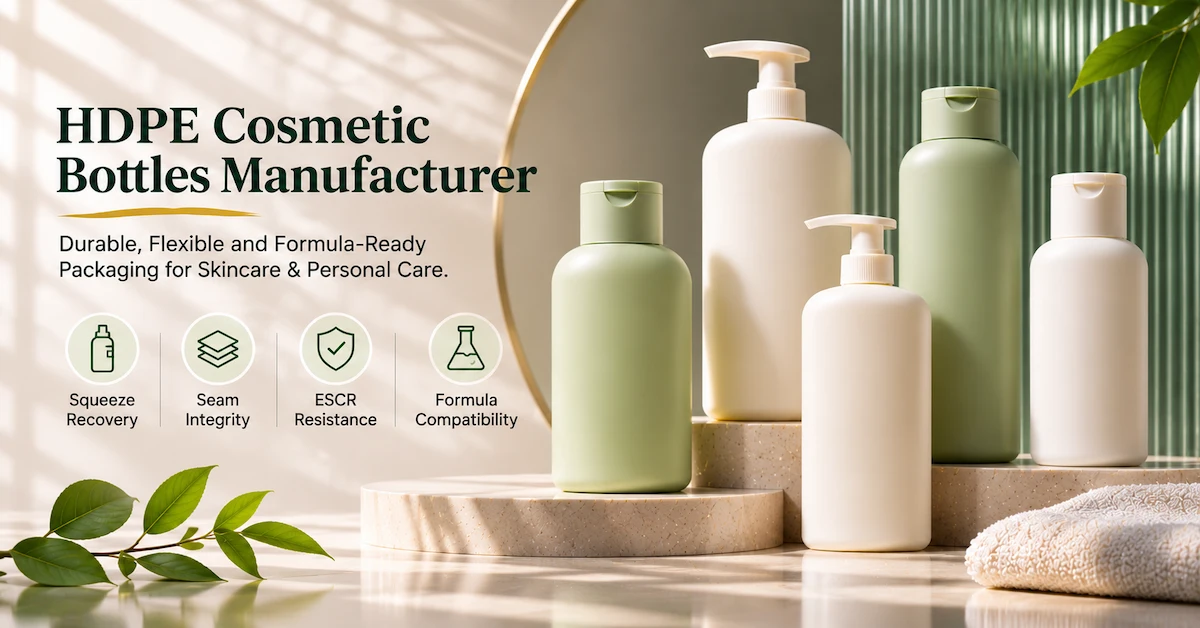

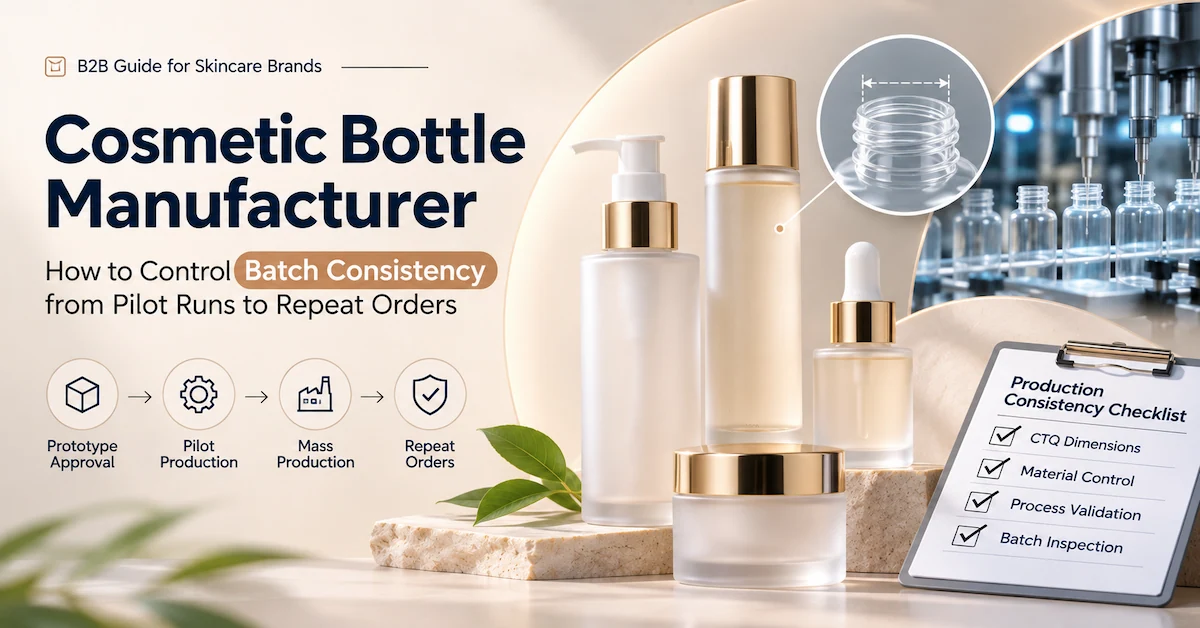
TL;DR: A reliable cosmetic bottle manufacturer should maintain consistency through controlled material specifications, validated tooling, critical dimensional inspections, pilot production, and documented batch acceptance. Skincare brands should approve not only a visual reference sample but also the production process, component interfaces, and quality criteria that determine whether every subsequent order matches the approved packaging.
A beautifully finished cosmetic bottle can pass initial sample approval and still create problems when production increases. A slightly distorted neck may affect pump assembly. Wall-thickness variation can influence rigidity. Inconsistent printing may cause noticeable differences between retail products.
These issues become especially costly when packaging is supplied for multiple skincare products or recurring manufacturing orders.
The challenge is not simply producing one acceptable bottle. It is establishing a manufacturing system capable of reproducing approved packaging within defined specifications.
COSME Packaging, operated by Zhejiang Cosme Industry Co., Ltd., supports cosmetic packaging development, mold manufacturing, plastic molding, customization, and quality inspection for international skincare and personal-care brands.
This guide explains the engineering principles, production risks, quality-control methods, and purchasing decisions involved in scaling cosmetic bottle manufacturing.
Key Takeaways: How to Control Cosmetic Bottle Production Consistency
The following quick-reference table summarizes the most important decisions for skincare brands moving from prototype development to commercial production.
| Production concern | Potential problem | Recommended control | Buyer benefit |
|---|---|---|---|
| Material variation | Changes in dimensions or appearance | Approved material specifications | More consistent packaging |
| Mold and process variation | Warpage, shrinkage, surface defects | Controlled tooling and process conditions | Reduced production variation |
| Neck and closure fit | Pump or cap assembly failures | Critical dimensional verification | Improved component compatibility |
| Decoration inconsistency | Different colors or printing alignment | Approved visual references | Consistent brand presentation |
| Pilot-to-mass-production transition | Prototype differs from production output | Representative pilot validation | Lower scale-up risk |
| Repeat-order changes | Unapproved material or tooling modifications | Engineering change control | Improved long-term supply reliability |
Core engineering principle: Cosmetic bottle quality depends on controlling the complete manufacturing process, not merely inspecting finished products.
Why Trust This Cosmetic Bottle Manufacturing Guide?
This guide combines COSME Packaging's published manufacturing information with established plastic molding, dimensional inspection, and supplier-quality practices.
COSME Packaging was established in 2015. According to its official company profile, it operates an approximately 15,000-square-meter facility with around 200 employees.
The company describes capabilities involving R&D, mold development, injection molding, blow molding, printing, and quality inspection.
Its published quality-control procedures include incoming material checks, dimensional and wall-thickness inspection, visual defect assessment, leakage testing, printing evaluation, and batch records.
Two technical standards provide additional context:
-
ISO 20457:2026 — Plastics Moulded Parts: Tolerances and Acceptance Conditions. Provides guidance on dimensional tolerances for specified plastic molding processes.
-
ISO 2859-1:2026 — Sampling Procedures for Inspection by Attributes. Provides acceptance sampling schemes for evaluating production lots.
These standards help buyers develop technical requirements. They do not establish universal cosmetic bottle tolerances or confirm that any individual supplier has passed a particular product test.
Evidence boundary: The methods below are recommended engineering and purchasing practices. They are not unpublished COSME production results, factory audit findings, or claims of verified defect-rate improvements.
What Does Batch Consistency Mean in Cosmetic Bottle Manufacturing?
Batch consistency means that packaging produced in different manufacturing runs continues to meet the same approved functional, dimensional, material, and appearance requirements.
It does not mean every manufactured bottle must be physically identical in every measurable respect.
All manufacturing processes involve some variation.
The objective is to keep that variation within limits appropriate for the product's intended function.
Four Dimensions of Packaging Consistency
1. Dimensional consistency
Bottles should meet critical dimensions required for filling, closure assembly, labeling, and secondary packaging.
2. Material consistency
The proposed resin, additives, color components, and relevant product-contact materials should remain within the approved specification.
3. Functional consistency
Bottles and their components should meet agreed requirements for assembly, dispensing, containment, and normal handling.
4. Visual consistency
Color, transparency, surface appearance, printing, and decorative finishing should remain within approved acceptance criteria.
For a premium skincare line, even a relatively small visible color difference may be commercially important.
For a pump bottle, dimensional variation at the sealing interface may be more consequential than a minor difference on a nonfunctional surface.
The manufacturer and buyer should determine which characteristics are critical before production begins.
Which Cosmetic Bottle Dimensions Require the Tightest Control?
Not all bottle dimensions have equal functional importance.
A practical quality plan identifies Critical-to-Quality (CTQ) characteristics and assigns appropriate inspection requirements.
Cosmetic Bottle CTQ Specification Table
| Critical characteristic | Functional importance | Suggested verification |
|---|---|---|
| Neck diameter | Pump and closure compatibility | Dimensional measurement |
| Thread geometry | Closure engagement | Drawing and fit inspection |
| Sealing surface | Package integrity | Surface and assembly checks |
| Bottle height | Filling-line compatibility | Dimensional inspection |
| Body diameter or width | Equipment handling and carton fit | Measurement against drawings |
| Wall distribution | Rigidity and appearance | Applicable wall-thickness inspection |
| Base geometry | Standing stability | Dimensional and physical evaluation |
| Pump interface | Assembly and dispensing | Completed assembly testing |
| Printing alignment | Brand presentation | Approved artwork comparison |
How Should Tolerances Be Determined?
For plastic molded components, tolerance selection should consider material behavior, geometry, tooling, and processing conditions.
ISO 20457:2026 provides a framework for evaluating achievable tolerances for the molding processes within its scope.
However, it should not automatically be applied to every blow-molded bottle or other manufacturing process without confirming applicability and agreement between the parties.
A skincare brand should first define functional requirements. The manufacturer should then evaluate whether the selected design and production process can meet them economically.
Why Extremely Tight Tolerances Can Increase Costs
A bottle does not necessarily perform better because every dimension has an exceptionally narrow tolerance.
Unnecessary precision can increase inspection complexity and production costs.
Instead, the buyer should prioritize the dimensions that influence assembly, filling, sealing, and consumer use.
Engineering recommendation: Use function-based tolerances rather than applying the same dimensional limit to the entire bottle.
Why Do Cosmetic Bottle Dimensions Drift During Mass Production?
A plastic bottle's final geometry depends on material behavior and manufacturing conditions.
Even when the mold design remains unchanged, production variation can affect the finished component.
Material Shrinkage
Plastic materials undergo dimensional changes during processing and cooling.
The magnitude and direction of these changes depend on the material, part geometry, and manufacturing process.
When shrinkage differs from the expected behavior, dimensions may move outside the approved limits.
Uneven Cooling and Warpage
Different sections of a molded component may cool at different rates.
This can influence deformation and dimensional stability.
Complex shapes, large thickness transitions, or inappropriate process conditions can increase the difficulty of controlling the finished geometry.
Tooling Variation
Tooling wear, damage, repairs, or adjustments may affect critical dimensions and appearance.
For multi-cavity molds, differences between cavities can also require monitoring.
Processing Variation
Changes in relevant manufacturing conditions can affect the final product.
The specific variables depend on whether the component is injection molded, blow molded, or produced using another process.
Production Variation and Quality Risk
| Production variable | Possible effect | Recommended monitoring |
|---|---|---|
| Material grade | Shrinkage or performance variation | Material identification |
| Processing conditions | Dimensional or appearance changes | Relevant process records |
| Cooling behavior | Warpage or deformation | Dimensional inspection |
| Mold condition | Surface and geometry variation | Tooling maintenance records |
| Cavity differences | Inconsistent output between cavities | Cavity-level checks where relevant |
| Color masterbatch | Appearance differences | Approved color standards |
Important: These are potential technical relationships, not a diagnosis of a specific COSME production defect.
A manufacturer should investigate actual inspection results before changing materials, tooling, or process conditions.
How Can Cosmetic Bottle Manufacturers Control Production Variation?
Reliable production requires a combination of preventive controls and inspection.
Step 1: Verify Materials Before Production
Incoming materials should be checked against the approved specification.
Any changes to resin grades, additives, or important components should be reviewed before use.
Step 2: Maintain Tooling and Production Equipment
The manufacturer should establish relevant tooling maintenance and inspection procedures.
Critical molding surfaces and dimensional features require appropriate monitoring.
Step 3: Monitor Critical Production Characteristics
In-process inspections help identify variation before an entire production lot is completed.
Relevant checks may include bottle dimensions, wall thickness, visible defects, and closure interfaces.
Step 4: Review Trends, Not Just Individual Failures
Inspection records can reveal gradual movement toward a specification limit.
Where sufficient data and a suitable measurement system are available, statistical process-control methods may help evaluate production stability.
However, buyers should not assume that a particular Cpk target or statistical capability has been achieved without supporting process data.
Step 5: Verify Finished Packaging
Finished products should be assessed against the agreed inspection criteria.
For assembled packaging, functional checks may be necessary in addition to dimensional and visual inspection.
This approach moves quality control from simply detecting defects toward identifying production variation earlier.
How Do You Move From Pilot Samples to Stable Mass Production?
A production-ready cosmetic bottle should pass through controlled development and validation stages.
The exact process depends on whether the project uses existing tooling or requires a new design.
Pilot-to-Production Validation Workflow
| Stage | Main activity | Buyer approval evidence |
|---|---|---|
| 1. Design freeze | Confirm materials, dimensions, components, and artwork | Approved technical specification |
| 2. Tooling trial | Produce initial samples under defined conditions | Trial sample evaluation |
| 3. Pilot production | Manufacture representative packaging | Dimensional and visual inspection |
| 4. Component assembly | Verify pumps, caps, and closures | Assembly and functional results |
| 5. Filling-line trial | Test intended filling operations | Filling and handling evaluation |
| 6. Production approval | Confirm reference samples and acceptance limits | Formal approval records |
| 7. Mass production | Monitor critical process and product characteristics | Production inspection records |
| 8. Lot release | Evaluate finished batches | Agreed acceptance decision |
Why Pilot Production Matters
A prototype may demonstrate the intended bottle shape, but pilot production helps evaluate the consistency of the manufacturing process.
A useful pilot should represent the intended materials, tooling, manufacturing method, and relevant production conditions.
Why Filling Trials Matter
A bottle may meet dimensional requirements yet present difficulties on the filling line.
Potential issues include equipment handling, bottle stability, closure assembly, or interaction with the actual formulation.
These problems should be evaluated before placing a large packaging order.
Why Production Approval Must Be Documented
The final approved configuration should be identified using controlled specifications and representative samples.
Further changes should follow an agreed review process.
Without documentation, the buyer and supplier may interpret the approved design differently.
How Should Finished Cosmetic Bottle Quality Be Inspected?
A complete quality-control plan generally includes incoming, in-process, and finished-product inspections.
Three-Level Quality Control System
| Quality stage | Inspection focus | Main purpose |
|---|---|---|
| Incoming Quality Control (IQC) | Materials and relevant components | Prevent unsuitable inputs |
| In-Process Quality Control (IPQC) | Critical dimensions, surfaces, manufacturing variation | Detect process-related defects |
| Final Quality Control (FQC) | Appearance, assembly, applicable functional requirements | Verify finished-batch acceptance |
Acceptance Sampling and AQL
ISO 2859-1:2026 provides an established system for acceptance sampling by attributes.
A buyer and supplier can use an appropriate agreed sampling plan to determine how production lots will be inspected.
The selected approach should account for defect classification, inspection severity, and the product's risk profile.
Passing an acceptance-sampling inspection does not prove that every individual unit in the batch is defect-free.
Critical sealing or functional risks may require additional controls.
Why Appearance Inspection Needs Clear Criteria
A bottle may exhibit cosmetic defects without losing its ability to contain the product.
Other defects may directly affect functionality.
The inspection plan should distinguish between different consequences rather than treating every visual difference as equally important.
For premium retail packaging, approved color and decoration references are particularly useful.
How Do Quality Priorities Differ Across Cosmetic Bottle Types?
Different packaging formats require different controls.
| Bottle type | Critical manufacturing concern | Recommended validation |
|---|---|---|
| Lotion pump bottle | Neck dimensions and pump fit | Assembly and dispensing checks |
| Airless bottle | Reservoir and pump interfaces | Functional and integrity evaluation |
| Dropper bottle | Closure sealing and component alignment | Assembly and leakage checks |
| Foaming bottle | Foaming pump compatibility | Dispensing and formula testing |
| Refillable bottle | Repeated component engagement | Assembly durability evaluation |
| Glass bottle | Neck dimensions and breakage risk | Component compatibility and handling checks |
These are general engineering priorities, not published test results for individual COSME models.
For brands considering specialized formats, the COSME Airless Bottles collection provides relevant product directions.
The correct quality plan should be designed for the specific packaging architecture.
Engineering Example: Preventing a Pump Bottle Assembly Failure Before Scale-Up
The following is a hypothetical engineering scenario illustrating a procurement problem. It is not a documented COSME customer project.
Project Background
A skincare brand is preparing a coordinated lotion packaging range.
The initial bottle samples look acceptable, and the selected pump appears to fit the neck.
The brand plans to increase production for commercial distribution.
Potential Problem
During representative assembly trials, some pumps require different assembly forces.
Further review identifies variation near the bottle's closure interface.
Although the bottle bodies appear visually similar, critical dimensions may not remain consistent across all samples.
Root-Cause Investigation
The buyer and supplier should examine:
-
Approved neck and closure drawings.
-
Dimensional inspection records.
-
Material and tooling information.
-
Assembly conditions.
-
Differences between production samples.
The investigation should determine whether the issue originates from the bottle, pump, assembly method, or a combination of factors.
Recommended Corrective Approach
Once the actual cause is established, appropriate measures may include reviewing tolerances, adjusting approved tooling or process settings, changing the assembly method, or selecting a compatible component.
The revised configuration should be validated before production approval.
Lessons for Skincare Buyers
This scenario demonstrates why final approval should involve complete assembled packaging rather than isolated bottle samples.
It also shows why dimensional control should focus on critical interfaces.
No defect-rate reduction, cost saving, or production-performance improvement is claimed for this illustrative example.
How Can Skincare Brands Prevent Quality Drift in Repeat Orders?
Consistent repeat supply requires more than approving the first commercial batch.
Over time, materials, tooling, components, and manufacturing processes may change.
A supplier should have procedures to manage changes that could affect approved product characteristics.
Engineering Change Control Matrix
| Change | Potential risk | Recommended buyer action |
|---|---|---|
| Resin grade change | Dimensional or compatibility variation | Review material and sample data |
| Mold maintenance or modification | Geometry or appearance differences | Verify affected characteristics |
| Pump or closure substitution | Fit or dispensing problems | Approve complete assembly |
| Colorant change | Visible batch variation | Confirm appearance standards |
| Decoration process change | Printing or coating differences | Review decorated samples |
| Production-location change | Process or quality variation | Review supplier controls |
| Recycled-content adjustment | Material and appearance changes | Evaluate revised material |
Repeat-Order Documentation
A stable supply program should retain current specifications, approved reference samples, inspection records, and relevant revision information.
Changes that affect critical characteristics should trigger appropriate review and approval.
If a quality complaint occurs, batch traceability can help identify the affected production and support investigation.
Long-term packaging consistency depends on preventing uncontrolled changes—not simply repeating the original purchase order.
How Do Quality Controls Affect Cosmetic Bottle Manufacturing Costs?
A competitive unit price matters, but it should not be evaluated separately from production consistency.
Dimensional variation, rejected components, delayed filling schedules, and decoration defects can increase the total cost of packaging.
Production Cost and Quality Trade-Offs
| Cost factor | Quality implication | Purchasing consideration |
|---|---|---|
| Tooling design | Influences achievable geometry | Review manufacturability early |
| Material selection | Affects processing and compatibility | Compare approved grades |
| Dimensional requirements | Affect manufacturing and inspection effort | Prioritize functional tolerances |
| Decoration complexity | Adds visual consistency requirements | Approve production references |
| Component selection | Affects assembly performance | Verify compatibility |
| Inspection requirements | Influence testing effort | Match controls to actual risks |
| Production variation | Can generate rejected or unusable bottles | Review effective usable yield |
A useful commercial measure is:
Cost per accepted usable bottle = Total relevant purchasing cost ÷ Accepted usable quantity
The comparison should use consistent cost boundaries and documented acceptance quantities.
This approach helps buyers avoid choosing packaging based only on an attractive initial quotation.
For a complementary purchasing framework, see COSME's Cosmetic Bottle Manufacturer RFQ-to-Production Guide.
Why Consider COSME Packaging for Cosmetic Bottle Production?
COSME Packaging is operated by Zhejiang Cosme Industry Co., Ltd., a China-based cosmetic packaging company established in 2015.
According to its official company profile, COSME operates an approximately 15,000-square-meter facility with around 200 employees.
Its published capabilities include:
-
Packaging research and development.
-
3D design, CNC sampling, and mold development.
-
Injection- and blow-molding operations.
-
OEM/ODM customization and decorative finishing.
-
Material, dimensional, surface, leakage, and printing inspections.
-
Production inspection records for batch traceability.
These capabilities provide a foundation for discussing customized packaging development and repeat manufacturing projects.
However, exact dimensional tolerances, production capacity, inspection frequencies, equipment specifications, and individual product test results must be confirmed for the selected project.
For a coordinated skincare product range, COSME also presents a Cosmetic Packaging Set combining matching bottle and jar formats.
Brands can review the company's manufacturing and quality-control information before beginning technical discussions.
What Should You Include in a Production Consistency RFQ?
When contacting a cosmetic bottle manufacturer, provide a package of information that supports both technical evaluation and quotation.
| RFQ item | Information to provide |
|---|---|
| Product application | Serum, lotion, cleanser, cream or other formulation |
| Bottle format | Plastic, airless, dropper, pump or other |
| Material requirements | Approved or preferred material specification |
| Target capacity | Intended fill volume |
| Drawings | Dimensions and critical functional interfaces |
| Components | Pumps, caps, closures and related parts |
| Decoration | Artwork, colors and finishes |
| Initial volume | Expected first production quantity |
| Repeat-order forecast | Anticipated future demand |
| Quality requirements | Inspection, compatibility and acceptance criteria |
| Schedule | Target production and delivery dates |
A complete inquiry helps identify whether the proposed packaging can meet manufacturing, functional, and commercial requirements.
For project-specific evaluation, contact COSME Packaging with your drawings, design references, order forecast, and quality expectations to discuss suitable packaging solutions and sample approval.
FAQs About Cosmetic Bottle Manufacturing Consistency
1. Why do cosmetic bottle samples sometimes differ from mass-produced bottles?
Prototype and commercial production conditions may differ. Material behavior, tooling, process conditions, and decoration can affect dimensions or appearance. Representative pilot production and controlled specifications help identify these differences.
2. What is the most important quality requirement for a cosmetic bottle manufacturer?
The priority depends on the intended application. Critical factors often include material suitability, closure compatibility, dimensional accuracy, package integrity, and consistent production records. Functional requirements should be established before visual preferences.
3. What is a golden sample in cosmetic packaging?
A golden sample is an approved physical reference for appearance or assembly. It should be linked to controlled technical drawings and specifications because the physical sample alone does not define every measurable requirement.
4. Which cosmetic bottle dimensions should have the tightest tolerances?
Critical functional dimensions, such as neck finishes, sealing interfaces, and component connections, often require particular attention. The appropriate tolerances depend on the material, manufacturing process, and design.
5. Can ISO 20457:2026 be used for cosmetic bottle tolerances?
It provides a framework for plastic molded parts within its specified scope. Buyers must verify whether the relevant bottle manufacturing process is covered or whether contractual agreement is needed for another process.
6. Does AQL inspection guarantee that every bottle is defect-free?
No. AQL-based acceptance sampling evaluates production lots according to an agreed plan. It does not guarantee that every individual unit is defect-free.
7. How do manufacturers prevent color differences between production batches?
Relevant controls include approved material and color references, consistent processing, defined visual inspection conditions, and review of changes that may affect appearance.
8. Should skincare brands conduct filling-line trials before mass production?
Yes, when relevant to the project. Filling trials can identify packaging handling, equipment compatibility, assembly, and finished-product performance issues before a large production order.
9. How can buyers maintain consistent quality in repeat orders?
Use controlled specifications, approved samples, batch traceability, inspection records, and engineering change procedures. Review modifications that may affect approved product characteristics.
10. How can I request cosmetic bottle production samples from COSME?
Provide the intended application, bottle design, material preferences, target capacity, component specifications, customization details, expected order quantity, and testing requirements through the company's contact page.
Conclusion
Choosing the right cosmetic bottle manufacturer is not simply about obtaining an attractive prototype or a competitive unit price. For skincare brands and cosmetic OEM/ODM manufacturers, the real challenge is producing packaging that meets approved requirements consistently across pilot runs, mass production, and repeat orders.
Dimensional accuracy, material selection, molding stability, component compatibility, decoration, and quality inspection should be managed as connected elements of one production system.
A reliable scale-up strategy begins with clear functional specifications, continues through representative pilot manufacturing and filling validation, and relies on controlled approval records and appropriate inspection procedures during commercial production.
By focusing on critical-to-quality characteristics and preventing uncontrolled manufacturing changes, skincare brands can reduce avoidable packaging risks and strengthen long-term supply planning.
With its published capabilities in cosmetic packaging R&D, mold development, plastic manufacturing, customization, and quality management, COSME Packaging offers a potential partner for brands developing or scaling cosmetic packaging projects.
Whether you are launching a new skincare collection, increasing order volumes, or improving packaging consistency across repeat purchases, contact COSME Packaging with your technical specifications, quality expectations, and production forecast to discuss suitable manufacturing solutions, sample evaluation, and a project-specific quotation.