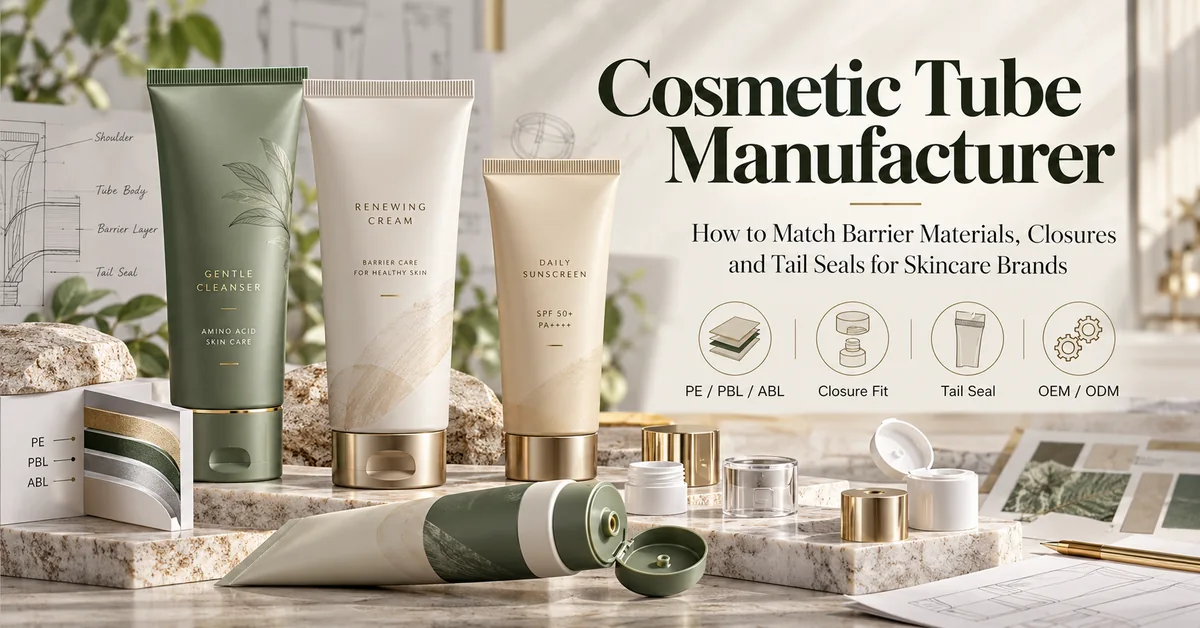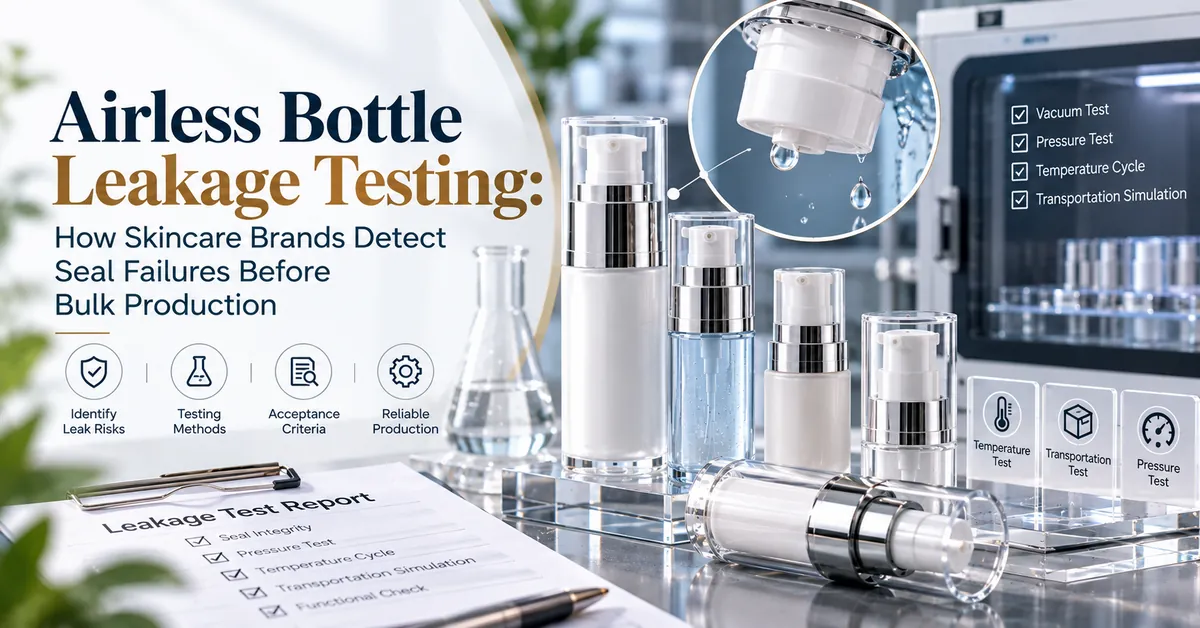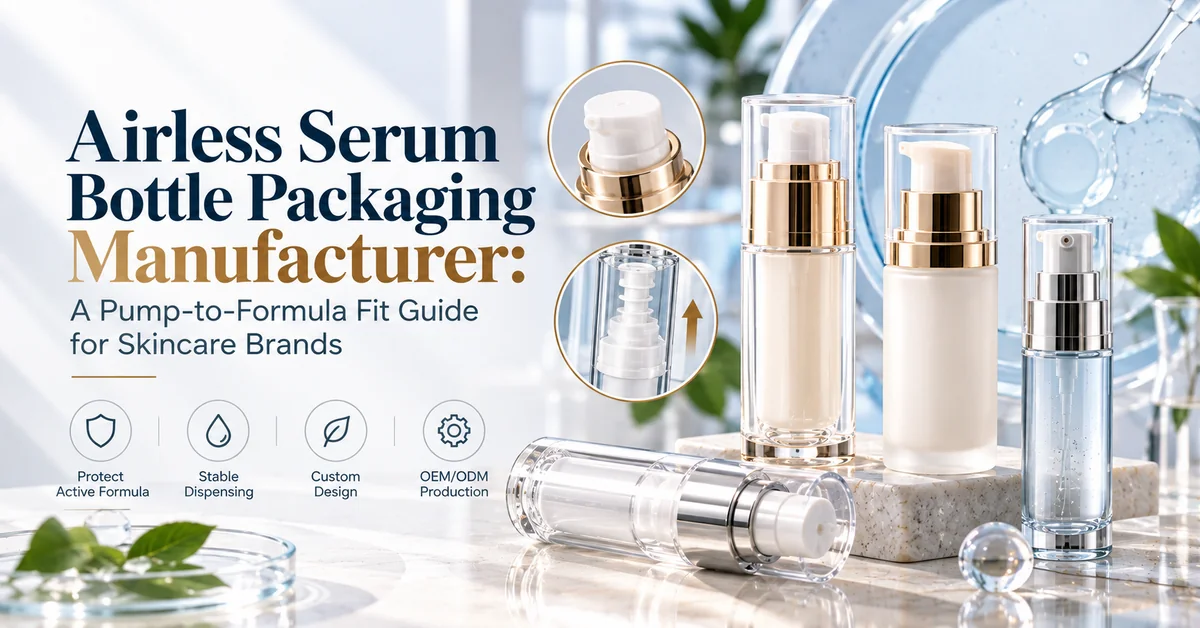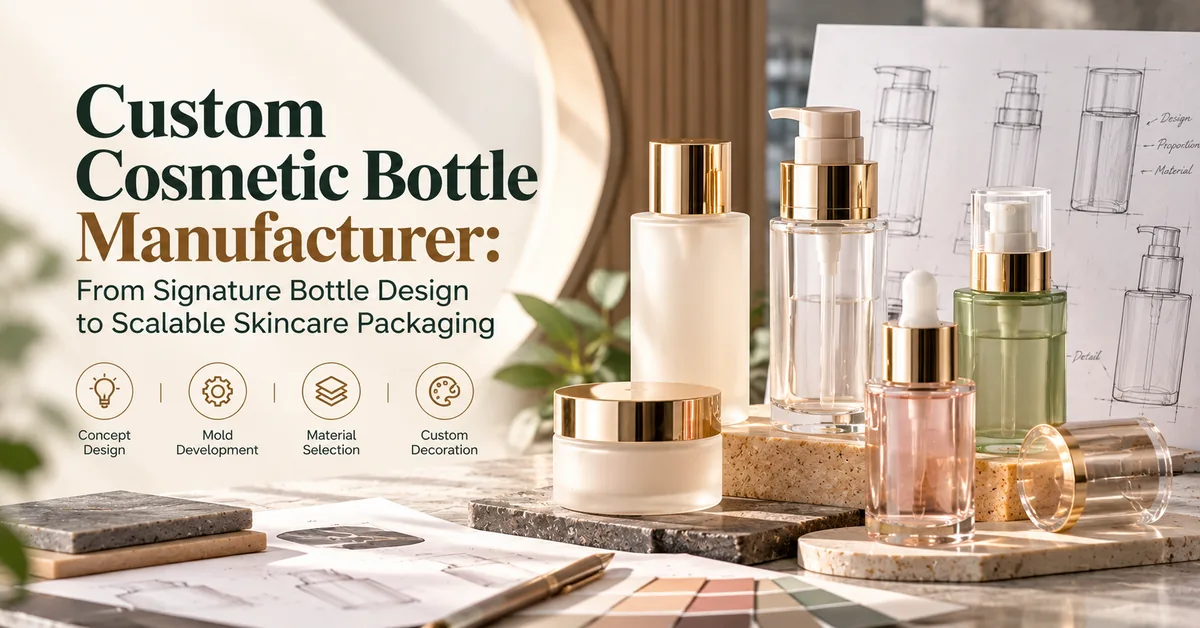

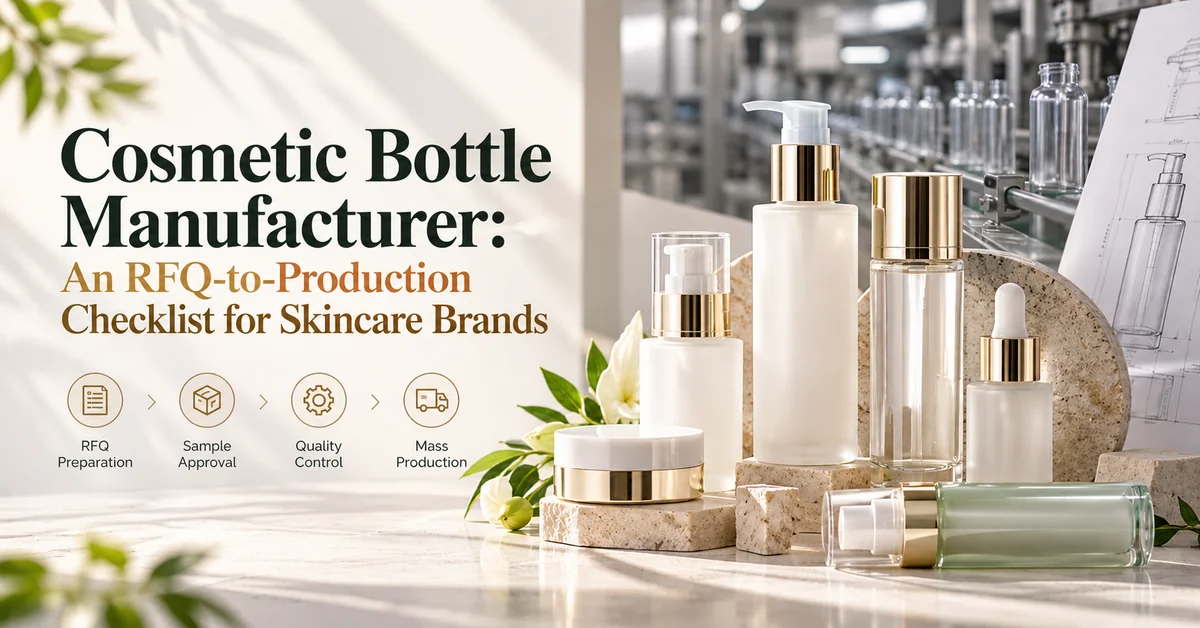
Selecting the right cosmetic bottle manufacturer is not simply about finding an attractive bottle at a competitive unit price. For skincare brands, contract manufacturers, private-label companies, and packaging distributors, the real challenge is approving a packaging system that works with the intended formula, filling process, brand identity, and production budget.
A bottle that looks excellent in a product photograph may behave differently during filling, transportation, repeated dispensing, or storage. An unclear neck specification can delay a launch. Incomplete artwork approval can create decoration defects. A quotation that excludes pumps, tooling, or assembly can lead to unexpected costs.
The solution is a structured RFQ-to-production approval process. Buyers should define the formula and technical requirements, compare suitable packaging formats, request a complete quotation, test assembled samples, approve measurable quality criteria, and confirm production documentation before placing a bulk order.
COSME Packaging, operated by Zhejiang Cosme Industry Co., Ltd., supports cosmetic packaging manufacturing and OEM/ODM customization for international beauty and personal-care brands.
1. Quick Answer: What Should You Check Before Choosing a Cosmetic Bottle Manufacturer?
A reliable cosmetic bottle manufacturer should be evaluated across six purchasing criteria: product suitability, material specifications, component compatibility, manufacturing capability, quality assurance, and total procurement cost.
A practical purchasing process follows these steps:
-
Define the product: Identify the formula, viscosity, fill volume, dispensing method, and target market.
-
Select the packaging: Compare bottle materials, closures, pumps, and custom design options.
-
Request technical documents: Obtain available drawings, material details, and component specifications.
-
Compare complete quotations: Check unit price, tooling, MOQ, decoration, samples, and delivery terms.
-
Validate samples: Test filling compatibility, leakage, dispensing, artwork, and transport performance.
-
Approve mass production: Confirm the production sample, inspection criteria, packaging instructions, and order schedule.
The goal is not to find the cheapest empty bottle. It is to source an approved packaging system with predictable performance and manageable production risk.
2. Which Buyers Benefit Most From Working Directly With a Bottle Manufacturer?
Different customers require different levels of engineering, customization, and commercial support.
| B2B buyer | Primary requirement | Recommended purchasing approach |
|---|---|---|
| Skincare brand owners | Distinctive design and dependable product packaging | Compare stock designs with customized branding |
| Cosmetic OEM/ODM factories | Filling compatibility and consistent component supply | Approve complete assembled samples |
| Private-label beauty brands | Brand differentiation and controlled launch costs | Evaluate existing molds before investing in new tooling |
| Packaging distributors | Repeatable quality and wholesale supply | Request standardized specifications and batch controls |
| Packaging engineers | Materials, dimensions, tolerances, and dispensing performance | Review drawings and test results |
| Premium beauty brands | Visual consistency and refined decoration | Evaluate finishes, assembly, and appearance acceptance criteria |
A manufacturer is particularly relevant when a buyer needs tooling development, component coordination, customized colors, or production quality management.
However, a fully customized bottle is not always the appropriate choice. A small trial launch with limited demand may benefit from an existing bottle design and simpler decoration. An unusual formula may require additional packaging development and compatibility studies before commercial approval.
Choose the purchasing model based on the actual project—not simply the lowest quoted price or most elaborate design.
3. Compare Cosmetic Bottle Types Before Requesting a Quote
The first technical decision is selecting a packaging format that matches how the consumer will use the product.
COSME's cosmetic bottle product range includes category directions such as plastic bottles, glass bottles, foaming bottles, dropper bottles, refillable packaging, and specialized dispensing formats. Specific models and availability should be confirmed during inquiry.
Cosmetic Bottle Format Comparison
| Bottle type | Typical applications | Main advantage | Critical buyer check |
|---|---|---|---|
| Standard lotion pump bottle | Face lotion, body lotion, skincare emulsions | Convenient, controlled dispensing | Pump output, dip tube, neck fit |
| Airless pump bottle | Serum, skincare treatment, selected creams | Can reduce air exchange during use | Actual airless mechanism, compatibility, evacuation |
| Dropper bottle | Liquid serums, facial oils, essences | Adjustable small-dose application | Pipette, bulb, drop behavior, seal |
| Foaming pump bottle | Foaming cleanser, hand wash, body wash | Dispenses prepared foam | Formula viscosity, mesh and pump compatibility |
| Refillable bottle | Refill-oriented skincare and personal care | Potential reuse of durable components | Refill connection, cleaning, component life |
| Dual-chamber bottle | Separately stored formulations | Allows distinct formula compartments | Chamber separation, dispensing ratio, filling |
These are packaging-format comparisons, not confirmed COSME stock model specifications.
Standard Pumps vs. Airless Systems
A conventional lotion pump typically uses a dip tube to draw the formula from the bottle. An airless system may use a rising piston or another mechanism designed to limit air replacement inside the reservoir.
Neither design is automatically suitable for every formulation.
For example, a free-flowing daily lotion may work well with a conventional pump. A higher-value treatment that requires reduced air exposure may benefit from a verified airless design, but compatibility and actual performance still need testing.
Brands considering these systems can review COSME's airless bottle packaging options and its airless pump bottle product example before discussing technical requirements.
When to Consider Specialized Dispensing
Foaming pumps need suitable liquid flow and air-liquid mixing. Dropper systems require appropriate pipette and closure components. Refillable designs need interfaces that remain functional after repeated use.
Choosing the wrong dispensing system can cause inconsistent dosing, clogging, leakage, or excessive residual product.
A capable supplier should help define the questions that must be resolved before the format is approved.
4. How Do You Choose Cosmetic Bottle Materials?
Material selection affects appearance, weight, manufacturing methods, transport risk, and compatibility with the formula.
The correct choice depends on the complete package, including every product-contact component—not only the outer bottle.
Cosmetic Bottle Material Selection Table
| Material | Relevant characteristics | Typical purchasing considerations |
|---|---|---|
| PET | Transparency and lightweight construction | Resin grade, wall design, formula compatibility |
| PETG | Good visual clarity and design flexibility | Chemical compatibility, processing, material cost |
| PP | Commonly used for closures and molded components | Rigidity, component fit, compatibility |
| PE / HDPE | Available in flexible or rigid packaging grades | Permeation, stiffness, appearance |
| Glass | Premium visual and tactile presentation | Breakage, weight, closure interface, shipping |
| Aluminum | Metallic exterior and distinctive appearance | Internal lining, corrosion resistance, closure compatibility |
| PCR plastic | Incorporates post-consumer recycled resin | Recycled content verification, color variation, product-contact suitability |
Why Formula Compatibility Comes First
A serum containing solvents or fragrance ingredients may behave differently from a water-based moisturizer. Oils, surfactants, acids, and other ingredients can affect packaging components in different ways.
Potential problems include swelling, stress cracking, color changes, permeation, decoration damage, or interaction with seals.
A brand should provide the relevant formulation properties and conduct compatibility studies using representative packaging components. Where necessary, the testing should include elevated and reduced temperatures, storage orientation, and the intended filling conditions.
Never approve a bottle material based only on a generic description such as "cosmetic grade" or "chemical resistant." Those terms do not replace testing with the actual formulation.
For recycled material projects, buyers should also verify the PCR percentage, traceability, repeatability of color, and suitability for the proposed product-contact application.
COSME describes PET, PETG, PP, PE, and PCR material options in its company and sustainability information. Final grades and available configurations must be confirmed for the specific packaging project.
5. Technical Specifications Every Cosmetic Bottle RFQ Should Include
An incomplete request for quotation often produces prices that are difficult to compare.
One cosmetic bottle manufacturer may quote the bottle body only, while another includes the pump, cap, printing, and assembly. Both prices can appear competitive while describing different deliverables.
A professional RFQ should specify the complete packaging system.
Cosmetic Bottle RFQ Specification Checklist
| Specification | Information to confirm | Why it matters |
|---|---|---|
| Nominal capacity | Intended labeled fill volume | Matches the marketed product quantity |
| Overflow capacity | Maximum internal volume | Supports filling and headspace planning |
| Bottle dimensions | Height, diameter, width, drawing revision | Determines filling-line and carton compatibility |
| Bottle material | Resin, grade, and product-contact components | Supports compatibility assessment |
| Neck finish | Thread, snap-fit, dimensional drawing | Ensures correct closure assembly |
| Pump or dispenser | Type, output, priming, dip tube | Determines dispensing performance |
| Closure | Cap design, liner, tamper feature if needed | Affects sealing and product protection |
| Decoration | Pantone reference, artwork, print area, finish | Controls branding and appearance |
| Quality requirements | Dimensional, cosmetic and functional limits | Creates measurable acceptance criteria |
| Order requirements | Quantity, destination, target schedule | Enables accurate commercial planning |
For pump packaging, request the complete assembled unit specification rather than evaluating the bottle and pump independently.
A neck finish may look compatible but still differ in thread geometry, sealing interface, closure height, or torque requirements. Such differences can create expensive filling-line problems.
Example: A Quote-Ready Skincare Bottle Request
A purchasing team developing a facial lotion could describe its requirements as follows:
Application: Facial lotion for retail skincare
Packaging: Rigid bottle with lotion pump and protective cap
Fill volume: To be confirmed with the filling partner
Formula: Emulsion; viscosity and compatibility data available for review
Decoration: Color-matched body with printed brand logo
Quantity: Initial launch forecast plus annual reorder estimate
Required documents: Component specifications, drawings, sample approval criteria, and quotation breakdown
This information gives suppliers a clearer basis for discussing available designs, engineering requirements, and production costs.
6. Existing Bottle Designs vs. Custom Mold Development
A cosmetic bottle manufacturer may offer two different project routes: customizing an existing design or developing a new structure.
Route A: Customize an Existing Design
Existing packaging can be a practical solution when the brand needs an efficient launch and does not require exclusive bottle geometry.
Typical steps include:
-
Select a suitable bottle shape and target capacity.
-
Confirm the closure, pump, and material options.
-
Define the required colors, logo, printing, and surface finish.
-
Review the quotation and technical requirements.
-
Approve a pre-production sample.
-
Begin production after formal approval.
This approach may reduce tooling investment, although decoration, minimum production quantities, and manufacturing schedules still need confirmation.
Route B: Develop New Packaging Tooling
A custom mold becomes relevant when the required shape, dimensions, or functionality cannot be achieved with existing tooling.
COSME's published tooling process includes:
Custom Bottle Development Workflow
| Step | Development stage | Main objective |
|---|---|---|
| 1 | Confirm Design | Establish the packaging structure and requirements |
| 2 | 3D Drawing | Develop and review engineering drawings |
| 3 | CNC Prototype | Evaluate a physical design representation |
| 4 | Mold Opening | Produce the manufacturing tooling |
| 5 | T1/T2 Samples | Evaluate and refine initial molded samples |
| 6 | Mass Production | Manufacture the approved packaging |
| 7 | Delivery | Prepare and deliver the finished order |
Custom development requires additional attention to tooling ownership, design revisions, sampling costs, engineering feasibility, and approval responsibilities.
Do not authorize production tooling solely from a visual rendering. A physical prototype and an approved engineering drawing help establish whether the bottle can meet functional and manufacturing requirements.
The two routes have different commercial implications. Buyers should request quotations that identify the selected route and its associated costs.
7. Quality Control: What Should Be Tested Before Bulk Production?
Manufacturing capability is valuable only when the resulting products meet agreed specifications consistently.
COSME states that its quality process includes incoming material inspection, dimensional checks during injection and blow molding, inspection of wall thickness and visible surface defects, finished-product leakage checks, printing adhesion assessments, and batch-traceability records.
These are documented company-level practices. Buyers should still confirm the exact testing protocol and results relevant to their own bottle configuration.
Pre-Production Quality Approval Matrix
| Inspection area | Recommended buyer validation | Potential purchasing risk |
|---|---|---|
| Material identity | Confirm declared resin and contact components | Unexpected formula interaction |
| Dimensions | Measure against approved drawings and tolerances | Filling-line or closure mismatch |
| Wall thickness | Review uniformity and critical sections | Deformation or mechanical weakness |
| Neck and closure | Check assembly, torque, fit and sealing | Loose closures or damaged threads |
| Leakage | Test filled assemblies in defined conditions | Product loss and shipping complaints |
| Pump performance | Measure priming, output consistency and actuation | Unreliable consumer dispensing |
| Formula compatibility | Evaluate actual formula with complete packaging | Swelling, cracking or discoloration |
| Decoration | Inspect color, adhesion, registration and abrasion | Inconsistent retail appearance |
| Distribution packaging | Assess carton protection and handling | Breakage and cosmetic damage |
| Batch consistency | Define sampling, defect limits and records | Variation across bulk deliveries |
Establish an Approved Reference Sample
Before mass production, buyer and manufacturer should agree on a signed or otherwise formally documented reference sample, supported by current specifications and artwork.
It should establish the approved appearance and measurable functional requirements. Any permitted differences should be recorded, rather than decided informally after goods have been manufactured.
For incoming or final inspection, ISO 2859-1 provides an established framework for acceptance sampling by attributes. For distribution evaluation, ASTM D4169 describes performance-testing practices for shipping containers and systems.
These are references that buyers may use when developing agreed test plans. Their inclusion does not imply that COSME holds a particular certification or that every product has been tested to these standards.
The actual test methods, sample quantities, acceptance limits, and reporting requirements should be confirmed in the purchase specification.
8. What Determines Custom Cosmetic Bottle Pricing?
The lowest unit price does not necessarily produce the lowest final project cost.
When comparing manufacturers, purchasing teams should evaluate the complete commercial scope.
Key Cost Factors
| Cost factor | Why it changes |
|---|---|
| Bottle material | Resin type, weight, grade, recycled-content requirements |
| Design complexity | Shape, wall distribution, number of components |
| Mold development | New tooling, engineering changes, validation |
| Dispensing system | Pump, dropper, valve, cap, or special mechanism |
| Decoration | Number of colors, printing processes, finishes |
| Order quantity | Setup costs, production efficiency, material procurement |
| Quality requirements | Additional inspections, compatibility or performance tests |
| Export logistics | Cartons, protective packing, shipment volume, destination |
How to Compare Quotations Correctly
Ask every cosmetic bottle manufacturer to separate the following where applicable:
-
Bottle body, closure, pump, and component assembly costs.
-
Printing, color customization, and surface decoration.
-
Tooling and prototype charges.
-
Sample costs and applicable testing charges.
-
MOQ for each material, color, or decoration option.
-
Production lead time and quoted delivery terms.
The quotation should identify what is included and what remains subject to technical approval.
For repeat purchases, also confirm whether future orders require additional setup charges and how replacement components or design modifications will be handled.
The strongest cost-saving opportunity often comes from removing ambiguity before production—not negotiating a lower unit price after the specification is finalized.
9. Why Consider COSME Packaging for Custom Cosmetic Bottles?
A suitable manufacturing partner should connect product development, production planning, decoration, and quality control.
COSME Packaging, operated by Zhejiang Cosme Industry Co., Ltd., was founded in 2015 and specializes in cosmetic primary packaging for beauty and personal-care applications.
According to the company's published information, its capabilities include:
-
Packaging R&D: Product development and packaging design support.
-
Mold development: 3D drawings, CNC prototypes, trial samples, and new tooling.
-
Manufacturing equipment: A reported factory area of approximately 15,000 m² and more than 50 injection molding machines.
-
Customization: Bottle shapes, colors, logo printing, silk screening, hot stamping, and decorative finishes.
-
Quality management: Incoming material inspection, dimensional checks, leakage checks, printing inspections, and batch records.
COSME supports both existing packaging customization and new OEM/ODM development projects. This allows buyers to discuss different routes depending on their design needs and commercial requirements.
Explore the company's manufacturing background and quality control capabilities to understand its published production and inspection processes.
The most important next step is to confirm whether the required design, material, dispensing system, production quantity, and testing expectations can be supported for the specific project.
10. Request a Production-Ready Cosmetic Bottle Quotation
Before contacting a cosmetic bottle manufacturer, prepare a concise packaging brief covering the essential commercial and engineering information.
Your Cosmetic Bottle RFQ Checklist
Include these details to support a more accurate technical review and quotation:
-
Product type and intended formula: Identify the cosmetic product, viscosity, and relevant formulation characteristics.
-
Target fill volume and bottle material: Define the required capacity and preferred packaging material.
-
Bottle shape and dispensing system: Specify whether the application requires a lotion pump, airless pump, dropper, foaming system, or another closure.
-
Colors, logo, and decorative finish: Provide branding references, artwork, and printing requirements.
-
Estimated initial order quantity: Indicate the expected first order and annual demand if known.
-
Existing design or new mold requirement: Clarify whether an existing bottle format can be considered.
-
Destination market and launch schedule: Specify the delivery region and target project timeline.
-
Sample, testing, and quality requirements: List relevant functional testing and approval expectations.
A detailed request helps the manufacturer identify suitable packaging options, review engineering feasibility, and prepare a more accurate commercial proposal.
COSME's team can be contacted through its official inquiry page to discuss packaging requirements, available options, sample requests, and commercial terms.
Providing specific information helps the supplier evaluate the project more efficiently and reduces unnecessary quotation revisions.
11. Frequently Asked Questions About Cosmetic Bottle Manufacturing
1. How do I verify whether a cosmetic bottle manufacturer has genuine manufacturing capabilities?
Review its company identity, factory information, equipment, tooling process, and quality control documentation. Request relevant production evidence or arrange a factory audit when appropriate. A website product catalog alone does not prove that every listed packaging component is manufactured in-house.
2. What is the typical MOQ for custom cosmetic bottles?
MOQ depends on the bottle design, material, production process, color, decoration, and whether new tooling is required. COSME does not publish one universal MOQ for every product. Request a project-specific quotation rather than assuming a standard quantity.
3. Can I customize an existing cosmetic bottle without developing a new mold?
Yes, existing packaging designs may support customization such as color matching, logo printing, and selected decorative finishes. Structural changes, however, may require different tooling. The manufacturer should confirm which modifications are technically available for the chosen design.
4. How long does cosmetic bottle production take?
COSME's published FAQ describes a typical production period of approximately 40–50 days, depending on customization complexity. This is not a guaranteed lead time for every order. Tooling, sampling, approvals, production scheduling, and international shipping should be confirmed separately.
5. Which cosmetic bottle material is best for skincare products?
There is no universally superior material. PET, PETG, PP, PE, glass, and aluminum each have different design and performance considerations. The correct selection depends on formula compatibility, appearance, filling methods, dispensing requirements, and cost.
6. Are airless cosmetic bottles always better than standard pump bottles?
No. Airless systems may offer advantages for certain formulations, but actual performance depends on the mechanism and its compatibility with the product. Conventional pump bottles may be appropriate when they meet the required dispensing, sealing, and stability criteria.
7. What specifications should I request for a cosmetic bottle pump?
Request the available pump drawing, neck compatibility information, intended output per stroke, priming behavior, dip-tube specifications where applicable, and assembly requirements. Test the complete pump-and-bottle combination with the intended formula before production approval.
8. Should I request samples before placing a bulk cosmetic bottle order?
Yes. Evaluate representative assembled samples for appearance, dimensions, closure fit, dispensing, leakage, and formula compatibility. For custom projects, an approved pre-production sample and written technical specifications help establish the reference for future quality inspections.
9. Does a cosmetic bottle manufacturer need to provide testing and certification documents?
The required documentation depends on the packaging material, intended use, market, and buyer specification. Request relevant material declarations, inspection reports, test records, and applicable certificates. Do not assume that general factory quality control automatically demonstrates compliance with every requested standard.
10. What information should I provide to receive an accurate wholesale quotation?
Provide the bottle type, fill volume, material, dispensing system, decoration requirements, initial quantity, annual demand estimate, target market, delivery expectations, and any technical drawings or reference images. Clearly state whether you need an existing design or new custom tooling.
12. Conclusion
Choosing a cosmetic bottle manufacturer is a technical and commercial decision that influences product quality, customer experience, manufacturing efficiency, and long-term packaging costs.
For skincare brands, OEM/ODM companies, and wholesale packaging buyers, the most effective approach is to define requirements before requesting prices. Compare bottle formats and materials, confirm the complete component specification, validate samples with the actual formula, establish clear inspection criteria, and approve production documentation before bulk manufacturing.
COSME Packaging combines cosmetic packaging development, mold customization, manufacturing processes, decorative options, and published quality control practices to support beauty and personal-care packaging projects.
If you are developing a new skincare range, sourcing wholesale cosmetic bottles, or exploring customized packaging, contact COSME Packaging with your product specifications and purchasing requirements to discuss suitable options and obtain a project-specific quotation.