
Choosing a reliable cosmetic bottle with pump supplier is an important purchasing decision for skincare brands, cosmetic contract manufacturers, packaging distributors, and private-label beauty businesses. A pump bottle may appear simple, but its performance depends on several components working together: the bottle body, neck finish, pump mechanism, dip tube, seals, closure, and product formulation.
A beautiful bottle can still become an expensive packaging problem. The pump may deliver an inconsistent dose, the closure may leak during transportation, or the dip tube may be too short to dispense the remaining lotion. Another common issue occurs when a bottle and pump are purchased separately without confirming dimensional compatibility. Both components may meet their individual specifications, yet the assembled package may fail during filling or consumer use.
For OEM buyers, the goal is not merely to purchase attractive containers at a competitive price. It is to source a complete dispensing system that performs consistently, fits the intended production process, protects the formulation, and supports repeat orders.
The most effective sourcing strategy is to evaluate the bottle, pump, formula, and filling process as one packaging system.
This guide explains how to compare cosmetic pump bottle types, select dispensing mechanisms, verify materials and neck compatibility, evaluate quality testing, understand OEM customization costs, and qualify a supplier before placing a bulk order.
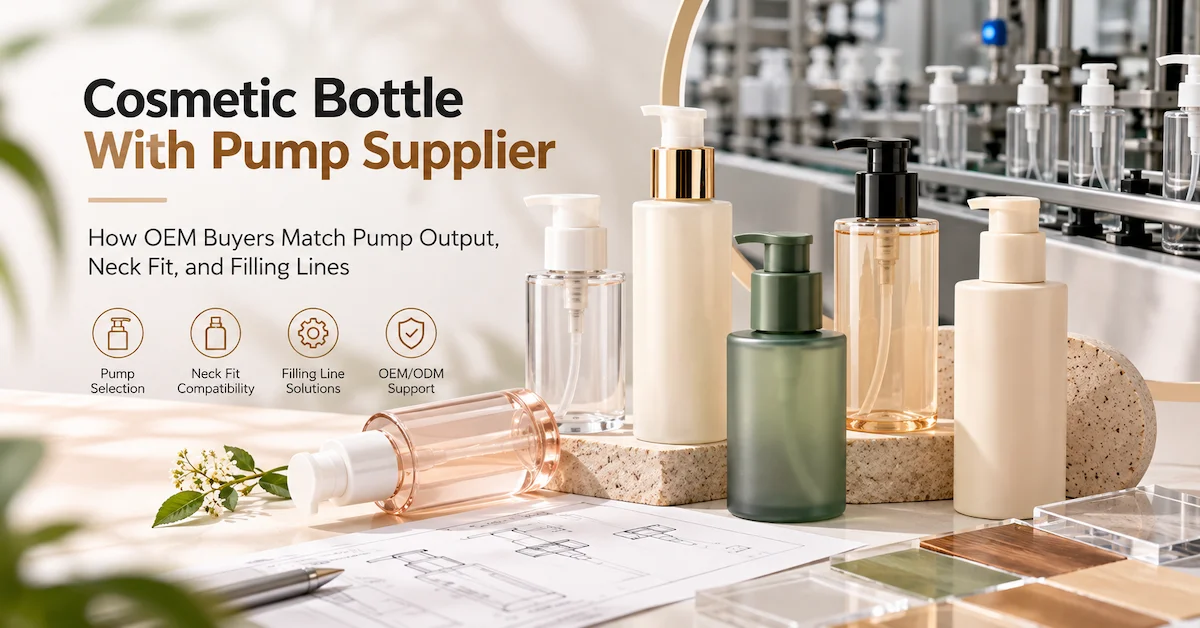
What Should You Look for in a Cosmetic Bottle With Pump Supplier?
A professional cosmetic bottle with pump supplier should help buyers match the packaging structure to the product's actual requirements.
That means looking beyond bottle capacity, material, and appearance. The pump must deliver the intended formulation, the closure must fit the bottle correctly, and the complete package must withstand the expected filling, storage, transportation, and consumer-use conditions.
Five factors deserve particular attention:
-
Dispensing performance: Pump output, priming, actuation force, consistency, and residual product.
-
Component compatibility: Bottle neck finish, pump closure, gasket, dip tube, and sealing interface.
-
Formula compatibility: Product-contact materials must be assessed against the finished cosmetic formulation.
-
Manufacturing quality: Dimensional control, assembly consistency, appearance inspection, and functional testing.
-
Commercial reliability: OEM customization, sample approval, documented specifications, repeat-order consistency, and transparent quotation terms.
These requirements are interconnected.
For example, a brand may choose a premium glass bottle for its facial lotion. However, if the selected pump closure does not match the bottle's neck finish or the dip tube cannot reach an appropriate dispensing position, the complete package may perform poorly.
The same problem can occur with plastic bottles.
Even small differences in neck geometry, wall thickness, or pump assembly can influence the reliability of the finished product.
When comparing suppliers, buyers should therefore request complete packaging samples rather than relying exclusively on separate bottle and pump samples.
Brands exploring different cosmetic containers can begin by reviewing the COSME Cosmetic Bottles collection and discussing their required dispensing system with the manufacturer.
Understanding the Different Types of Cosmetic Pump Bottles
Not every pump bottle works in the same way.
The correct dispensing mechanism depends on the viscosity of the formulation, the desired application, consumer expectations, and the product's protection requirements.
Lotion Pump Bottles
Lotion pump bottles are commonly used for facial lotions, body lotions, moisturizers, liquid soaps, and selected cosmetic emulsions.
A conventional lotion pump typically draws the formulation through a dip tube and releases it when the actuator is pressed.
The amount dispensed per stroke depends on the pump design and the formulation.
For a lightweight facial lotion, consumers may prefer a controlled output that allows small applications. A body lotion packaged in a larger bottle may benefit from a different pump output and actuator design.
A buyer should never assume that the same pump is appropriate for both products.
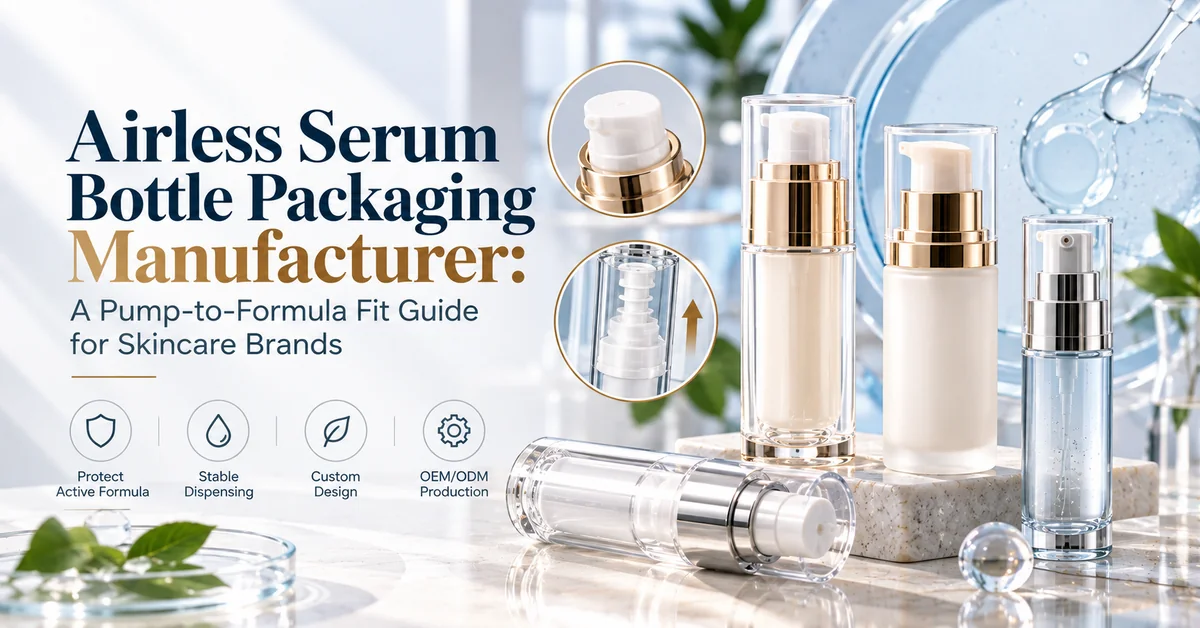
Treatment and Serum Pump Bottles
Treatment pumps are often considered for products applied in relatively small quantities.
These may include facial serums, essences, liquid skincare treatments, and selected cosmetic concentrates.
Depending on the formula, procurement considerations can include controlled output, smooth actuation, compact packaging, and compatibility with low-viscosity or moderately viscous liquids.
However, the term serum pump does not describe one universal technical specification.
A supplier should identify the actual pump model, output characteristics, product-contact materials, and suitable operating conditions.
Foaming Pump Bottles
Foaming pump bottles are designed to produce foam through a specialized dispensing mechanism.
Unlike a conventional lotion pump, a foaming pump combines liquid and air through a system intended to generate a foam texture.
The formulation must be suitable for that mechanism.
A standard lotion may not produce the intended foam, while an appropriately formulated cleanser may perform well.
For buyers sourcing foam dispensers, formulation viscosity, foam quality, pump mesh structure, and repeated operation become especially important.
The supplier must confirm that the selected foaming mechanism matches the product rather than assuming that every liquid cleanser is suitable.
Fine-Mist Spray Bottles
Fine-mist pumps are commonly considered for facial mists, toners, fragrance products, and other suitable low-viscosity liquids.
Instead of dispensing a concentrated drop or stream, the pump produces a spray pattern.
Important performance considerations include spray distribution, actuation force, leakage, clogging, and material compatibility.
A misting pump should not be selected merely because it looks similar to a lotion dispenser.
The required atomization behavior is different.
Airless Pump Bottles
Airless packaging uses a dispensing architecture intended to limit the introduction of replacement air into the product reservoir during normal use.
Depending on the design, it may employ a moving piston, collapsible inner reservoir, or another specialized mechanism.
This is different from a conventional dip-tube lotion pump.
A premium-looking bottle with a pump actuator is not necessarily an airless bottle.
When airless performance is important, buyers should request structural confirmation and applicable testing.
COSME also provides an Airless Bottle product category for customers comparing conventional pump packaging with alternative dispensing structures.
Cosmetic Pump Bottle Comparison
| Pump type | Typical applications | Key performance requirement | Main sourcing concern |
|---|---|---|---|
| Lotion pump | Facial lotion, body lotion, liquid skincare | Consistent dispensing of the intended viscosity | Dose variation, dip-tube fit |
| Treatment pump | Serum, essence, concentrated skincare | Controlled output | Low-volume accuracy, priming |
| Foaming pump | Foaming facial cleanser, hand wash | Appropriate foam generation | Formula compatibility, mesh clogging |
| Fine-mist sprayer | Facial mist, toner, fragrance | Consistent spray pattern | Atomization, leakage |
| Airless dispenser | Selected serums, lotions and creams | Verified airless mechanism and controlled dispensing | Reservoir design, pump performance |
This comparison provides general selection guidance. Specific applications must be confirmed against the formulation and tested packaging.
How to Match Pump Output to the Cosmetic Formula
Pump output is one of the most important technical specifications in cosmetic bottle purchasing.
It describes the amount of product dispensed during a defined actuation.
Depending on the measurement method, output may be expressed in milliliters per stroke or grams per stroke.
The value influences the consumer experience, product consumption, label directions, and perceived product quality.
Why Pump Output Matters
Consider two skincare products.
The first is a concentrated facial treatment intended for small applications. The second is a body lotion intended to cover a much larger skin area.
Using the same pump design for both products may create an unsuitable dispensing experience.
A pump that releases too much product can make application inconvenient and increase waste.
A pump that releases too little may require excessive repeated pressing, creating frustration.
The appropriate output should reflect the intended use, formulation, and packaging size.
Measuring Pump Output
For a basic gravimetric assessment, the pump can be operated under a defined procedure while the dispensed product is collected and weighed.
A simplified calculation is:
Average Pump Output = Total Dispensed Product Mass ÷ Number of Measured Actuations
For example, suppose a development test collects 12 grams of product over 60 measured actuations after an agreed priming procedure.
The calculated average output is 0.20 grams per actuation.
This is an illustrative calculation, not a published COSME specification or recommended output for every cosmetic product.
The actual test should also evaluate variation between actuations and between samples.
An average alone may hide inconsistent performance.
Factors That Influence Dispensing Consistency
Pump output may change with:
-
Formulation viscosity and rheological behavior.
-
Product temperature.
-
Pump chamber and valve design.
-
Actuator stroke and user technique.
-
Priming conditions.
-
Dip-tube geometry.
-
Reservoir geometry and fill level.
-
Storage conditions and component aging.
Buyers should provide the supplier with relevant formulation characteristics before choosing a pump.
A sample that performs adequately with water may behave differently with a rich cosmetic emulsion.
Test Output Across the Product's Useful Life
Dispensing performance should be evaluated at several stages.
A useful test plan may examine initial priming, normal dispensing, performance near the end of the bottle, and operation after defined storage conditions.
For a high-value skincare formulation, residual product can also be commercially significant.
The brand should agree with the supplier on the acceptable amount of product remaining after the intended dispensing procedure.
Procurement recommendation: Record the pump model, formula, sample quantity, priming procedure, test temperature, output measurements, and acceptance criteria in the approval documentation.
This makes repeat-order verification considerably more reliable than comparing samples by feel alone.
Bottle Neck Finish and Pump Closure Compatibility
One of the most frequent sourcing mistakes is assuming that pumps with similar-looking closures are interchangeable.
A pump may appear to fit a bottle during a quick manual trial but still fail to maintain reliable sealing or assembly performance.
What Is a Bottle Neck Finish?
The neck finish describes the relevant geometry of the bottle opening and closure interface.
Depending on the design, its specification can include opening diameter, thread configuration, sealing surfaces, and other dimensional features.
In packaging procurement, designations such as 18/410, 20/410, 24/410, and 28/410 are frequently encountered.
However, these designations alone should not be treated as proof of interchangeability.
Actual compatibility depends on the relevant dimensional standard, supplier drawings, thread tolerances, gasket arrangement, and closure design.
Two components with the same nominal neck-finish designation can still require detailed fit confirmation.
What Should Buyers Verify?
| Component | Specification to verify | Potential failure if incorrect |
|---|---|---|
| Bottle neck | Drawing, diameter, thread and sealing geometry | Incomplete closure engagement |
| Pump closure | Compatible finish and dimensional tolerance | Poor fit or unstable assembly |
| Gasket or liner | Material, dimensions and compression behavior | Leakage or compatibility problems |
| Dip tube | Length, diameter and connection fit | Poor dispensing or excessive residual product |
| Actuator | Discharge direction and operating mechanism | Uncomfortable use or unintended dispensing |
| Protective cap | Fit and retention | Accidental actuation during handling |
| Locking mechanism | Actual lock design and retention | Leakage during transport or storage |
Why Gasket Compression Matters
The pump closure may require a sealing element to establish the intended seal between the closure and bottle neck.
The design should provide appropriate compression without damaging the components.
Insufficient compression can create leakage paths.
Excessive compression or incorrect assembly conditions can damage the seal or distort components.
The appropriate assembly torque or application force should be specified for the actual bottle-and-pump combination.
There is no single universal torque value suitable for every cosmetic bottle.
Dip-Tube Length Is Not a Minor Detail
The dip tube must be positioned correctly inside the container.
If it is too short, the pump may stop drawing product while a significant amount remains.
If it is excessively long or incorrectly positioned, it may bend, obstruct the inlet, or behave unpredictably.
The correct length depends on the internal bottle height, bottom geometry, pump design, and assembly requirements.
For unusual bottle shapes, buyers should request an assembled sample and conduct a residual-product test.
The neck finish, pump closure, gasket and dip tube should be approved as a matched assembly.
Purchasing them solely from separate catalogs without assembly validation introduces avoidable risk.
Selecting the Right Bottle Material: PET, PETG, PP, PE or Glass
Material selection influences appearance, weight, durability, processing requirements, and compatibility with the finished cosmetic formulation.
A cosmetic bottle with pump supplier may offer different material options, but the correct choice depends on the actual product.
PET Cosmetic Pump Bottles
PET is used in many transparent packaging applications.
Its visual appearance and practical processing characteristics make it relevant for a range of cosmetic and personal-care containers.
However, material suitability cannot be determined from transparency alone.
The buyer should evaluate the actual PET grade, bottle construction, formulation compatibility, expected storage conditions, and recycling considerations.
PETG Cosmetic Pump Bottles
PETG may be considered when packaging appearance, clarity, or specific forming and molding requirements are important.
For premium skincare packaging, it can be relevant to designs where the visual presentation of the bottle matters.
Nevertheless, PETG should not automatically be described as chemically resistant to every cosmetic ingredient.
Its performance must be evaluated using the intended formulation and actual packaging components.
PP Cosmetic Pump Bottles
PP is widely used in cosmetic packaging components, including certain containers and closures.
It may be considered where rigidity, molded features, or particular compatibility requirements are important.
For a PP pump-bottle project, the buyer should verify the product-contact material and specific grade rather than relying solely on the general material name.
PE Cosmetic Pump Bottles
PE materials are common in cosmetic and personal-care packaging.
Depending on the selected grade and structure, PE may provide different flexibility and processing characteristics from more rigid packaging materials.
The intended bottle shape, formula, dispensing requirements, and manufacturing process should guide selection.
Glass Cosmetic Pump Bottles
Glass may be suitable for products where weight, appearance, perceived quality, and certain material-contact requirements are important.
However, glass packaging also introduces breakage, transportation, neck-finish, and filling-line considerations.
A glass bottle and a plastic bottle with the same nominal capacity can have very different handling and shipping characteristics.
The selected pump must be compatible with the actual neck finish and sealing surfaces.
Material Comparison for B2B Buyers
| Material | Main selection considerations | Questions to resolve before approval |
|---|---|---|
| PET | Transparency, bottle design, weight, processing | Is the selected grade compatible with the formula? |
| PETG | Appearance, clarity, component design | Is the material suitable for expected storage and handling? |
| PP | Molding properties, structural features, compatibility | Which grade is proposed and where is it used? |
| ON | Flexibility, packaging structure, processing | Will the proposed construction meet dimensional requirements? |
| Glass | Premium presentation, weight, breakage considerations | Can the pump, filling line and shipping package accommodate it? |
| PCR plastic | Recycled-content sourcing and variability | Is the material grade, recycled percentage and use location documented? |
COSME describes PET, PETG, PP, PE and recycled-material packaging directions in its company information.
For procurement purposes, buyers should still request the material composition of the specific bottle and its product-contact components.
Formula Compatibility: Why the Complete Pump Assembly Must Be Tested
Material compatibility is not limited to the bottle body.
A formula may contact multiple materials as it passes through the dispensing system.
Potential contact points include the dip tube, internal pump chamber, valves, seals, and outlet.
The packaging engineer must consider the complete product-contact pathway.
Common Compatibility Risks
Possible problems include swelling, material degradation, stress cracking, discoloration, changes in pump performance, leakage, and interactions that affect the formulation.
These risks depend on the actual materials and cosmetic ingredients.
A packaging system that performs satisfactorily with one formula may not be suitable for another.
What Information Should the Cosmetic Brand Provide?
The brand or contract manufacturer should provide sufficient relevant information to support material selection and testing.
This can include:
-
Product category and intended application.
-
General formulation type.
-
Relevant viscosity information.
-
pH where applicable.
-
Presence of oils, solvents, alcohols or fragrance ingredients.
-
Storage and shelf-life requirements.
-
Filling temperature and production conditions.
-
Any known packaging-compatibility concerns.
The supplier does not necessarily need unrestricted access to the complete confidential formula.
Relevant technical information can be communicated through an agreed confidentiality and testing arrangement.
Formula Stability and Packaging Validation
A practical validation program may assess appearance, odor, viscosity, pH where relevant, dispensing behavior, leakage, and interactions with product-contact components.
The responsible cosmetic manufacturer should determine the appropriate formulation stability and product safety evaluation.
For products intended for the European Union, Regulation (EC) No 1223/2009 addresses cosmetic product safety documentation. Its Annex I includes relevant packaging-material characteristics, particularly purity and stability, in the cosmetic product safety report.
This does not mean that every pump bottle must carry an independent certification under that regulation.
Rather, it reinforces the importance of obtaining sufficient packaging information for the finished cosmetic product's safety assessment.
Packaging testing should be designed around the actual formula, product use and target market.
Filling-Line Compatibility: A Critical Requirement for Contract Manufacturers
A pump bottle can perform perfectly in manual testing and still create significant problems on an automated filling or assembly line.
For cosmetic contract manufacturers, packaging efficiency depends on the relationship between container dimensions, handling equipment, filling process, and closure application.
Bottle Stability and Conveyor Handling
The bottle must remain stable during production.
Tall, narrow bottles may require specific handling arrangements. Irregular shapes can influence alignment and transport.
Buyers should provide bottle drawings to the contract filler before the production order is finalized.
Relevant details include overall height, base dimensions, body geometry, and dimensional tolerances.
Filling Nozzle Clearance
The bottle opening must allow the intended filling process.
The filler should evaluate nozzle positioning, clearance, fill speed, and the potential for product splashing or contamination of sealing surfaces.
A highly viscous lotion may require different filling conditions from a low-viscosity serum.
The packaging supplier should coordinate with the brand's filling partner when necessary.
Pump Application and Closure Torque
After filling, the pump may need to be placed and tightened using automated or semi-automated equipment.
The pump closure must be suitable for the application method.
If the closure is incorrectly aligned or tightened, the package may leak even when the pump and bottle are individually acceptable.
A production trial should establish suitable machine settings and acceptance criteria.
Dip-Tube Insertion
The dip tube must enter the filled container correctly.
Depending on bottle shape and tube geometry, insertion can become a source of misalignment or assembly difficulties.
The packaging team should examine whether the dip tube bends appropriately, catches on the bottle opening, or creates other insertion problems.
Packaging-Line Trial Checklist
| Filling-line issue | What to verify |
|---|---|
| Conveyor stability | Bottle handling at intended line speed |
| Filling access | Neck opening and filling nozzle compatibility |
| Fill accuracy | Product quantity and process consistency |
| Pump placement | Actuator and closure orientation |
| Dip-tube insertion | Correct insertion without damage |
| Closure application | Fit, torque and sealing |
| Labeling | Available label area and bottle orientation |
| Cartoning | Finished package dimensions and stability |
| Line rejection | Common failure points and corrective actions |
Before placing a large purchase order, buyers should ideally conduct a representative filling trial using production-intended components.
This can reveal problems that are difficult to identify during desktop design reviews.
Quality Control Standards for Cosmetic Pump Bottles
Quality control should verify the complete packaging assembly rather than simply check the appearance of empty bottles.
For bulk orders, a structured inspection plan helps reduce disputes and provides measurable acceptance criteria.
Incoming Material and Component Inspection
The first stage involves reviewing incoming materials and purchased components.
Relevant information may include material identity, visual condition, dimensions, and supplier documentation.
For pump assemblies, the manufacturer should establish how critical purchased components are inspected or otherwise qualified.
In-Process Dimensional Inspection
Bottle dimensions influence filling, pump fit, visual consistency, and carton packing.
The manufacturer should identify critical dimensions and monitor them during production.
Important features can include neck geometry, body height, wall thickness, and assembly interfaces.
Surface and Decoration Inspection
Cosmetic packaging is both functional and visual.
Common appearance concerns include scratches, bubbles, molding defects, color variation, printing misalignment, and inconsistent decorative finishes.
Acceptance criteria should be agreed before production.
A premium cosmetics brand may require different cosmetic appearance limits from a basic personal-care line.
Functional Pump Testing
The quality plan should include testing appropriate to the pump design and application.
This may include priming, pump output, repeated actuation, actuation force, closure fit, and dispensing near the end of the bottle.
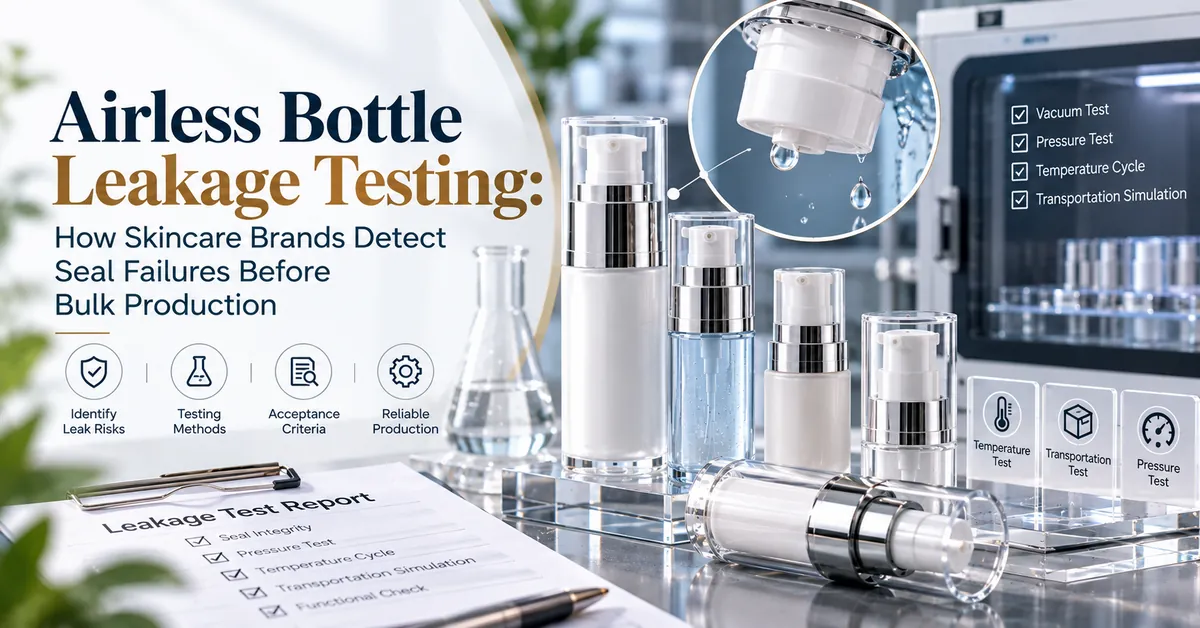
Leakage and Sealing Tests
A packaging sample should be assessed under relevant conditions rather than judged only by a quick upside-down check.
The appropriate procedure may include storage orientation, temperature conditioning, mechanical handling, or other conditions reflecting intended use.
The test and acceptance criteria should be specified by the project team.
Recommended Quality-Control Matrix
| QC stage | Inspection focus | Common risks |
|---|---|---|
| Incoming materials | Material identity and component condition | Wrong materials or damaged components |
| Bottle production | Dimensions, neck finish, wall thickness | Poor pump fit, deformation |
| Pump incoming inspection | Assembly condition and critical features | Incorrect pump components |
| Assembly | Gasket, dip tube, closure engagement | Leakage, dispensing failure |
| Functional testing | Pump output, priming and operation | Inconsistent dispensing |
| Finished appearance | Scratches, color, printing and coating | Cosmetic defects |
| Final packaging | Protection, carton quantity and labeling | Transit damage or packing errors |
| Shipment release | Approved specifications and records | Nonconforming batches reaching customers |
According to COSME's published manufacturing and quality-control information, the company describes incoming inspection, dimensional checks during molding, leakage testing, printing adhesion checks, color inspection, and batch traceability.
These published practices are relevant to buyers evaluating its general manufacturing capabilities.
Specific pump testing methods, limits, and applicable product inspection records should be confirmed for each project.
Common Cosmetic Pump Bottle Failures and How Buyers Can Prevent Them
Understanding failure modes is useful because many packaging problems can be reduced during the specification and approval stages.
Problem 1: The Pump Does Not Dispense Consistently
Possible contributing factors include inappropriate pump selection, formulation viscosity, priming differences, internal component variation, or a restricted product pathway.
The buyer should first confirm the test procedure and whether the issue occurs with all units or only selected samples.
Testing should use the intended formulation and documented operating conditions.
Problem 2: Product Leaks Around the Closure
Leakage may result from poor neck compatibility, damaged seals, incorrect assembly torque, or deformation.
The corrective action should begin with inspecting the bottle neck, pump closure, gasket, and assembly process.
Simply tightening the pump more aggressively may not solve the problem and could damage the package.
Problem 3: Too Much Product Remains in the Bottle
A large residual quantity may indicate inappropriate dip-tube length, bottle-bottom geometry, formulation properties, or dispensing design.
The buyer should define an acceptable residual amount and test it using a repeatable procedure.
Problem 4: Pumps Become Difficult to Operate After Storage
Changes in dispensing force or function may result from material interactions, changes in the formulation, or pump-component behavior.
Storage testing and comparison with properly controlled samples can help identify the cause.
Problem 5: Pump Components Become Loose During Shipping
Vibration, impact, inappropriate closure engagement, or insufficient protective packaging can contribute to transport problems.
The project team should evaluate both the primary packaging and the complete shipping configuration.
ASTM D4169 provides a framework for evaluating shipping units under simulated distribution conditions. It is relevant to transportation testing but should not be mistaken for a universal cosmetic pump performance standard.
Problem 6: Reordered Pumps No Longer Match Existing Bottles
This can happen when a component specification changes without sufficient compatibility review.
Buyers should require controlled drawings, approved reference samples, and notification of critical engineering changes.
The best way to prevent repeat-order problems is to treat approved components as a controlled packaging system, not as interchangeable commodity parts.
OEM and ODM Cosmetic Pump Bottle Customization
Many skincare brands need packaging that communicates their identity while remaining practical for manufacturing.
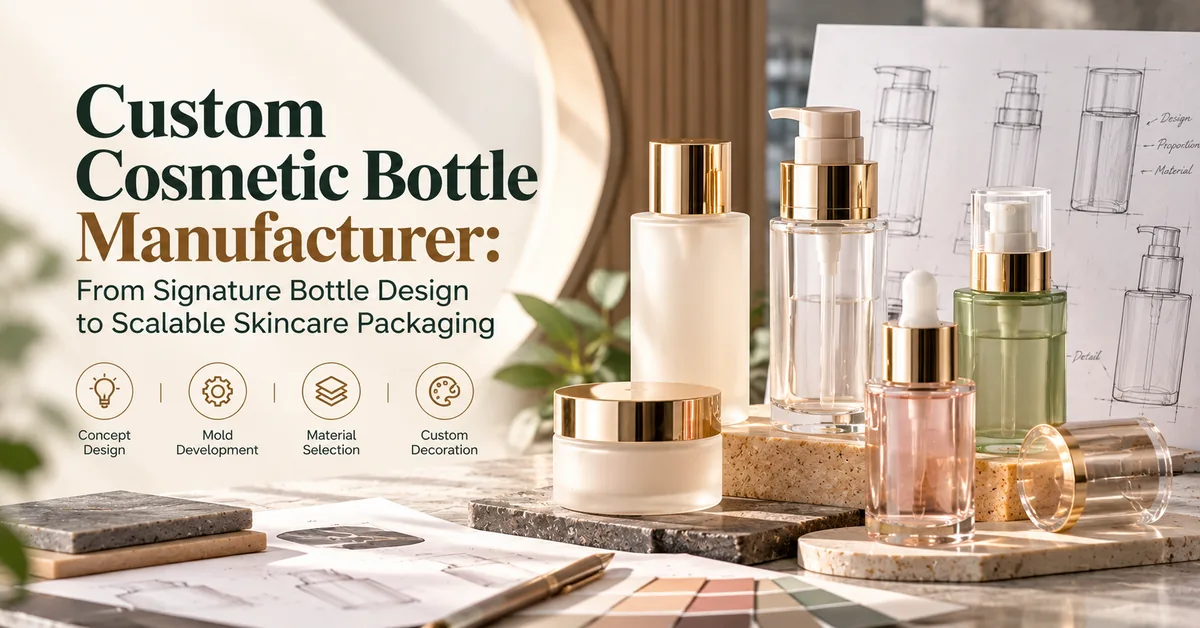
Customization may involve bottle shape, material, color, surface treatment, printing, pump design, and coordinated packaging components.
Existing Mold Customization
Using an existing suitable bottle design may reduce the need for new structural tooling.
A brand can explore options such as custom colors, printed logos, or available decorative finishes.
However, not every change is possible with every existing design.
For example, a different neck finish or substantially altered geometry may require tooling changes.
The supplier should identify which components can be modified without affecting the approved mechanical interfaces.
New Mold Development
A custom shape or structural feature may require new tooling.
This approach can provide greater design flexibility, but increases engineering responsibility.
The buyer should clarify who owns the tooling, how changes are approved, and what happens if the packaging design is revised.
For pump bottles, a new exterior body should still be validated with the selected closure and dispensing system.
Coordinated Cosmetic Packaging Sets
Many brands launch multiple products within one skincare range.
These products may require different dispensing formats while sharing a common visual identity.
For example, a skincare collection could include a lotion pump bottle, a treatment dispenser, and a wide-mouth cream jar.
Maintaining consistent color, proportions, and decoration can simplify brand presentation while allowing each formula to use an appropriate container.
COSME displays an example of coordinated pump bottles and jars in its Cosmetic Packaging Set product page.
The product presentation shows matching bottle-and-jar styling, but buyers must verify actual material, capacity, pump specifications, and other technical details before purchase.
Decoration Options to Evaluate
| Decoration method | Potential application | Procurement concern |
|---|---|---|
| Screen printing | Direct brand graphics | Adhesion, registration, durability |
| Hot stamping | Metallic decorative details | Adhesion and wear resistance |
| Color customization | Brand-specific appearance | Color consistency across batches |
| Labels | Variable graphics and information | Label fit and adhesion |
| Surface coating | Special visual finish | Compatibility and durability |
The appropriate finishing method depends on the bottle material, artwork, order requirements, and available manufacturing processes.
A decoration sample should be reviewed on the actual selected substrate.
Understanding MOQ, Unit Price and Total Procurement Cost
Pricing is often the first question a buyer asks, but it should not be the only basis for choosing a cosmetic bottle with pump supplier.
Two quotations may appear comparable while including different components or services.
One supplier may quote an empty bottle without the pump. Another may include the pump, dip tube, decoration, individual protection, and outer cartons.
The buyer must compare equivalent specifications.
What Drives Cosmetic Pump Bottle Costs?
Important cost factors include bottle material, size, geometry, selected pump mechanism, order volume, decoration, component sourcing, tooling, testing, and packaging requirements.
Custom-developed components may require additional investment.
More complex printing or decorative finishing may also increase processing requirements.
A specialized pump assembly can have a different cost structure from a more common dispensing component.
Separate One-Time Costs From Recurring Costs
A useful quotation should distinguish tooling or development expenses from repeat-order unit costs.
One-time or project-specific costs may involve new molds, engineering work, special sampling, or qualification activities.
Recurring costs generally involve materials, manufacturing, components, assembly, inspection, decoration, and packing.
The exact allocation must be agreed with the supplier.
Calculate the Landed Cost
A more useful purchasing comparison is based on the cost of approved, saleable packaging delivered to the required destination.
A simplified model is:
Total Landed Packaging Cost = Product Cost + Applicable Tooling Allocation + Packaging + Freight + Duties and Other Relevant Charges
Buyers may also need to account for rejected units, delays, inventory carrying costs, and additional qualification expenses.
A lower unit quotation does not necessarily mean a lower total cost.
What Is the MOQ for Cosmetic Pump Bottles?
Minimum order quantities are project-specific.
They may depend on the bottle model, material, pump selection, decoration, component sourcing, and manufacturing arrangements.
The MOQ for a standard bottle may differ from that for a custom-colored pump or newly developed bottle design.
Buyers should request a written MOQ for each relevant component and configuration.
Do not assume that the company offers a fixed universal MOQ across all cosmetic pump bottle products.
Questions to Ask When Comparing Prices
Ask whether the quoted price includes the bottle, pump, dip tube, gasket, cap, decoration, assembly, and export packing.
Clarify whether the quotation refers to the complete pump-bottle set or only part of it.
Confirm the applicable Incoterm and other commercial conditions.
Also ask whether the quotation depends on a particular pump model, color, or supplier-specified component.
These details make quotations easier to compare and help reduce unexpected changes after sample approval.
How to Qualify a Cosmetic Pump Bottle Supplier in China
Professional B2B buyers should evaluate manufacturing and technical reliability before committing to a long-term supply relationship.
A supplier's website can help identify its product direction, but samples, drawings, documentation, and commercial terms provide stronger evidence for a purchasing decision.
Supplier Evaluation Checklist
| Evaluation area | Questions for the supplier |
|---|---|
| Manufacturing capabilities | Which bottle manufacturing processes are performed internally? |
| Pump sourcing | Are pump assemblies manufactured internally or sourced from specialist suppliers? |
| Engineering support | Can the supplier provide controlled drawings and component specifications? |
| Product range | Are appropriate lotion, treatment, foam or spray pumps available for evaluation? |
| Formula compatibility | What support is available for product-contact material review? |
| Quality control | How are bottle dimensions, appearance, pump fit and sealing evaluated? |
| OEM/ODM | What can be customized without new tooling? |
| Sampling | Can the supplier provide fully assembled, representative samples? |
| MOQ and pricing | Are quotations based on the complete required configuration? |
| Supply consistency | How are approved specifications maintained for repeat orders? |
| Traceability | Can relevant batches and changes be identified? |
| Delivery terms | What is the confirmed project production and shipping schedule? |
Should a Supplier Manufacture Every Pump Component?
Not necessarily.
A packaging manufacturer may specialize in bottle production and obtain pump assemblies from qualified component suppliers.
This can be a reasonable business model when the assembled packaging is properly controlled.
The important questions involve technical compatibility, responsibility, inspection, and change management.
If the pump supplier changes a critical internal component, the packaging manufacturer should assess whether the change affects the approved system.
For importers and contract manufacturers, traceability and engineering discipline may be more valuable than unsupported claims that every component is produced internally.
COSME Packaging: Cosmetic Bottle Manufacturing and OEM/ODM Support
COSME Packaging is the brand of Zhejiang Cosme Industry Co., Ltd., a cosmetic packaging company established in 2015.
The company focuses on cosmetic primary packaging, including cosmetic bottles, jars, tubes, airless packaging categories, and custom OEM/ODM projects.
Its published company information describes a manufacturing facility of approximately 15,000 square meters, around 200 employees, molding equipment, printing operations, mold development capabilities, and an internal research and development center.
These are company-reported capabilities rather than independent verification of a particular pump-bottle model.
Custom Packaging Development
COSME's published customization workflow covers existing-style customization and new-tooling development.
For existing designs, the process involves confirming the style, capacity, colors, printing, quotation, order, and pre-production samples before bulk manufacturing.
For new structural designs, the published process includes design confirmation, 3D drawings, CNC samples, mold development, tooling samples, and production.
These development routes provide a framework for discussing private-label cosmetic packaging projects.
Packaging Quality Control
The company also describes raw-material inspection, in-process checks, finished-package leakage evaluation, decoration inspection, and batch traceability.
For a pump bottle project, the buyer should establish which additional dispensing-system tests are required and request confirmation that the proposed bottle-and-pump combination can meet the intended acceptance criteria.
When COSME May Be Relevant to Your Project
COSME may be worth evaluating if your company requires cosmetic bottle customization, a coordinated skincare packaging series, OEM/ODM development, or technical discussions involving pump-compatible bottles.
However, the availability of a particular pump output, neck finish, material grade, or dispensing mechanism must be confirmed for the selected design.
Contact COSME Packaging to Discuss Custom Pump Bottle Requirements
RFQ Checklist: What to Send a Cosmetic Bottle With Pump Supplier
A detailed request for quotation can make supplier communication more efficient and help ensure that the proposed packaging matches the buyer's actual needs.
A generic request such as "Please quote 50,000 cosmetic pump bottles" leaves many critical questions unanswered.
The supplier may not know which formula will be filled, what dispensing performance is expected, or whether the buyer needs custom decoration.
A stronger RFQ should contain the following information.
Cosmetic Pump Bottle RFQ Template
| RFQ item | Information to provide |
|---|---|
| Buyer company | Company name and business type |
| Product category | Lotion, serum, facial cleanser, body care or another product |
| Target market | Intended sales countries or regions |
| Bottle capacity | Nominal capacity and relevant fill requirements |
| Bottle material | Preferred material or performance requirements |
| Formula information | Viscosity, pH where relevant, and compatibility concerns |
| Pump mechanism | Lotion, treatment, foam, spray or another specified system |
| Pump output | Target dispensing quantity and measurement requirements |
| Neck finish | Required interface drawing or existing closure specification |
| Dip tube | Bottle-specific insertion and residual-product requirements |
| Closure features | Cap, lock, twist-lock or other requirements |
| Customization | Color, logo, printing, surface treatment |
| Order quantity | Initial purchase volume and forecast |
| Sampling | Samples and technical documents required |
| Testing | Performance and quality acceptance criteria |
| Packing | Carton, pallet and shipping protection requirements |
| Delivery | Destination, timeline and commercial terms |
Example Buyer Inquiry
"We are a skincare brand developing a new facial lotion range and are evaluating a cosmetic bottle with pump supplier for an OEM packaging project.
We would like to review bottle options that are suitable for our intended formulation, target fill volume, and brand design.
Please advise which bottle materials and pump configurations are available for evaluation. We also require confirmation of the neck finish, product-contact components, dispensing characteristics, and sample-testing requirements.
Our team can provide formulation information, artwork, initial order quantity, and the target launch schedule.
We would appreciate a quotation covering the complete bottle-and-pump assembly, applicable customization, sampling, minimum order quantities, and estimated production arrangements."
This approach gives the supplier a more useful starting point.
It also reduces the chance that the buyer receives a low quotation for a component combination that does not meet the technical requirements.
Request Cosmetic Pump Bottle Samples and an OEM Quotation
Practical Sourcing Scenario: Launching a Three-Product Skincare Line
Consider a hypothetical skincare brand preparing three products:
-
A lightweight facial essence.
-
A daily moisturizing lotion.
-
A rich body lotion.
The brand wants consistent packaging across the product line.
At first, selecting one pump bottle design in several capacities seems convenient.
However, the dispensing needs may differ.
The facial essence may require a small, controlled application quantity.
The moisturizer may require a different dose and pumping feel.
The rich body lotion may require a mechanism suitable for its higher viscosity.
Using a single pump model across all three products should therefore be treated as a design question, not an automatic cost-saving measure.
The brand could begin by comparing suitable bottle formats and then evaluating different pump assemblies that preserve a consistent exterior appearance.
It should request complete samples, define output targets for each formula, and assess compatibility with its filling partner.
Once the technical requirements are confirmed, the packaging team can compare costs, decoration options and production arrangements.
The resulting decision is more valuable than selecting the cheapest bottle at the first quotation stage.
This example illustrates a general procurement approach. It is not a claim about an actual COSME customer project.
Frequently Asked Questions About Cosmetic Bottle With Pump Suppliers
1. What is the difference between a cosmetic pump bottle and an airless bottle?
A conventional cosmetic pump bottle commonly uses a dip tube to dispense product from a rigid reservoir, while an airless system uses a different mechanism intended to limit replacement air entering the product chamber during normal dispensing.
Not every cosmetic bottle with a pump is airless. Buyers should verify the internal structure when airless performance is required.
2. How do I choose the right pump for a skincare lotion?
Start with the formula's viscosity, intended application quantity, filling requirements, and desired consumer experience.
Then compare suitable pump mechanisms and test their actual performance with the formulation.
Pump output, priming, actuation force, leakage, and residual product should be considered before approval.
3. Can different pumps fit the same cosmetic bottle?
Sometimes, but compatibility must be confirmed.
Matching nominal neck-finish descriptions alone does not guarantee appropriate thread engagement, gasket compression, or sealing.
The bottle and pump should be assessed using actual component drawings and assembled samples.
4. What materials are suitable for cosmetic pump bottles?
PET, PETG, PP, PE, glass and other materials may be considered depending on the product and packaging structure.
The right selection depends on appearance, physical requirements, formulation compatibility, filling conditions and shipping needs.
No single material is universally suitable for every cosmetic formulation.
5. What tests should a cosmetic pump bottle supplier provide?
Depending on the project, relevant tests may include dimensional inspection, dispensing performance, priming, leakage, residual product, material compatibility, actuation durability, decoration adhesion and shipping-package performance.
The buyer should agree with the supplier on test methods and acceptance criteria before mass production.
6. Can I customize cosmetic bottles with my own logo and color?
Many OEM/ODM cosmetic packaging projects include custom colors, printing and decoration.
However, the available options depend on the selected product and supplier capabilities.
Changes to structural components may require additional tooling or validation.
7. What is the minimum order quantity for cosmetic pump bottles?
MOQ varies by bottle model, pump configuration, color, decoration, component sourcing and development requirements.
Buyers should obtain project-specific conditions instead of assuming one fixed MOQ applies to all products.
8. Why does a cosmetic pump bottle leak during transportation?
Leakage may result from incorrect bottle-and-pump fit, damaged seals, unsuitable closure application, unintended actuator movement, or transportation conditions.
A proper investigation should evaluate the complete packaging assembly and relevant shipping configuration.
9. How should I compare cosmetic pump bottle suppliers in China?
Compare technical capability, complete product specifications, representative samples, quality-control procedures, customization support, component sourcing, engineering-change control, and commercial terms.
The lowest unit quotation should not be the only selection criterion.
10. Can a cosmetic packaging supplier support both pump bottles and cream jars?
Some packaging suppliers offer coordinated bottle-and-jar collections.
This can be useful for skincare brands launching several products with different dispensing needs but a shared design language.
Buyers should still verify each component's material, dimensions, compatibility and performance independently.
Conclusion
Choosing a reliable cosmetic bottle with pump supplier requires more than comparing bottle designs, pump appearances or wholesale prices. For skincare brands, packaging distributors and cosmetic contract manufacturers, the most important factors are dispensing performance, bottle-and-pump compatibility, formula suitability, manufacturing quality, and dependable repeat-order specifications.
A successful purchasing project begins by defining the formula, intended pump output, neck finish, bottle material, filling-line requirements and quality acceptance criteria. These details make it easier to compare suppliers accurately, identify technical risks and avoid unnecessary costs after production begins.
OEM customization should support both brand appearance and functional performance. A premium exterior is valuable, but consistent dispensing, suitable sealing and reliable component fit are what help the finished package perform as intended.
COSME Packaging provides cosmetic packaging manufacturing and OEM/ODM customization services for skincare and personal-care brands. Buyers developing lotion, serum or other pump-bottle projects can discuss available bottle designs, customization requirements, component specifications and sample evaluation with the company.
For a more accurate quotation, provide your formula type, target capacity, pump requirements, preferred materials, branding details and purchase quantity.