
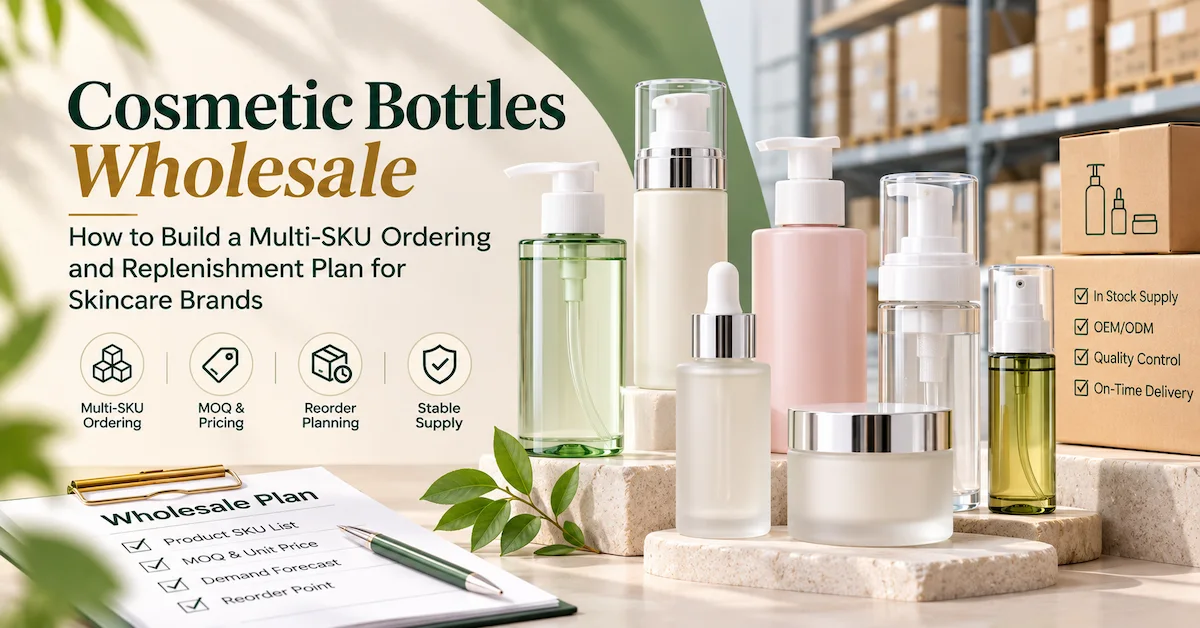
Buying cosmetic bottles wholesale is not simply about ordering large quantities at the lowest available price. For skincare brands, cosmetic OEM/ODM manufacturers, and packaging distributors, successful bulk purchasing requires coordinated packaging specifications, accurate demand forecasts, consistent component quality, and reliable replenishment planning.
A skincare brand may need pump bottles for lotions, airless containers for serums, and foaming bottles for facial cleansers. Although these products belong to the same collection, they may require different materials, production processes, minimum order quantities, and delivery schedules.
Poor coordination can create excess inventory in one bottle style while another essential component runs out before the next production run.
The most effective wholesale purchasing strategy is to manage every packaging SKU as part of a complete supply plan—not as an isolated bulk order.
COSME Packaging, operated by Zhejiang Cosme Industry Co., Ltd., provides cosmetic packaging manufacturing, mold development, OEM/ODM customization, and quality control services for international beauty and personal-care brands.
This guide explains how to compare wholesale packaging options, manage multi-SKU purchasing, understand total costs, reduce stockout risks, and prepare a practical bulk packaging inquiry.
1. Quick Answer: How Should You Plan Cosmetic Bottles Wholesale?
For efficient cosmetic bottles wholesale purchasing, buyers should first confirm packaging requirements, separate orders by SKU, verify minimum order quantities, and calculate replenishment timing using realistic demand and supply lead times.
A structured wholesale purchasing process includes six steps:
-
Define the product range: Identify required bottle styles, capacities, materials, and dispensing systems.
-
Standardize specifications: Confirm which components and decoration options can be shared across products.
-
Verify MOQ by SKU: Check minimum quantities for each bottle design, color, pump, and custom finish.
-
Compare total costs: Include bottle components, decoration, tooling, freight, and other relevant charges.
-
Approve samples: Validate assembled packaging before authorizing commercial production.
-
Plan replenishment: Establish reorder points using demand forecasts, lead times, and safety stock.
The objective is to maintain sufficient packaging inventory without tying up unnecessary working capital.
For brands purchasing several packaging formats, this approach is often more useful than evaluating unit price alone.
2. Who Benefits Most From Wholesale Cosmetic Bottle Purchasing?
Wholesale packaging procurement serves several types of B2B customers.
However, purchasing priorities vary by business model.
| B2B buyer | Main purchasing priority | Recommended wholesale approach |
|---|---|---|
| Established skincare brands | Stable packaging supply across product lines | Forecast demand by packaging SKU |
| Cosmetic OEM/ODM factories | Consistent components for production schedules | Coordinate packaging with filling plans |
| Packaging distributors | Product variety and reliable repeat supply | Standardize frequently ordered specifications |
| Private-label beauty companies | Brand differentiation with manageable costs | Compare existing designs and customized decoration |
| E-commerce beauty brands | Product launches and seasonal demand | Use staged purchasing and safety stock |
| Professional spa brands | Consistent packaging appearance and usability | Select coordinated bottle families |
Wholesale sourcing is especially relevant when a business expects recurring purchases or needs a consistent supply of multiple packaging components.
For a small trial launch, however, a highly customized bulk order may create unnecessary inventory risk.
Buyers should compare the commercial advantages of wholesale purchasing against their realistic sales forecasts.
3. Which Cosmetic Bottle Types Should You Buy in Bulk?
The correct wholesale product mix depends on the formulations, dispensing requirements, target customers, and retail positioning.
COSME's cosmetic bottle product collection includes packaging directions such as plastic bottles, glass bottles, refillable bottles, foaming bottles, dropper bottles, and other dispensing formats.
Wholesale Cosmetic Bottle Selection Table
| Bottle type | Typical application | Main purchasing consideration |
|---|---|---|
| Lotion pump bottles | Facial lotion, body lotion, emulsions | Pump output and closure compatibility |
| Airless bottles | Serums, creams, selected treatments | Dispensing mechanism and formula compatibility |
| Dropper bottles | Facial oils, liquid serums, essences | Pipette, bulb, and sealing performance |
| Foaming bottles | Facial cleansers and foaming products | Foam pump and formula compatibility |
| Refillable bottles | Refill-oriented skincare collections | Component durability and replacement fit |
| Glass cosmetic bottles | Premium skincare products | Weight, breakage resistance, transport protection |
| Plastic cosmetic bottles | General skincare and personal care | Material grade, appearance, and cost |
The table describes common packaging applications rather than confirmed inventory availability.
Buyers should request product-specific specifications and available options before placing an order.
Avoid Choosing Bottles Based Only on Appearance
Two bottles with similar dimensions may use different materials, pumps, neck finishes, or assembly methods.
These differences can affect filling-line compatibility and finished-product performance.
For example, a pump designed for a lightweight lotion may not perform consistently with a highly viscous emulsion.
Before standardizing a bottle for wholesale purchasing, evaluate the complete package with the intended formulation.
4. Why Is Multi-SKU Planning Important for Skincare Packaging?
SKU stands for Stock Keeping Unit.
In wholesale cosmetic packaging, a separate SKU may be required for each distinct combination of bottle design, capacity, color, material, or dispensing system.
Even when multiple products share the same brand identity, their packaging components may not be interchangeable.
Example Multi-SKU Packaging Plan
| Product line | Packaging format | Component requirements | Purchasing priority |
|---|---|---|---|
| Hydrating serum | Airless pump bottle | Reservoir, pump, cap | Pump and formula compatibility |
| Daily facial lotion | Lotion pump bottle | Bottle, pump, dip tube, cap | Neck fit and dispensing |
| Foaming facial cleanser | Foaming bottle | Bottle, foaming pump, cap | Foam performance |
| Facial essence | Dropper bottle | Bottle, pipette, bulb, closure | Sealing and product compatibility |
A purchasing team should track each configuration separately.
Why Component-Level Inventory Matters
A finished package may require several components before the product can be filled.
Having sufficient bottle bodies is not helpful if compatible pumps or caps are unavailable.
For every packaging SKU, record:
-
Bottle body identification.
-
Nominal capacity and material.
-
Compatible pump or closure.
-
Decoration and color specifications.
-
Approved drawing and sample revision.
-
Required quantity and replenishment schedule.
Where possible, use compatible components across related packaging designs.
However, component standardization must be verified through drawings and testing—not assumed from visual similarity.
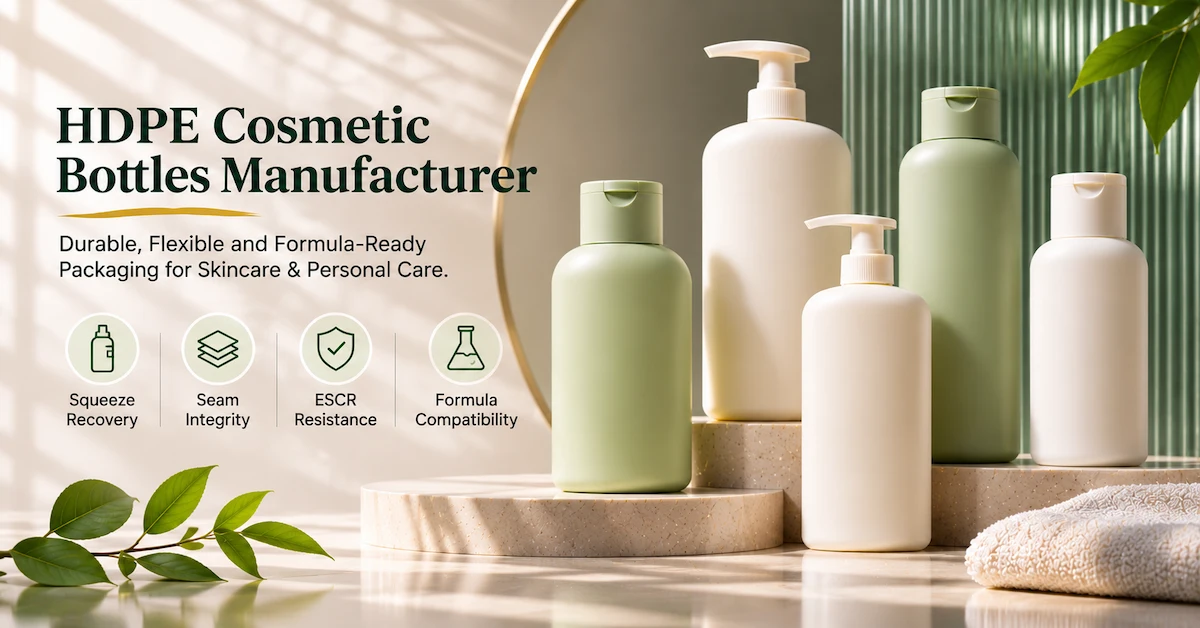
COSME's coordinated cosmetic packaging set illustrates how bottles and jars can share a consistent visual design across a skincare collection. Exact component specifications and availability require confirmation.
5. How Do Minimum Order Quantities Affect Wholesale Purchasing?
Minimum Order Quantity, or MOQ, is one of the most important commercial variables when buying cosmetic bottles wholesale.
However, MOQ does not necessarily apply to the total number of bottles across an entire order.
Manufacturing minimums may differ according to:
-
Bottle model.
-
Material.
-
Capacity.
-
Color.
-
Pump or closure type.
-
Decoration method.
-
New tooling requirements.
Why a Mixed Order May Have Several MOQs
Consider a hypothetical skincare brand that needs three bottle colors.
The brand forecasts 4,000 units of each color, or 12,000 bottles in total.
If a supplier requires a minimum of 10,000 units per customized color, the total order quantity alone does not satisfy those individual production minimums.
The buyer may need to adjust the design, negotiate an appropriate production arrangement, or reconsider the number of variants.
This example is illustrative and does not represent COSME's actual MOQ.
How to Manage MOQ Without Excess Inventory
A practical approach is to:
-
Identify the highest-demand packaging variants.
-
Investigate existing bottle designs before commissioning custom tooling.
-
Reduce unnecessary color and component variations.
-
Confirm MOQ separately for bottles, pumps, caps, and decoration.
-
Ask whether phased deliveries or other commercial arrangements are available.
Do not assume that multiple colors, bottle styles, or orders can automatically be combined to meet a production minimum.
The manufacturer must confirm the applicable conditions.
6. Stock Packaging vs. Custom Wholesale Bottles
Wholesale customers often need to decide between adapting existing packaging and developing customized designs.
Both approaches can be appropriate depending on the brand's requirements.
| Purchasing option | Potential advantage | Main consideration |
|---|---|---|
| Existing bottle design | May avoid new structural tooling | Available formats and component choices |
| Existing design with custom decoration | Supports brand identification | Printing MOQ and appearance consistency |
| Custom structural packaging | Enables distinctive geometry | Tooling, development, validation, and demand forecast |
When Existing Designs Make Sense
Existing designs may be appropriate for emerging brands, initial product launches, and companies prioritizing cost control.
They can also help distributors build product portfolios without developing exclusive packaging structures.
When Custom Packaging Makes Sense
Custom designs become more attractive when a brand requires unique dimensions, specific dispensing features, or a recognizable structural identity.
They may also be relevant for established product lines with sufficient long-term demand.
COSME offers OEM/ODM packaging customization, including design development, mold development, color matching, logo printing, and surface decoration.
Before committing to new tooling, buyers should estimate the expected order volume over the packaging's commercial life.
7. How Do You Calculate the Real Wholesale Cost Per Bottle?
Unit price is only one component of total purchasing cost.
For international buyers, comparing quotations requires a consistent definition of what is included.
Wholesale Cosmetic Bottle Cost Breakdown
| Cost element | Why it matters |
|---|---|
| Bottle body | Main packaging material and manufacturing cost |
| Pump or closure | Determines complete component cost |
| Decoration | Printing, color, coating, and finishing |
| Tooling | New mold or component development |
| Sample approval | Prototype and validation expenses |
| Export packaging | Cartons, protection, and packing requirements |
| Transportation | Freight and relevant handling expenses |
| Import charges | Applicable duties, taxes, and clearance costs |
| Inspection | Agreed testing and quality checks |
| Defect allowance | Potential cost of unusable components |
Total Landed Cost Per Accepted Unit
A useful purchasing calculation is:
Landed cost per accepted unit = Total relevant procurement and import costs ÷ Number of accepted usable units
For an accurate comparison, buyers should determine which taxes are recoverable and whether tooling costs should be allocated across the initial order or a longer forecast production volume.
Why Quotation Terms Matter
A factory quotation and a delivered-price quotation may cover different responsibilities.
Buyers should confirm the agreed Incoterms® rule, named location, freight responsibilities, insurance arrangements, and applicable import charges.
For example, EXW and FOB quotations cannot be compared simply by looking at the stated unit price.
The relevant costs and responsibilities must be normalized before evaluating offers.
For a technical RFQ framework covering bottles, components, and production approval, see COSME's cosmetic bottle manufacturer purchasing guide.
8. How Should You Calculate Reorder Points for Cosmetic Bottles?
One of the main challenges in wholesale packaging purchasing is preventing stockouts without holding excessive inventory.
A reorder point identifies when a new replenishment order should be triggered.
Basic Reorder Point Formula
Reorder Point = Average Daily Demand × Replenishment Lead Time + Safety Stock
For example, consider a hypothetical skincare brand with:
-
Average bottle usage: 200 units per day.
-
Total replenishment lead time: 70 days.
-
Planned safety stock: 3,000 units.
Its reorder point would be:
(200 × 70) + 3,000 = 17,000 units
The brand should review replenishment when its relevant inventory position reaches approximately 17,000 units.
This example is for planning purposes and does not represent COSME's production or delivery commitment.
What Should Be Included in Replenishment Lead Time?
The full lead time may include:
-
Purchase order confirmation.
-
Raw-material procurement.
-
Production scheduling.
-
Manufacturing and decoration.
-
Quality inspection.
-
International transportation.
-
Customs clearance and receiving.
Production time and delivery time should not be treated as identical.
COSME's website describes a typical production period of approximately 40–50 days depending on customization complexity. Buyers must confirm project-specific timing and account separately for shipping and other procurement activities.
Why Safety Stock Matters
Safety stock helps protect against demand variation and unexpected supply delays.
However, excessively high safety stock increases storage costs and ties up working capital.
The appropriate quantity should reflect demand volatility, forecast accuracy, supplier performance, and the consequences of a stockout.
For multi-SKU orders, calculate reorder points for each critical bottle and component separately.
9. How Can Wholesale Buyers Reduce Excess Packaging Inventory?
Excess inventory is particularly costly when packaging includes custom colors, printed branding, or product-specific components.
These items may have limited use if a product is reformulated, redesigned, or discontinued.
Five Practical Inventory-Control Strategies
1. Standardize where possible. Consider shared bottle families and compatible components across product lines.
2. Prioritize high-demand SKUs. Allocate purchasing resources to products with more predictable consumption.
3. Control artwork revisions. Avoid ordering large quantities before final brand artwork and packaging specifications are approved.
4. Review forecasts regularly. Update purchasing plans using actual product consumption and confirmed launches.
5. Coordinate packaging and filling schedules. Ensure bottles, pumps, caps, and formulas are available for the same production window.
A skincare company should also establish procedures for identifying outdated packaging components.
Changing a label, formula claim, or product design may make previously purchased packaging unsuitable even when the containers remain physically usable.
10. What Quality Checks Matter Most for Repeat Wholesale Orders?
A sample approved for the first order is not enough to guarantee consistency across future production batches.
Wholesale purchasing depends on stable specifications and appropriate quality management.
Wholesale Packaging Quality Checklist
| Inspection item | Recommended buyer requirement |
|---|---|
| Material | Confirm agreed resin or packaging material |
| Capacity and dimensions | Check against current approved drawings |
| Bottle neck | Verify critical closure dimensions |
| Pump and cap fit | Confirm correct assembly and operation |
| Leakage | Test representative finished assemblies |
| Decoration | Check color, printing registration, and adhesion |
| Surface appearance | Define acceptable defects and inspection conditions |
| Export cartons | Confirm protective packing requirements |
| Batch records | Maintain traceable production and inspection information |
Why Approved Reference Samples Matter
An approved production reference helps both parties evaluate future orders consistently.
It should be supported by current specifications, artwork, and inspection criteria.
If the supplier changes a material, component, manufacturing process, or critical dimension, the change should be reviewed before the replacement packaging is accepted.
Supplier Quality Control
COSME reports quality inspection procedures covering incoming materials, dimensions, wall thickness, surface defects, leakage, printing adhesion, and batch traceability.
These capabilities are relevant to repeat wholesale orders.
However, buyers should request project-specific inspection requirements and supporting documents rather than assuming every product has the same test plan.
11. How Should Wholesale Cosmetic Bottles Be Packed for Export?
Transportation can affect both packaging function and cosmetic appearance.
Wholesale bottle shipments may involve multiple handling points, stacking loads, temperature variation, and vibration.
Appropriate export packing depends on the bottle material, geometry, decorative finish, and assembled components.
Export Packaging Considerations
For lightweight plastic bottles, buyers should evaluate carton strength, component protection, and the risk of deformation.
Glass packaging may require additional protective separation and cushioning.
Decorated components may need protection against scratching or surface abrasion.
For pump bottles, the shipping configuration should also prevent damage or unintended actuator movement.
Before shipment, confirm:
-
Units per carton.
-
Bottle and component packing configuration.
-
Carton dimensions and gross weight.
-
Protective materials.
-
Carton and pallet identification.
-
Relevant handling and distribution requirements.
Where appropriate, buyers may use a distribution-testing program developed with reference to ASTM D4169 to evaluate the complete shipping system.
The actual test requirements should be agreed for the intended distribution environment.
12. Why Consider COSME Packaging for Wholesale Cosmetic Bottles?
COSME Packaging, operated by Zhejiang Cosme Industry Co., Ltd., is a China-based cosmetic packaging manufacturer established in 2015.
According to its published company information, COSME operates an approximately 15,000-square-meter facility with around 200 employees and more than 50 injection molding machines.
Its business covers cosmetic bottles, airless bottles, cosmetic jars, soft tubes, and customized packaging solutions.
Relevant capabilities include:
-
Packaging R&D: Support for packaging development and design.
-
Mold development: Engineering drawings, CNC samples, and tooling.
-
Manufacturing: Injection and blow-molding processes.
-
OEM/ODM services: Customized designs, colors, printing, and decorative finishing.
-
Quality control: Material inspection, dimensional checks, leakage checks, and batch records.
These capabilities make COSME a potential manufacturing partner for buyers sourcing custom cosmetic packaging and coordinating repeat bulk orders.
However, the availability of a specific bottle model, minimum order quantity, stock position, component compatibility, and commercial delivery schedule must be confirmed during inquiry.
Learn more about COSME's factory and manufacturing capabilities or explore its cosmetic packaging products.
13. What Should You Include in a Wholesale Cosmetic Bottles RFQ?
A complete wholesale inquiry should provide both technical specifications and commercial purchasing information.
Wholesale RFQ Checklist
| Information | Details to provide |
|---|---|
| Buyer type | Skincare brand, OEM factory, distributor, or private-label company |
| Bottle formats | Pump, airless, dropper, foaming, or other |
| Capacity | Required fill quantity for each SKU |
| Materials | Preferred resin, glass, or performance requirements |
| Components | Pumps, caps, closures, and accessories |
| Customization | Colors, printing, surface decoration |
| Order quantities | Quantity by design, color, and SKU |
| Annual forecast | Expected repeat-order demand |
| Packaging approval | Samples, drawings, and testing requirements |
| Shipping | Destination, packing requirements, delivery terms |
| Target schedule | Required production and receiving dates |
Request a Project-Specific Wholesale Quotation
Instead of asking only for a price per bottle, request a quotation that identifies each packaging configuration and the relevant commercial terms.
For multi-SKU projects, include a spreadsheet or purchasing schedule showing the expected quantities for each item.
This information helps both parties assess available packaging options, component coordination, customization requirements, and production feasibility.
If you are sourcing wholesale cosmetic bottles for a new skincare range, an existing beauty brand, or a packaging distribution business, contact COSME Packaging with your product list, expected quantities, and target delivery schedule to discuss suitable solutions and request a quotation.
14. Frequently Asked Questions About Cosmetic Bottles Wholesale
1. What is the minimum order quantity for cosmetic bottles wholesale?
MOQ depends on bottle design, material, color, closure system, decoration, and tooling requirements. There is no universal minimum quantity applicable to every COSME product. Buyers should request MOQ information for each packaging SKU.
2. Can I order different cosmetic bottle styles in one wholesale inquiry?
Yes, buyers can submit inquiries covering multiple bottle styles. However, the supplier must confirm availability, separate production minimums, component requirements, and whether the proposed configurations can be coordinated commercially.
3. Is wholesale cosmetic bottle pricing lower for larger orders?
Larger quantities may improve production efficiency or allow certain setup costs to be distributed across more units. However, the final price depends on the complete specification and order terms. Larger orders do not automatically produce the best total cost.
4. Can wholesale cosmetic bottles be customized with a brand logo?
Customization may include colors, logo printing, surface finishes, and selected packaging structures. The applicable minimum quantities, artwork requirements, and tooling costs depend on the chosen design.
5. Which cosmetic bottle material is best for wholesale skincare packaging?
The most suitable material depends on formulation compatibility, product positioning, dispensing requirements, transportation, and budget. PET, PETG, PP, PE, glass, and aluminum have different characteristics and should be evaluated for the intended application.
6. How should I calculate reorder quantities for cosmetic bottles?
Start with expected consumption during the replenishment period, add an appropriate safety-stock allowance, and account for current inventory and incoming orders. Adjust order quantities to reflect supplier MOQ, production scheduling, and realistic demand.
7. Can I buy bottles and pumps separately?
Separate purchasing may be possible, but compatibility must be confirmed through drawings and representative assembly testing. A bottle and pump that appear similar may have different interfaces or sealing requirements.
8. How do I reduce inventory risk when buying custom cosmetic bottles?
Use realistic demand forecasts, minimize unnecessary packaging variants, verify MOQ by SKU, approve artwork before production, and coordinate replenishment with the filling schedule. Where possible, investigate existing designs and standardized components.
9. What quality documents should I request for repeat wholesale orders?
Request agreed specifications, current drawings, approved sample references, relevant inspection criteria, material information, and available batch quality records. The documentation should support consistent evaluation across deliveries.
10. How can I request wholesale cosmetic bottle samples from COSME?
Provide your intended product application, preferred bottle formats, capacities, materials, component requirements, customization details, and estimated purchasing quantity. COSME can then discuss relevant packaging options and sample arrangements.
15. Conclusion
Successful cosmetic bottles wholesale purchasing requires more than identifying a suitable supplier or negotiating a competitive unit price.
For skincare brands, cosmetic OEM/ODM manufacturers, and packaging distributors, the real value comes from coordinating packaging specifications, minimum order quantities, component availability, production schedules, quality requirements, and replenishment planning.
A well-structured multi-SKU purchasing strategy can help reduce avoidable inventory costs, prevent packaging-related production delays, and improve consistency across product lines.
Before committing to bulk orders, buyers should verify complete component specifications, evaluate realistic demand, calculate total purchasing costs, and establish quality and reorder requirements.
With its published capabilities in cosmetic packaging manufacturing, mold development, OEM/ODM customization, and quality control, COSME Packaging provides a potential sourcing partner for international beauty and personal-care businesses.
Whether you need bulk lotion bottles, airless skincare packaging, dropper bottles, or coordinated cosmetic packaging collections, contact COSME Packaging with your packaging specifications, required quantities, and purchasing forecast to discuss suitable wholesale solutions and request a project-specific quotation.