
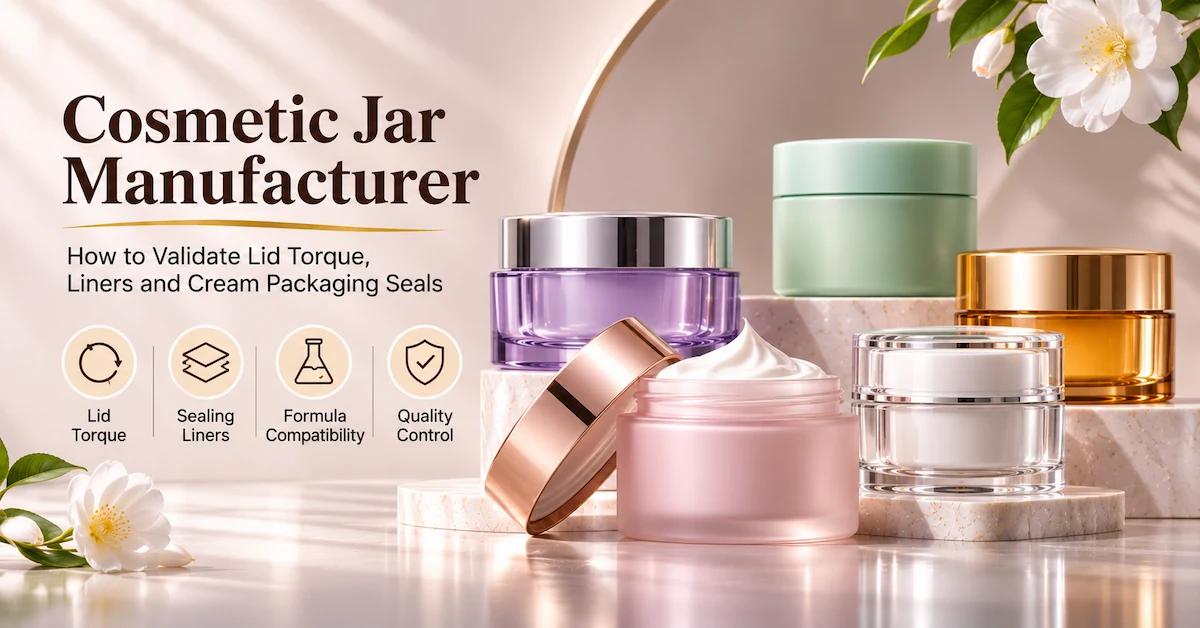
TL;DR: A reliable cosmetic jar manufacturer should help skincare brands evaluate the complete jar assembly, including the container body, threaded lid, sealing interface, optional liner, and product-contact materials. Critical requirements include controlled closure torque, formula compatibility, filling-line suitability, and repeatable sealing performance. Buyers should approve representative filled samples and measurable quality criteria before bulk production.
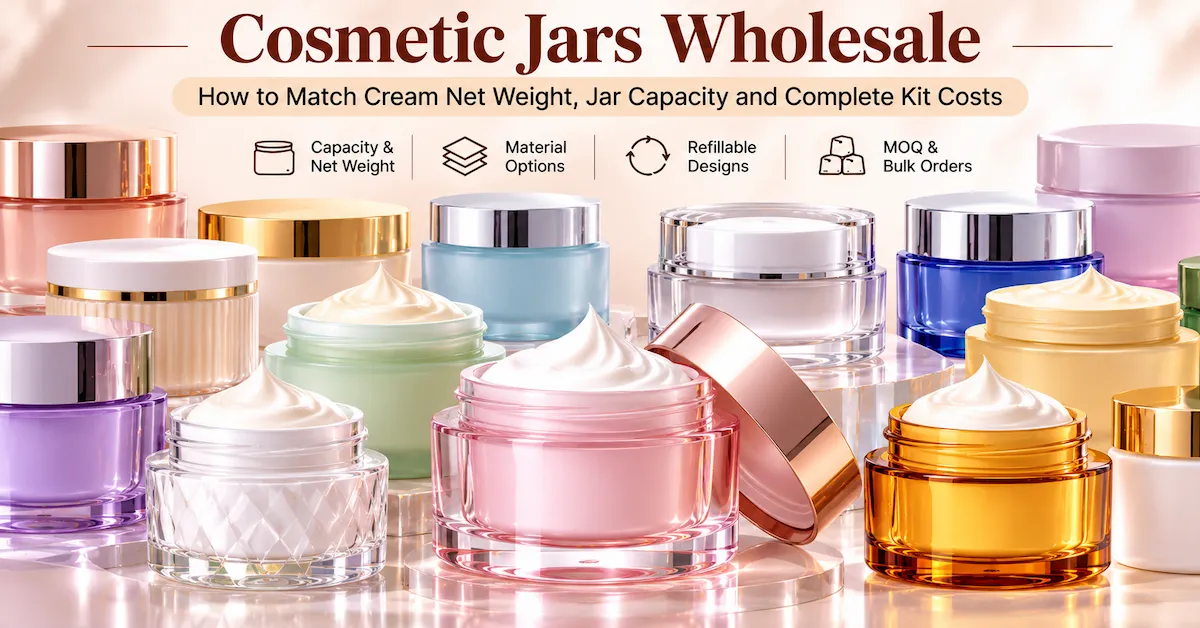
For skincare brands developing facial moisturizers, night creams, body butters, and beauty masks, cosmetic jars are an important part of product presentation and consumer experience.
However, a premium-looking jar does not automatically provide dependable packaging performance.
A lid may feel secure during initial inspection but loosen after storage. An unsuitable liner can become compressed or interact with a cream formulation. A jar may pass an empty-package inspection yet develop leakage or closure problems after filling.
These problems can result in rejected packaging, damaged shipments, production delays, and customer complaints.
The most effective sourcing strategy is to validate the entire cosmetic jar system—not simply approve the appearance of the jar body.
COSME Packaging, operated by Zhejiang Cosme Industry Co., Ltd., provides cosmetic packaging development, mold manufacturing, customization, and quality-control services for international skincare and personal-care brands.
This guide explains how to evaluate cosmetic jar construction, sealing components, closure torque, filling compatibility, and quality requirements before commercial production.
Key Takeaways: What Should Buyers Check Before Choosing Cosmetic Jars?
| Engineering factor | Potential problem | Recommended validation |
|---|---|---|
| Jar material | Formula incompatibility | Material and formulation testing |
| Lid geometry | Poor thread engagement | Dimensional inspection |
| Closure torque | Loose or excessively tight lid | Application and removal torque testing |
| Sealing liner | Incorrect compression or incompatibility | Liner and closure validation |
| Filling conditions | Product contamination of sealing surfaces | Filling-line trials |
| Repeated opening | Changes in closure performance | Opening and closing cycle testing |
| Package integrity | Cream leakage during transportation | Filled-package integrity testing |
| Batch consistency | Differences between manufacturing lots | Controlled specifications and inspection |
Core engineering principle: The reliability of a cosmetic cream jar depends on the interaction between its body, lid, sealing components, formulation, and filling process.
1. What Does a Cosmetic Jar Manufacturer Need to Provide?
A cosmetic jar manufacturer may support material selection, mold development, jar and lid production, decorative finishing, and packaging customization.
However, manufacturing responsibilities vary by product and supplier.
Some jars have relatively simple two-piece constructions. Others may include separate inner cups, liners, decorative shells, or dispensing components.
Cosmetic Jar Construction Comparison
| Jar configuration | Typical application | Main technical consideration |
|---|---|---|
| Standard screw-top jar | Face creams and body balms | Lid engagement and sealing |
| Double-wall plastic jar | Premium skincare products | Component fit and material compatibility |
| Glass cream jar | Luxury moisturizers and masks | Closure compatibility and handling |
| Refillable jar | Refill-oriented skincare | Inner cup retention and repeated assembly |
| Airless pump jar | Selected skincare formulations | Pump mechanism and dispensing performance |
| Decorative metal jar | Selected premium products | Product-contact protection and component interfaces |
These are general packaging formats rather than confirmed COSME stock-model specifications.
A purchasing team should establish the required functionality before selecting a decorative design.
For available packaging directions, explore the COSME Cosmetic Jars collection.
2. Which Cosmetic Jar Materials Are Suitable for Skincare Creams?
Material selection affects appearance, rigidity, manufacturing processes, and compatibility with the intended formula.
The correct material depends on the complete packaging design.
Cosmetic Jar Material Comparison
| Material | General characteristics | Important buyer consideration |
|---|---|---|
| PP | Moldable plastic used in jars and closures | Rigidity, dimensions, formula compatibility |
| PETG | Transparent copolyester used in selected designs | Chemical resistance and molding requirements |
| Acrylic / PMMA | High-clarity premium appearance | Chemical compatibility and impact behavior |
| Glass | Rigid, premium visual presentation | Weight, breakage, and lid fit |
| Aluminum | Metallic appearance | Internal lining and corrosion compatibility |
| Refillable multi-component design | Separate housing and inner container | Material identification and assembly stability |
No single material is best for every cosmetic cream.
A moisturizer containing particular oils, fragrances, or other ingredients may interact differently with plastics, liners, or coatings.
Why Product-Contact Components Matter
A jar may have an acrylic outer shell but a different material for its inner container.
Likewise, the lid, sealing liner, or insert may use materials different from the jar body.
Buyers should identify every component that contacts the formulation.
Material suitability must be verified using the actual proposed packaging and finished cosmetic formula.
3. How Does Cosmetic Jar Lid Torque Affect Packaging Performance?
Closure torque is an important characteristic of threaded cosmetic jar packaging.
Torque refers to the rotational moment applied when tightening or removing a lid.
An unsuitable torque level may create problems during assembly, transportation, or consumer use.
Application Torque
Application torque is the rotational force used to install the lid.
It should be sufficient for the intended closure engagement without damaging the jar or cap.
Excessive tightening can create mechanical stress or interfere with opening.
Removal Torque
Removal torque is the force required to open the closure.
It may differ from the original application torque because of material relaxation, liner behavior, temperature, and storage conditions.
Torque Retention
Torque retention evaluates how closure resistance changes after application under defined conditions.
ASTM D2063/D2063M-24 — Measurement of Torque Retention for Packages With Continuous Thread Closures provides methods for evaluating applicable threaded closure systems using manual torque-testing equipment.
The standard can help packaging engineers establish suitable evaluation procedures.
However, it does not establish a universal acceptable torque for every cosmetic jar.
Cosmetic Jar Torque Testing Matrix
| Test parameter | Evaluation objective |
|---|---|
| Application torque | Confirm controlled lid installation |
| Initial removal torque | Assess first-opening resistance |
| Removal torque after storage | Evaluate torque retention |
| Repeated-use torque | Assess opening and closing consistency |
| Closure alignment | Identify cross-threading or engagement problems |
| Post-conditioning torque | Evaluate relevant environmental effects |
The manufacturer and buyer should agree on the measurement method, sample conditions, units, and acceptance limits.
A jar should not be described as leakproof simply because its lid reaches a target torque.
Closure torque and package-integrity performance are related but distinct requirements.
4. How Do Sealing Liners Affect Cosmetic Jar Performance?
Some cosmetic jars incorporate a liner, gasket, sealing disc, or other closure component.
These parts can serve different purposes.
A liner may contribute to sealing, product separation, appearance, or handling.
However, not every disc placed beneath a cosmetic jar lid is designed to provide a hermetic seal.
Common Cosmetic Jar Sealing Components
| Component | Potential function | Important verification |
|---|---|---|
| Compressible liner | Supports sealing at the closure interface | Compression and material compatibility |
| Inner protective disc | Covers the cream surface | Fit and intended protective function |
| Gasket | Provides a defined sealing interface | Material and dimensional suitability |
| Induction-sealing foil | Creates a seal where the system is designed for induction sealing | Container finish, foil and process compatibility |
| Refillable inner cup | Holds the formulation inside an outer housing | Cup retention and closure fit |
The availability of these components must be confirmed for the selected jar design.
Why Liner Compression Matters
A sealing liner generally requires an appropriate interface between the lid and jar.
Too little compression may prevent the intended seal from forming.
Excessive compression or unsuitable material selection may affect the liner or closure.
The correct design depends on the materials, dimensions, and expected loading conditions.
Does Every Cosmetic Jar Need an Inner Liner?
No.
The need for an additional sealing component depends on the formulation, closure architecture, intended storage conditions, and performance requirements.
A simple cream jar may use a different closure approach from a product requiring an additional factory-applied seal.
Buyers should specify the required sealing function rather than automatically request a particular liner type.
5. Why Do Cosmetic Jars Leak During Storage or Shipping?
Leakage can result from several factors, and not every failure originates from the lid itself.
Common Cosmetic Jar Leakage Causes
| Failure location | Possible cause | Recommended investigation |
|---|---|---|
| Lid-to-jar interface | Incorrect compression or fit | Closure and liner inspection |
| Threaded closure | Cross-threading or dimensional mismatch | Thread and assembly evaluation |
| Jar body | Cracks or manufacturing defects | Structural inspection |
| Inner cup | Poor retention or component mismatch | Assembly testing |
| Sealing liner | Material degradation or displacement | Compatibility and fit verification |
| Filling area | Product on the sealing surface | Review filling and cleaning procedures |
Formula Viscosity Does Not Guarantee Leak Resistance
A thick cream may appear unlikely to leak during ordinary handling.
However, its flow behavior may change with temperature or mechanical movement.
A package should therefore be evaluated under conditions relevant to its intended distribution and storage.
Test the Completed Filled Jar
A useful validation procedure may include:
-
Fill representative jars under defined conditions.
-
Apply closures using the agreed procedure.
-
Inspect the sealing interface.
-
Evaluate relevant storage orientations.
-
Conduct suitable environmental or handling tests.
-
Reinspect for leakage and functional changes.
The actual test method should be selected according to the jar design and formulation.
A short upright storage test does not establish reliability under every shipping condition.
6. How Do Filling-Line Conditions Affect Jar Sealing?
Cosmetic jar manufacturing and cosmetic product filling are related but distinct operations.
A jar supplier may provide empty packaging that is subsequently filled by a skincare manufacturer or contract packer.
The complete production process must therefore be coordinated.
Important Filling-Line Considerations
Jar dimensions: The container must fit the intended handling and filling equipment.
Filling temperature: The material and components must tolerate the actual filling conditions.
Fill quantity: The product should have appropriate headspace for the selected jar and closing method.
Sealing surface cleanliness: Cream residue on the jar rim may interfere with certain sealing arrangements.
Closure application: The filling line must install the lid or other sealing component consistently.
Product compatibility: The completed packaging must remain suitable after filling and storage.
Recommended Filling-Line Validation
| Validation stage | Main objective |
|---|---|
| Empty-jar handling | Verify equipment compatibility |
| Filling trial | Confirm filling behavior and capacity |
| Rim inspection | Check relevant sealing surfaces |
| Liner installation | Verify correct placement where applicable |
| Closure application | Establish appropriate assembly conditions |
| Filled-jar storage | Evaluate containment and compatibility |
| Production sample approval | Confirm the finished configuration |
For production planning, buyers should distinguish between nominal fill volume and the container's available internal volume.
The actual fill quantity must be verified using the intended formulation.
7. How Does Wide-Mouth Jar Packaging Affect Product Protection?
Wide-mouth jars provide convenient access to creams, balms, and other viscous products.
However, they also expose the formula when the consumer removes the lid.
This can create different product-protection considerations from a closed dispensing system.
Repeated Consumer Contact
A consumer may access the formulation using fingers or a spatula.
The U.S. FDA's guidance on Microbiological Safety and Cosmetics identifies consumer use, including dipping fingers into products, as a possible route of microbiological contamination.
The FDA also explains that packaging, manufacturing conditions, storage, and preservation systems can influence cosmetic microbiological safety.
What Does This Mean for Jar Selection?
Skincare brands should evaluate:
-
Intended consumer application.
-
Frequency of opening.
-
Formulation preservation requirements.
-
Packaging material compatibility.
-
Relevant product stability and microbiological safety.
-
Instructions for safe storage and use.
Can a Jar Liner Prevent Microbial Contamination?
A suitable factory-applied seal may provide protection before first opening, depending on its construction.
However, it does not eliminate contamination risks after the product is opened and repeatedly used.
Likewise, a protective disc or decorative inner cover should not automatically be treated as a microbiological barrier.
Packaging design supports product protection, but it does not replace formulation safety and preservation validation.
8. How Should Refillable Cosmetic Jars Be Evaluated?
Refillable cosmetic jars introduce additional components and user interactions.
A design may contain a reusable outer housing, replaceable inner cup, and separate lid.
This arrangement creates opportunities for coordinated branding, but it also requires additional functional validation.
Refillable Jar Evaluation Matrix
| Design characteristic | Recommended buyer check |
|---|---|
| Inner cup fit | Confirm stable positioning |
| Cup removal | Evaluate intended replacement procedure |
| Outer housing | Verify dimensional and appearance consistency |
| Lid engagement | Assess closure performance with installed cup |
| Repeated replacement | Check wear and component stability |
| Formula contact | Confirm the actual contact materials |
| Refill availability | Establish replacement component specifications |
COSME's Refillable Jars for Skincare and Cream Packaging product page shows a multi-component design with a separate outer shell, inner cup, and lid.
However, exact materials, capacities, and sealing performance are not established by the product images.
Why Refillable Does Not Automatically Mean Better Sealing
A refillable structure introduces additional interfaces.
Its closure and inner-cup systems should be evaluated together.
The design's intended reuse and replacement process must also be considered.
For brands pursuing refillable packaging, component durability and future replacement compatibility are important purchasing requirements.
9. What Quality Controls Should a Cosmetic Jar Manufacturer Provide?
A professional cosmetic jar quality plan should address component dimensions, sealing interfaces, appearance, and production traceability.
Cosmetic Jar QC Inspection Matrix
| Inspection category | Recommended verification |
|---|---|
| Material identity | Confirm approved component materials |
| Jar dimensions | Check capacity and critical geometry |
| Thread finish | Inspect closure engagement |
| Lid fit | Verify assembly and alignment |
| Liner or gasket | Confirm component compatibility |
| Closure torque | Measure under agreed conditions |
| Package integrity | Test the completed filled package |
| Surface appearance | Inspect molding and decoration |
| Refillable components | Verify inner-cup retention |
| Batch identification | Maintain production traceability |
Production Sampling
An appropriate acceptance-sampling procedure can support production-lot inspection.
However, routine sampling should not replace critical formula compatibility or closure validation.
Golden Sample Approval
A physical reference sample can help establish appearance and assembly requirements.
It should be supported by current drawings, component specifications, and agreed acceptance criteria.
Engineering Change Control
Changes to jar materials, liners, closures, tooling, or critical dimensions should be reviewed before being introduced into repeat production.
The objective is repeatable performance across batches—not simply producing one acceptable sample.
10. Application Example: Developing a Premium Face Cream Jar
The following is a hypothetical engineering scenario, not a documented COSME customer project.
Project Requirements
A skincare brand is developing a premium moisturizing cream.
The proposed packaging uses a wide-mouth jar, decorative lid, and optional inner protective component.
The brand wants a refined appearance and reliable performance during filling and shipping.
Potential Engineering Challenges
The development team needs to confirm:
-
Jar and lid material compatibility.
-
Thread engagement and closure torque.
-
The intended function of the inner disc or liner.
-
Cream contact with sealing surfaces.
-
Filled-package integrity.
-
Consistent appearance during production.
Recommended Development Process
The brand should first approve material and component specifications.
Representative empty assemblies should then be evaluated for lid fit and opening behavior.
Next, filled samples should be produced using the actual formulation and intended closing method.
The final packaging should be evaluated after relevant storage and handling conditions.
Procurement Lesson
A premium appearance is only one part of packaging approval.
The jar must also satisfy the product's functional and manufacturing requirements.
No cost savings, defect-rate improvements, or specific customer outcomes are assumed in this example.
11. What Determines Custom Cosmetic Jar Manufacturing Costs?
The price of a custom cosmetic jar depends on more than the jar body.
A complete packaging quotation may include a lid, liner, inner cup, decoration, tooling, and export packing.
Cosmetic Jar Cost Comparison
| Cost factor | Purchasing consideration |
|---|---|
| Jar material | Plastic, glass, metal or other construction |
| Jar capacity | Material consumption and design |
| Wall structure | Single-wall, double-wall or other |
| Lid design | Geometry, material and decoration |
| Sealing components | Liner, gasket or protective insert |
| Refillable parts | Additional components and assembly |
| Mold development | Tooling and engineering expenses |
| Decoration | Printing, coating and finishing |
| Testing | Relevant compatibility and functional validation |
| Order quantity | MOQ and manufacturing economics |
Existing Designs vs. New Tooling
An existing jar design may reduce some initial tooling requirements.
A new mold may be necessary for proprietary geometry or specialized component interfaces.
Both routes require appropriate sample validation.
Why Complete Packaging Cost Matters
A low jar-body quotation may exclude the lid, liner, decoration or assembly.
Buyers should compare complete, equivalent packaging configurations.
The relevant cost is the total expense of obtaining acceptable, usable packaging that meets the approved project specification.
12. Why Consider COSME Packaging for Custom Cosmetic Jars?
COSME Packaging, operated by Zhejiang Cosme Industry Co., Ltd., is a China-based cosmetic packaging manufacturer established in 2015.
According to its published company information, COSME operates an approximately 15,000-square-meter facility with around 200 employees.
Its published capabilities include:
-
Packaging R&D and design development.
-
3D engineering, CNC sampling and mold development.
-
Plastic injection- and blow-molding operations.
-
OEM/ODM customization.
-
Color matching, silk-screen printing and decorative finishing.
-
Incoming material, dimensional and appearance inspections.
-
Finished-product quality checks and batch records.
The COSME product catalog includes PETG, PP, acrylic, glass, aluminum, airless pump, and refillable cosmetic jar categories.
These represent published product directions. Specific available models, resin grades, capacities, liner options, and verified sealing performance must be confirmed individually.
For relevant options, explore the COSME Cosmetic Jars collection.
Buyers can also review COSME's company and manufacturing capabilities before discussing custom projects.
13. What Should You Include in a Cosmetic Jar Manufacturer RFQ?
A detailed Request for Quotation helps the manufacturer evaluate packaging feasibility and commercial requirements.
Cosmetic Jar RFQ Checklist
| Requirement | Information to provide |
|---|---|
| Product application | Face cream, eye cream, mask, balm or other |
| Formulation | Relevant ingredients and physical characteristics |
| Target fill | Required nominal volume or net weight |
| Jar material | PP, PETG, acrylic, glass or other |
| Jar construction | Single-wall, double-wall, refillable |
| Closure | Screw cap or required design |
| Sealing requirements | Liner, gasket, protective disc or performance specification |
| Filling conditions | Temperature, equipment and closing method |
| Quality testing | Torque, leakage, compatibility and appearance |
| Customization | Colors, printing, decoration |
| Initial quantity | Expected first order |
| Repeat forecast | Anticipated future purchases |
| Project schedule | Target production and delivery |
Request a Project-Specific Cosmetic Jar Quotation
For accurate technical discussions, provide reference images, formula characteristics, desired jar dimensions, and closure requirements.
Ask the manufacturer to confirm whether the proposed packaging can use an existing design or requires new tooling.
If you are sourcing cosmetic cream jars for a skincare collection, contact COSME Packaging with your packaging specifications, target quantity, and customization requirements to discuss suitable jar options, samples and commercial terms.
Frequently Asked Questions About Cosmetic Jar Manufacturing
1. What should I look for in a cosmetic jar manufacturer?
Evaluate relevant manufacturing capabilities, material options, closure compatibility, sample development, quality procedures, and customization services. Confirm the complete jar configuration before approving bulk production.
2. Which materials are commonly used for cosmetic cream jars?
PP, PETG, acrylic, glass, and aluminum are among the materials considered for different cosmetic jar applications. The appropriate choice depends on product compatibility, appearance, structure and cost.
3. Do cosmetic jars need sealing liners?
Not always. A liner may be appropriate for a particular closure design or protection requirement. Its function and compatibility should be verified rather than assumed.
4. What is the correct tightening torque for a cosmetic jar lid?
There is no universal torque value for every jar. The appropriate application and removal torque depend on the closure material, dimensions, sealing components and intended use.
5. Can ASTM D2063 be used for cosmetic jar closure testing?
ASTM D2063/D2063M-24 provides methods for measuring torque retention of applicable continuous-thread closure systems. Its suitability depends on the actual jar and lid design. It is not a universal leakage or airtightness test.
6. Can cosmetic cream jars leak during transportation?
Yes. Poor closure fit, unsuitable sealing components, damaged jar bodies, or inappropriate assembly may contribute to leakage. Completed filled packages should be tested under relevant conditions.
7. Are refillable cosmetic jars suitable for premium skincare?
Refillable designs may be appropriate for selected skincare products. Buyers should evaluate inner-cup fit, repeated replacement, material compatibility, closure performance and the intended refill process.
8. What is the MOQ for custom cosmetic jars?
MOQ depends on material, capacity, tooling, decoration and components. COSME does not publish one verified universal MOQ for every cosmetic jar configuration. Request a project-specific quotation.
9. What tests should be completed before mass production?
Relevant tests may include material compatibility, critical dimensions, closure torque, filled-package integrity, repeated opening, decoration inspection and production sample approval.
10. How can I request cosmetic jar samples from COSME?
Provide your product type, target fill quantity, preferred jar material, closure and sealing requirements, decoration preferences and expected purchasing quantity. COSME can then discuss available options and sample arrangements.
Conclusion
Choosing a reliable cosmetic jar manufacturer requires more than selecting an attractive jar shape or comparing wholesale prices.
For skincare brands, cosmetic OEM/ODM manufacturers and packaging procurement teams, the most important objective is ensuring that the complete jar assembly meets functional, material, sealing and manufacturing requirements.
Jar geometry, closure torque, liner compatibility, filling-line conditions and repeated consumer use should be evaluated together.
A successful packaging development process begins with clear specifications, continues through representative sample and filled-product validation, and concludes with controlled production requirements and quality acceptance criteria.
With its published capabilities in cosmetic packaging R&D, mold development, plastic manufacturing, customization and quality management, COSME Packaging offers a potential partner for discussing custom cosmetic jar projects.
Whether you are developing premium face cream jars, exploring refillable skincare packaging or preparing a private-label cosmetic collection, contact COSME Packaging with your product specifications, closure requirements and purchasing plans to discuss suitable packaging solutions and request a tailored quotation.