
Choosing a custom deodorant container manufacturer is about more than finding an attractive stick package at a competitive wholesale price. For personal care brands, private-label developers, and contract manufacturers, the container must work with the formula, dispense smoothly, survive daily use, and remain consistent throughout repeat production orders.
A deodorant stick may look simple, but its internal components can determine whether the finished product succeeds. An unreliable screw mechanism can prevent the product from advancing. A poorly fitted cap can create storage problems. Incorrect filling conditions may cause shrinkage, product cracking, or weak adhesion between the formula and packaging.
The appropriate solution starts with the formula and the intended application—not the external appearance.
For B2B buyers, the most effective approach is to select the dispensing structure, establish formula compatibility, validate production samples, and then approve customization and commercial terms.
This guide explains how to evaluate deodorant container designs, understand their manufacturing requirements, prepare an effective RFQ, and select a suitable OEM packaging partner.
What Should You Expect From a Custom Deodorant Container Manufacturer?
A professional custom deodorant container manufacturer should help translate a personal care brand's product concept into a repeatable packaging specification.
This involves understanding the formulation, consumer application method, packaging materials, filling process, decoration requirements, and target market.
The manufacturer's responsibilities may include container manufacturing, mold development, decoration, component sourcing, assembly, and quality control. However, the exact scope should be verified for each supplier.
Before purchasing, buyers should establish six requirements:
-
Dispensing functionality: The product must advance or dispense through the intended mechanism.
-
Formula compatibility: Packaging materials must remain suitable for the finished deodorant formulation.
-
Filling compatibility: The container must work with the planned filling temperature, equipment, and process.
-
Structural durability: Caps, platforms, threads, and moving components must withstand intended use.
-
Customization: Shape, color, decoration, and branding should be reproducible across orders.
-
Commercial reliability: Sampling, tooling, MOQ, inspections, and delivery conditions must be documented.
These criteria are particularly important for brands purchasing multiple container sizes or developing refillable deodorant packaging.
A good supplier should be able to explain which specifications are confirmed and which require testing.
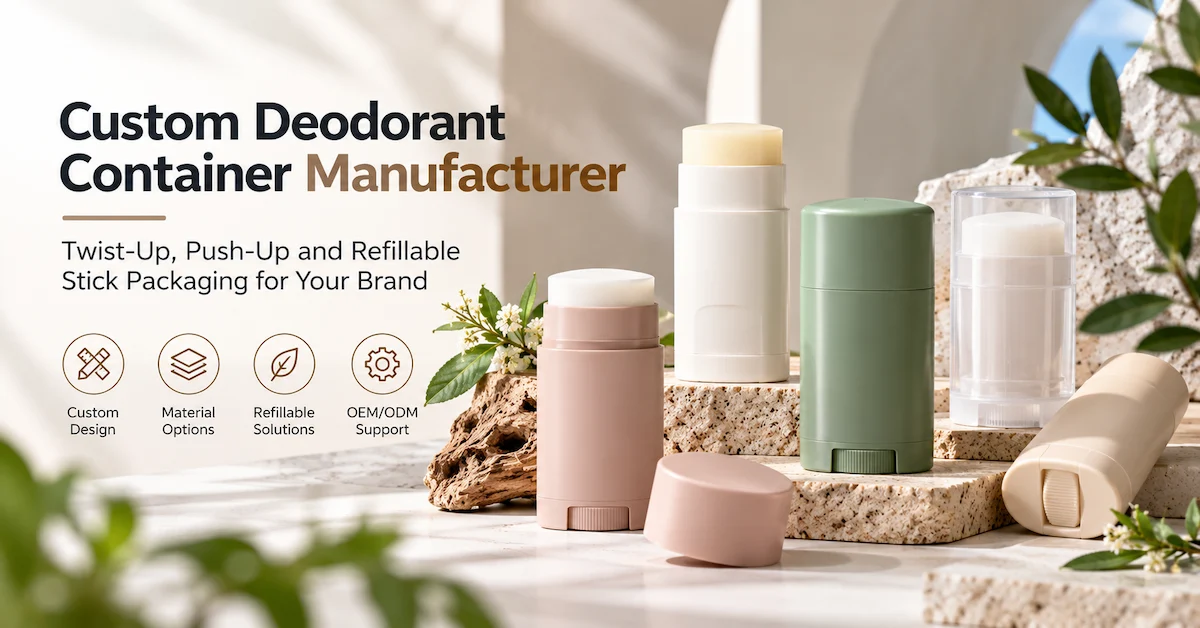
Twist-Up vs Push-Up vs Refillable Deodorant Containers
The first technical decision is selecting the dispensing structure.
Different mechanisms provide different consumer experiences, manufacturing requirements, and cost considerations.
Twist-Up Deodorant Stick Containers
A twist-up container typically uses a rotating base connected to an internal movement mechanism.
Turning the base advances a platform or elevator that pushes the deodorant stick upward.
This design is widely considered for solid deodorants and selected personal care sticks.
Its functional performance depends on the screw mechanism, elevator stability, internal friction, and compatibility with the formulation.
Buyers should evaluate whether the product advances smoothly without slipping, tilting, or jamming.
The rotating base should also remain functional after repeated operations.
Push-Up Deodorant Tubes
A push-up container generally uses a platform that moves when pressure is applied from the bottom.
Unlike a conventional screw mechanism, the product is advanced through direct manual force.
This concept may be considered for suitable solid deodorants, balms, and other personal care sticks.
However, the movement resistance must be controlled.
If the platform moves too easily, the product may rise unintentionally. If excessive force is required, consumers may struggle to use the package.
For paperboard push-up tubes, additional attention may be required for moisture exposure, barrier performance, and dimensional stability.
Refillable Deodorant Containers
Refillable packaging typically separates a reusable outer component from a replaceable product-containing component.
The precise refill design varies.
Some concepts replace an inner cartridge, while others require removing specific components before installing a replacement unit.
For brands considering refillable packaging, the most important questions concern cartridge fit, consumer handling, hygiene, replacement availability, and repeated assembly durability.
Refillability should be demonstrated through the intended replacement process rather than inferred from an attractive outer shell.
Deodorant Packaging Structure Comparison
| Container type | Dispensing method | Potential advantages | Main purchasing considerations |
|---|---|---|---|
| Twist-up stick | Rotating mechanism | Controlled advancement, familiar operation | Screw durability, elevator alignment |
| Push-up stick | Manual platform movement | Relatively simple dispensing concept | Movement resistance, platform stability |
| Refillable stick | Replaceable inner component | Retention of selected outer components | Cartridge fit, reuse durability |
| Roll-on bottle | Rotating ball applicator | Suitable for certain liquid formulations | Ball fit, leakage, application |
| Cream or balm jar | Direct manual application | Suitable for selected semi-solid products | Closure sealing, hygiene, product access |
These are industry packaging configurations, not a list of confirmed COSME stock models.
Buyers can explore the company's Deodorant Containers category and request confirmation of available or feasible custom designs.
Match the Deodorant Container to the Formula
One of the most expensive procurement mistakes is selecting packaging before the formulation has been sufficiently defined.
Deodorants may contain different combinations of waxes, oils, powders, fragrances, water, solvents, and other ingredients.
Their physical behavior can vary considerably.
Solid Wax-Based Deodorants
Solid sticks often depend on a structured formulation that maintains its shape during normal storage and application.
A suitable container must support the product during filling, cooling, transportation, and repeated use.
Important questions include whether the deodorant shrinks after cooling, cracks under storage conditions, or becomes difficult to advance.
Packaging dimensions and internal platform design may affect product retention and movement.
Cream and Balm Deodorants
Cream formulations may require a different packaging structure from firm solid sticks.
Depending on viscosity and consistency, jars or specialized dispensing containers may be considered.
A push-up mechanism should not be selected until the formula's ability to maintain its shape and advance consistently has been demonstrated.
Water-Based and Gel Formulations
Gel and water-based deodorants can introduce different material compatibility and leakage considerations.
Some products may be more suitable for roll-on or other dispensing formats than for conventional solid stick containers.
The formula and consumer application requirements should determine the final format.
Formula and Packaging Selection Matrix
| Formulation characteristic | Potential packaging concern | Recommended evaluation |
|---|---|---|
| Firm wax-based stick | Cracking, shrinkage, product retention | Cooling behavior, stick stability |
| Soft deodorant balm | Platform movement, deformation | Dispensing and storage testing |
| Oil-rich formulation | Material interaction, leakage | Product-contact compatibility |
| Water-based deodorant | Sealing, microbiological stability | Formula and complete-package evaluation |
| Fragrance-rich formulation | Compatibility with plastics and seals | Storage and material testing |
| Temperature-sensitive formula | Melting, softening, deformation | Appropriate thermal conditioning |
Packaging suitability should be established using the actual formulation, not simply by identifying the product as deodorant.
Buyer recommendation: Supply the manufacturer with relevant formulation information and expected filling conditions before approving a container structure.
Key Technical Specifications for Custom Deodorant Packaging
A professional purchasing specification should describe both the visible container and its functional components.
The following information helps manufacturers prepare comparable quotations.
| Specification | Information to confirm |
|---|---|
| Nominal capacity | Intended net content and fill requirements |
| Container dimensions | Height, width, diameter and tolerances |
| Material | Actual resin or other construction materials |
| Dispensing structure | Twist-up, push-up, refillable or another design |
| Internal platform | Shape, movement and product-support features |
| Cap design | Fit, retention and sealing requirements |
| Base mechanism | Rotating or pushing force requirements |
| Formula compatibility | Product-contact material requirements |
| Filling process | Filling temperature, orientation and equipment |
| Decoration | Color, printing, label and surface treatment |
| Testing | Functional, leakage, durability and storage criteria |
| Packing | Carton configuration and transport protection |
Capacity and Filling Weight Are Not Identical
The physical size of a container does not automatically determine the net weight of deodorant it can hold.
The relationship depends on the formulation's density, container geometry, and filling conditions.
Therefore, buyers should distinguish between the container's internal volume and the intended product fill weight.
A product labeled with a specific net weight should be evaluated using the actual formulation and filling process.
Why the Internal Platform Matters
In a twist-up container, the elevator supports and advances the deodorant.
An unsuitable platform may fail to hold the product securely or may create excessive movement resistance.
The manufacturer should verify the mechanism using representative filled samples.
A visually acceptable empty container is not sufficient proof of dispensing performance.
What Quality Tests Should Deodorant Container Manufacturers Perform?
Quality testing should focus on the complete filled package, not only the empty container.
Tests should be selected according to the formula, mechanism, intended use, and distribution conditions.
1. Twist Mechanism Testing
For twist-up packaging, evaluate whether the base rotates smoothly and advances the product as intended.
The test should examine repeated operation, platform movement, and potential slipping or jamming.
2. Push-Up Force Testing
For push-up formats, assess the force required to move the platform.
The product should remain stable during normal handling while allowing the intended consumer operation.
3. Cap Retention Testing
The cap should remain secure under expected handling and storage conditions.
A cap that detaches too easily may compromise consumer convenience and product protection.
4. Formula Compatibility Testing
Product-contact materials should be evaluated with the finished formula.
The assessment may consider swelling, discoloration, cracking, changes in mechanical properties, and other relevant interactions.
5. Filling and Cooling Validation
For hot-filled solid deodorants, evaluate whether filling and cooling create shrinkage, cracking, deformation, or problems with product retention.
The manufacturer's filling partner should approve the actual production process.
6. Transportation and Storage Testing
Finished packages may be exposed to vibration, impact, compression, or changing temperatures during distribution.
The test plan should reflect the intended shipping conditions and applicable acceptance criteria.
Recommended Quality-Control Checklist
| Test area | Possible failure | Procurement objective |
|---|---|---|
| Dimensional inspection | Components do not fit correctly | Consistent assembly |
| Twist mechanism | Slipping or jamming | Reliable advancement |
| Push-up platform | Excessive or insufficient movement resistance | Controlled dispensing |
| Cap retention | Loose or detached cap | Secure closure |
| Formula compatibility | Material deterioration | Suitable product-contact packaging |
| Filling validation | Shrinkage or product cracking | Stable finished product |
| Appearance | Scratches, color differences, print defects | Consistent brand presentation |
| Shipping evaluation | Broken or displaced components | Transport reliability |
The test limits should be defined for the actual product. Universal performance guarantees should not be assumed without supporting data.
Plastic Materials, PCR Content, and Refillable Design
Material selection affects appearance, mechanical performance, cost, and end-of-life considerations.
Polypropylene (PP) and polyethylene (PE) are among the materials commonly considered for molded personal care packaging components.
Other materials may be suitable depending on the construction.
Material Selection for Functional Components
A twist-up container contains moving surfaces and parts that must remain dimensionally consistent.
Material selection should account for rigidity, processing characteristics, and component interaction.
The same resin is not automatically appropriate for every cap, platform, or mechanism.
For customized projects, buyers should request the relevant material specifications and confirm which parts contact the formulation.
PCR Deodorant Packaging
Post-consumer recycled plastic may be considered for suitable components, depending on material availability and engineering requirements.
However, PCR content introduces additional considerations involving consistency, appearance, documentation, and product-contact suitability.
Brands should distinguish between recycled content in a specific part and recycled content in the entire package.
A statement such as "made with recycled plastic" should be supported by a clearly defined material scope and appropriate evidence.
Refillable Does Not Automatically Mean More Sustainable
A refillable structure may reduce repeated purchasing of selected outer components.
Its overall environmental impact depends on material use, replacement frequency, logistics, actual consumer behavior, and end-of-life handling.
Brands should avoid unsupported claims about carbon savings or recyclability.
COSME presents several materials and development directions in its Sustainable Packaging collection.
Project-specific material options and environmental documentation should be confirmed before commercial claims are made.
OEM and ODM Customization: From Existing Designs to New Tooling
Custom deodorant packaging can support brand differentiation, but appearance and functionality must be developed together.
Customizing an Existing Design
An existing suitable container may allow changes to color, branding, or decoration without requiring an entirely new dispensing mechanism.
This approach can reduce the structural development work required.
However, the actual customization scope depends on the selected design.
Changing the material, platform, or closure geometry may require further tooling and validation.
Developing a New Container
A distinctive shape or dispensing concept may require new tooling.
COSME Packaging describes a general OEM/ODM development process involving design confirmation, 3D drawings, CNC samples, mold development, tooling trials, and production.
These capabilities are presented in the company's About Us information and homepage.
For a custom deodorant container project, the engineering team should define how the outer shape interacts with the internal dispensing mechanism.
An attractive prototype does not establish that the final injection-molded package will advance the formula correctly.
Customization Options to Discuss
Potential project requirements include:
-
Container shape and external dimensions.
-
Brand colors and visual finishes.
-
Logo printing and decoration.
-
Cap and base appearance.
-
Internal dispensing structure.
-
Material selection.
-
Packaging and carton presentation.
-
Coordinated personal care product ranges.
All options should be confirmed against the proposed product and tooling arrangement.
How Much Does Custom Deodorant Container Manufacturing Cost?
The cost of custom deodorant packaging depends on its structure, materials, tooling, decoration, purchase quantity, and quality requirements.
A simple push-up package and a multi-component twist-up system may have different manufacturing cost structures.
Refillable containers can introduce additional components and validation requirements.
Main Cost Factors
| Cost factor | How it affects procurement |
|---|---|
| Container mechanism | Component complexity and assembly |
| Material choice | Resin or alternative material costs |
| Tooling | Mold investment and development |
| Decoration | Printing, finishing and setup |
| Order quantity | Production efficiency and unit economics |
| Quality testing | Samples and validation work |
| Packing | Protection and transportation |
| Repeat orders | Component continuity and inventory |
Compare Complete Packaging Costs
Two suppliers may quote different component scopes.
One quotation might include the complete container, while another covers only the body or selected parts.
Buyers should confirm whether the cap, internal platform, screw mechanism, decoration, assembly, and packing are included.
For refillable systems, obtain separate prices for the initial complete package and replacement components.
What Is the MOQ?
MOQ depends on the design, materials, decoration, tooling, and production requirements.
An existing design may involve different commercial conditions from a new custom mold project.
COSME has not published a verified universal MOQ for its deodorant container categories. Buyers should request a quotation based on the proposed construction and expected order quantities.
How to Evaluate a Custom Deodorant Container Manufacturer in China
The right supplier should demonstrate an understanding of both packaging manufacture and the requirements of the intended product.
A purchasing review should examine:
Technical capability: Can the supplier explain the proposed movement mechanism and provide useful drawings?
Manufacturing scope: Which components are produced internally, and which are sourced externally?
Material documentation: Are the actual materials and product-contact components identified?
Testing support: Can performance and compatibility requirements be evaluated against agreed criteria?
Quality control: How are dimensions, appearance, assembly, and batch consistency managed?
Commercial transparency: Are tooling costs, MOQ, ownership, sampling arrangements, and delivery conditions documented?
Repeat-order reliability: How are critical component changes controlled?
A manufacturer need not produce every component internally, but the complete system requires clear quality responsibility.
For brand owners developing a long-term product line, component consistency can be more important than selecting the lowest initial quotation.
COSME Packaging: OEM/ODM Support for Personal Care Packaging Projects
COSME Packaging is the brand of Zhejiang Cosme Industry Co., Ltd., established in 2015.
The company focuses on cosmetic packaging development and manufacturing, with published capabilities covering mold development, molding equipment, decoration, and OEM/ODM customization.
Its website includes product categories for deodorant containers, plastic deodorant containers, refillable deodorant packaging, and PCR deodorant packaging.
At the time of review, the main deodorant container category does not display a verified standalone product SKU. Therefore, buyers should inquire about available designs and development feasibility rather than assume a particular container is already in production.
COSME also describes incoming material inspection, dimensional and appearance checks, leakage evaluation, printing inspection, and traceability within its general packaging quality-control system.
For a deodorant project, the relevant mechanism, filling, and formula tests should be agreed separately.
When Should Brands Contact COSME?
COSME is a relevant company to approach when evaluating custom cosmetic and personal care packaging, particularly where mold development, visual customization, and OEM/ODM project discussions are required.
A technical inquiry should establish whether the proposed deodorant packaging configuration can be supplied or developed.
Discuss Your Custom Deodorant Packaging Project With COSME
RFQ Checklist for Custom Deodorant Packaging Buyers
A detailed RFQ can prevent misunderstandings and improve quotation accuracy.
Instead of requesting only a price for "custom deodorant sticks," provide the packaging requirements.
| RFQ item | Information to provide |
|---|---|
| Product type | Solid deodorant, balm, cream or other formulation |
| Container structure | Twist-up, push-up, refillable or another design |
| Target fill | Required net weight and relevant formula density |
| Dimensions | Target shape, size and tolerances |
| Formula | Relevant ingredients and compatibility concerns |
| Filling | Filling temperature and equipment requirements |
| Materials | Preferred plastics or other materials |
| Decoration | Color, artwork, logo and finish |
| Quantity | Initial order and annual forecast |
| Samples | Required technical and production samples |
| Testing | Movement, cap, formula and transport requirements |
| Commercial terms | MOQ, tooling, schedule and destination |
Example OEM Inquiry
"We are developing a new solid deodorant line for an international personal care brand.
We need to evaluate custom twist-up or push-up packaging suitable for our formulation and filling process.
Please advise whether you have an existing compatible design or can develop a custom container.
We would like to review material options, internal dispensing mechanisms, available decoration methods, sample requirements, tooling arrangements, MOQ, quality testing, and production conditions.
Our team can provide formula information, target fill weight, preferred dimensions, branding references, and forecast quantities."
This inquiry gives the manufacturer a clearer starting point than a generic request for the lowest unit price.
Request Custom Deodorant Container Samples and an OEM Quotation
Frequently Asked Questions
What is the best packaging for a solid deodorant stick?
The appropriate packaging depends on formulation firmness, desired dispensing method, consumer experience, filling conditions, and project cost. Twist-up and push-up formats are common options, but the complete package should be validated with the actual formula.
Can custom deodorant containers be made with recycled plastic?
Potentially, depending on component design, material sourcing, and application requirements. Buyers should verify the actual PCR grade, recycled content, product-contact suitability, and documentation. Recycled content should not be assumed for every component.
What tests are important for twist-up deodorant containers?
Typical evaluations may include screw-mechanism operation, elevator movement, cap retention, dimensional accuracy, formula compatibility, repeated use, and performance after storage or transportation.
Can a deodorant packaging manufacturer customize the shape and logo?
A manufacturer with suitable OEM/ODM capabilities may support customized appearance, colors, decoration, and structural development. Feasibility depends on the selected design, tooling, materials, and production arrangements.
How can buyers reduce the risk of packaging failure?
Define the formula and filling process early, approve the mechanism through representative samples, establish performance acceptance criteria, and verify production-intended components before bulk purchasing. A controlled specification also helps maintain repeat-order consistency.
How should I compare suppliers for private-label deodorant packaging?
Compare verified engineering capabilities, complete component specifications, quality systems, sampling support, customization scope, commercial terms, and future supply reliability. The cheapest quotation may not represent the lowest overall packaging cost.
Conclusion
Choosing a custom deodorant container manufacturer requires careful attention to the dispensing mechanism, formula compatibility, materials, filling conditions, and manufacturing consistency.
Twist-up, push-up, and refillable designs can serve different product concepts, but each must be evaluated with the intended deodorant formulation. Functional testing and clear technical specifications are essential before committing to tooling or bulk production.
For international personal care brands, the strongest procurement strategy is to define the packaging requirements, request representative samples, compare complete costs, and confirm quality responsibilities before approving the final design.
COSME Packaging provides OEM/ODM cosmetic packaging development and manufacturing services. Brands planning custom deodorant packaging can discuss design requirements, material options, manufacturing feasibility, sampling, and project-specific quotations with its team.
Contact COSME Packaging to Start Your Custom Deodorant Container Project