
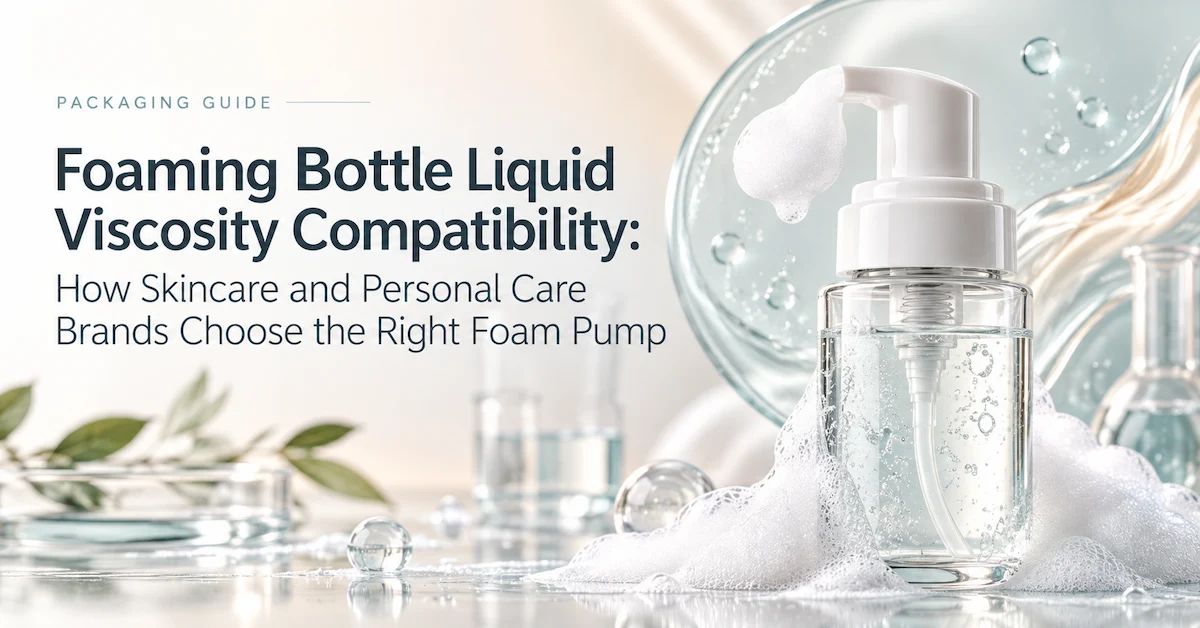
When a foaming bottle produces weak foam, stops priming, leaks around the closure, or leaves too much liquid in the bottle, the problem is rarely the bottle body alone. In most cases, the complete dispensing system has not been matched to the formula. Foaming bottle liquid viscosity compatibility depends on the liquid's viscosity and rheology, surfactant system, air-liquid mixing behavior, pump mesh, valve design, dip tube, closure fit, filling process, and storage conditions.
The short answer is this: a foaming pump generally performs best with a free-flowing, low-to-moderate viscosity liquid that can move through the pump chamber and mesh without excessive resistance. However, there is no universal viscosity number that guarantees a successful result. A formula that works in one foaming bottle may fail in another because the pump output, mesh structure, inlet path, air ratio, and product chemistry are different. Buyers should therefore approve the formula and the assembled packaging as one system, not as separate components.
This guide is written for skincare brands, personal care manufacturers, private-label companies, contract fillers, packaging distributors, and procurement teams evaluating a foaming bottle solution. It explains what to compare, which tests to request, when a foam pump is the wrong format, and how to prepare a useful OEM inquiry.
Quick Answer: What Viscosity Works in a Foaming Bottle?
Foaming bottles are normally selected for liquid formulas that can be drawn through a dip tube or inlet, mixed with air inside the pump, and passed through a mesh or foaming element. Very thin formulas usually prime quickly and create foam with less pumping force. Moderately viscous formulas may work if the pump is designed for them and the surfactant system creates the required foam structure. Thick lotions, rich creams, heavy emulsions, and formulas containing particles are usually better candidates for a lotion pump, airless bottle, jar, or soft tube.
For early development, buyers can use the following screening bands as engineering starting points rather than as a published supplier specification. A foaming bottle liquid viscosity compatibility review should always identify the formula, pump assembly, test temperature, and acceptance criteria together:
| Formula condition | Initial foaming bottle suitability | What to verify before approval |
|---|---|---|
| Watery cleanser, liquid soap, toner-like wash, or low-viscosity serum cleanser | Often a strong candidate | Priming time, foam density, output per stroke, and leakage |
| Mild gel cleanser or moderately structured liquid | Possible, depending on pump design | Viscosity at test temperature, mesh clogging, repeated dispensing, and end-of-life output |
| Rich lotion, high-viscosity emulsion, balm, cream, or product with suspended particles | Often a poor fit for a standard foam pump | Consider a lotion pump, airless bottle, jar, or tube and compare total packaging performance |
| Formula that changes viscosity with temperature or shear | Requires a controlled test plan | Test at filling, room, low, and high temperatures and record recovery after storage |
The practical decision is not simply whether a liquid is “thin” or “thick.” A buyer must understand how the formula behaves under shear, how quickly it separates, whether it contains oils or particles, and whether its surface tension supports the desired foam. This is why a specification sheet should state the test temperature and test method. A viscosity value without a temperature or measurement method can mislead a procurement team.
For a wider packaging program, Cosme Packaging lists foaming bottles alongside dropper bottles, dual-chamber bottles, syringe bottles, refillable bottles, plastic bottles, glass bottles, and other cosmetic packaging formats on its cosmetic bottle category page. That broader range is useful when a formula does not fit a standard foam pump or when a brand wants to keep the same visual language while changing the dispensing mechanism.
Why Foaming Bottle Liquid Viscosity Compatibility Matters to Buyers
A foaming bottle changes the consumer experience in several ways. It determines how much liquid is dispensed, how much air is incorporated, how the foam feels on skin, how many pump strokes are needed, and how much product remains after normal use. If the liquid is too resistant for the pump, the actuator may feel hard to press and the user may stop using the product. If the pump is too aggressive for a very thin formula, the output can be inconsistent or messy.
Compatibility also affects manufacturing economics. A formula-packaging mismatch can create filling-line stoppages, high rejection rates, leakage complaints, excess product residue, and costly rework. Packaging may look correct during a hand check and still fail when hundreds or thousands of units are filled, capped, labeled, packed, and transported.
For B2B buyers, the correct question is not “Does this foaming bottle look suitable?” It is “Does this assembled pump and bottle deliver the required formula at the required output, under the intended filling, storage, shipping, and consumer-use conditions?” That question aligns packaging development with the real commercial risk.
Who Should Use a Foaming Pump Bottle?
Skincare and facial cleanser brands
Foam pumps are common for facial cleansers because they can turn a liquid wash into a ready-to-use foam. The format can reduce the amount of manual lathering required by the consumer and can support a clean, controlled routine. The formula still needs to be developed for the dispensing system. A cleanser that is too structured or contains insoluble particles may not pass through the mesh consistently.
Hand wash and personal care brands
Liquid hand wash, body wash, and selected personal care products may use foam pumps when the brand wants a light foam, lower-dose application, or a convenient countertop package. The pump should be tested with the actual surfactant system, fragrance load, colorants, preservatives, and expected temperature range.
Hospitality, salon, and professional-use programs
Hotels, spas, salons, and professional back-bar programs may value foam dispensing because the package can be easy to operate and visually consistent across a product line. These environments can involve frequent repeated actuation, so cycle testing, actuator durability, cap retention, and refill or replacement procedures deserve more attention than a short retail trial.
Private-label and contract manufacturing projects
Private-label buyers often need a proven bottle shape with custom color, logo, decoration, and formula compatibility. An existing foaming bottle can shorten the structural development path, but it still requires a complete sample approval. Custom decoration should be checked for print alignment, adhesion, scuff resistance, and consistency across the batch.
When a foam pump is not the right format
A foam pump may be unsuitable when the product is a rich cream, a high-viscosity emulsion, an oil-heavy formula, a product with exfoliating particles, or a formula that must be isolated from air by a verified airless architecture. In these cases, compare a cosmetic soft tube, a lotion pump bottle, a jar, or an airless bottle. The best package is the one that delivers the formula reliably and supports the filling process, not the one with the most attractive appearance in a catalog.
How a Foaming Pump Converts Liquid into Foam
A foaming bottle usually relies on a pump assembly that moves liquid and air through separate or coordinated paths. When the actuator is pressed, the liquid is drawn from the reservoir and the pump introduces air. The combined stream passes through a mesh or foaming element, creating bubbles or a lather-like output.
The final foam depends on several interacting variables:
- Liquid flow resistance. Higher viscosity increases the force required to move the formula through the inlet and pump chamber.
- Air-liquid ratio. Too little air may create a wet, dense stream. Too much air may create unstable foam or an underfilled pump chamber.
- Mesh or foaming element. The mesh geometry affects bubble size, foam density, priming, and clogging risk.
- Valve and chamber design. Valves must manage refill, prevent backflow, and maintain repeatable output.
- Actuator and closure fit. A loose or poorly matched closure can cause leakage or air ingress.
- Formula chemistry. Surfactants, polymers, oils, salts, fragrances, and particles all influence wetting, foam stability, and material compatibility.
The phrase foaming bottle liquid viscosity compatibility therefore describes a system relationship. It does not describe the bottle body in isolation. Two bottles with the same nominal capacity can produce different results if their pump chambers or mesh structures differ.
Formula Properties to Review Before Selecting the Bottle
Viscosity and rheology
Ask the formula team to provide viscosity at a stated temperature and shear condition. A single number is useful for screening, but it may not explain how the product behaves during a fast pump stroke. Some formulas thin under shear and recover after dispensing. Others contain a yield stress and resist movement until a threshold force is applied.
For a meaningful test, record the instrument, spindle or geometry where relevant, speed, temperature, and sample conditioning time. Use the same method for the packaging sample comparison. If a supplier tests the pump with water while the commercial formula contains surfactants, polymers, or oils, the result may not represent production behavior.
Surfactant system and foam stability
Viscosity is only one part of foam performance. The surfactant system controls how bubbles form and how long the foam remains stable. A formula can have an acceptable viscosity and still create weak foam if its surface tension, surfactant balance, or air interaction is unsuitable. In other words, foaming bottle liquid viscosity compatibility is not a viscosity-only approval.
The brand should define what “good foam” means. It may mean a fine, dense foam for facial cleansing, a light foam for hand wash, a quick-rinsing foam for body care, or a stable foam that remains visible for a specific period. Without an agreed endpoint, buyers may approve different results based only on personal preference.
Particles, oils, and active ingredients
Exfoliating particles, botanical powders, pigments, high oil content, and suspended solids can increase clogging or alter flow through a mesh. Active ingredients and fragrance materials may also interact with pump seals, gaskets, dip tubes, or internal coatings. The product-contact pathway includes more than the bottle body.
Provide the supplier with relevant information about pH, alcohol, oils, fragrance, solvents, active ingredients, filling temperature, and storage conditions. Confidential formulas do not always need to be disclosed in full. A technical summary and an agreed compatibility testing plan can be sufficient for initial packaging development.
Temperature sensitivity
Viscosity often changes with temperature. A foam pump that performs well in a warm factory may prime slowly in a cool warehouse or dispense too quickly after exposure to high temperature. Test the package at the expected filling temperature, room temperature, and relevant transport or storage conditions.
If the product will be sold globally, include realistic temperature cycling. The purpose is not to create a universal certification claim. The purpose is to identify whether the package and formula remain functional within the actual distribution range.
Components That Control Foam Pump Compatibility
Bottle body and internal geometry
The bottle must provide enough stability for actuation and filling. A tall narrow body may need careful conveyor handling. Internal bottom geometry affects dip-tube reach and residual product. The shoulder and neck influence the available space for the pump, closure, and sealing elements.
Neck finish and closure
The neck finish includes opening diameter, thread or snap-fit geometry, sealing surfaces, and dimensional tolerances. A pump that appears to fit by hand may still leak or loosen during transportation if the closure and bottle are not validated as an assembly. Ask for a drawing or an approved reference sample, and record the critical dimensions in the purchase specification.
Dip tube or inlet path
If the dip tube is too short, the pump may stop drawing liquid while a significant amount remains. If it is too long, it can bend, interfere with the bottom, or restrict the inlet. The correct length depends on the bottle height, bottom shape, pump design, and assembly method. Residual-product testing should be performed with the intended formula.
Pump chamber, valves, and mesh
These parts govern priming, air mixing, output, and foam texture. Buyers should ask which components are in contact with the formula and how the supplier controls variation. A mesh that produces a fine foam may be more sensitive to particles or high viscosity than a more open design. The foaming bottle liquid viscosity compatibility check should therefore include the pump's internal path, not only the bottle's label capacity.
Protective cap and transport retention
The cap protects the actuator from dust, accidental pressing, and shipping contact. Confirm that the cap remains secure under vibration and normal handling. If the product is intended for travel or e-commerce, test the assembled package in its secondary packaging rather than evaluating only the empty bottle.
Technical Specification Checklist for Foaming Bottle Projects
The following table can be used as a starting point for a technical inquiry. It does not replace a supplier drawing or approved sample.
| Specification area | Information to request | Why it matters |
|---|---|---|
| Bottle capacity | Nominal fill volume, overflow volume, and usable volume | Supports formula planning, label claims, and line setup |
| Bottle material | Exact resin or substrate for every product-contact part | Affects compatibility, weight, appearance, and recycling decisions |
| Neck finish | Drawing, dimensions, thread or snap-fit details | Prevents pump and bottle mismatch |
| Pump output | Target mass or volume per stroke and acceptable variation | Controls dose, consumer feel, and product consumption |
| Priming | Initial strokes and priming procedure | Helps compare samples consistently |
| Foam performance | Foam density, texture, stability, and rinse behavior | Turns subjective approval into testable criteria |
| Mesh/foaming element | Structure, replacement option, and clogging sensitivity | Influences foam quality and formula tolerance |
| Dip tube | Length, diameter, connection, and bottom position | Affects residual product and end-of-life dispensing |
| Sealing | Gasket, liner, closure fit, and leakage method | Reduces transport and storage failures |
| Decoration | Printing, labeling, hot stamping, color and finish | Protects brand appearance and batch consistency |
| Filling compatibility | Nozzle clearance, cap application, line speed, and orientation | Prevents production interruptions |
| QC records | Incoming, in-process, functional, appearance, and final checks | Supports traceability and repeat orders |
Cosme Packaging publicly describes incoming raw-material inspection, dimensional and surface checks during molding, finished-product leakage testing, printing adhesion and color checks, and batch traceability. Project-specific acceptance limits and pump test methods should be confirmed during the quotation and sample-approval stage.
The website does not publish a complete list of certifications for every product or market. Buyers should request the applicable quality, material, social-compliance, food-contact, or regional regulatory documents for the exact model and destination. Do not treat a general factory description as proof that every SKU carries the same certification. The right documentation should identify the product, material, test scope, issue date, and responsible laboratory or organization where relevant.
Capacity and Lead Time
The homepage presents a manufacturing profile that includes a factory area of more than 15,000 square meters, around or more than 200 employees, and more than 50 injection machines. These figures help a buyer understand the stated production base, but they do not automatically define available capacity for a particular foaming bottle project. Capacity also depends on tooling availability, component sourcing, decoration requirements, number of SKUs, order quantity, and the production schedule at the time of approval.
The website FAQ states that production typically takes 40 to 50 days depending on customization complexity. Buyers should clarify whether this estimate starts after order confirmation, deposit, tooling completion, artwork approval, or pre-production sample approval. Ask for separate timing for sampling, mold development, decoration, assembly, inspection, and shipment. A written project schedule is more useful than a generic lead-time number.
How to Test Foaming Bottle Liquid Viscosity Compatibility
For procurement documents, define foaming bottle liquid viscosity compatibility as an acceptance criterion instead of a vague description. The approved criterion should identify the formula, temperature, pump model, output target, foam appearance, leakage limit, and end-of-life residual amount. This makes the packaging decision measurable and gives the supplier a clear reference for production and repeat orders.
Step 1: Define the formula and use case
State whether the product is a facial cleanser, hand wash, body wash, shampoo, sanitizer, or another personal care liquid. Define the intended dose, user frequency, pack size, and storage environment. A small facial cleanser may need a different output from a larger hand wash used by many people each day.
Step 2: Measure the formula consistently
Measure viscosity using an agreed method and temperature. Record whether the formula was rested, mixed, or conditioned before testing. If the formula is shear-thinning, measure at more than one condition and explain the result to the packaging supplier.
Step 3: Test a complete assembled package
Do not approve a bottle body and pump separately when the final product uses them together. Assemble the bottle, pump, dip tube, gasket, cap, and decoration as they will appear in production. Fill with the intended formula or a justified laboratory substitute.
Step 4: Record priming and output
Measure the number of strokes required to prime the pump, the output per stroke, and the variation across repeated actuations. Record the actuator force and any unusual sound, hesitation, sputtering, or air lock. Test at the beginning, middle, and near the end of the fill.
Step 5: Evaluate foam quality
Use agreed observations or measurements for foam texture, density, bubble size, stability, wetness, and rinse behavior. Take photographs or short videos under consistent lighting if visual approval is part of the project. The exact acceptance criteria should reflect the brand's intended user experience.
Document the result as a foaming bottle liquid viscosity compatibility record so that the same formula and package can be compared during pilot production and repeat orders.
Step 6: Check leakage and seal performance
Inspect the closure after filling, storage, inversion, and handling. A quick upside-down check may not represent actual distribution conditions. Define the storage orientation, temperature conditioning, duration, and pass/fail criteria with the supplier.
Step 7: Run filling-line trials
Before a large purchase order, use production-intended components on the actual or representative filling line. Check bottle stability, nozzle clearance, fill accuracy, pump placement, dip-tube insertion, closure application, labeling, and cartoning. A successful manual sample does not prove automated line compatibility.
Step 8: Approve a reference sample
Keep an approved assembled sample, drawing, artwork proof, material declaration, and test record as the reference for mass production and repeat orders. This reduces the risk that a replacement pump, cap, or material change silently alters performance.
Foaming Bottle vs Other Cosmetic Packaging Formats
The right comparison is based on the formula and use case. The following table supports an initial format decision.
| Packaging format | Typical dispensing behavior | Strong fit | Main limitation | Key buyer check |
|---|---|---|---|---|
| Foaming bottle | Liquid and air are combined to create foam | Low-viscosity cleansers, hand wash, selected body care | Sensitive to viscosity, particles, mesh, and surfactant system | Foam quality, priming, mesh clogging, output, and leakage |
| Lotion pump bottle | Liquid is delivered through a dip tube and actuator | Lotions, emulsions, liquid soaps, selected serums | May not provide the desired foam and can leave residual product | Pump output, dip-tube length, closure, and formula compatibility |
| Fine-mist sprayer | Low-viscosity liquid is atomized into a spray | Toner, facial mist, fragrance, selected sanitizing liquids | Not designed for thick or particle-containing formulas | Spray pattern, clogging, leakage, and alcohol compatibility |
| Airless bottle | Formula is dispensed from a protected reservoir structure | Selected serums, creams, sensitive formulas | Higher structural complexity and different refill or filling requirements | Verified airless mechanism, evacuation, pump function, and compatibility |
| Cosmetic soft tube | User squeezes the body to dispense product | Cream, gel, ointment, travel and sample formats | Less suitable for hands-free foam dispensing | Tube softness, closure, seal, decoration, and filling method |
| Cosmetic jar | Wide-mouth access for manual or spatula application | Creams, balms, masks, gels, thick products | More direct user contact and less controlled dose | Lid fit, liner, sealing, opening cycles, and contamination control |
This comparison is especially useful for brands that are deciding between a foam cleanser and a richer cream cleanser. A coordinated product line does not need to use one package for every SKU. The Cosme cosmetic packaging set range can be used as a reference for combining different dispensing formats while maintaining a consistent visual direction.
Manufacturing and Workmanship Considerations
Foaming bottle workmanship is visible in the details that affect both performance and brand perception. Plastic components may be molded with different tools for the bottle, cap, actuator, valve housing, and other parts. The components then need to be assembled with consistent alignment and controlled force. Decoration can be applied through printing, labeling, hot stamping, color matching, or other finishing methods selected for the package geometry.
The manufacturing sequence should protect the functional interfaces. A beautiful coating is not useful if it interferes with the thread or snap fit. A sharp print is not a successful decoration if it loses adhesion during filling, shipping, or repeated handling. A pump that passes a visual check still needs functional testing with the formula and the approved closure.
For new structures, the development path typically includes design confirmation, 3D drawing, CNC sample, mold opening, T1/T2 samples, corrections, and mass production. For existing styles, the project may move directly through style and capacity confirmation, color and printing approval, quotation, pre-production sample, mass production, and delivery. In both cases, workmanship should be evaluated against a controlled reference sample and measurable acceptance criteria.
Quality Control, Certifications, and Documentation
Incoming material control
Confirm material identity, color, surface condition, and component availability. If PCR or recycled-content material is used, define the expected color range and any approved variation. A recycled resin may introduce more visible batch variation than a virgin resin, so the cosmetic standard should be agreed before production.
Dimensional and visual inspection
Critical dimensions include neck geometry, body height, wall thickness, base stability, pump interface, and assembly points. Visual inspection should cover scratches, bubbles, sink marks, flash, warpage, haze, color difference, print alignment, coating defects, and contamination.
Functional testing
Functional tests may include priming, pump output, repeated actuation, actuator force, foam texture, cap retention, closure engagement, and end-of-life dispensing. The test procedure should identify the formula, temperature, sample size, number of cycles, and pass/fail limits.
Leakage and transportation risk
Leakage can arise from poor neck compatibility, damaged gaskets, incorrect torque, deformation, or vibration. Evaluate the full shipping configuration, including primary package, secondary carton, orientation, and protective inserts. Do not assume that tightening the closure harder will solve every leak. Excessive force may deform the components or damage the seal.
Repeat-order control
Packaging specifications should control approved drawings, color references, artwork, material declarations, pump models, and reference samples. Any critical change to the pump, closure, resin, decoration, or assembly method should be reviewed before production. The same foaming bottle liquid viscosity compatibility record should be used when a brand repeats an order or adds a new SKU. This is essential for brands that expect repeat orders across multiple seasons.
Materials and Sustainable Options
Material choice affects the formula, appearance, logistics, and environmental story. PET and PETG may support clear or premium-looking bodies. PP and PE are common options for molded components and flexible structures. Aluminum and glass can create a different premium experience but require careful consideration of weight, breakage, coating, and closure compatibility. PCR can support recycled-content objectives but requires control of source, percentage, color, and batch variation.
Cosme Packaging presents PET, PETG, PP, PE, PCR, recyclable packaging, refillable designs, and other sustainable directions through its sustainable packaging category. Buyers should request the exact material composition and any available supporting documentation for the selected model. A material option is not automatically proof of biodegradability, recyclability in every local system, or a specific carbon reduction.
For a foaming bottle, sustainability decisions should include the whole dispensing system. The pump, mesh, spring, gasket, dip tube, bottle, cap, label, and secondary packaging may use different materials. A package that looks recyclable may still be difficult to recycle if components cannot be separated or if local infrastructure does not accept the combination. A refillable design can reduce the need to replace an outer package, but the refill method, cleaning procedure, and consumer instructions must be practical. Foaming bottle liquid viscosity compatibility still has to be validated after any material or component change.
Cost and Commercial Risk
The lowest unit price is not always the lowest project cost. Buyers should consider tooling, samples, decoration setup, pump testing, filling-line trials, rework, leakage claims, rejected units, freight volume, and repeat-order stability. A cheaper foam pump that produces inconsistent output may cost more after launch than a better-matched system that passes testing earlier.
For an existing style, the commercial path may include style and capacity confirmation, color and printing approval, quotation, order confirmation, pre-production sample, mass production, and delivery. For a new structure, the path may include 3D drawing, CNC sample, mold opening, T1/T2 samples, mass production, and delivery. The exact timing depends on customization complexity, quantity, sample revisions, material availability, and shipping destination.
Cosme Packaging's website FAQ states that production typically ranges from 40 to 50 days depending on customization complexity. Buyers should clarify the starting point of that estimate, whether it includes decoration and assembly, and whether sample approval, tooling, and freight are counted separately. Do not use a general lead-time statement as a purchase commitment without a project-specific quotation.
OEM and ODM Development with Cosme Packaging
Cosme Packaging presents a full-chain model that combines R&D, mold development, production, printing, assembly, quality control, and delivery. That model is relevant when a brand wants a custom foaming bottle rather than a generic catalog item.
An effective OEM/ODM brief should include:
- Product category and formula type.
- Viscosity data and test temperature.
- Desired foam texture and output per stroke.
- Fill volume, overflow volume, and target dimensions.
- Bottle material and product-contact component requirements.
- Pump, mesh, valve, dip-tube, cap, and closure preferences.
- Color, surface finish, logo, artwork, and decoration method.
- Filling-line details and closure-application method.
- Target quantity, SKU count, sample expectations, and launch date.
- Required testing, acceptance criteria, packaging configuration, and destination.
The more complete the brief, the easier it is for the supplier to propose a suitable bottle, identify compatibility risks, and quote the correct scope. A good supplier conversation should identify what is known, what must be tested, and what cannot be confirmed until a sample is filled with the intended formula.
To begin a project, buyers can review the Cosme Packaging About Us page for company and quality information, then send the formula and packaging requirements through the Contact Us page. The inquiry should ask for an assembled sample rather than only an empty bottle whenever foaming performance is important.
Buyer Questions to Ask a Foaming Bottle Supplier
- What viscosity and formula conditions is the proposed foaming pump designed to handle?
- Which test temperature and viscosity method were used for the supplier's sample?
- What are the target pump output and acceptable output variation?
- How many strokes are required for priming, and how does output change near the end of the fill?
- What mesh, valve, chamber, and dip-tube components contact the formula?
- Can the supplier run leakage, repeated-actuation, foam-quality, and formula-compatibility tests?
- Is the proposed bottle compatible with our filling and closure-application line?
- Which material grades, PCR percentages, and decoration options are available for this model?
- What are the sample, tooling, MOQ, production, and delivery terms for this project?
- How will the approved reference sample and critical specifications be controlled for repeat orders?
These questions turn a general packaging inquiry into a technical and commercial evaluation. They also help a buyer compare suppliers on evidence rather than on appearance or unit price alone.
FAQ: Foaming Bottle Liquid Viscosity Compatibility
1. What is foaming bottle liquid viscosity compatibility?
Foaming bottle liquid viscosity compatibility is the ability of a specific formula and a specific foam pump assembly to prime, move, mix with air, pass through the foaming element, and dispense consistent foam throughout normal use. It includes more than the liquid's viscosity. Surfactants, rheology, particles, oils, temperature, pump output, mesh, valves, dip tube, and closure sealing all contribute to the result.
2. Is there one universal viscosity range for every foaming bottle?
No. Foaming pumps have different chamber volumes, inlet paths, mesh structures, valves, and air ratios. A low-viscosity liquid is generally easier to foam, but the correct range must be confirmed with the actual pump and formula. Treat any general cP range as a screening guide, not as a guaranteed performance specification.
3. Can a thick facial cleanser use a foaming bottle?
It may be possible if the formula is engineered for the pump and the selected mesh can handle it, but many thick or yield-stress cleansers are better suited to a lotion pump, tube, or jar. Test priming, actuator force, foam output, clogging, and end-of-life dispensing before approval.
4. What happens when the formula is too viscous?
The pump may require excessive force, prime slowly, dispense an inconsistent dose, create weak or wet foam, trap air, or stop drawing product before the bottle is empty. A high-viscosity formula can also increase the risk of mesh clogging and production-line variation.
5. Does low viscosity always guarantee good foam?
No. A very thin liquid can still produce unstable foam if the surfactant system, air-liquid ratio, mesh, or valve design is unsuitable. The formula may also leak more easily if the closure or gasket is not matched. Viscosity screening must be combined with foam-quality and leakage testing.
6. How should a buyer test foaming bottle compatibility?
Use the intended formula or a justified laboratory substitute in a complete assembled package. Measure viscosity at a controlled temperature, then test priming, output per stroke, actuator force, foam texture, repeated actuation, leakage, residual product, and storage performance. Confirm the result on the intended or representative filling line.
7. Which products commonly use foam pump bottles?
Common applications include facial cleansers, hand wash, body wash, selected shampoos, personal care liquids, and some sanitizing or hygiene products. The exact suitability depends on formula chemistry and the required user experience. Review the foaming bottle category and request a model-specific sample.
8. Can PCR or sustainable materials be used for a foaming bottle?
Potentially, depending on the selected model, material grade, product-contact requirements, color expectations, and local recycling goals. PCR can introduce color and batch variation, while refillable systems require a practical refill workflow. Confirm material composition, recycled percentage, documentation, and compatibility for the actual package.
9. What is the difference between a foaming bottle and an airless bottle?
A foaming bottle is designed to combine liquid and air to create foam. An airless bottle is designed around a reservoir and dispensing architecture intended to limit replacement air entering the product during use. They solve different problems. A foam cleanser may need a foam pump, while an oxygen-sensitive serum or cream may need a verified airless system.
10. What information should be included in an OEM inquiry?
Include formula type, viscosity and test temperature, surfactants or relevant ingredients, target capacity, desired foam output, bottle material, decoration, filling-line details, quantity, target market, testing requirements, and delivery expectations. Ask for a complete assembled sample and a clear specification sheet before mass production.
Request a Foaming Bottle Compatibility Review
If you are developing a cleanser, hand wash, body wash, shampoo, or other personal-care liquid, send the supplier more than a product name. Share the formula condition, viscosity method, target foam, capacity, decoration, and filling process. This allows the packaging team to evaluate the pump, mesh, valves, dip tube, closure, material, and production requirements as one system.
Cosme Packaging supports OEM/ODM cosmetic packaging projects across bottles, jars, tubes, airless formats, aluminum containers, and sustainable packaging. You can start with the cosmetic bottles product range, review related formats such as refillable packaging, and submit the project requirements through Contact Us. Request a sample filled with the intended formula whenever foaming performance, leakage control, or filling-line compatibility is critical.
Conclusion
Foaming bottle liquid viscosity compatibility is a complete system decision, not a simple bottle selection. The formula must move through the pump, mix with air, pass through the foaming element, and produce a repeatable user experience without leakage, excessive force, premature clogging, or unacceptable residual product. Viscosity is a critical starting point, but surfactant chemistry, rheology, temperature, pump output, mesh design, valves, dip tube, closure, material, filling line, and storage conditions must be evaluated together. A documented foaming bottle liquid viscosity compatibility test is the strongest bridge between a promising sample and a controlled production order.
For brands comparing models, review the Cosme foaming bottle range and the wider cosmetic bottle collection. To discuss formula compatibility, sampling, decoration, MOQ, lead time, and OEM/ODM requirements, submit the project through Contact Us.