
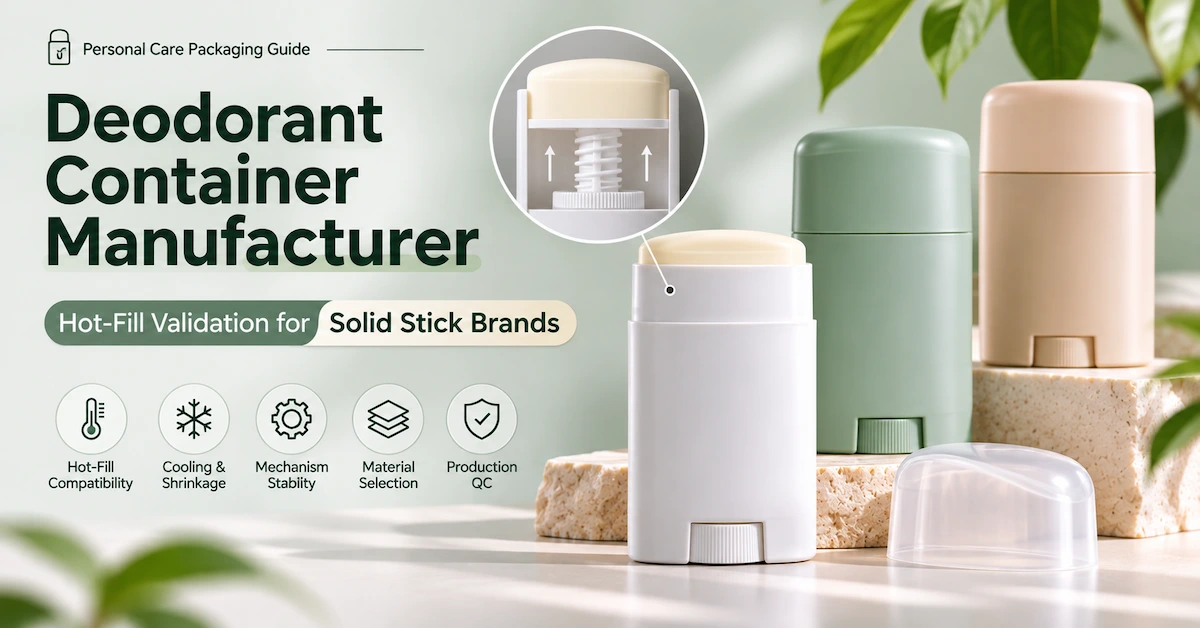
TL;DR: A reliable deodorant container manufacturer should help brands evaluate whether the container, internal platform, cap, and dispensing mechanism remain functional throughout filling, cooling, storage, and repeated use. For hot-filled solid deodorants, buyers should validate material compatibility, shrinkage, product retention, mechanism movement, and production consistency before approving bulk orders.
Developing solid deodorant packaging involves more than selecting an attractive container. For personal care brands, cosmetic OEM/ODM factories, and private-label manufacturers, one of the most important challenges is ensuring that the package performs correctly after the formulation has been filled and cooled.
A deodorant stick may look perfect immediately after filling but develop shrinkage cavities, cracks, or dispensing problems during cooling and subsequent storage.
These defects can affect the appearance of the product, its retention within the container, and the consumer's ability to advance the stick.
The key to successful production is evaluating the finished deodorant as a complete system: formula, container material, internal platform, filling process, cooling conditions, and dispensing mechanism.
COSME Packaging, operated by Zhejiang Cosme Industry Co., Ltd., provides cosmetic packaging manufacturing, mold development, and OEM/ODM customization services for international beauty and personal-care brands.
This guide explains how to assess deodorant container engineering requirements, prevent common hot-fill defects, establish validation procedures, and prepare a production-ready packaging inquiry.
Key Takeaways: What Should Deodorant Brands Validate Before Production?
| Production concern | Potential problem | Recommended validation |
|---|---|---|
| Filling temperature | Container or component deformation | Material and hot-fill compatibility |
| Cooling behavior | Shrinkage, cavities, cracking | Filled-stick cooling trials |
| Internal platform | Product movement or poor retention | Platform and formulation fit |
| Twist-up mechanism | Jamming, slipping, inconsistent advancement | Functional and repeated-use testing |
| Container closure | Poor retention or unwanted exposure | Cap fit and storage testing |
| Batch consistency | Variable appearance and performance | Pilot production and quality inspection |
For professional buyers, these checks are more useful than approving packaging solely from an empty sample or product photograph.
Why Does Hot-Fill Compatibility Matter in Deodorant Container Manufacturing?
Many solid deodorant formulations contain ingredients that are processed at elevated temperatures and filled while sufficiently fluid.
After filling, the formulation cools and develops its final structure.
During this transition, the product may change in volume, consistency, and mechanical behavior.
However, not every deodorant formulation uses a hot-fill process. Some products have different processing requirements, and the following considerations apply specifically where elevated-temperature filling is used.
The Relationship Between Formula and Container
A deodorant package must tolerate the intended filling conditions without unacceptable changes in shape, dimensions, or performance.
The formulation must also remain compatible with the product-contact materials.
Problems can arise when the filling process is established without confirming the packaging's thermal and mechanical limitations.
Why an Empty Container Test Is Not Enough
An empty plastic container may function correctly at room temperature.
That result does not establish how it will behave when exposed to a heated formula and subsequent cooling.
Testing should therefore include production-representative filling conditions.
Engineering recommendation: Define the actual filling temperature, processing duration, product composition, and cooling profile before selecting or approving the container.
How Does Deodorant Container Construction Affect Filling Performance?
Different container mechanisms respond differently to filling and cooling.
A solid stick package may contain an outer body, internal product-support platform, screw mechanism, rotating base, and protective cap.
The configuration depends on the design.
Twist-Up Deodorant Containers
A twist-up container typically advances the product through a rotating mechanism.
Its functional components may include a screw and an internal elevator platform.
Important engineering characteristics include:
-
Platform movement and alignment.
-
Screw engagement.
-
Friction and actuation resistance.
-
Product retention during advancement.
-
Stability after filling and cooling.
A problem with any of these elements may prevent consistent dispensing.
Push-Up Deodorant Containers
Push-up designs generally rely on manually moving a platform.
These systems may have fewer moving components, but they still require appropriate friction and product support.
If the platform moves too easily, the product may shift unintentionally.
If movement resistance is excessive, dispensing may become difficult.
Refillable Deodorant Containers
Refillable formats introduce additional interfaces between reusable and replaceable components.
These interfaces should be evaluated for repeated installation, product retention, and functional stability.
Container Structure Comparison
| Structure | Filling-related concern | Main validation priority |
|---|---|---|
| Twist-up stick | Internal platform and screw movement | Post-cooling functional operation |
| Push-up stick | Platform friction and product support | Controlled advancement |
| Refillable stick | Inner cartridge and external housing | Interface compatibility and repeated use |
| Simple solid-stick package | Container geometry and product retention | Cooling and finished-product stability |
These are general industry packaging configurations, not confirmed specifications of individual COSME stock models.
Buyers can review the COSME Deodorant Containers category and inquire about available designs or custom development possibilities.
Which Materials Should Be Evaluated for Hot-Filled Deodorant Packaging?
Material selection affects dimensional stability, mechanical behavior, appearance, and compatibility with the deodorant formulation.
Plastic materials such as polypropylene (PP) and polyethylene (PE) are commonly considered for personal-care packaging components.
However, their suitability depends on the specific grade, processing conditions, geometry, and intended temperature exposure.
Material Selection Considerations
| Material direction | Potential application | Key purchasing concern |
|---|---|---|
| PP components | Molded body, cap, or mechanism components | Thermal and dimensional behavior |
| PE components | Selected molded packaging parts | Rigidity, compatibility, processing |
| PCR-containing plastics | Applicable packaging components | Grade consistency, recycled content, suitability |
| Multicomponent structures | Specialized dispensing packages | Interaction between different materials |
The table provides general material considerations rather than guaranteed performance values.
A supplier should identify the proposed resin grades and explain their suitability for the planned manufacturing process.
Why Thermal Compatibility Cannot Be Assumed
A material's nominal melting temperature does not alone establish whether a container will remain dimensionally stable during filling.
The component's geometry, loading conditions, exposure duration, and processing history also matter.
Buyers should request production-representative testing instead of relying on a single material property.
Formula Compatibility
Deodorant formulations can contain oils, waxes, fragrance ingredients, powders, and other substances.
Depending on the composition, these may interact differently with packaging materials.
Compatibility should be evaluated using the actual finished formulation and the components that contact it.
What Causes Shrinkage, Cracks, and Cavities in Deodorant Sticks?
Cooling-related defects are an important concern in solid deodorant production.
Their appearance depends on formulation composition, processing conditions, geometry, and the way the material solidifies.
1. Shrinkage During Cooling
Some formulations contract as they transition from the filling state to a solid structure.
This may create separation from the container wall or internal voids.
The extent of shrinkage depends on the formula and process.
2. Internal Cavities
Voids may form if material solidifies unevenly or if air is trapped during filling.
A smooth exterior does not necessarily establish that the interior is free from cavities.
3. Surface Cracking
Cracking may arise from formulation behavior, cooling conditions, internal stress, or subsequent environmental exposure.
The actual cause should be determined through testing rather than assumed.
4. Poor Product Retention
A solid stick may lose contact with its support platform or move undesirably within the container.
This can affect advancement and consumer use.
Deodorant Stick Defect Analysis
| Defect | Possible contributing factor | Recommended buyer evaluation |
|---|---|---|
| Shrinkage gap | Formula contraction | Cooling and storage trials |
| Internal cavity | Air entrapment or uneven solidification | Representative filled samples |
| Surface crack | Formulation or cooling stress | Visual inspection after conditioning |
| Loose stick | Poor retention or shrinkage | Platform and product-retention checks |
| Jammed mechanism | Interference or misalignment | Functional testing after cooling |
| Deformed container | Incompatible thermal conditions | Filled-container dimensional inspection |
These are possible failure mechanisms, not evidence of defects in a specific COSME product.
The objective is to identify the cause and validate a corrective action before mass production.
How Should a Deodorant Container Manufacturer Validate Hot Filling?
A reliable validation program should examine the complete production sequence.
Step 1: Confirm the Packaging Configuration
Record the container design, materials, dimensions, internal components, and relevant drawing revisions.
The manufacturer and filler should work from the same approved specification.
Step 2: Establish Filling Conditions
The formulation team should define the required filling process.
Important information may include filling temperature, product flow behavior, intended fill quantity, and equipment requirements.
Step 3: Conduct Representative Filling Trials
Use containers and components representative of intended commercial production.
Observe filling behavior, container stability, and any visible interaction between the formulation and the package.
Step 4: Evaluate Cooling and Solidification
Record the relevant cooling procedure.
Inspect the finished product after it has reached the intended condition for evaluation.
Look for shrinkage, cracks, cavities, product displacement, and container deformation.
Step 5: Test the Dispensing Mechanism
After cooling, evaluate whether the stick advances and remains supported during use.
For twist-up designs, confirm that the screw and elevator mechanism operate consistently.
Step 6: Repeat Relevant Tests After Storage
Some failures may develop after temperature exposure or extended storage.
A complete validation plan should therefore include appropriate post-conditioning functional checks.
Pilot Production Validation Matrix
| Stage | Main check | Approval objective |
|---|---|---|
| Empty container | Dimensions, assembly, appearance | Confirm initial packaging quality |
| Filling trial | Heat exposure and filling compatibility | No unacceptable packaging changes |
| Cooling | Shrinkage and solidification behavior | Acceptable finished-stick structure |
| Post-cooling | Platform and screw operation | Functional dispensing |
| Storage | Appearance and material stability | Acceptable performance after conditioning |
| Production trial | Repeatability across samples | Consistent commercial process |
Specific acceptance limits should be agreed according to the actual formula and package.
How Do You Evaluate Fill Weight and Usable Container Capacity?
One common purchasing mistake is assuming that container volume and finished deodorant weight are interchangeable.
They are not.
The amount of deodorant that can be filled depends on formula density, usable internal geometry, platform position, and filling conditions.
Volume vs. Net Fill Weight
A simplified relationship is:
Fill mass = Fill volume × Formula density
The density and volume must be expressed using compatible units and relevant measurement conditions.
For example, the same nominal internal volume may accommodate different net weights of formulations with different densities.
However, usable capacity may also be affected by the internal platform and required filling allowance.
Why Fill Weight Must Be Confirmed
A packaging supplier should not guarantee a particular net content based only on external container dimensions.
The brand or filling partner should validate the target net quantity using the actual formulation and filling process.
This is particularly important for products sold by weight.
Buyers should request the container's relevant internal dimensions and define the intended net fill requirement separately.
Which Tests Matter Most for Solid Deodorant Packaging?
Testing should evaluate the finished package under realistic conditions.
The appropriate program depends on the formulation, intended consumer use, packaging design, and distribution environment.
Recommended Deodorant Container QC Matrix
| Test category | Main objective | Potential risk addressed |
|---|---|---|
| Dimensional inspection | Verify component fit | Assembly problems |
| Thermal conditioning | Evaluate relevant temperature exposure | Deformation or instability |
| Cooling inspection | Identify shrinkage and cracking | Finished-product defects |
| Twist mechanism testing | Verify advancement | Jamming or slipping |
| Platform retention | Confirm product support | Product displacement |
| Cap retention | Evaluate closure performance | Poor handling protection |
| Formula compatibility | Review material interactions | Component deterioration |
| Repeated-use testing | Assess intended operation | Premature mechanism failure |
| Distribution evaluation | Assess filled-packaged products | Shipping damage |
| Appearance inspection | Confirm visual consistency | Retail presentation defects |
Conditioning and Transportation
ASTM D4332-22, Standard Practice for Conditioning Containers, Packages, or Packaging Components for Testing, provides a framework for exposing packaging to defined environmental conditions before evaluation.
Such testing can help support repeatable measurements under selected conditions.
However, conditioning does not by itself establish that a deodorant package will survive every commercial distribution scenario.
The brand and supplier should agree on relevant storage, handling, and transportation tests.
Sampling for Production Quality
ISO 2859-1:2026 provides an international framework for acceptance sampling by attributes.
It may be used as a reference when developing agreed production-lot inspection plans.
However, acceptance sampling does not replace formula compatibility, mechanism durability, or pilot production validation.
These standards should be treated as technical references, not claims of certification or specific testing already performed by COSME.
How Can Personal Care Brands Control Deodorant Packaging Production Costs?
A custom deodorant container may require several molded components, a mechanical dispensing system, decoration, and assembly.
These factors influence production cost.
Manufacturing Cost Factors
| Cost factor | Purchasing implication |
|---|---|
| Container material | Material grade and consumption |
| Internal mechanism | Component count and complexity |
| Mold development | Tooling and engineering investment |
| Decoration | Printing and finishing requirements |
| Assembly | Component handling and fit |
| Testing | Development and quality verification |
| Order quantity | Production setup and purchasing efficiency |
| Export packaging | Protection and logistics requirements |
Avoid Costly Redesigns
Late changes to the internal platform, container dimensions, or filling requirements may affect tooling and production schedules.
Brands should therefore establish the functional design before approving final decoration.
Existing Designs vs. Custom Tooling
An existing design may reduce initial development work if it meets the application requirements.
A new mold may be necessary when the brand requires a unique container geometry or mechanism.
Neither approach eliminates the need for representative filled-product testing.
For a broader comparison of twist-up, push-up, and refillable packaging formats, see COSME's Custom Deodorant Container Manufacturer Guide.
Application Scenario: Developing a Hot-Filled Solid Deodorant Line
The following is a hypothetical engineering scenario, not a documented COSME customer case or published factory test result.
Project Background
A personal care brand plans to launch a wax-based solid deodorant.
The initial packaging concept uses a twist-up container with a decorative outer body.
Initial Challenge
Empty samples operate correctly.
However, during early filled-product trials, the brand observes differences in stick appearance and advancement after cooling.
Engineering Evaluation
The team reviews:
-
Filling conditions and formula characteristics.
-
Container material and dimensional specifications.
-
Cooling and solidification behavior.
-
Internal platform geometry.
-
Mechanism operation after storage.
Recommended Approach
Rather than immediately changing the container, the team should investigate whether the problem originates from the formula, filling process, mechanism, or component interaction.
Any design or process modification should then be validated through representative samples.
Purchasing Lesson
A container that passes empty-package inspection may not be suitable for commercial deodorant filling.
Production approval should depend on the finished package, not solely the appearance of the empty container.
Why Consider COSME Packaging for Deodorant Container Development?
COSME Packaging is operated by Zhejiang Cosme Industry Co., Ltd., a China-based cosmetic packaging company established in 2015.
According to its published information, COSME operates an approximately 15,000-square-meter facility and provides packaging R&D, mold development, plastic molding, decoration, and OEM/ODM customization.
Its product catalog includes categories for:
-
Plastic Deodorant Containers.
-
Refillable Deodorant Bottles.
-
PCR Deodorant Bottles.
These represent published product directions. The deodorant category currently does not display a verified standalone product SKU, so actual model availability, material specifications, and development feasibility require confirmation.
COSME also describes company-level quality procedures covering incoming materials, molding dimensions, appearance, leakage checks, decoration, and batch records.
For a deodorant stick project, the specific filling, cooling, and mechanism tests should be agreed separately.
Buyers can review COSME's company and manufacturing information and its deodorant packaging category before requesting technical discussions.
What Should You Include in a Deodorant Container RFQ?
A detailed request for quotation helps the supplier assess technical feasibility and provide relevant commercial information.
Deodorant Packaging RFQ Checklist
| RFQ item | Information to provide |
|---|---|
| Product format | Solid stick, balm, gel, or other |
| Formulation | Relevant ingredients and physical behavior |
| Filling process | Hot-fill or other method, relevant conditions |
| Target fill | Net weight and relevant density information |
| Container structure | Twist-up, push-up, refillable, or other |
| Materials | Preferred resin or performance requirements |
| Dimensions | Target height, diameter, and geometry |
| Decoration | Logo, color, and finish |
| Initial order | Planned first production quantity |
| Annual forecast | Expected repeat-order demand |
| Testing | Cooling, mechanism, storage, compatibility |
| Delivery | Destination and target project schedule |
Request a Technical Packaging Review
For custom deodorant packaging projects, buyers should request confirmation of available designs, tooling requirements, sample arrangements, component specifications, and production feasibility.
If you are developing a new solid deodorant product, contact COSME Packaging with your formulation characteristics, filling process, preferred container structure, and order forecast to discuss suitable OEM/ODM packaging options and request a project-specific quotation.
Frequently Asked Questions About Deodorant Container Manufacturing
1. What should I check when choosing a deodorant container manufacturer?
Evaluate the supplier's packaging design capability, materials, internal dispensing mechanisms, sample development process, quality control, and commercial terms. For solid deodorants, filled-product and cooling validation are particularly important.
2. Can plastic deodorant containers withstand hot filling?
Some plastic container designs may be suitable for specific elevated-temperature filling processes. Suitability depends on the material grade, geometry, exposure conditions, and complete assembly. It must be verified for the intended formula and filling process.
3. Why does a deodorant stick shrink after cooling?
Shrinkage can occur when a formulation contracts during cooling or solidification. Its severity depends on the formula, filling conditions, container geometry, and cooling process.
4. Can shrinkage affect twist-up deodorant packaging?
Yes. Shrinkage may affect product retention or interaction with the internal platform. The complete filled package should be evaluated after cooling and relevant storage conditions.
5. What is the difference between container capacity and deodorant net weight?
Capacity refers to volume, while net weight refers to product mass. The relationship depends on formulation density and usable container geometry. Buyers should validate the intended net content with the actual formula.
6. What materials are commonly considered for deodorant containers?
PP and PE are common materials for selected personal-care packaging components. The appropriate choice depends on structural requirements, formula compatibility, processing, and thermal conditions.
7. What is the typical MOQ for custom deodorant packaging?
MOQ varies according to design, material, decoration, tooling, and production requirements. COSME does not publish a verified universal MOQ for every deodorant container configuration. Request a project-specific quotation.
8. Can COSME develop custom deodorant containers with a brand logo?
COSME publishes general OEM/ODM capabilities covering mold development, packaging design, color matching, printing, and decoration. The availability of a particular deodorant container structure or custom feature must be confirmed during project review.
9. What quality tests should be completed before bulk production?
Relevant evaluations may include material compatibility, filled-product cooling behavior, container dimensions, cap retention, dispensing mechanism performance, repeated use, and storage or transportation testing.
10. How do I request samples from a deodorant container manufacturer?
Provide the intended formula, filling method, net fill requirement, preferred mechanism, dimensions, decoration needs, and expected purchasing quantity. The supplier can then discuss suitable configurations, samples, testing requirements, and commercial terms.
Conclusion
Choosing the right deodorant container manufacturer requires a detailed understanding of how the packaging interacts with the formulation throughout filling, cooling, storage, and consumer use.
For solid deodorant brands, hot-fill compatibility, product shrinkage, internal platform design, and mechanism performance are important considerations that should be evaluated before commercial production.
An attractive empty container is only the beginning. A production-ready packaging system must support the intended formula, maintain its structure, and function consistently after relevant manufacturing and storage conditions.
By establishing clear technical specifications, conducting representative filling trials, and defining appropriate quality criteria, personal care brands can reduce avoidable packaging failures and make more informed sourcing decisions.
With its published capabilities in cosmetic packaging R&D, mold development, plastic manufacturing, and OEM/ODM customization, COSME Packaging is a potential partner for discussing customized personal-care packaging projects.
Whether you are developing a new solid deodorant collection, evaluating alternative packaging designs, or preparing for bulk production, contact COSME Packaging with your product specifications, filling requirements, and purchasing plans to discuss available packaging options and request a tailored quotation.