
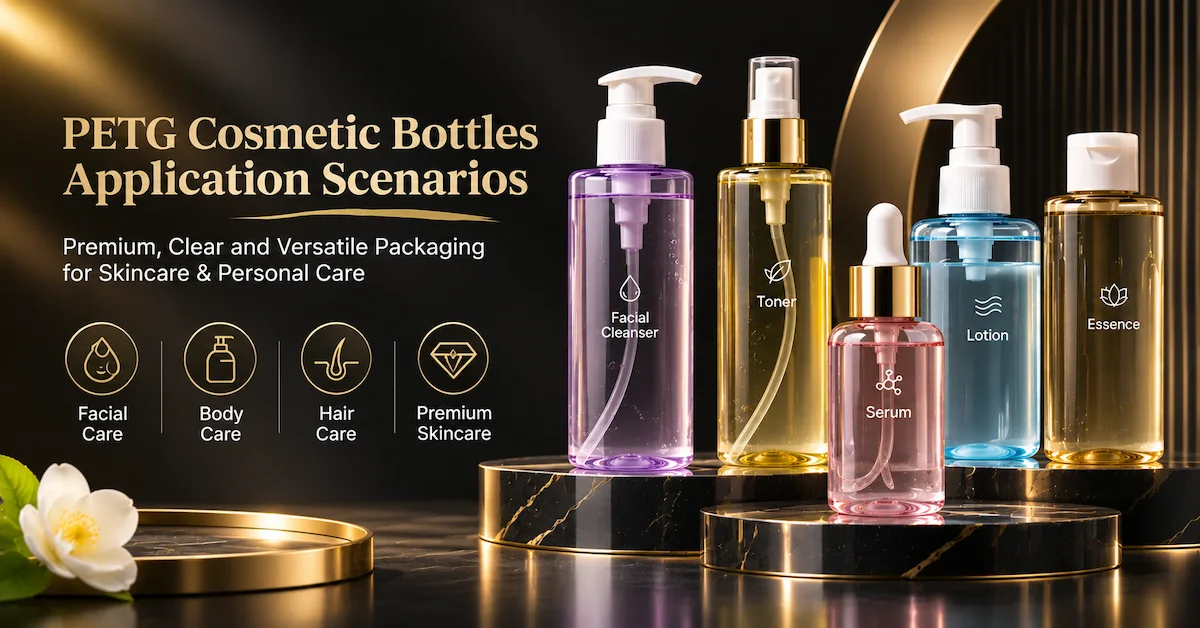
TL;DR: A reliable PETG cosmetic bottles manufacturer should help brands evaluate resin-grade suitability, bottle geometry, molding conditions, residual stress, formula compatibility, and closure performance before approving bulk production. PETG can support clear, premium-looking packaging designs, but thick sections, uneven cooling, and chemical exposure may introduce manufacturing risks. The best approach is to validate production-representative samples and the complete filled packaging system.
Premium skincare packaging needs to communicate product quality while remaining practical to manufacture, fill, transport, and use.
PETG, a glycol-modified polyester material, is considered for selected transparent cosmetic packaging applications because of its appearance and processing characteristics.
However, selecting PETG does not automatically produce a premium bottle.
A design with substantial wall thickness may experience molding challenges. Incorrect processing can affect appearance and dimensional stability. Certain formulations or chemical ingredients may create compatibility concerns, particularly when mechanical stress is present.
These issues can become expensive when discovered after custom tooling has been completed.
The most effective approach is to evaluate PETG bottle manufacturability and formula compatibility during design development—not after the first commercial production order.
COSME Packaging, operated by Zhejiang Cosme Industry Co., Ltd., provides cosmetic packaging R&D, mold development, plastic manufacturing, OEM/ODM customization, and quality control services for international beauty and personal-care brands.
This guide explains how to evaluate PETG packaging designs, identify manufacturing risks, select appropriate testing methods, and prepare a technical inquiry for custom production.
Key Takeaways: What Should Buyers Evaluate Before Choosing PETG?
| Engineering priority | Potential problem | Recommended verification |
|---|---|---|
| PETG resin grade | Unsuitable processing or chemical performance | Review material specifications |
| Thick-wall design | Uneven cooling, sink marks, residual stress | Conduct design-for-manufacturing review |
| Mold development | Warpage or dimensional inconsistency | Validate tooling and trial samples |
| Chemical compatibility | Swelling, crazing, or stress cracking | Test actual formulation and components |
| Neck and closure | Assembly or sealing problems | Verify critical dimensions |
| Surface decoration | Poor adhesion or appearance variation | Approve decorated samples |
| Production consistency | Differences between manufacturing batches | Establish inspection and change controls |
Core engineering principle: PETG packaging quality depends on the interaction between material grade, part geometry, manufacturing conditions, and the finished formulation.
1. What Makes PETG Relevant to Cosmetic Bottle Manufacturing?
PETG belongs to the polyester family and is commonly described as glycol-modified polyethylene terephthalate.
Its molecular structure differs from conventional PET, giving suitable grades different processing and physical characteristics.
For cosmetic packaging, PETG may be considered when a brand requires transparent molded components, distinctive geometry, or a particular visual presentation.
Typical Application Directions
| Cosmetic application | Packaging objective | Main engineering consideration |
|---|---|---|
| Premium facial serum | Transparent, distinctive appearance | Formula compatibility and dispensing |
| Skincare lotion | Coordinated bottle-and-cap design | Closure fit and material suitability |
| Cosmetic essence | Clear retail presentation | Product compatibility and appearance |
| Premium treatment packaging | Decorative rigid structure | Geometry, molding and assembly |
| Coordinated skincare collection | Consistent packaging identity | Repeatable color and component design |
These are potential applications rather than confirmed COSME PETG bottle models.
When PETG May Not Be Appropriate
PETG should not be selected solely because a product requires a transparent appearance.
It may be unsuitable if the actual formulation is incompatible with the proposed resin grade, the design cannot be manufactured economically, or the required temperature conditions exceed the packaging's validated performance.
The supplier should evaluate the proposed application before recommending a material.
2. PETG vs. PET vs. Acrylic: What Matters for Premium Bottle Design?
Several materials can produce transparent cosmetic packaging, but they should not be treated as interchangeable.
Transparent Packaging Material Comparison
| Material | General design characteristic | Key engineering concern |
|---|---|---|
| PETG | Clear copolyester suitable for selected molded designs | Resin grade, residual stress, compatibility |
| PET | Transparent rigid packaging material | Manufacturing process, grade and application |
| PMMA / Acrylic | High-clarity material used in premium packaging components | Impact behavior, chemical compatibility |
| Glass | Rigid, premium-feeling material | Weight, breakage and closure fit |
Why PETG Is Not Simply Another Name for PET
PET and PETG have different polymer structures and manufacturing characteristics.
A bottle designed for one material should not automatically be manufactured using the other without reviewing processing requirements, dimensions, and compatibility.
Material changes may require engineering modifications and renewed sample approval.
What Creates a Premium Appearance?
Premium presentation depends on more than resin choice.
Bottle proportions, transparency, surface quality, closure design, decoration, and assembly all contribute to the final appearance.
For some projects, an appropriately designed outer housing may create the desired thick-wall visual effect without requiring every section of the product-contact reservoir to be unusually thick.
The best design should achieve the intended brand appearance while remaining manufacturable and functional.
3. How Does Thick-Wall Design Affect PETG Bottle Manufacturing?
Thick-wall appearances are often associated with premium skincare packaging.
However, increasing material thickness can introduce processing challenges.
Uneven Wall Thickness
Large differences between thick and thin sections can affect material flow, cooling, shrinkage, and the final geometry.
Depending on the molding process, these variations may contribute to sink marks, deformation, or residual stress.
Sharp Corners and Transitions
Abrupt changes in geometry can create localized stress concentrations.
Rounded transitions may reduce certain concentration effects, but the correct radius depends on the component design and manufacturing requirements.
Mold Cooling
Cooling conditions can influence the consistency of molded components.
Uneven cooling may affect dimensions, appearance, and residual stress.
Eastman's Processing and Mold Design Guidelines discuss the importance of uniform wall thickness, controlled cooling, and mold design for relevant Eastman copolyester grades.
These principles provide useful engineering guidance, but the processing recommendations must be evaluated for the actual resin grade and production method.
Thick-Wall Design Risk Matrix
| Design feature | Potential concern | Recommended approach |
|---|---|---|
| Large solid wall sections | Uneven cooling or sink marks | Review alternative wall construction |
| Abrupt thickness changes | Localized stress | Evaluate transitions and geometry |
| Sharp internal corners | Stress concentration | Review suitable radii |
| Large flat surfaces | Visible deformation | Evaluate rigidity and cooling |
| Complex closure geometry | Molding or assembly variation | Validate critical dimensions |
| Decorative outer shell | Component-fit differences | Test complete assembly |
Buyer recommendation: Request a Design for Manufacturability (DFM) review before approving custom PETG tooling.
4. Why Can PETG Cosmetic Bottles Develop Stress Cracking?
Stress cracking is a potential failure mode in which a plastic component develops cracks or crazing under particular combinations of mechanical stress and chemical exposure.
For cosmetic packaging, the actual risk depends on the resin grade, component geometry, processing history, formulation, and storage conditions.
Sources of Mechanical Stress
Potential contributors include:
-
Residual stress from molding.
-
Excessive assembly force.
-
Tight-fitting closures or decorative components.
-
Localized deformation.
-
Inappropriate component tolerances.
Stress may be present even when a newly manufactured component appears visually acceptable.
Chemical Exposure
Cosmetic formulations can contain oils, fragrance ingredients, alcohols, surfactants, and other substances.
Their effects on PETG cannot be predicted reliably from the broad formulation category alone.
Some combinations may be compatible, while others may produce unacceptable changes under relevant conditions.
Environmental Stress Cracking
A component may perform adequately when exposed to a chemical without mechanical loading but behave differently when stress is present.
This is why a basic material immersion test may not fully represent a finished packaging assembly.
Recommended Investigation
| Failure observation | Potential contributing factor | Verification method |
|---|---|---|
| Fine surface cracks | Chemical exposure and stress | Compatibility and stress evaluation |
| Cracking near the neck | Assembly or molding stress | Dimensional and mechanical review |
| Localized whitening | Deformation or material response | Material and process investigation |
| Delayed cracking after filling | Formula interaction or stored stress | Filled-package stability study |
| Component deformation | Material, heat or mechanical loading | Relevant conditioning tests |
These are possible mechanisms, not evidence of defects in any specific COSME product.
5. How Should PETG Chemical Compatibility Be Tested?
A professional PETG packaging project should include a compatibility program appropriate to the intended formula.
The test plan should consider both the resin and the complete package.
Material-Level Chemical Resistance
ASTM D543-21 — Standard Practices for Evaluating the Resistance of Plastics to Chemical Reagents provides procedures for assessing how plastics respond to chemical exposure.
Its methods include immersion and mechanical-stress-related evaluations under defined conditions.
The results depend on factors such as the test medium, concentration, temperature, exposure duration, stress, and measured properties.
ASTM D543 is useful when developing material-level evaluation methods. It does not automatically certify a finished cosmetic bottle as compatible with every formulation.
Finished-Package Compatibility
For commercial approval, testing should also consider the actual filled bottle and its product-contact components.
Recommended evaluations may include:
-
Initial dimensional and appearance inspection.
-
Relevant chemical compatibility testing.
-
Filled-package storage under defined conditions.
-
Inspection for crazing, cracking or deformation.
-
Closure and dispensing verification.
-
Comparison with approved control samples.
Why Test Conditions Matter
A short room-temperature test may not represent long-term storage or relevant temperature exposure.
The brand's formulation team should determine appropriate test conditions and acceptance criteria.
Material compatibility should be established using the specific PETG grade and intended formula—not a generic statement that PETG is chemical resistant.
6. What Manufacturing Controls Matter Most for PETG Components?
PETG manufacturing requirements depend on the selected resin grade and process.
A bottle or decorative component may require different methods from other plastic packaging products.
The manufacturing route must therefore be confirmed with the supplier.
Resin Drying and Moisture Control
Certain copolyester grades absorb moisture.
For relevant melt-processing operations, insufficient drying can contribute to material degradation and appearance or performance problems.
The manufacturer should follow the resin supplier's grade-specific recommendations.
Tooling and Part Geometry
Tooling should be evaluated for material flow, cooling, dimensional requirements, and removal of the molded component.
Processing Conditions
Relevant manufacturing variables should be controlled according to the resin grade, equipment, and product design.
The appropriate conditions should be validated rather than copied from a different polymer or product.
Manufacturing Quality Checklist
| Production area | Recommended buyer verification |
|---|---|
| Resin identification | Approved grade and material records |
| Material preparation | Relevant drying and handling controls |
| Tooling | Approved geometry and maintenance |
| Molding process | Validated production conditions |
| Critical dimensions | Measurement against drawings |
| Surface appearance | Defined visual acceptance |
| Finished assembly | Fit and functional checks |
| Batch records | Traceability and change control |
These are recommended controls, not claims about PETG-specific equipment or validated processing conditions at COSME.
7. How Should PETG Bottle Necks, Pumps and Closures Be Specified?
The bottle body is only one part of the complete cosmetic packaging system.
A PETG bottle may require a separate pump, cap, collar, liner, or other dispensing components.
The assembled system should be evaluated using controlled specifications.
Critical Bottle and Closure Specifications
| Specification | Buyer requirement | Main risk |
|---|---|---|
| Nominal fill capacity | Intended product quantity | Filling mismatch |
| Bottle dimensions | Approved drawing | Equipment incompatibility |
| Neck finish | Critical interface dimensions | Closure fit |
| Sealing surface | Approved geometry | Leakage |
| Pump or dispenser | Output and formula compatibility | Poor dispensing |
| Closure material | Relevant product-contact information | Compatibility |
| Assembly requirements | Appropriate fit and force | Stress or damage |
| Decoration | Approved finish and artwork | Appearance inconsistency |
Why Assembly Stress Matters
A closure that is excessively tight or an incorrectly fitted decorative component may introduce stress.
This can be particularly important when the bottle already contains residual stress from manufacturing.
For that reason, packaging qualification should include assembled samples rather than testing only the empty bottle body.
The selected pump must also be evaluated with the intended formulation.
8. What Should Be Included in a PETG Bottle Quality-Control Plan?
For skincare brands purchasing customized PETG packaging, quality requirements should be established before commercial production.
The plan should address material, dimensions, appearance, functionality, and traceability.
PETG Packaging Quality-Control Matrix
| Inspection item | Recommended verification |
|---|---|
| PETG grade | Approved material specification |
| Bottle dimensions | Critical dimensional inspection |
| Wall construction | Relevant geometry and wall checks |
| Appearance | Surface defects and visual consistency |
| Stress-related defects | Relevant post-molding or conditioning inspection |
| Chemical compatibility | Formula-specific testing |
| Closure assembly | Fit and sealing performance |
| Decoration | Color and adhesion |
| Export packing | Protection against damage |
| Batch identification | Material and manufacturing traceability |
Why Golden Samples Matter
An approved physical sample can help establish the expected appearance and assembly.
However, it should be supported by engineering drawings, material specifications, and acceptance criteria.
Production-Lot Inspection
ISO 2859-1 provides acceptance-sampling methods that can inform production-lot inspection planning when appropriately specified.
However, acceptance sampling does not replace chemical compatibility studies or engineering validation.
A PETG bottle should not be approved solely because a sample looks clear and attractive.
9. How Should PETG Bottle Development Move From Concept to Mass Production?
A custom PETG packaging project should progress through controlled engineering and validation stages.
Recommended OEM Development Workflow
| Stage | Main activity | Buyer approval |
|---|---|---|
| Concept design | Define appearance and application | Design brief |
| Material review | Select proposed PETG grade | Material specification |
| DFM evaluation | Review geometry and moldability | Engineering feedback |
| Prototype development | Evaluate appearance and fit | Prototype approval |
| Tooling trial | Produce representative molded parts | Dimensional and appearance review |
| Compatibility testing | Evaluate actual formula and assembly | Test results |
| Pilot production | Confirm manufacturing consistency | Approved production samples |
| Commercial production | Apply agreed quality controls | Batch acceptance |
Why Design Freeze Matters
After engineering specifications and tooling are approved, further changes may affect cost, performance, and production schedules.
Any material, dimensional, or component modification should follow an agreed change-control process.
Existing Packaging vs. New Tooling
An existing design may reduce some development requirements if a suitable PETG configuration is available.
A new design may require tooling and additional validation.
Buyers should ask the supplier to explain which development route is feasible.
For broader information about custom bottle development, read COSME's Custom Cosmetic Bottle Design Guide.
10. How Do PETG Material and Tooling Decisions Affect Cost?
Custom PETG packaging costs depend on the complete proposed design and manufacturing process.
Important considerations can include material selection, component geometry, tooling, decoration, assembly, quality requirements, and order volume.
PETG Packaging Cost Factors
| Cost factor | Purchasing consideration |
|---|---|
| Resin grade | Material pricing and availability |
| Wall construction | Material consumption and process requirements |
| Bottle geometry | Tooling and manufacturability |
| Closure system | Component costs and compatibility |
| Surface decoration | Printing and finishing |
| Mold development | Engineering and tooling investment |
| Compatibility testing | Validation requirements |
| Production quantity | Setup and manufacturing economics |
| Export packing | Protection and transportation costs |
Why the Lowest Quote May Not Be the Best Choice
A lower unit price may exclude testing, tooling, closures, or decoration.
It may also describe a different material grade or manufacturing configuration.
Buyers should request itemized quotations for comparable specifications.
The most useful commercial comparison is the total cost of obtaining accepted, usable packaging that meets the approved design and functional requirements.
11. Application Example: Developing a Premium PETG Skincare Bottle
The following is a hypothetical engineering example, not a documented COSME customer project.
Project Requirements
A skincare brand wants a clear bottle with a substantial-looking wall and a distinctive closure.
The bottle will be used for a premium treatment product.
Initial Design Challenge
The proposed geometry includes thick sections and sharp transitions.
The brand also wants the finished package to withstand the intended formulation and repeated dispensing.
Recommended Engineering Review
Before approving tooling, the team should:
-
Confirm the proposed PETG grade.
-
Evaluate whether the desired visual effect requires thick solid sections.
-
Review geometry for stress concentrations.
-
Assess manufacturing and cooling requirements.
-
Validate the closure interface.
-
Test the complete package with the intended formula.
-
Approve production-representative samples.
Procurement Lesson
The brand should prioritize a technically achievable packaging design rather than selecting the most visually elaborate prototype.
A DFM review and representative compatibility testing may reveal design adjustments before commercial production.
No cost-saving percentage, defect rate, or verified production improvement is assumed in this example.
12. Why Consider COSME Packaging for PETG Cosmetic Bottle Development?
COSME Packaging, operated by Zhejiang Cosme Industry Co., Ltd., is a China-based cosmetic packaging manufacturer established in 2015.
According to its published company information, COSME operates an approximately 15,000-square-meter facility with around 200 employees.
Its general manufacturing capabilities include:
-
Packaging R&D and design development.
-
3D drawings and CNC prototypes.
-
Mold development and trial sampling.
-
Plastic injection- and blow-molding operations.
-
Color matching, printing, and decoration.
-
Incoming material and dimensional inspection.
-
Finished-product quality control and traceability.
The company identifies PETG among its packaging material directions and lists a PETG Cosmetic Jars category.
However, this does not establish that a specific PETG cosmetic bottle model, capacity, or resin grade is currently available.
For PETG bottle projects, buyers should confirm manufacturing feasibility, proposed materials, tooling requirements, product specifications, samples, and commercial arrangements directly.
You can review COSME's company and manufacturing capabilities and its Cosmetic Bottles collection when preparing a custom packaging inquiry.
13. What Should You Include in a PETG Cosmetic Bottle RFQ?
A detailed Request for Quotation helps the supplier evaluate material suitability and manufacturing feasibility.
PETG Bottle RFQ Checklist
| Requirement | Information to provide |
|---|---|
| Product application | Serum, lotion, essence, or treatment |
| Formula information | Relevant ingredients and storage conditions |
| Target capacity | Required fill volume |
| PETG specification | Preferred grade or required properties |
| Bottle geometry | Design reference and dimensions |
| Wall construction | Desired thickness or visual effect |
| Neck finish | Closure interface requirements |
| Components | Pump, cap, collar, seals |
| Decoration | Colors, logo, finish |
| Quality requirements | Appearance, dimensions, compatibility |
| Samples | Prototype and validation expectations |
| Order quantity | Initial demand and repeat forecast |
| Project schedule | Target development and delivery dates |
Request a Custom PETG Packaging Evaluation
For a useful proposal, provide design sketches, reference images, formulation information, and expected purchasing quantities.
Ask the manufacturer to confirm whether the design can be developed using an appropriate PETG grade and whether existing tooling or new mold development is required.
If your brand is evaluating premium PETG cosmetic bottles, contact COSME Packaging with your design requirements and technical specifications to discuss manufacturing feasibility, sample development, and a project-specific quotation.
Frequently Asked Questions About PETG Cosmetic Bottle Manufacturing
1. What is PETG used for in cosmetic packaging?
PETG is a glycol-modified polyester that can be considered for selected transparent cosmetic packaging applications. Its suitability depends on the resin grade, manufacturing process, design, and formulation.
2. Is PETG better than PET for premium cosmetic bottles?
Not universally. PETG and PET have different processing and material characteristics. The correct choice depends on the proposed bottle geometry, formula compatibility, appearance, manufacturing method, and budget.
3. Can PETG be used for thick-wall cosmetic packaging?
Suitable PETG grades may be considered for certain thick-wall or premium-looking molded packaging designs. However, wall geometry, cooling, residual stress, and production feasibility must be evaluated before approval.
4. What causes stress cracking in PETG packaging?
Potential contributors include residual molding stress, mechanical loading, component interference, and chemical exposure. The actual cause depends on the specific material and application.
5. Is PETG compatible with alcohol-based skincare formulations?
Compatibility cannot be established from the PETG material name alone. The actual resin grade and finished formulation should be evaluated under relevant storage and mechanical conditions.
6. What should manufacturers control during PETG molding?
Relevant controls may include material preparation, resin drying where applicable, tooling geometry, molding conditions, cooling, dimensional inspection, and appearance. Exact processing requirements depend on the material grade and manufacturing process.
7. What is the typical MOQ for custom PETG cosmetic bottles?
MOQ depends on design, material, tooling, decoration, components, and production requirements. COSME does not publish a verified universal MOQ for PETG bottle projects. Request a project-specific quotation.
8. Can PETG cosmetic bottles be customized with a brand logo?
Suitable packaging may support selected colors, printing, decoration, and structural customization. Actual options must be confirmed for the proposed PETG grade and design.
9. What tests should be completed before PETG bottle mass production?
Relevant evaluations may include material identification, dimensional inspection, chemical compatibility, stress-related failure assessment, closure fit, leakage performance, decoration quality, and production-representative sample approval.
10. How can I request PETG bottle development support from COSME?
Submit your intended application, design references, proposed material, target capacity, closure requirements, formulation information, estimated quantity, and relevant testing needs. COSME can then assess available manufacturing and customization options.
Conclusion
Choosing a reliable PETG cosmetic bottles manufacturer requires more than selecting a transparent material or approving an attractive packaging design.
For skincare brands, cosmetic OEM/ODM manufacturers, and packaging engineers, the most important challenge is ensuring that the proposed PETG bottle can be manufactured consistently and remain compatible with its intended formulation.
Thick-wall geometry, mold cooling, residual stress, chemical exposure, closure compatibility, and production quality should all be considered during the engineering process.
A successful development program begins with a clearly defined resin grade and technical design, continues through manufacturability review and representative testing, and concludes with controlled production specifications and sample approval.
With its published capabilities in cosmetic packaging R&D, mold development, plastic manufacturing, OEM/ODM customization, and quality management, COSME Packaging offers a potential partner for discussing PETG cosmetic packaging development projects.
Whether you are exploring a premium transparent skincare bottle, evaluating a new thick-wall design, or sourcing custom cosmetic packaging for future production, contact COSME Packaging with your design references, formulation details, and purchasing requirements to discuss feasible solutions and request a tailored quotation.