
A distinctive cosmetic bottle can make a skincare brand instantly recognizable. However, turning an attractive packaging concept into a reliable commercial product requires more than choosing a unique shape, color, or logo.
For skincare brands, private-label businesses, and cosmetic OEM/ODM companies, the challenge is balancing visual differentiation with manufacturing feasibility, formulation compatibility, dispensing performance, and long-term production costs.
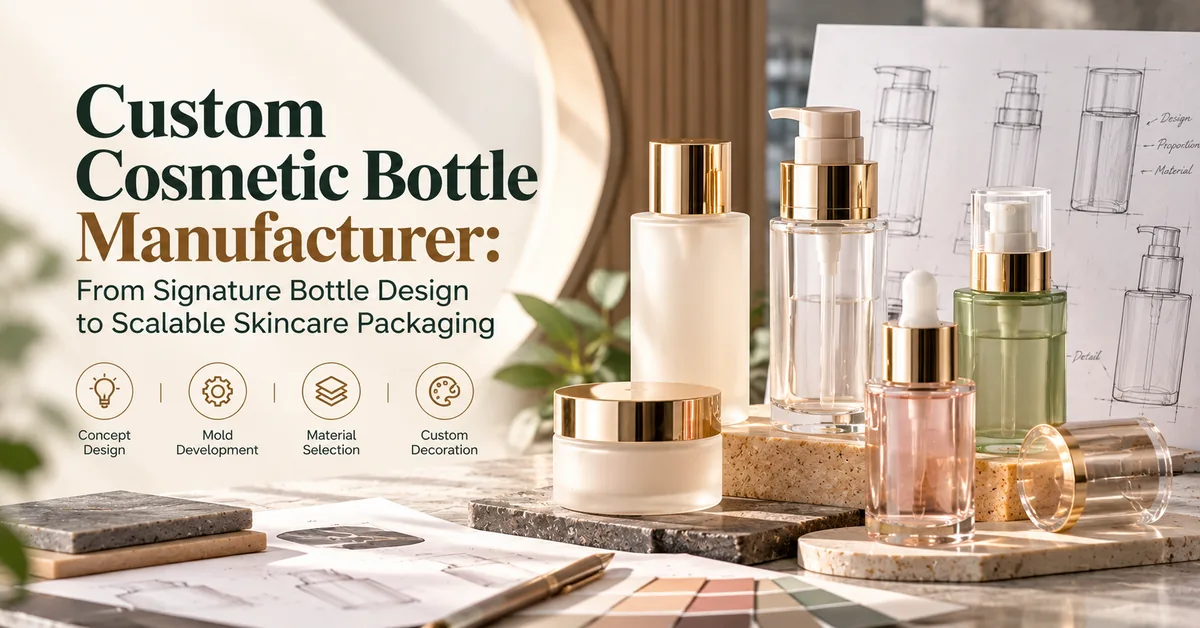
A professional custom cosmetic bottle manufacturer helps bridge the gap between creative packaging design and practical manufacturing. This includes evaluating bottle geometry, selecting suitable materials, developing tooling, coordinating closures, and establishing production quality requirements.
The most effective approach is to design for both brand identity and manufacturability from the beginning. Brands should determine how much customization they need, confirm the complete packaging structure, and validate critical design features before committing to mass production.
At COSME Packaging, cosmetic packaging development combines product design support, mold development, plastic manufacturing, decoration, and OEM/ODM customization for international beauty and personal-care brands.
This guide explains how to develop packaging that looks distinctive, functions correctly, and can be manufactured consistently as demand grows.
1. What Does a Custom Cosmetic Bottle Manufacturer Actually Do?
A custom cosmetic bottle manufacturer develops or modifies primary packaging to meet a brand's functional, visual, and commercial requirements.
Customization may involve changes to the bottle body, material, color, closure, dispensing mechanism, surface decoration, or structural design.
However, not every customization project requires an entirely new bottle mold.
Manufacturers typically support three levels of customization:
| Customization level | Typical modifications | Tooling implications | Suitable buyers |
|---|---|---|---|
| Decorative customization | Bottle color, logo, printing, finishing | May use existing tooling | Emerging skincare brands and private-label businesses |
| Component customization | Selected pumps, caps, collars, decorative parts | Depends on component compatibility | Established beauty brands |
| Structural customization | Original bottle geometry, dimensions, or functional structures | New tooling may be necessary | Brands developing distinctive or proprietary packaging |
The appropriate choice depends on the brand's launch objectives, product positioning, budget, and expected order volume.
For businesses entering the market with limited initial demand, modifying an existing packaging design may offer sufficient brand differentiation.
For established brands building long-term product portfolios, investing in a custom structure may support stronger visual consistency and a more recognizable packaging identity.
2. When Should a Skincare Brand Invest in Custom Bottle Design?
Custom packaging creates value when it solves a specific branding, functional, or commercial problem.
A unique bottle shape alone does not guarantee a better consumer experience.
Before approving an original design, brands should consider the intended application.
| Skincare application | Design priorities | Potential custom packaging approach |
|---|---|---|
| Facial serums | Controlled dispensing, product protection, premium appearance | Custom airless or dropper bottle |
| Moisturizing lotions | Comfortable grip, reliable pump operation | Custom lotion pump bottle |
| Luxury skincare | Visual depth, finish consistency, brand recognition | Customized rigid bottle and decorative components |
| Facial cleansers | Convenient dispensing and wet-environment handling | Custom pump or foaming bottle |
| Travel skincare | Compact dimensions, portability, secure closure | Small-format bottle with suitable cap |
| Refillable skincare | Component durability and replacement functionality | Refillable outer bottle and compatible inner container |
For example, a premium facial serum may benefit from an elegant bottle with a carefully selected dispensing system. A body lotion brand may gain more practical value from improved ergonomics and a convenient pump.
When full customization may not be appropriate
New tooling may be unnecessary when:
-
An existing bottle already meets the formula and dispensing requirements.
-
The brand's primary differentiation comes from color, printing, or decoration.
-
Launch volume is too uncertain to justify substantial tooling investment.
-
The product is intended for a short-term promotional campaign.
Brands can begin by reviewing COSME's cosmetic bottle packaging range to identify available design directions before discussing additional engineering.
3. Start With a Technical Design Brief, Not Just a Bottle Rendering
One of the most expensive packaging development mistakes is finalizing the appearance before confirming functional requirements.
A beautiful design may need significant revisions if its proportions interfere with filling equipment, closure assembly, or product dispensing.
A custom cosmetic bottle project should begin with a technical brief.
Essential Cosmetic Bottle Design Specifications
| Specification | What the brand should define | Engineering relevance |
|---|---|---|
| Product application | Serum, lotion, cleanser, essence, or treatment | Determines packaging and dispensing requirements |
| Target fill volume | Required commercial fill quantity | Influences bottle dimensions and headspace |
| Bottle material | PET, PETG, PP, PE, or another suitable material | Affects appearance, molding, and compatibility |
| Bottle geometry | Round, square, oval, or proprietary shape | Influences tooling and production feasibility |
| Neck finish | Closure interface and dimensional requirements | Controls pump and cap compatibility |
| Dispensing system | Pump, dropper, airless mechanism, or cap | Influences user experience |
| Decoration | Body color, printing, coating, or metallic effects | Determines finishing operations |
| Quality criteria | Appearance, dimensions, sealing, and functionality | Establishes measurable production standards |
| Production forecast | Initial order and expected repeat demand | Helps evaluate tooling investment |
This brief should also document any requirements for existing filling equipment, secondary packaging, and target-market documentation.
The goal is to establish a technically achievable design before substantial tooling and production commitments are made.
4. Design for Manufacturability: Five Details That Affect Custom Bottle Production
Design for Manufacturability (DFM) means developing packaging that can be produced repeatedly within agreed quality and cost requirements.
For custom cosmetic bottles, several structural details deserve attention during engineering review.
4.1 Wall Thickness and Material Distribution
Wall thickness influences bottle weight, rigidity, appearance, and mechanical performance.
Uneven material distribution can contribute to deformation, visible inconsistencies, or weaknesses in certain areas.
The preferred wall design depends on the material, bottle geometry, and manufacturing process.
4.2 Corners, Curves, and Bottle Geometry
Sharp transitions and complex geometric features may create challenges in molding, finishing, or part removal.
A packaging engineer should evaluate corner radii, surface transitions, and critical dimensions before finalizing the design.
4.3 Parting Lines and Visible Molding Marks
A custom bottle may have parting lines, gate marks, or other manufacturing features.
Their location matters because visible defects can affect the appearance of premium packaging.
Brands should identify the most important display surfaces and discuss how manufacturing features will appear on the finished product.
4.4 Dimensional Tolerances
Different components must fit together reliably.
Potential problems include:
-
Pump collars that do not seat correctly.
-
Closures that require excessive assembly force.
-
Bottles that do not fit existing filling-line guides.
-
Decorative components that appear misaligned.
Critical tolerances should be defined in approved engineering drawings rather than estimated from visual samples.
4.5 Ergonomics and Stability
A distinctive bottle should also be comfortable to hold and stable when placed on a surface.
Consider the grip, center of gravity, base geometry, and dispensing operation.
For retail skincare packaging, functional usability should be evaluated alongside shelf appearance.
5. Which Materials Work Best for Custom Cosmetic Bottles?
Material selection affects how a bottle looks, feels, performs, and can be manufactured.
There is no universally superior material for every cosmetic formulation.
Material Comparison for Custom Bottle Development
| Material | Design characteristics | Important engineering considerations |
|---|---|---|
| PET | Clear appearance and lightweight structure | Processing method, wall design, compatibility |
| PETG | Transparent appearance and design flexibility | Chemical resistance, cost, processing |
| PP | Moldability and application in closures or other components | Rigidity, dimensional behavior, compatibility |
| PE / HDPE | Available in different rigidity and flexibility grades | Permeation, appearance, dimensional requirements |
| Glass | Premium appearance and perceived weight | Fragility, closure compatibility, transportation |
| Aluminum | Metallic exterior and distinctive finishing | Internal coating, corrosion, component compatibility |
| PCR plastic | Incorporates post-consumer recycled material | Recycled content, consistency, traceability |
These are general material-selection considerations. Specific resin grades, production methods, and available configurations must be confirmed with the manufacturer.
Product-contact materials require additional attention
The visible exterior is not necessarily the only material touching the formula.
A complete package may contain seals, gaskets, pump springs, pistons, dip tubes, and other components.
Formula compatibility should therefore be evaluated using the assembled packaging system.
For sensitive skincare formulations, consult the manufacturer's available technical information and arrange appropriate testing before approval.
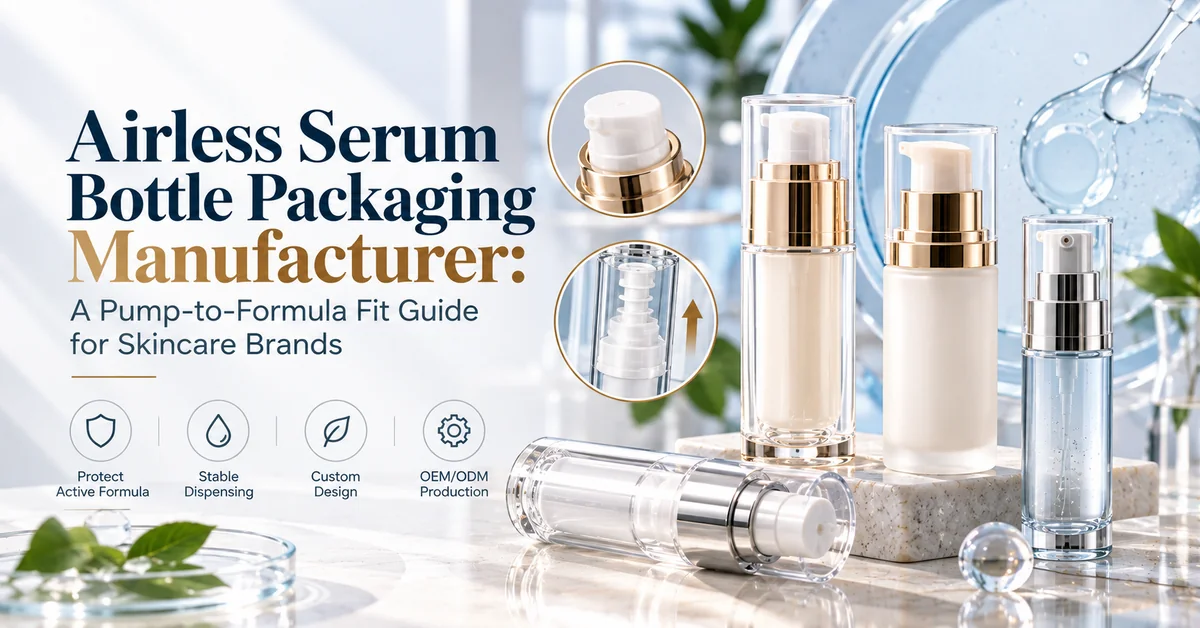
Brands exploring specialized dispensing systems can review COSME's airless bottle range when assessing possible packaging architectures.
6. Custom Pumps and Closures Must Be Designed Into the Bottle
Bottle customization often focuses on the container body, but the closure system is equally important.
A custom shape cannot compensate for poor pump fit or unreliable dispensing.
The engineering team should confirm:
-
Neck geometry and closure compatibility.
-
Pump output and formula viscosity requirements.
-
Dip-tube dimensions where applicable.
-
Sealing surfaces and assembly requirements.
-
Compatibility between decorative collars and functional components.
Why component coordination matters
A pump may operate correctly when tested independently but behave differently after assembly with a particular bottle.
Misalignment, incorrect neck geometry, or incompatible materials can create dispensing or leakage problems.
For airless packaging, the complete internal mechanism must also be evaluated.
The manufacturer's role is to identify a packaging architecture that works as an assembled system, not simply combine visually matching components.
7. Surface Decoration: How to Create a Premium Appearance Without Sacrificing Consistency
Visual customization helps beauty brands communicate their identity across retail shelves and online product listings.
Common decorative approaches include color matching, silk-screen printing, hot stamping, and other suitable surface-finishing processes.
COSME lists color customization, printing, and decorative finishing among its manufacturing services.
Comparing Cosmetic Bottle Decoration Options
| Decoration method | Branding effect | Important production consideration |
|---|---|---|
| Molded-in color | Integrated bottle color | Resin and color consistency |
| Silk-screen printing | Direct logos, text, and graphics | Registration, adhesion, coverage |
| Hot stamping | Metallic or decorative accents | Surface geometry, adhesion, wear |
| Surface coating | Matte, glossy, or selected visual effects | Coating compatibility and durability |
| Decorative components | Distinctive collars, caps, and outer details | Assembly fit and finish consistency |
The exact availability of each finish should be confirmed for the selected bottle material and design.
Control appearance with measurable standards
A visual reference alone is insufficient for repeatable production.
Brands should specify approved colors, artwork dimensions, printing locations, acceptable appearance variations, and inspection conditions.
For coated surfaces, ISO 2409:2020 describes a cross-cut method used to assess coating resistance to separation, subject to its stated limitations. Direct printing inks and alternative decorative processes may require different agreed evaluation methods.
Before approving decoration, evaluate representative finished samples under relevant handling, storage, and transport conditions.
For multi-product skincare ranges, consistent decoration across different bottle sizes is particularly important.
COSME's cosmetic packaging set example illustrates how coordinated bottle and jar styling can support a recognizable product family.
8. From Prototype to Production: Critical Design Approval Stages
A custom cosmetic bottle manufacturer should provide a structured development process that allows problems to be identified before commercial manufacturing.
COSME publishes a process involving design confirmation, 3D drawings, CNC samples, mold development, T1/T2 samples, mass production, and delivery.
Custom Cosmetic Bottle Development Process
| Stage | Main activity | Recommended approval |
|---|---|---|
| 1. Concept confirmation | Review appearance and functional requirements | Approved design brief |
| 2. 3D engineering | Develop bottle geometry and component interfaces | Approved technical drawing |
| 3. Prototype review | Evaluate physical appearance and ergonomics | Prototype feedback |
| 4. Mold development | Manufacture tooling after design approval | Approved tooling scope |
| 5. Trial samples | Evaluate molded dimensions, appearance, and assembly | Trial-sample acceptance |
| 6. Production validation | Confirm decoration and relevant functional performance | Approved production reference |
| 7. Mass production | Manufacture and inspect approved packaging | Batch acceptance requirements |
Why design freeze matters
A design freeze is the point when agreed specifications are controlled and further changes require formal review.
Late changes to the bottle neck, geometry, or components can affect tooling, decoration, assembly, and delivery schedules.
Establishing a clear approval record helps reduce unnecessary rework.
The manufacturer and buyer should agree on drawing revisions, sample approval responsibilities, and procedures for handling later modifications.
9. How Can Brands Control Custom Bottle Development Costs?
Custom bottle pricing depends on more than material weight.
New tooling, component selection, geometry, surface decoration, production volume, and quality requirements can all influence total project cost.
Cost Drivers and Practical Design Decisions
| Cost driver | Potential impact | Practical cost-control approach |
|---|---|---|
| Exclusive bottle geometry | Additional tooling investment | Verify whether an existing design can be adapted |
| Complex structural features | More demanding development | Simplify features that provide limited user value |
| Multiple custom components | Increased tooling and coordination | Evaluate compatible standard components |
| Premium decoration | Additional processing and quality checks | Concentrate decoration on high-visibility areas |
| Multiple bottle sizes | Additional production and tooling considerations | Use consistent visual and component architecture where possible |
| Material selection | Different material and processing costs | Compare alternatives based on functional requirements |
The right strategy is not necessarily to eliminate customization.
Instead, invest in design features that contribute to recognizable branding or measurable functional value.
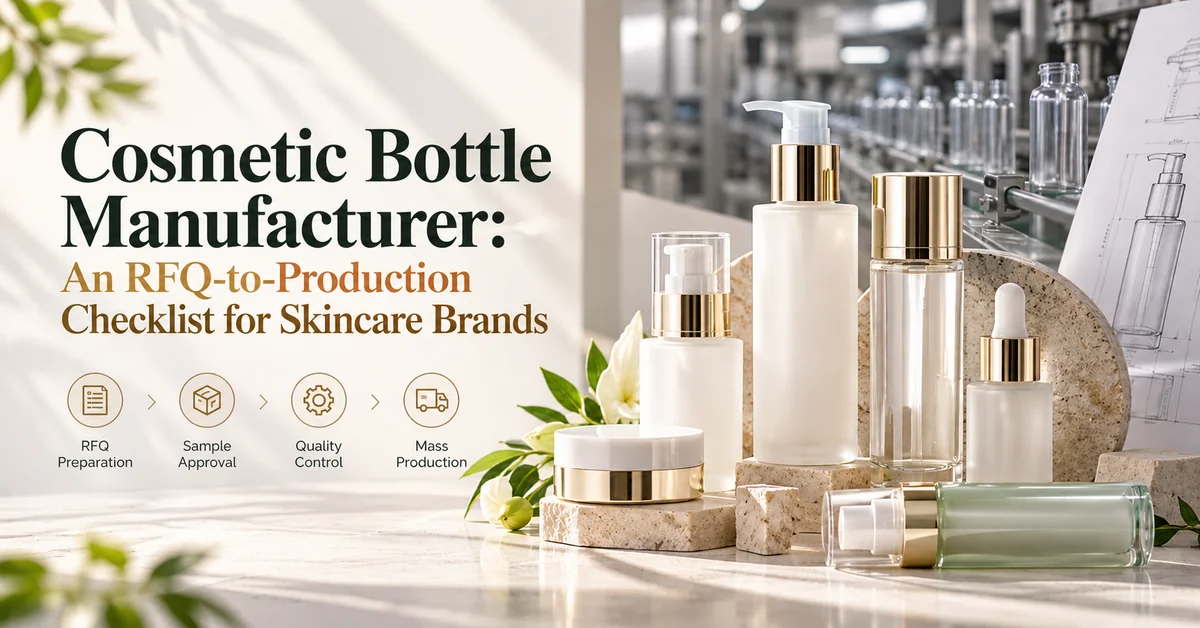
For procurement teams focused on complete quotation comparison rather than the design-development process, COSME's cosmetic bottle manufacturer RFQ guide provides a complementary sourcing framework.
10. Sustainable Custom Packaging Requires Design-Level Decisions
Sustainable packaging should be considered during product architecture development rather than added as a marketing claim after production.
Brands may investigate PCR materials, refillable designs, material reduction, and simpler component structures.
However, no single feature guarantees overall environmental performance.
The British Plastics Federation and RECOUP's Recyclability by Design guidance highlights considerations such as material compatibility, color, labels, sleeves, and separable components.
For cosmetic brands, this creates several practical design questions:
-
Can unnecessary packaging components be eliminated?
-
Can closures and decorative components be separated?
-
Is the recycled-content claim supported by material documentation?
-
Will the chosen pigments or decorations affect recycling compatibility?
-
Does the refillable design remain functional after repeated use?
A refillable bottle should also be assessed for component durability, replacement convenience, and formula compatibility.
Explore COSME's sustainable cosmetic packaging category to discuss available material and design directions. Environmental claims should be confirmed for the specific proposed configuration and target market.
11. Quality Control for Custom Cosmetic Bottle Production
Custom packaging requires both functional consistency and reliable appearance across manufacturing batches.
A detailed quality agreement should define inspection points before production begins.
Important checks include:
-
Incoming material inspection: Confirm material identity and agreed component requirements.
-
Dimensional inspection: Check critical bottle, neck, and component dimensions.
-
Surface inspection: Identify scratches, bubbles, deformation, and visible molding defects.
-
Assembly verification: Confirm correct fitting of closures and dispensing components.
-
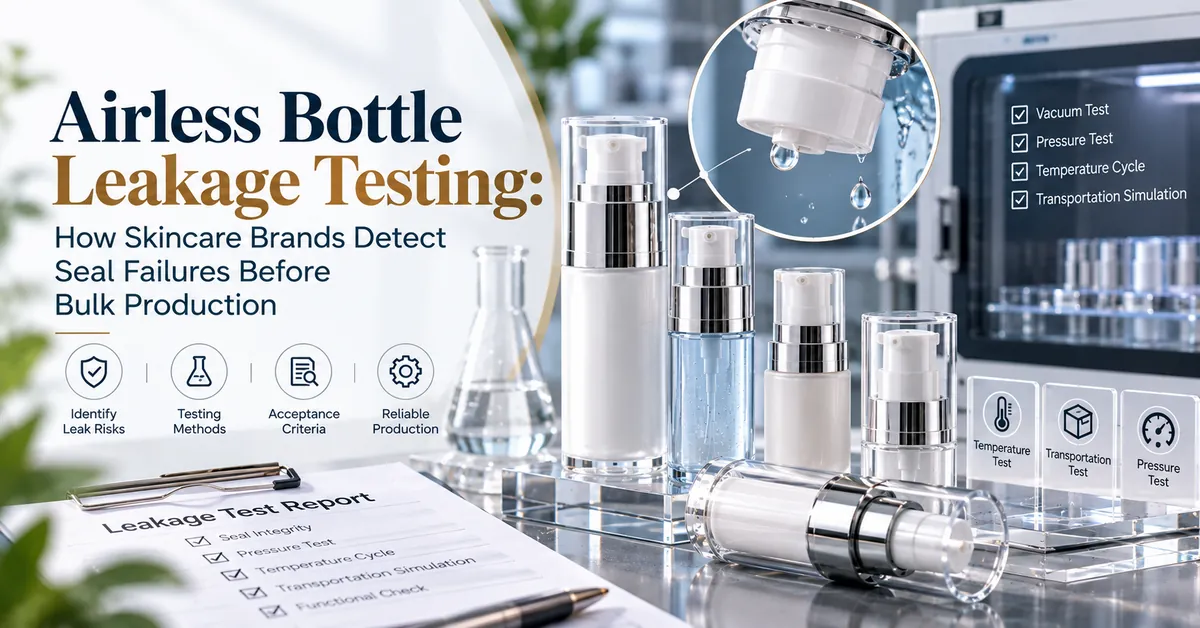
Leakage and dispensing checks: Use agreed conditions appropriate to the completed package.
-
Decoration inspection: Verify color, printing location, and finish durability.
-
Batch traceability: Retain relevant production and inspection records.
COSME states that its manufacturing quality procedures include raw-material checks, molding inspections, leakage testing, printing assessments, and batch records.
Buyers should request project-specific inspection criteria and testing evidence rather than assuming every bottle design has identical validation requirements.
12. Why Work With COSME Packaging on Custom Cosmetic Bottle Development?
COSME Packaging, operated by Zhejiang Cosme Industry Co., Ltd., is a China-based cosmetic packaging manufacturer established in 2015.
According to its published company information, COSME operates a factory of approximately 15,000 square meters, employs around 200 people, and supports packaging development through manufacturing equipment, mold capabilities, and decoration processes.
Its relevant services include:
-
R&D support: Packaging design and product development.
-
Mold development: 3D engineering, CNC samples, and trial molding.
-
Plastic manufacturing: Injection and blow-molding operations.
-
OEM/ODM customization: Bottle appearance, colors, printing, and selected structural designs.
-
Quality control: Incoming inspection, dimensional checks, finished-product inspection, and traceability records.
These capabilities provide a basis for discussing both customized existing designs and new packaging development.
Brands can learn more about the company's facilities and manufacturing approach through the COSME Packaging About Us page.
The suitability of a particular custom project should be established through technical discussion, material review, sampling, and project-specific quotation.
13. What Should You Prepare Before Starting a Custom Bottle Project?
A useful initial design package helps the manufacturer understand both creative and engineering expectations.
Share the following information:
-
Product category and intended formula.
-
Target capacity and preferred dispensing mechanism.
-
Reference bottle images or design sketches.
-
Preferred materials and appearance.
-
Artwork, logo, and decoration requirements.
-
Estimated launch quantity and future order potential.
-
Target market and planned launch schedule.
-
Any existing filling-line or component constraints.
If the design is intended to be proprietary, discuss tooling ownership, design confidentiality, and intellectual-property arrangements before development.
Ready to develop a distinctive skincare packaging concept?
Share your design brief with COSME Packaging's technical and sales team to discuss manufacturing feasibility, available designs, tooling requirements, samples, and a project-specific quotation.
14. Frequently Asked Questions About Custom Cosmetic Bottle Manufacturing
1. What is the difference between OEM and ODM cosmetic bottle manufacturing?
OEM generally involves manufacturing packaging according to customer-defined requirements, while ODM involves greater participation by the supplier in design or development. Actual responsibilities vary by contract. Buyers should clarify who owns drawings, tooling, and final design rights.
2. Can a custom cosmetic bottle manufacturer create a completely original bottle shape?
Yes, original bottle structures may be developed through engineering and tooling, subject to feasibility. The design must be evaluated for molding, component compatibility, dimensions, and manufacturing requirements before approval.
3. Do I need a new mold to customize cosmetic bottle packaging?
Not always. Color matching, logo decoration, and certain component combinations may use existing tooling. A fundamentally different bottle body or dimensional structure may require new mold development.
4. What is the typical MOQ for custom cosmetic bottles?
MOQ varies according to material, tooling, bottle size, decoration, and manufacturing requirements. There is no universal quantity applicable to every COSME project. Buyers should request an order-specific quotation.
5. How long does custom cosmetic bottle manufacturing take?
COSME's website describes a typical production period of approximately 40–50 days, depending on customization complexity. New tooling, prototype approval, scheduling, and shipping may require additional time. Confirm the project timeline before committing to a launch date.
6. Which cosmetic bottle material is best for premium skincare packaging?
PETG, PET, glass, and other suitable materials can support different premium design objectives. Selection should consider appearance, formulation compatibility, manufacturing requirements, transportation, and budget rather than appearance alone.
7. Can one custom bottle design be used across multiple skincare products?
Potentially, yes. A coordinated packaging family may share visual design elements or compatible components. Each formula still requires appropriate dispensing, capacity, and compatibility evaluation.
8. How do I protect my custom cosmetic bottle design?
Discuss confidentiality agreements, design ownership, tooling ownership, usage rights, and relevant intellectual-property protection before sharing proprietary drawings. The specific legal arrangements should be documented in the development contract.
9. Can recycled plastic be used for custom cosmetic bottles?
PCR materials may be suitable for certain cosmetic packaging projects, depending on the resin grade, recycled-content requirements, product-contact suitability, and production process. Verify the specific material and relevant documentation before approval.
10. What samples should I approve before bulk production?
Approve relevant appearance prototypes, engineering drawings, molded trial samples, and representative finished packaging assemblies. Functional requirements such as sealing, dispensing, decoration, and formulation compatibility should be validated against agreed criteria.
15. Conclusion
Choosing a custom cosmetic bottle manufacturer is about more than creating packaging with a distinctive appearance. Successful customization requires cooperation between brand designers, packaging engineers, manufacturing teams, and quality personnel.
For skincare brands, the most effective development strategy begins with clear functional requirements, followed by appropriate customization decisions, material selection, engineering validation, and controlled sample approval.
A well-designed cosmetic bottle should communicate the brand's identity while remaining compatible with its formula, dispensing system, filling operations, and commercial production requirements.
With its published capabilities in packaging R&D, mold development, plastic manufacturing, decoration, and quality management, COSME Packaging provides a manufacturing partner option for brands exploring customized primary packaging.
Whether you need personalized existing bottle designs or a completely new packaging concept, contact COSME Packaging with your product requirements and design references to discuss suitable OEM/ODM solutions and the next steps toward production.