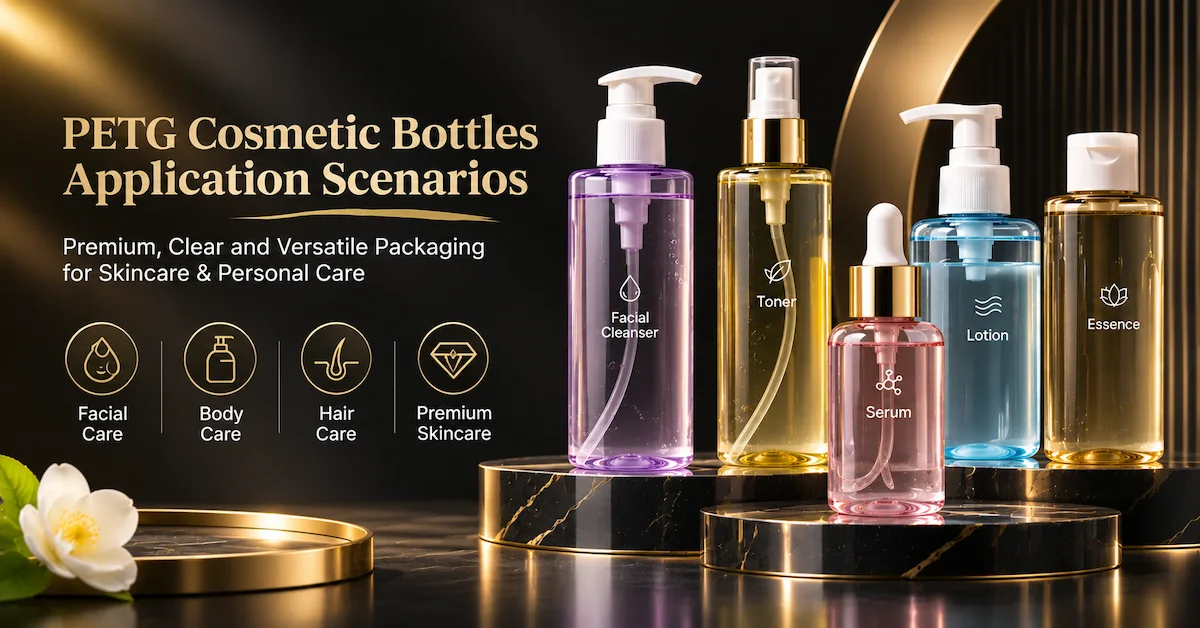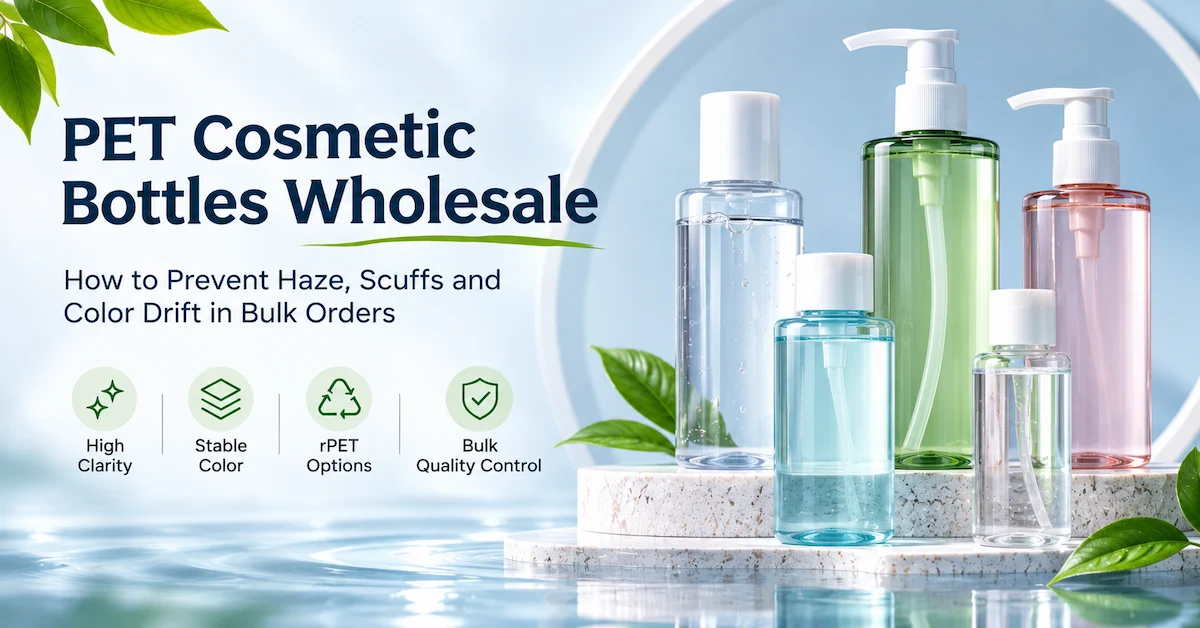

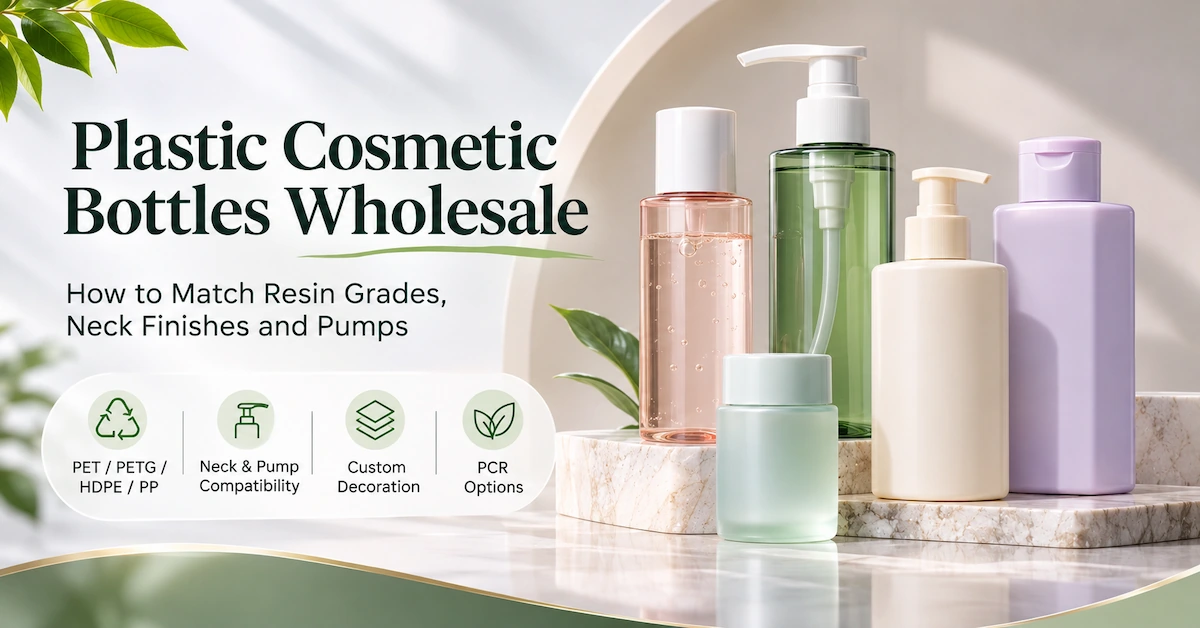
TL;DR: When purchasing plastic cosmetic bottles wholesale, skincare brands should evaluate the actual resin grade, formula compatibility, bottle dimensions, neck finish, and complete dispensing assembly before comparing prices. PET, PETG, HDPE, and PP offer different characteristics, but no material is universally suitable. Approve representative filled samples, document critical specifications, and establish batch quality requirements before committing to bulk production.
For skincare brands, contract manufacturers, and cosmetic packaging distributors, plastic bottles provide a versatile foundation for lotions, cleansers, serums, essences, and personal-care formulations.
However, two visually identical bottles may use different plastic materials, manufacturing processes, or closure specifications.
A PET bottle designed for a lightweight facial toner may not meet the requirements of a formula containing certain solvents. An HDPE bottle may provide a different appearance and handling experience. A pump that fits one bottle neck may fail to seal correctly on another.
These differences become more important when packaging is purchased in large quantities.
The most effective wholesale purchasing strategy is to specify the entire packaging system—including material, bottle body, neck finish, dispensing components, decoration, and quality requirements—before approving production.
COSME Packaging, operated by Zhejiang Cosme Industry Co., Ltd., provides cosmetic packaging development, plastic manufacturing, mold development, and OEM/ODM customization services for international beauty and personal-care brands.
This guide explains how to evaluate plastic bottle materials, prevent compatibility problems, manage wholesale production quality, and prepare an effective purchasing inquiry.
Key Takeaways: What Matters When Buying Plastic Cosmetic Bottles in Bulk?
| Purchasing factor | Potential risk | Recommended buyer action |
|---|---|---|
| Resin selection | Formula incompatibility | Confirm resin grade and conduct compatibility testing |
| Bottle dimensions | Filling-line problems | Approve engineering drawings |
| Neck finish | Pump or cap leakage | Verify complete assembly fit |
| Wall construction | Deformation or inconsistent rigidity | Establish relevant structural requirements |
| Decoration | Visible batch differences | Approve color and printing references |
| PCR content | Unverified material claims | Request recycled-content documentation |
| Production consistency | Differences between batches | Define inspection and change controls |
| Wholesale quotation | Missing component charges | Compare complete assembled costs |
Core procurement principle: A bottle is ready for bulk purchasing only when its material, geometry, closure system, and manufacturing requirements have been validated for the intended application.
1. Which Plastic Materials Are Used for Cosmetic Bottles?
Plastic cosmetic packaging can use different thermoplastic materials depending on the required appearance, mechanical behavior, product compatibility, and manufacturing process.
Four materials frequently considered are PET, PETG, HDPE, and PP.
PET Cosmetic Bottles
Polyethylene terephthalate (PET) is commonly used for rigid transparent packaging.
Depending on the selected grade and manufacturing method, PET can offer good visual clarity and lightweight construction.
It may be considered for:
-
Facial toners.
-
Selected liquid skincare products.
-
Body-care lotions.
-
Personal-care liquids.
However, PET is not automatically compatible with every cosmetic formula.
Product composition, storage conditions, and the actual resin grade must be evaluated.
PETG Cosmetic Bottles
Polyethylene terephthalate glycol-modified (PETG) is used in selected transparent packaging applications where its processing and appearance characteristics are suitable.
PETG may be relevant for distinctive shapes, clear components, and premium-looking packaging designs.
However, PETG should not be treated as chemically or environmentally identical to conventional PET.
Buyers should confirm its exact grade, manufacturing suitability, and compatibility with the intended product.
HDPE Cosmetic Bottles
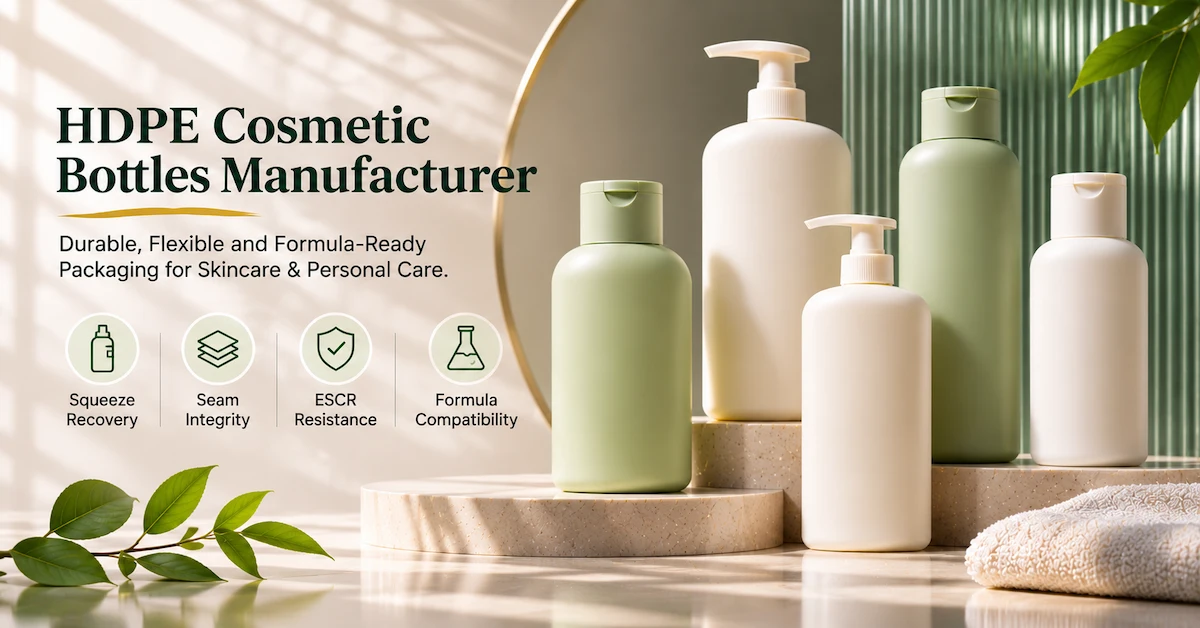
High-density polyethylene (HDPE) is commonly used for rigid or semi-rigid packaging.
Depending on the grade and wall design, it can provide a different combination of toughness, flexibility, and appearance from PET.
HDPE bottles are often considered for:
-
Body lotions.
-
Shampoos and conditioners.
-
Facial cleansers.
-
Selected liquid personal-care formulations.
Their appearance is often more opaque or translucent than clear PET packaging.
PP Cosmetic Packaging
Polypropylene (PP) is widely used for closures, caps, dispensing components, and certain container designs.
PP can be suitable where particular structural, molding, or functional characteristics are required.
For wholesale buyers, it is especially important to distinguish between the bottle-body material and the materials used in pumps and closures.
A cosmetic bottle described as PET may still contain PP, PE, elastomeric, or metallic components elsewhere in the dispensing assembly.
2. PET vs. PETG vs. HDPE vs. PP: Material Comparison for Wholesale Buyers
The appropriate resin should be selected according to the intended formula and packaging requirements.
Plastic Cosmetic Bottle Material Comparison
| Material | General characteristics | Typical application direction | Main purchasing concern |
|---|---|---|---|
| PET | Transparent, lightweight, rigid | Toners, liquid skincare | Formula compatibility and bottle design |
| PETG | Clear appearance and selected design flexibility | Premium-looking rigid packaging | Grade suitability and chemical compatibility |
| HDPE | Tough, often opaque or translucent | Cleansers, lotions, personal care | Wall design, stiffness, formulation |
| PP | Moldability and structural applications | Closures, components, selected containers | Component fit and resin grade |
| PCR PET or HDPE | Includes recycled plastic content | Selected recycled-content packaging projects | PCR percentage, consistency, suitability |
These characteristics are general industry considerations, not guaranteed performance specifications for every COSME product.
Is PET Better Than HDPE?
Neither material is universally better.
PET may be more appropriate when a brand requires a transparent rigid bottle with a particular visual presentation.
HDPE may be useful when its mechanical characteristics, appearance, and processing options fit the product requirements.
The decision should include formulation compatibility, manufacturing feasibility, component availability, and commercial cost.
Is PETG More Premium Than PET?
PETG can support particular visual and manufacturing objectives, but premium positioning depends on the complete design.
Bottle geometry, decoration, cap selection, and finish quality may contribute more to the finished appearance than the material designation alone.
Buyers should compare actual samples and specifications rather than relying on terms such as "premium plastic" or "high-quality resin."
3. Why Does Resin Grade Matter More Than the Material Name?
PET, PETG, HDPE, and PP are material families, not complete engineering specifications.
Different grades can have different processing characteristics and performance properties.
A purchasing specification should identify the actual proposed resin grade where available.
Material Information to Request
| Specification | Why it matters |
|---|---|
| Polymer family | Identifies the broad material type |
| Resin grade | Defines the proposed material more precisely |
| Product-contact materials | Supports compatibility evaluation |
| Color masterbatch | Influences color consistency |
| Additives | May affect processing and performance |
| Recycled content | Establishes declared PCR requirements |
| Processing method | Influences achievable geometry |
| Available technical data | Supports engineering approval |
Formula Compatibility Comes First
Skincare formulas can contain surfactants, oils, fragrances, solvents, acids, and active ingredients.
These components may interact differently with packaging materials.
Potential issues include swelling, discoloration, cracking, changes in mechanical behavior, or interaction with seals.
The final selection should therefore be supported by compatibility testing with the actual formula.
Where necessary, evaluate the filled packaging after relevant temperature and storage exposure.
A material declaration is useful, but it does not replace product-specific compatibility testing.
4. How Do Bottle Neck Finishes Affect Pump and Cap Compatibility?
Neck finish compatibility is one of the most important engineering requirements for wholesale cosmetic packaging.
The neck finish includes the bottle opening and the features used to attach a closure or dispensing system.
Two bottles with similar external dimensions may not accept the same pump.
Critical Neck and Closure Specifications
| Parameter | What to confirm | Potential problem |
|---|---|---|
| Neck diameter | Approved dimensional interface | Incorrect pump fit |
| Thread geometry | Thread form and engagement | Loose or damaged closure |
| Sealing surface | Contact with the closure seal | Leakage |
| Neck height | Component seating requirements | Assembly interference |
| Pump collar | Compatibility with bottle finish | Poor engagement |
| Dip tube | Length and material | Incomplete product pickup |
| Closure liner | Material and sealing design | Compatibility or leakage |
Why a Matching Thread Name Is Not Enough
A nominal neck designation does not automatically guarantee compatibility between components from different manufacturers.
Actual dimensions, sealing surfaces, tolerances, and assembly conditions can differ.
Buyers should request the relevant drawings and validate the complete bottle-and-pump combination.
Test With the Actual Formula
A dispensing assembly may perform differently depending on viscosity and formulation characteristics.
A pump suitable for a lightweight lotion may not be suitable for a thicker product.
For specialized dispensing applications, explore COSME's airless bottle packaging collection.
The exact available structures and pump specifications should be confirmed for each project.
5. How Do You Select Plastic Bottles for Different Skincare Applications?
A plastic bottle should be matched to the product's dispensing behavior and formulation requirements.
Skincare Application Selection Matrix
| Skincare application | Packaging direction | Important validation |
|---|---|---|
| Facial toner | Rigid plastic bottle | Formula compatibility and closure |
| Body lotion | Lotion pump bottle | Pump output and viscosity |
| Facial cleanser | Plastic bottle or foaming system | Dispensing and formulation compatibility |
| Hydrating serum | Conventional or airless system | Stability and dispensing |
| Hair conditioner | Suitable plastic bottle and closure | Viscosity and product evacuation |
| Refillable skincare | Reusable housing and compatible refill | Repeated assembly and material suitability |
These applications represent common packaging directions rather than fixed product-material assignments.
For example, a facial cleanser may be suitable for a standard dispensing bottle or a foaming pump, depending on the formulation.
COSME provides a foam bottle packaging product example that illustrates a specialized dispensing format.
However, the proposed resin, capacity, pump configuration, and commercial availability should be verified directly.
Do Not Select by Capacity Alone
A nominal capacity describes the intended fill quantity, but it does not fully define the bottle.
Buyers should also consider:
-
Overflow capacity.
-
Headspace requirements.
-
Bottle dimensions.
-
Wall construction.
-
Filling-line compatibility.
-
Closure geometry.
-
Dispensing characteristics.
These specifications help prevent problems when transferring a packaging design into commercial filling.
6. How Do Bottle Weight and Wall Thickness Affect Wholesale Costs?
Bottle weight can influence material consumption, rigidity, handling, and manufacturing economics.
However, a lighter bottle is not automatically a better design.
Insufficient structural performance may create deformation, closure problems, or transportation damage.
Material Consumption Example
Consider a hypothetical wholesale order of 20,000 plastic bottles.
| Design | Bottle-body weight | Total material mass |
|---|---|---|
| Design A | 28 g | 560 kg |
| Design B | 32 g | 640 kg |
| Difference | 4 g | 80 kg |
The lighter design uses 80 kg less bottle-body material across the order.
However, the example does not demonstrate actual manufacturing savings.
The two designs may have different tooling, processing, quality, or structural requirements.
How Should Buyers Evaluate Lightweighting?
The relevant question is whether material reduction can be achieved without compromising:
-
Bottle strength.
-
Dimensional consistency.
-
Neck and closure performance.
-
Filling-line handling.
-
Product protection.
-
Consumer usability.
A production-ready design should demonstrate acceptable performance through representative testing.
Material efficiency has commercial value only when the finished packaging remains suitable for its intended application.
7. How Can Brands Control Color and Decoration Across Bulk Orders?
Appearance consistency matters for skincare brands selling through retail stores, distributors, and online channels.
Different production batches should maintain the approved visual identity.
Common Decoration Options
Depending on material and production feasibility, cosmetic bottles may support:
-
Molded-in colors.
-
Silk-screen printing.
-
Hot stamping.
-
Selected surface finishes.
-
Decorative caps or collars.
-
Color-matched packaging components.
COSME publishes color matching, silk-screen printing, hot stamping, and other decorative capabilities.
Why Approved Color References Matter
A color reference should be supported by an appropriate physical production sample.
Digital artwork alone may not communicate how a color will appear on different resins.
The same pigment system can produce different visual results depending on material transparency, wall thickness, processing, and surface finish.
Decoration Quality Checks
Buyers should establish relevant criteria for:
-
Color consistency.
-
Print positioning.
-
Surface appearance.
-
Printing adhesion.
-
Abrasion resistance where applicable.
-
Matching between bottles and closures.
When ordering several sizes or colors, maintain separate approved references for each relevant configuration.
8. What Should Buyers Verify About PCR Plastic Cosmetic Bottles?
Post-consumer recycled (PCR) plastic is an important option for brands exploring recycled-content packaging.
However, PCR requirements introduce additional material and procurement considerations.
PCR Purchasing Checklist
| Requirement | Buyer verification |
|---|---|
| PCR percentage | Declared recycled content |
| Material source | Available traceability information |
| Resin grade | Technical suitability |
| Color consistency | Approved appearance limits |
| Product-contact suitability | Relevant supporting documentation |
| Batch variation | Material and production controls |
| Recycling claim | Applicability to the actual package and market |
Does PCR Mean the Bottle Is Recyclable?
Not automatically.
Recycled content and recyclability are different characteristics.
A bottle may contain recycled material while its complete packaging system presents recycling limitations because of material combinations, colorants, labels, or other components.
Environmental claims should be supported by relevant documentation and market-specific evaluation.
Is PCR Suitable for Every Cosmetic Formula?
Suitability depends on the specific recycled resin, its quality, the formulation, and the product-contact requirements.
Buyers should not assume that all PCR materials are interchangeable with their virgin-resin equivalents.
COSME lists sustainable packaging options, including PCR-related packaging directions.
Specific configurations and declared recycled-content percentages must be confirmed during inquiry.
9. What Quality Checks Matter for Wholesale Plastic Cosmetic Bottles?
Wholesale production requires consistent dimensional, material, functional, and visual quality.
A professional inspection plan should define the relevant requirements before commercial manufacturing.
Plastic Cosmetic Bottle Quality Inspection Matrix
| Inspection area | Recommended check | Risk addressed |
|---|---|---|
| Material identity | Confirm agreed resin specification | Material substitution |
| Bottle dimensions | Verify critical drawing requirements | Filling-line incompatibility |
| Neck finish | Check closure interface | Assembly failure |
| Wall thickness | Review relevant structural characteristics | Deformation |
| Surface appearance | Inspect scratches, bubbles, and defects | Poor retail presentation |
| Pump compatibility | Test complete assembly | Dispensing problems |
| Leakage | Evaluate assembled packaging | Product loss |
| Decoration | Check color and adhesion | Batch appearance variation |
| Batch traceability | Confirm identification and records | Difficult defect investigation |
Acceptance Sampling
ISO 2859-1:2026 provides acceptance sampling schemes for inspection by attributes.
Buyers and suppliers may use an appropriate agreed sampling plan for production-lot inspection.
However, acceptance sampling does not guarantee that every individual bottle is defect-free.
Functional risks may require additional validation.
Transportation and Export Packaging
Plastic bottles may experience compression, vibration, and handling stresses during distribution.
ASTM D4169-23e1 provides a framework for performance testing of shipping containers and systems against relevant distribution hazards.
These standards are technical references for purchasing and testing plans. Their inclusion does not imply that every COSME product has been tested or certified under them.
10. How Should You Compare Wholesale Plastic Bottle Quotations?
Price comparisons should cover the same complete packaging configuration.
A supplier quoting only the bottle body cannot be compared directly with a supplier quoting a bottle, pump, cap, decoration, and export packing.
Wholesale Quotation Comparison
| Cost factor | What buyers should confirm |
|---|---|
| Resin material | Material type and grade |
| Bottle body | Design, capacity, and weight |
| Pump or closure | Included components |
| Decoration | Printing and finishing charges |
| Tooling | Existing or new mold requirements |
| MOQ | Minimum quantity by configuration |
| Samples | Development and approval expenses |
| Quality requirements | Included testing and inspection |
| Export packing | Carton and protective packaging |
| Delivery | Agreed trade terms and shipping responsibilities |
Existing Bottles vs. Custom Tooling
Existing bottle designs may reduce certain initial tooling requirements.
Custom structural designs can support distinctive branding but may require additional engineering and manufacturing investment.
Both approaches require appropriate sample approval.
Avoid Comparing Incomplete Prices
The relevant commercial figure is the cost of obtaining acceptable complete packaging assemblies.
Buyers should request a clear quotation breakdown and identify any items not included.
For broader multi-SKU purchasing and replenishment planning, see COSME's Cosmetic Bottles Wholesale Buying Guide.
11. Application Example: Selecting Plastic Bottles for a Three-Product Skincare Line
The following is a hypothetical procurement scenario, not a documented COSME customer project.
Buyer Requirements
A skincare brand plans to introduce:
-
A facial toner.
-
A moisturizing lotion.
-
A foaming facial cleanser.
The purchasing team wants consistent branding while using packaging suitable for each formulation.
Technical Evaluation
For the toner, the brand evaluates transparent rigid bottle options.
For the moisturizing lotion, it evaluates material suitability together with pump output and closure compatibility.
For the cleanser, it considers a foaming bottle system designed for the formulation.
Purchasing Challenge
The three products may require different materials, pumps, or manufacturing processes.
Using one material across the entire collection may simplify sourcing, but it may not provide the appropriate functional performance for every product.
Recommended Decision
The buyer should prioritize formulation compatibility and dispensing performance while maintaining a coordinated visual design.
Each packaging configuration should be supported by its own material specifications, approved components, and relevant tests.
The goal is a consistent brand identity without forcing incompatible formulas into identical packaging systems.
12. Why Consider COSME Packaging for Plastic Cosmetic Bottle Sourcing?
COSME Packaging, operated by Zhejiang Cosme Industry Co., Ltd., is a China-based cosmetic packaging manufacturer established in 2015.
According to its published company information, COSME operates an approximately 15,000-square-meter facility with around 200 employees.
Its business includes cosmetic bottles, airless packaging, cosmetic jars, soft tubes, and customized OEM/ODM packaging solutions.
Published manufacturing capabilities include:
-
Packaging R&D: Product development and design support.
-
Mold development: 3D engineering, prototypes, and tooling.
-
Plastic manufacturing: Injection- and blow-molding operations.
-
Customization: Colors, printing, and decorative finishing.
-
Quality management: Incoming materials, dimensional checks, leakage inspection, decoration evaluation, and batch records.
COSME lists PET, PETG, PP, PE, and PCR-related material directions in its company information.
However, the Plastic Cosmetic Bottles product category currently does not display independently verified individual product listings.
Specific resin grades, models, sizes, MOQ, tooling requirements, and commercial availability should therefore be confirmed for the proposed project.
Buyers can explore COSME's company and manufacturing information and its broader Cosmetic Bottles collection before submitting an inquiry.
13. What Should You Include in a Plastic Cosmetic Bottles Wholesale RFQ?
A complete Request for Quotation should define both the packaging's technical requirements and the buyer's commercial expectations.
Plastic Cosmetic Bottle RFQ Checklist
| Information | Details to provide |
|---|---|
| Product application | Toner, lotion, cleanser, serum, or other |
| Formulation | Relevant ingredients and physical characteristics |
| Target capacity | Nominal fill volume and headspace requirements |
| Material | PET, PETG, HDPE, PP, or performance requirements |
| Resin requirements | Specific grade or product-contact considerations |
| Bottle design | Shape, dimensions, and references |
| Neck finish | Closure interface and technical drawing |
| Dispensing components | Pump, cap, dropper, or other |
| Customization | Colors, logo, decoration |
| PCR requirements | Target recycled content where applicable |
| Order quantity | Initial demand and forecast |
| Quality requirements | Samples, compatibility, inspection |
| Delivery | Destination and target schedule |
Request a Project-Specific Wholesale Quotation
A useful quotation should identify the proposed material, available design, complete component scope, customization options, MOQ, and relevant production requirements.
Where possible, provide the actual cosmetic formula information and filling-line requirements for technical review.
If you are sourcing plastic cosmetic bottles for a skincare launch, contract manufacturing project, or wholesale distribution business, contact COSME Packaging with your specifications and purchasing forecast to discuss suitable packaging options, sample evaluation, and a customized quotation.
Frequently Asked Questions About Plastic Cosmetic Bottles Wholesale
1. Which material is best for plastic cosmetic bottles wholesale?
The appropriate material depends on formula compatibility, appearance, structural requirements, dispensing, and cost. PET, PETG, HDPE, and PP offer different characteristics. The actual resin grade and finished packaging should be evaluated.
2. Are PET and PETG cosmetic bottles the same?
No. PET and PETG have different material and processing characteristics. They should not be treated as interchangeable without confirming technical requirements, formula compatibility, and suitability for the intended application.
3. Can HDPE bottles be used for skincare lotions?
Suitable HDPE bottle designs may be used for lotions and other personal-care formulations. The selected grade, wall construction, closure, and finished formula must be evaluated before approval.
4. What is the typical MOQ for wholesale plastic cosmetic bottles?
MOQ depends on bottle design, material, color, decoration, components, and tooling. COSME does not publish one universal MOQ for all plastic bottle configurations. Request a project-specific quotation.
5. Can plastic cosmetic bottles be customized with logos?
Depending on the material and design, customization may include molded colors, printing, decorative finishes, and selected structural changes. Specific production options should be confirmed with the manufacturer.
6. How do I choose a compatible pump for a plastic bottle?
Confirm the bottle's actual neck finish, sealing surface, dimensional requirements, and dispensing specifications. Approve a representative complete assembly rather than relying on nominal thread descriptions alone.
7. Are PCR plastic cosmetic bottles suitable for all skincare products?
Not necessarily. PCR suitability depends on the proposed material, product-contact requirements, formulation compatibility, and supporting documentation. Recycled content does not automatically establish suitability or recyclability.
8. What tests should be completed before a bulk plastic bottle order?
Relevant evaluations may include material verification, dimensional inspection, formula compatibility, closure fit, leakage resistance, dispensing performance, decoration quality, and transport protection.
9. How can brands prevent color differences between plastic bottle batches?
Use approved resin and color specifications, physical color references, controlled production processes, and agreed appearance criteria. Review changes to materials or colorants before repeat orders.
10. How do I request plastic cosmetic bottle samples from COSME?
Provide your intended product, target capacity, preferred material, bottle design, closure requirements, customization details, and estimated order quantity. COSME can then discuss suitable packaging directions and sample availability.
Conclusion
Successful plastic cosmetic bottles wholesale purchasing requires more than comparing empty bottle prices, choosing a material, or selecting an attractive packaging design.
For skincare brands, cosmetic OEM/ODM manufacturers, and packaging distributors, the most important objective is to obtain a complete packaging system that meets approved material, functional, dimensional, and commercial requirements.
PET, PETG, HDPE, and PP should be evaluated according to their actual grades and the intended cosmetic formulation. Bottle geometry, neck finish, pump compatibility, decoration, and production quality must also be considered together.
By establishing clear technical specifications, validating representative samples, and controlling batch variation, buyers can reduce avoidable packaging problems and improve long-term purchasing consistency.
With its published capabilities in cosmetic packaging R&D, mold development, plastic manufacturing, OEM/ODM customization, and quality management, COSME Packaging provides a potential partner for plastic cosmetic packaging projects.
Whether you are sourcing wholesale skincare bottles, developing a customized plastic bottle design, or evaluating packaging for an existing beauty product line, contact COSME Packaging with your material requirements, technical specifications, and expected purchase quantity to discuss available solutions and request a project-specific quotation.