
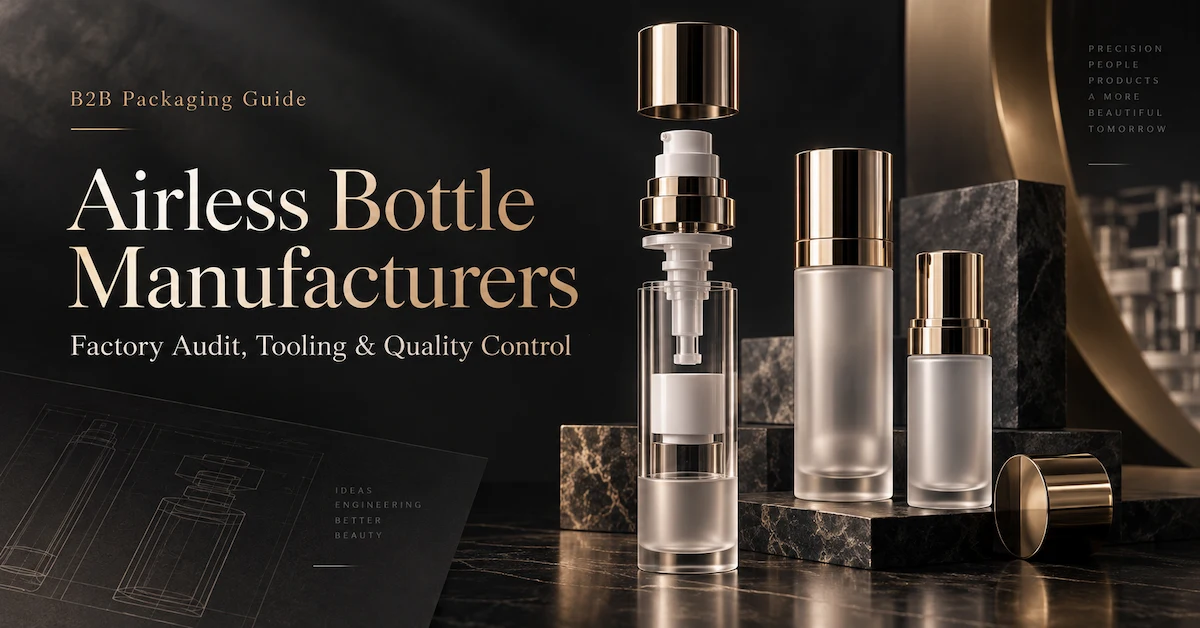
Choosing reliable airless bottle manufacturers requires more than identifying factories that can produce attractive skincare containers. Professional buyers must determine whether the manufacturer can control tooling, materials, component assembly, functional performance, quality inspection, and repeat production.
Two airless bottles may look almost identical but behave differently after filling. One may dispense consistently throughout its intended use, while another may experience piston movement problems, irregular pump output, leakage, or excessive residual product.
These differences often originate in engineering and production decisions that are not visible in product photographs.
For skincare brands, contract manufacturers, and packaging procurement teams, the key question is not simply whether a company offers airless packaging. It is whether the manufacturer can convert an approved packaging design into reliable commercial production.
The most effective approach is to evaluate manufacturing evidence, validate production-representative samples, and establish measurable acceptance criteria before placing a bulk order.
This guide explains how to distinguish manufacturers from trading companies, assess factory capabilities, understand airless bottle production, control OEM tooling projects, evaluate manufacturing consistency, and develop a practical supplier qualification process.
It also includes factory audit checklists, quality-control tables, sourcing risk assessments, and a technical request-for-quotation framework.
What Should Buyers Expect From Professional Airless Bottle Manufacturers?
A professional airless bottle manufacturer should be capable of supporting the development and repeatable supply of packaging components that meet clearly defined requirements.
These requirements extend beyond bottle shape, color, and decoration.
For technically demanding skincare packaging, buyers should examine the complete production chain:
-
Packaging engineering and design review.
-
Mold development and tooling management.
-
Material procurement and incoming inspection.
-
Bottle and component manufacturing.
-
Pump mechanism sourcing or manufacturing.
-
Component assembly and functional verification.
-
Cosmetic finishing and decoration.
-
Final inspection and batch traceability.
-
Production planning and commercial delivery.
Not every manufacturer performs all these operations internally.
For example, a factory may manufacture plastic bottles and outer components while obtaining specialized dispensing mechanisms from another qualified manufacturer.
This arrangement is not necessarily a disadvantage.
However, the buyer needs to know which organization controls each critical component and who is responsible for the final assembled packaging system.
A manufacturer should be able to explain its production responsibilities, component qualification procedures, and methods for preventing manufacturing defects.
The Difference Between Manufacturing Capability and Product Availability
A company may possess molding equipment and packaging development experience without having every airless bottle specification available as a standard product.
Similarly, a catalog may display multiple bottle designs without providing evidence of their current production status.
Professional buyers should therefore distinguish between:
Standard production models: Existing designs with confirmed components and production arrangements.
Customizable models: Established designs that may allow approved changes to color, decoration, or selected components.
Custom-developed models: New packaging designs requiring engineering work, tooling, and validation.
Concept or reference designs: Packaging ideas or sample presentations that require further feasibility confirmation.
These categories have different cost, timing, and technical implications.
Request confirmation of the exact configuration before assuming that a displayed design is ready for commercial production.
Airless Bottle Manufacturers vs Trading Companies: What Is the Difference?
The distinction between a manufacturer and a trading company is important during B2B sourcing, but it should not be oversimplified.
A manufacturer generally operates production processes for some or all of the packaging components it supplies.
A trading company typically coordinates sourcing from manufacturers and may provide commercial, logistical, or project management services.
An integrated packaging supplier may combine both approaches.
Manufacturer vs Trading Company Comparison
| Evaluation Factor | Direct Manufacturer | Trading Company or Sourcing Partner |
|---|---|---|
| Production equipment | May operate relevant manufacturing equipment | Usually relies on partner factories |
| Tooling control | May develop or manage molds directly | Coordinates tooling through manufacturers |
| Component sourcing | May manufacture some parts and purchase others | Typically coordinates external component sources |
| Engineering support | May provide direct process and design expertise | Depends on technical resources and manufacturing partners |
| Quality management | Controls applicable internal manufacturing stages | Requires effective supplier qualification and inspection |
| Production scheduling | May manage applicable production lines directly | Coordinates schedules across suppliers |
| Product selection | Often concentrated on relevant manufacturing capabilities | May offer a broader sourced product range |
| Main procurement risk | Process limitations or insufficient system integration | Limited visibility into actual production and changes |
A trading company can still be a suitable partner when it provides transparent sourcing, effective quality control, and reliable engineering coordination.
Likewise, a direct manufacturer is not automatically qualified for every airless dispensing application.
The most useful question is:
Who is responsible for the design, production, inspection, and long-term consistency of the exact packaging system being purchased?
What Should Buyers Verify About Manufacturing Ownership?
Request information about the actual production location and the processes performed there.
For airless bottles, this may include plastic molding, decorative finishing, assembly, mold maintenance, and quality inspection.
Ask whether the pump mechanism is produced internally or sourced from a qualified component manufacturer.
If important components are externally sourced, clarify how incoming quality is verified and whether the supplier can change component sources without customer approval.
This is particularly important for custom skincare packaging where replacing a pump, seal, or piston can affect performance even if the exterior remains unchanged.
How to Audit an Airless Bottle Manufacturing Factory
A factory audit is a structured evaluation of the manufacturer's ability to meet agreed product requirements.
It can be performed through document review, remote assessment, independent inspection, or an on-site visit.
The depth of the audit should depend on the project's technical and commercial risks.
For a standard bottle used with a straightforward formulation, a focused supplier qualification process may be sufficient.
For a custom airless system intended for a sensitive skincare formula, a more detailed engineering and process audit may be appropriate.
Twelve Essential Factory Audit Checks
| Audit Area | Questions Buyers Should Ask | Useful Evidence |
|---|---|---|
| Company identity | Who owns and operates the actual production facility? | Legal business details, factory information |
| Production scope | Which bottle and pump components are manufactured internally? | Process descriptions, production records |
| Engineering capability | Can the factory review design feasibility and tolerances? | Drawings, engineering procedures |
| Tooling management | How are molds developed, maintained, and modified? | Tooling records, maintenance procedures |
| Material control | How are resins and purchased components verified? | Material specifications, inspection records |
| Process control | Are molding parameters and critical dimensions monitored? | Process instructions, inspection results |
| Pump assembly | How is component fit and functionality controlled? | Assembly procedures, functional checks |
| Testing capability | Which packaging performance tests can be performed or arranged? | Test methods, reports, equipment information |
| Decoration quality | How are colors, printing, and finishes controlled? | Approved samples, color standards |
| Traceability | Can production lots be linked to relevant materials and records? | Batch identification and traceability procedures |
| Nonconformity management | How are defects investigated and corrected? | Corrective-action records |
| Production planning | Can the factory support the required delivery and repeat orders? | Capacity plans, lead-time commitments |
This checklist provides a practical basis for comparing manufacturing partners.
However, a factory should not automatically pass an audit merely because it provides photographs of its machinery.
Evidence should demonstrate that the equipment, personnel, procedures, and inspection systems are relevant to the proposed packaging project.
Red Flags During Factory Evaluation
Potential warning signs include an inability to identify product-contact materials, inconsistent technical drawings, unclear component sourcing, and unwillingness to explain how samples will be validated.
Other concerns include changing specifications without documentation, claiming universal formula compatibility, or offering unsupported performance guarantees.
A supplier that cannot explain the difference between an airless mechanism and a standard lotion pump may require further technical evaluation.
Professional communication should make manufacturing responsibilities clearer, not more confusing.
Understanding the Airless Bottle Manufacturing Process
Airless packaging manufacturing involves several interconnected processes.
The precise sequence depends on the selected materials, dispensing mechanism, manufacturing equipment, and design.
A typical custom plastic airless packaging project may involve engineering review, tooling development, component molding, decoration, assembly, inspection, and shipment.
Stage 1: Packaging Design and Engineering Review
Manufacturing begins with defining the functional requirements.
The design team should understand the target capacity, bottle dimensions, dispensing requirements, intended formulation, consumer-use environment, and desired appearance.
Engineering review evaluates whether the proposed design can be manufactured consistently.
Important considerations include wall thickness, part geometry, dimensional tolerances, mold release, closure fit, and component assembly.
For airless systems, the manufacturer must also consider how the internal dispensing mechanism fits within the overall container structure.
An attractive concept is not necessarily a production-ready design.
Stage 2: Mold Design and Development
Plastic packaging components often require injection molds, blow molds, or other tooling appropriate to the manufacturing process.
The tooling design affects dimensional consistency, surface quality, production efficiency, and maintenance requirements.
For custom packaging, the manufacturer may prepare engineering drawings, develop prototypes, open molds, and produce trial samples.
Buyers should confirm the number of molds required and the components covered by each tooling investment.
A custom outer shell does not always require a completely new dispensing mechanism.
Using an existing qualified pump assembly may reduce development complexity if it meets the project's functional requirements.
Stage 3: Component Manufacturing
Depending on the design, the factory may use injection molding for closures, actuators, housings, or other precision plastic parts.
Bottle bodies may require injection molding, blow molding, or another suitable forming process.
The manufacturer should control important processing variables and verify critical dimensions.
Surface defects, deformation, inconsistent wall thickness, and dimensional instability can create difficulties during later assembly.
Manufacturing capability should therefore be assessed through actual process controls rather than machine quantity alone.
Stage 4: Decoration and Surface Finishing
Cosmetic packaging often requires consistent exterior appearance across multiple production batches.
Possible decoration processes include color molding, screen printing, hot stamping, coating, or other appropriate finishing methods.
Each process introduces additional quality requirements.
For example, printing must be aligned correctly, colors must match approved references, and decorative finishes must withstand foreseeable handling.
Premium packaging quality depends on consistent production, not simply the appearance of one attractive sample.
Stage 5: Assembly and Inspection
The bottle, internal reservoir, pump assembly, protective cap, and decorative components must fit together correctly.
Assembly problems can lead to leakage, poor actuator operation, unusual friction, or dispensing failure.
The manufacturer should define inspection points relevant to the actual structure.
Where specialized pump components come from external partners, the final assembly must still be validated as a complete packaging system.
How Mold Engineering Affects Airless Bottle Quality
Tooling is one of the most important differentiators between basic packaging supply and professional custom manufacturing.
Poor tooling decisions may not be obvious during the first sampling stage.
Problems can emerge when production quantities increase, molds experience wear, or different manufacturing batches must remain consistent.
Design for Manufacturability
Design for Manufacturability, commonly called DFM, examines whether a design can be manufactured reliably and efficiently.
For custom airless bottles, DFM considerations may include:
-
Appropriate wall thickness and geometry.
-
Mold filling and material flow.
-
Mold release and draft requirements.
-
Dimensional tolerances at assembly interfaces.
-
Surface finish requirements.
-
Component compatibility.
-
Assembly access and orientation.
-
Risk of deformation or cosmetic defects.
The goal is not simply to simplify the design.
It is to achieve the desired appearance and functionality without introducing unnecessary production instability.
Prototype Samples vs Tooling Trial Samples
Buyers should understand the difference between an early prototype and a molded sample.
A CNC or other prototype may help assess dimensions, handling, or appearance.
However, prototype materials and manufacturing methods may differ from those used in production.
A tooling trial sample provides information about the components produced by the actual mold.
In many development projects, T1 and subsequent trials are used to evaluate dimensions, appearance, and required corrections.
A T1 sample should not automatically be considered the final approved production standard.
Tooling Approval and Design Changes
Before approving tooling, the buyer should confirm drawing revisions, dimensional tolerances, ownership arrangements, and responsibilities for corrective work.
Engineering changes should be documented.
If a change affects the pump interface, internal reservoir, piston movement, or sealing geometry, functional testing may need to be repeated.
Uncontrolled design changes can compromise a previously approved packaging system.
Why Pump Component Control Matters During Manufacturing
The pump assembly is central to airless packaging performance.
A manufacturer may produce an excellent outer bottle but still encounter dispensing problems if the internal components are inconsistent or unsuitable.
Internal Mechanism Verification
Airless systems may use a moving piston, collapsible pouch, or another mechanism designed to reduce replacement air entering the product reservoir.
However, not every product marketed as airless uses the same structure.
Buyers should request engineering information confirming how the proposed system operates.
A pump-based appearance alone does not prove that the packaging is genuinely airless.
Component Tolerances
Dimensional variations can affect the movement and sealing of internal components.
For piston-based packaging, relevant considerations may include reservoir dimensions, piston fit, friction, and alignment.
For pouch-based systems, pouch construction, connections, and collapse behavior are important.
The tolerances that matter most should be identified during engineering development.
Purchased Pump Components
A packaging factory may use pump components sourced from specialist manufacturers.
In this situation, the buyer should understand how the supplier approves components and manages supplier changes.
Critical information may include component identification, applicable material specifications, inspection procedures, and continuity arrangements.
A change in pump mechanism or sealing material can affect performance even when the bottle's exterior remains unchanged.
The manufacturer's responsibility should include ensuring that the complete supplied package meets the approved requirements.
Establishing a Complete Airless Bottle Specification
A professional sourcing project requires a written specification that covers more than nominal bottle capacity.
The document should define the attributes that will be inspected during development and production.
Recommended Manufacturing Specification
| Specification | Buyer Requirement |
|---|---|
| Product identification | Approved model name and revision |
| Packaging configuration | Complete component arrangement |
| Nominal capacity | Stated container capacity |
| Recommended fill volume | Intended commercial filling quantity |
| Bottle dimensions | Height, diameter, and other critical dimensions |
| Reservoir material | Confirmed product-contact material |
| Exterior materials | Outer shell, decorative components, closure |
| Dispensing mechanism | Verified airless structure |
| Pump output | Agreed output and test conditions |
| Priming performance | Defined functional acceptance criteria |
| Product evacuation | Agreed measurement method and requirement |
| Seal performance | Applicable leakage acceptance criteria |
| Surface appearance | Color, finish, printing, visual reference |
| Manufacturing tolerances | Critical dimensional limits |
| Packaging configuration | Carton quantity and protective requirements |
| Quality documentation | Required inspection and test records |
The manufacturer should confirm which specifications are standard and which require project-specific development.
Not every value must be finalized during the initial inquiry.
However, important functional requirements should be defined before final sample approval.
Identify Critical-to-Quality Characteristics
Critical-to-Quality characteristics, or CTQs, are attributes that strongly influence whether a product meets customer requirements.
For an airless bottle, CTQs may include dispensing function, leakage resistance, reservoir integrity, assembly fit, and selected critical dimensions.
Other characteristics, such as decorative appearance, may also be commercially important.
A manufacturer should distinguish between requirements that directly affect functionality and those primarily related to appearance.
This distinction helps determine suitable inspection methods, acceptance criteria, and corrective actions.
Quality Control for Airless Bottle Mass Production
Manufacturing quality should be managed throughout the production process rather than relying exclusively on final inspection.
A structured quality system typically includes incoming material control, in-process inspection, and outgoing product verification.
Incoming Quality Control
Incoming Quality Control, or IQC, focuses on materials and purchased components before they enter production.
Checks may include material identification, supplier documentation, dimensional inspection, and visible component defects.
For specialized pump assemblies, incoming verification may also involve appropriate functional checks.
The exact inspections should reflect the component's technical importance and identified risks.
In-Process Quality Control
In-Process Quality Control, or IPQC, monitors manufacturing activities while products are being produced.
For molded bottle components, inspection may focus on dimensions, wall thickness, surface defects, and structural consistency.
For assembled packaging, the process may include checks on closure engagement, component fit, and actuator function.
When production equipment or tooling is adjusted, the manufacturer should determine whether additional verification is necessary.
Outgoing Quality Control
Outgoing Quality Control, or OQC, verifies that finished products conform to approved requirements before shipment.
The outgoing inspection plan should address the applicable product characteristics.
For custom packaging, this may include appearance, printing, dimensions, assembly quality, leakage, and selected functional performance.
The inspection report should identify the product configuration and production lot being evaluated.
Example Quality-Control Matrix
| Production Stage | Typical Check | Risk Addressed |
|---|---|---|
| Material receiving | Material and component verification | Incorrect or inconsistent inputs |
| Molding setup | Initial component measurements | Incorrect process settings |
| Ongoing molding | Periodic dimensions and appearance | Process variation |
| Decoration | Color and print alignment | Visual inconsistency |
| Assembly | Component fit and mechanism function | Dispensing or sealing problems |
| Functional testing | Pump output, priming, leakage | Product performance failures |
| Final inspection | Approved sample and specification comparison | Shipment of nonconforming products |
| Batch release | Documentation and traceability | Uncontrolled quality records |
These are recommended inspection areas.
Specific test procedures and acceptance criteria should be agreed upon for the actual product.
How to Test Airless Bottle Performance Before Mass Production
A packaging sample should undergo appropriate functional verification before it becomes the approved reference for commercial production.
The required tests depend on the formulation, packaging structure, and intended distribution conditions.
Pump Priming
Priming evaluates how the dispenser begins operating.
A buyer may measure the number of actuations required before consistent product delivery occurs.
This test should use an agreed filling procedure and representative formulation.
An excessively difficult priming process can reduce consumer satisfaction and may indicate a mismatch between the pump and product.
Dispensing Consistency
Pump output should be evaluated across multiple actuations and representative samples.
Measurements may be expressed as mass or volume, depending on the test method.
The buyer should compare output consistency rather than relying on one successful actuation.
Variations may be influenced by formula properties, pump design, and manufacturing consistency.
Product Evacuation
Product evacuation measures how much of the filled formulation can be dispensed under defined conditions.
The calculation can be expressed as:
Product Evacuation Rate (%) = Total Product Dispensed ÷ Initial Product Fill × 100
However, this calculation is only meaningful when the testing procedure is specified.
Formula viscosity, product temperature, dispensing orientation, and the test endpoint can influence results.
Manufacturers should not make universal evacuation claims without product-specific evidence.
Leakage and Sealing
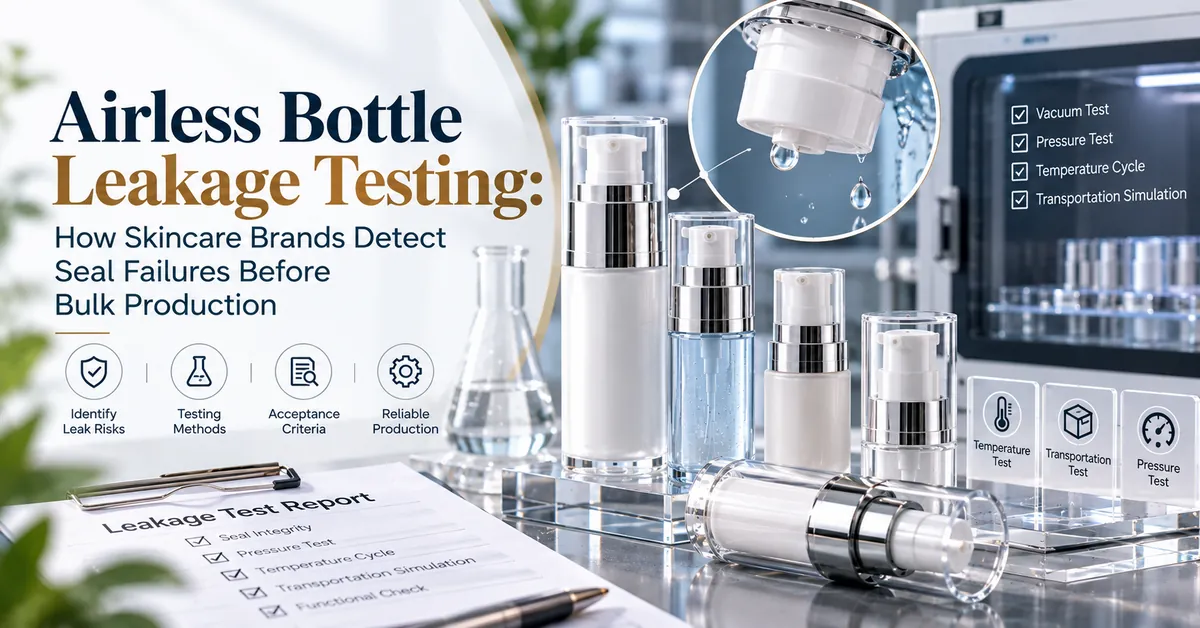
Leakage testing should evaluate the assembled package under agreed conditions.
Potential problems include damaged seals, dimensional mismatches, assembly errors, and formula interactions.
Transport orientation, pressure changes, and temperature variations may also influence leakage risk.
A supplier should explain which leakage tests are applicable to its proposed design.
Repeated-Use Durability
Repeated actuation testing can help identify mechanical wear or performance changes.
The procedure should reflect the expected product usage pattern.
Potential observations include changing actuator force, inconsistent pump recovery, reduced output, and dispensing failure.
A successful initial pump demonstration does not establish long-term durability.
How to Define Defects and Acceptance Standards
One frequently overlooked manufacturing issue is the absence of an agreed defect classification.
A supplier may consider a minor appearance variation acceptable while the brand considers it a significant quality problem.
Buyers should define defect categories before mass production.
Critical, Major, and Minor Defects
| Defect Level | Illustrative Issue | Procurement Consideration |
|---|---|---|
| Critical | A defect creating an unacceptable product safety risk | Requires risk-based controls and clear disposition |
| Major | Pump does not dispense, significant leakage, incorrect critical assembly | Usually prevents intended functionality |
| Minor | Limited cosmetic variation within a defined visual tolerance | May be acceptable under agreed criteria |
These examples are illustrative.
Actual classifications depend on the product's intended use and the severity of the failure.
A leakage defect may be classified differently depending on whether it causes only commercial loss or creates an additional safety concern.
Understanding AQL Sampling
Acceptance Quality Limit, or AQL, is commonly used in statistical acceptance sampling.
ISO 2859-1:2026 provides sampling schemes indexed by AQL for inspection by attributes.
However, AQL should not be interpreted as permission for a fixed percentage of defective products in every shipment.
The applicable sampling plan depends on the standard, inspection level, lot size, selected AQL, and other defined conditions.
Buyers should agree on how inspection results will be interpreted.
Critical functional problems may require additional safeguards beyond ordinary appearance sampling.
Approved Samples and Visual Standards
A signed or otherwise formally approved sample can provide an important reference for production.
However, the reference sample should be linked to the correct drawing revision, material specification, and decoration requirements.
A visual sample should not replace measurable functional standards.
The manufacturer and buyer should agree on acceptable color differences, printing variations, surface defects, and assembly requirements.
Moving From Approved Samples to Stable Mass Production
Sample approval is a major milestone, but it is not the end of manufacturing qualification.
Many sourcing problems arise because the product is approved without confirming whether the manufacturing process can reproduce the same result consistently.
First Article Inspection
First Article Inspection involves evaluating initial production items against approved specifications.
The purpose is to confirm that the production process can produce components that meet the required design.
The inspection should focus on critical characteristics.
For custom tooling, it may include dimensions, material verification, assembly fit, and selected functional tests.
Pilot Production
Where project risk justifies it, a pilot production run can help evaluate manufacturing consistency before full-scale production.
A pilot run may reveal issues involving assembly efficiency, defect rates, component handling, or testing capacity.
The buyer should define the purpose and acceptance criteria before the run.
Process Changes
Manufacturing processes may change because of tooling maintenance, equipment adjustments, component supplier changes, or material substitutions.
Not all changes have the same technical significance.
However, changes affecting critical characteristics should be evaluated and approved through an appropriate change-control process.
The manufacturer should avoid silently replacing important components after the customer has approved a specific packaging configuration.
Repeat-Order Consistency
For skincare brands developing multiple product batches, repeat-order consistency is particularly important.
The package should maintain acceptable appearance, fit, dispensing performance, and quality across successive manufacturing lots.
Traceability and controlled specifications help both parties identify whether deviations result from materials, processes, or component changes.
What Factory Capacity Really Means for B2B Buyers
Manufacturing capacity is often presented as a major supplier advantage.
However, equipment counts and factory size do not provide a complete picture of production capability.
Buyers should investigate whether the factory can actually produce the required packaging configuration within the requested schedule.
Equipment Capacity vs Effective Capacity
A molding machine may be capable of producing components at a particular rate.
Actual output also depends on tooling, cycle time, changeovers, maintenance, labor, inspection, and production quality.
Furthermore, airless packaging production may require several component manufacturing and assembly operations.
The slowest critical operation can limit overall output.
A factory with significant molding capacity may still face bottlenecks in pump sourcing, decoration, assembly, or testing.
How to Evaluate Delivery Capability
Ask the manufacturer to explain:
-
Which components are already available.
-
Which require production or external procurement.
-
Whether new molds are required.
-
Which operations determine the critical production schedule.
-
How quality inspection affects production release.
-
Whether the proposed timeline includes sample approval.
-
How shipment scheduling will be managed.
A realistic production plan is more valuable than an unsupported promise of exceptionally fast delivery.
Business Continuity and Repeat Supply
Long-term buyers should also consider component continuity.
If a specialized pump is supplied by an external manufacturer, changes in availability may affect production.
A qualified supplier should explain how critical component changes are communicated and managed.
Alternative components should be evaluated rather than substituted automatically.
For repeat orders, consistency of the complete packaging system is often more important than the ability to source the cheapest available part.
Airless Bottle Manufacturing Costs: What Drives the Final Price?
Packaging prices are influenced by design complexity, materials, tooling, order quantity, decoration, inspection, and logistics.
Understanding these factors helps buyers compare manufacturers fairly.
Tooling Investment
Custom bottle shapes and components may require new molds.
The initial investment can include engineering, tooling, trials, modifications, and sample approval.
Buyers should request a breakdown of tooling-related costs where appropriate.
The agreement should clarify tooling ownership, maintenance responsibilities, and future production arrangements.
Material and Component Costs
Material grade, component weight, pump complexity, and the number of parts influence production costs.
A premium exterior shell may add cost without necessarily changing the internal dispensing performance.
For function-sensitive projects, spending should first address the requirements that affect reliable dispensing and product compatibility.
Decoration Costs
Custom color matching, printing, coatings, and special finishes may add setup requirements and inspection work.
Complex decoration can be justified when it creates meaningful brand differentiation.
However, decorative choices should not compromise the package's manufacturing feasibility or functional performance.
Quality Costs
Quality control involves inspection, testing, documentation, and management of nonconforming products.
A low quotation that excludes necessary verification may not represent the lowest practical procurement cost.
Buyers should clarify which tests are included and which require separate arrangements.
Total Cost of Ownership
A useful procurement assessment includes:
Total Procurement Cost = Packaging Cost + Tooling + Sampling + Inspection + Logistics + Inventory Costs + Expected Quality-Related Costs
Expected quality-related costs may include rejected goods, replacement packaging, production interruptions, and customer complaints.
These costs should be evaluated using the buyer's actual experience or justified assumptions.
No manufacturer should claim a guaranteed percentage reduction in total costs without supporting project data.
OEM and ODM Airless Bottle Manufacturing: Choosing the Right Development Route
Skincare brands may choose either existing packaging customization or new product development.
These approaches serve different commercial needs.
Existing Mold Customization
When an available design meets the technical requirements, buyers may be able to customize selected exterior features.
Depending on the product, potential options include color matching, printing, surface finishes, and coordinated caps.
This approach can reduce the need for new tooling.
However, the manufacturer should confirm whether the requested changes are compatible with the existing material and production process.
New Mold Development
A new packaging concept may require structural engineering and custom tooling.
The process usually involves design requirements, engineering drawings, prototypes, mold development, trial samples, and production approval.
The development plan should identify which components require custom tooling and which can use existing qualified parts.
Development Stage Gates
A useful project management approach is to establish formal approval gates.
| Stage Gate | Main Objective | Approval Evidence |
|---|---|---|
| Gate 1: Feasibility | Confirm technical and commercial direction | Initial specification and feasibility review |
| Gate 2: Design | Approve engineering concept | Controlled drawings and design decisions |
| Gate 3: Tooling | Verify molded component feasibility | Tooling trial samples and inspection results |
| Gate 4: Validation | Confirm packaging functionality | Approved tests and representative samples |
| Gate 5: Production | Authorize commercial manufacture | Production standard and quality agreement |
| Gate 6: Release | Confirm shipment conformity | Batch inspection and release documentation |
This staged approach helps prevent premature mass-production commitments.
It also clarifies when technical changes require additional testing.
Refillable and Sustainable Airless Packaging: Manufacturing Considerations
Refillable and recycled-content packaging may offer useful options for beauty brands seeking alternative packaging strategies.
However, these designs can introduce additional engineering requirements.
Refillable Airless Systems
A refillable design may allow an outer shell to remain in use while an inner cartridge or reservoir is replaced.
The actual refill structure must be confirmed.
A bottle should not be described as refillable solely because some components can be unscrewed.
Manufacturers should evaluate the cartridge interface, replacement operation, material compatibility, and durability of components intended for repeated use.
PCR Material Integration
Post-consumer recycled materials may be considered for selected packaging components.
However, PCR content, material consistency, and suitability must be verified.
The use of PCR in an outer shell does not imply that the complete pump mechanism contains recycled material.
Product-contact suitability and technical performance remain important.
Material Separation and Recycling
Complex airless systems can include several different materials.
Their end-of-life handling depends on the complete structure and the recycling infrastructure in the target market.
Environmental claims should be supported by relevant evidence.
A manufacturer should not promise that a complete airless package is universally recyclable merely because one component uses a recyclable resin.
Buyers should confirm the actual materials and any supporting documentation before making product claims.
Packaging Documentation and International Market Requirements
Manufacturing documentation supports both supplier qualification and finished-product compliance.
However, packaging manufacturers and finished cosmetic brands may have different responsibilities.
For the European Union, Regulation (EC) No 1223/2009 establishes the framework for cosmetic product safety.
Its Annex I includes consideration of relevant packaging material characteristics.
European Commission guidance also addresses potential interactions between packaging materials and cosmetic formulations.
For a skincare brand, this makes material information and compatibility evaluation important parts of the overall product safety assessment.
ISO 22715:2006 specifies requirements relating to cosmetics packaging and labeling.
It should not be presented as evidence that an individual airless bottle has passed pump-function testing.
Similarly, a factory's general quality-system certification does not automatically prove that a specific dispensing mechanism meets the customer's performance requirements.
Recommended Manufacturer Documentation
Depending on the project, useful documents may include:
-
Controlled product drawings.
-
Component and material specifications.
-
Approved sample records.
-
Inspection standards.
-
Relevant functional test reports.
-
Batch identification information.
-
Applicable material declarations.
-
Tooling and engineering change records.
-
Packaging and shipment specifications.
Buyers should request documents appropriate to their intended product and market.
Not every project requires the same documentation.
However, important performance and compliance claims should always have an appropriate factual basis.
An Example Factory Qualification Scorecard
A weighted evaluation scorecard can help procurement teams compare manufacturing partners.
The following allocation is an illustrative purchasing framework rather than an industry certification standard.
| Evaluation Dimension | Suggested Weight | Key Evidence |
|---|---|---|
| Manufacturing capability | 20% | Equipment, processes, production scope |
| Engineering and tooling | 15% | Drawings, mold development, change control |
| Product performance | 20% | Pump and reservoir testing |
| Quality management | 20% | IQC, IPQC, OQC, traceability |
| Production reliability | 10% | Capacity planning, component control |
| Commercial competitiveness | 10% | Quotation, MOQ, lead time, tooling terms |
| Communication and support | 5% | Technical response and issue resolution |
This scorecard should be adapted to the actual project.
For a technically demanding formulation, product performance and compatibility may deserve greater weight.
For a standard packaging procurement project, delivery consistency and commercial flexibility may become more important.
A strong supplier qualification process evaluates evidence, not simply sales presentations.
How COSME Packaging Approaches Cosmetic Packaging Manufacturing
COSME Packaging is the packaging brand of Zhejiang Cosme Industry Co., Ltd., a Chinese cosmetic packaging company founded in 2015.
According to the company's published information, its operations include an approximately 15,000-square-meter facility, around 200 employees, molding equipment, printing operations, research and development, and mold development capabilities.
The company focuses on cosmetic primary packaging, including bottles, jars, tubes, airless packaging categories, and customized OEM/ODM projects.
Its published quality-control practices include incoming material inspection, periodic dimensional and surface inspection during injection and blow molding, finished-product leakage checks, printing adhesion and color inspection, and batch traceability.
Buyers can review the COSME cosmetic packaging manufacturing overview for more information about its stated capabilities.
Existing Styles and Custom Tooling
COSME describes two principal project routes.
For existing packaging styles, the process covers style and capacity selection, color and printing confirmation, quotation, order approval, pre-production samples, mass production, and delivery.
For new tooling projects, the company describes design confirmation, 3D drawing preparation, CNC sampling, mold opening, tooling trials, production, and delivery.
These processes are relevant to brands evaluating custom packaging development.
The published information does not, however, establish that every airless dispensing component is manufactured in-house or that every displayed design has confirmed functional specifications.
Evaluating Specific Airless Packaging Products
COSME maintains an airless cosmetic bottle product category, including packaging presented for skincare applications and refill-oriented designs.
One product is described as an Airless Bottle for Skincare and Cosmetic Dispensing.
Its public description makes clear that the internal dispensing mechanism cannot be confirmed from the appearance alone.
For this reason, buyers should request technical drawings, material details, available capacities, and representative samples before approving a design for applications requiring verified airless performance.
COSME's general molding, customization, and quality-control capabilities can form the basis of an initial manufacturing discussion, while exact airless system availability and specifications need to be confirmed for the proposed project.
Brands interested in further customization can also review the company's article on custom airless bottles for premium skincare packaging.
How to Prepare an Effective RFQ for Airless Bottle Manufacturers
A detailed Request for Quotation, or RFQ, helps manufacturers assess technical feasibility and provide comparable commercial proposals.
A vague request for a unit price may result in quotations based on different components, materials, and quality standards.
A well-prepared RFQ should describe the intended product, manufacturing requirements, and expectations for sample qualification.
Recommended RFQ Information
| Information | Details to Provide |
|---|---|
| Project application | Serum, lotion, moisturizer, cream, or other skincare product |
| Target markets | Intended countries or regions |
| Required capacity | Nominal and intended fill volume |
| Formula characteristics | Viscosity, relevant ingredients, compatibility concerns |
| Dispensing mechanism | Required verified airless structure |
| Packaging materials | Product-contact and exterior requirements |
| Dimensions | Target size and filling-line restrictions |
| Decoration | Colors, printing, finish, logo placement |
| Initial quantity | Estimated opening order |
| Annual demand | Forecast for repeat orders |
| Development route | Existing design customization or new tooling |
| Testing | Functional, compatibility, leakage, durability |
| Quality documentation | Drawings, samples, inspection requirements |
| Delivery | Intended destination and project schedule |
| Commercial requirements | MOQ, tooling fees, Incoterms, payment terms |
Example Manufacturer Inquiry
A professional skincare packaging buyer might submit the following inquiry:
"We are developing a premium skincare lotion and would like to evaluate a customizable airless bottle packaging solution.
Our preferred nominal capacity is approximately 50 mL, and our initial order forecast is 20,000 units, subject to sample testing and approval.
We require a verified airless dispensing mechanism, consistent pump performance, a custom exterior color, and logo decoration.
Please confirm your relevant manufacturing processes, available component configurations, material specifications, sample options, mold requirements, quality inspection procedures, estimated MOQ, and development schedule.
We would also like to understand which pump components are produced internally and which are obtained from qualified partners.
Our packaging engineering team can provide additional formulation information for compatibility evaluation."
This is an illustrative procurement scenario, not a confirmed COSME product specification, MOQ, or available capacity.
Providing clear technical requirements makes it easier for a manufacturer to identify a realistic development path.
For a project-specific assessment, buyers can contact COSME Packaging to discuss custom manufacturing requirements.
Frequently Asked Questions About Airless Bottle Manufacturers
1. How do I verify whether an airless bottle manufacturer is a real factory?
Request the company's production location, relevant business information, manufacturing process descriptions, and details of the components it makes internally.
A remote or on-site factory assessment can provide additional evidence.
Buyers should also ask how tooling, assembly, inspection, and purchased components are managed.
A company does not need to manufacture every component itself, but it should clearly explain responsibility for the complete supplied packaging system.
2. What are the most important manufacturing capabilities for airless bottles?
Important capabilities include packaging engineering, tooling management, component molding, assembly control, material inspection, functional testing, and batch traceability.
For custom projects, the manufacturer's ability to control engineering changes is also important.
The required manufacturing capabilities depend on the selected bottle design and dispensing mechanism.
3. Do all airless bottle manufacturers produce their own pumps?
No.
Some manufacturers produce bottle bodies and selected components while purchasing specialized pump assemblies from qualified suppliers.
This can be a valid manufacturing arrangement.
The buyer should verify who produces the critical parts, how their quality is controlled, and who is responsible for the final package's performance.
4. How can I confirm that an airless bottle uses a genuine airless mechanism?
Request technical drawings or other appropriate information showing the dispensing system.
Depending on the structure, this may involve a moving piston, collapsible pouch, or another engineered reservoir arrangement.
Representative samples should be tested for dispensing behavior and relevant performance requirements.
The exterior appearance of a pump bottle is not sufficient evidence.
5. What is the difference between a prototype and an approved production sample?
A prototype may be used to evaluate a design concept, dimensions, or appearance.
An approved production sample should represent the intended commercial materials, manufacturing processes, assembly, and decoration as closely as practical.
Functional requirements must also be verified.
A prototype should not automatically be treated as the reference for final production quality.
6. What quality tests should a manufacturer perform before shipment?
Relevant tests may include dimensional inspection, visual checks, priming, pump output, leakage, repeated-use durability, and product evacuation.
Depending on the project, decoration adhesion, formula compatibility, and distribution testing may also be required.
The appropriate tests and acceptance criteria should be agreed upon before production.
7. How much does custom airless bottle tooling cost?
Tooling cost depends on the design, component geometry, number of molds, materials, manufacturing processes, and engineering work required.
There is no universal tooling price applicable to all custom airless bottle projects.
Buyers should request a project-specific quotation identifying what is included.
Tool ownership, modifications, sample approval, and future maintenance arrangements should be documented.
8. How do manufacturers control quality between production batches?
Quality control may include material verification, controlled production settings, dimensional checks, assembly inspection, approved visual standards, functional testing, and batch traceability.
The manufacturer should maintain appropriate records and manage changes affecting critical components.
Consistent repeat production requires more than inspecting one sample from the initial order.
9. How should I compare airless bottle manufacturers for large wholesale orders?
Use the same technical specification and RFQ for each candidate.
Evaluate manufacturing capability, pump configuration, quality evidence, component sourcing, production capacity, tooling arrangements, and commercial terms.
Where possible, compare production-representative samples under equivalent conditions.
A low unit price should not compensate for unresolved functional or quality risks.
10. What should I prepare before contacting a custom airless bottle manufacturer?
Prepare the product application, intended formula characteristics, desired capacity, dispensing requirements, material preferences, branding details, estimated quantities, and target market.
If available, provide drawings, reference designs, expected quality criteria, and project timing.
Ask the manufacturer what additional information is required for technical feasibility and sample evaluation.
A detailed project brief improves communication and helps reduce unnecessary development revisions.
Conclusion
Selecting reliable airless bottle manufacturers requires a systematic review of factory capabilities, mold engineering, component sourcing, functional testing, production consistency, and commercial transparency. Skincare brands should prioritize verified manufacturing evidence and approved production samples over unsupported quality claims or the lowest initial price.
For OEM/ODM skincare packaging projects, contact COSME Packaging to discuss your bottle design, intended formulation, target capacity, customization requirements, and production plans, and request information on suitable manufacturing options.