
TL;DR: The best sourcing model for cosmetic bottles depends on whether your brand prioritizes custom manufacturing, access to multiple packaging formats, or coordinated supply of complete bottle assemblies. Direct manufacturers, distributors, and integrated packaging suppliers offer different advantages. Before selecting a partner, verify who controls the bottle, pump, cap, specifications, quality inspections, and replacement components.
Finding reliable cosmetic bottle suppliers is an important step for skincare brands preparing product launches, cosmetic OEM/ODM factories coordinating filling operations, and packaging distributors managing multiple product lines.
However, not all suppliers operate under the same business model.
One company may manufacture bottle bodies directly while purchasing pumps from another producer. Another may distribute ready-made packaging from several factories. A third may coordinate product development, component sourcing, decoration, and manufacturing through an integrated supply arrangement.
These differences affect quotation accuracy, customization flexibility, quality responsibility, and long-term supply continuity.
The most effective sourcing strategy is to choose a supplier whose manufacturing responsibilities, component controls, and commercial capabilities match the complete packaging project.
COSME Packaging, operated by Zhejiang Cosme Industry Co., Ltd., provides cosmetic packaging manufacturing, mold development, decoration, and OEM/ODM customization for international beauty and personal-care brands.
This guide explains how to compare different cosmetic bottle sourcing models, evaluate supplier capabilities, identify component-related risks, and establish reliable purchasing arrangements.
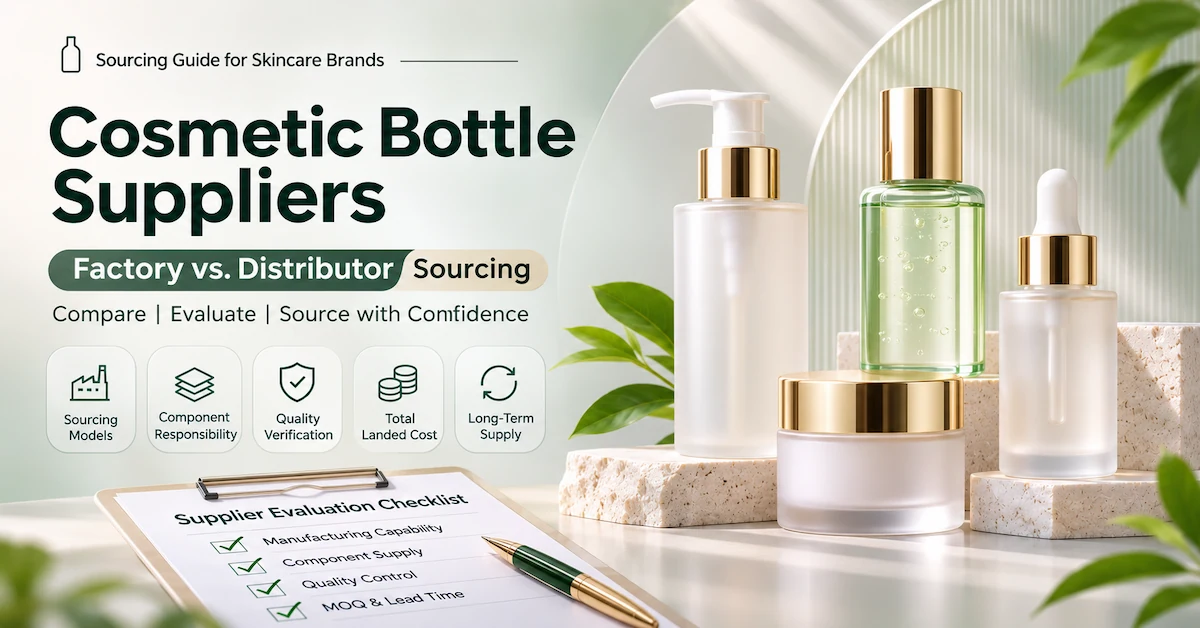
Key Takeaways: How to Compare Cosmetic Bottle Suppliers
Before requesting bulk quotations, skincare brands should understand the main differences between sourcing models.
| Purchasing factor | Direct manufacturer | Packaging distributor | Integrated packaging supplier |
|---|---|---|---|
| Primary role | Manufactures defined products | Sources and resells packaging | Coordinates multiple packaging activities |
| Product range | Depends on manufacturing scope | May include multiple manufacturers | Depends on production and sourcing network |
| Custom tooling | May support direct development | Often arranged through manufacturers | May coordinate engineering and tooling |
| Component sourcing | May be partly internal or outsourced | Often sourced from different producers | Can coordinate specified components |
| MOQ flexibility | Depends on production economics | Depends on available products and terms | Depends on each underlying component |
| Technical communication | Potential direct access to production teams | May involve an intermediary | Depends on engineering responsibility |
| Quality responsibility | Defined by purchase agreement | Defined by supply arrangement | Requires clear assembly-level accountability |
| Best-fit scenario | Defined products and ongoing custom manufacturing | Multiple standard product choices | Multi-component or coordinated packaging projects |
Important: These are general business-model differences, not guaranteed performance characteristics. A distributor may provide excellent technical service, while a manufacturer may rely on external producers for certain components.
The correct decision should be based on verified capabilities rather than supplier labels alone.
What Types of Cosmetic Bottle Suppliers Are Available?
Understanding the supplier's operating model helps buyers identify who is responsible for production, engineering, and commercial delivery.
1. Direct Cosmetic Bottle Manufacturers
A direct manufacturer operates relevant production processes for specified packaging products.
Its capabilities may include plastic injection molding, blow molding, mold development, component production, or decoration.
Direct manufacturing relationships can be valuable when buyers require:
-
Custom bottle geometry.
-
Material-specific manufacturing support.
-
Controlled engineering revisions.
-
Recurring production of approved packaging.
-
Direct discussion of manufacturing defects.
However, buyers should verify which components are actually produced internally.
A factory manufacturing plastic bottle bodies may purchase pumps, springs, collars, or other dispensing components from specialized suppliers.
Manufacturing the bottle body does not necessarily mean manufacturing every component in the finished package.
2. Cosmetic Packaging Distributors
Distributors may offer packaging products from multiple manufacturers.
This model can be attractive for brands that need different packaging formats without developing new molds.
Potential advantages include broader product selection and access to established packaging lines.
However, buyers should confirm the original manufacturer, technical documentation, product availability, and procedures for handling changes.
A distributor's ability to provide samples does not automatically demonstrate control over future manufacturing revisions.
3. Integrated Cosmetic Packaging Suppliers
An integrated supplier coordinates several stages of packaging development and supply.
These may include engineering, tooling, production, decoration, component sourcing, assembly, and quality management.
For a skincare brand launching multiple products, this approach may reduce the number of separate supplier relationships.
However, integration should not be confused with complete in-house manufacturing.
The buyer should identify which operations are internal, which are subcontracted, and who accepts responsibility for the approved finished assembly.
Which Sourcing Model Is Best for Your Skincare Business?
Different purchasing scenarios require different supplier capabilities.
Cosmetic Bottle Supplier Selection by Buyer Type
| Buyer scenario | Main requirement | Recommended sourcing consideration |
|---|---|---|
| New skincare startup | Existing packaging and controlled launch costs | Compare available standard designs |
| Established skincare brand | Custom appearance and long-term consistency | Evaluate manufacturing and engineering capabilities |
| Cosmetic OEM/ODM factory | Filling compatibility and dependable component supply | Prioritize complete assembly specifications |
| Packaging distributor | Multiple product formats and repeat availability | Evaluate product breadth and supplier traceability |
| Premium skincare brand | Distinctive design and decoration consistency | Review tooling and finishing capabilities |
| Multi-product beauty brand | Coordinated bottles, pumps, and jars | Consider integrated packaging coordination |
When Direct Manufacturing Makes Sense
A manufacturer may be particularly relevant when the packaging project requires original tooling, technical modifications, or repeat production of the same approved design.
When a Distributor May Be Appropriate
A distributor may suit buyers looking for existing product formats or multiple packaging sources without substantial structural development.
When Integrated Sourcing Becomes Valuable
Integrated sourcing can be useful when the project includes multiple bottles, different dispensing systems, customized colors, and coordinated delivery schedules.
The deciding factor is whether the supplier can demonstrate reliable control over the proposed packaging configuration.
Why Is Complete Bottle Assembly Responsibility So Important?
One of the most common procurement risks is treating a cosmetic bottle as a single component when the finished package actually contains several parts.
A lotion bottle, for example, may include the body, pump, collar, dip tube, protective cap, and additional sealing elements.
Different manufacturers may produce these components.
Cosmetic Bottle Bill of Materials (BOM)
| Component | Supplier responsibility to confirm | Main compatibility concern |
|---|---|---|
| Bottle body | Material, dimensions, manufacturing source | Capacity, neck finish, geometry |
| Pump mechanism | Pump specification and source | Dose, viscosity, actuation |
| Closure or collar | Component drawing and assembly | Thread engagement and sealing |
| Dip tube | Material and dimensional specification | Length and product evacuation |
| Seal or gasket | Material and interface information | Formula compatibility and leakage |
| Protective cap | Design, fit, and identification | Handling and transport protection |
| Decoration | Artwork, colors, and process | Appearance and adhesion |
| Export carton | Packing specification and supplier | Product protection |
What Happens When Components Come From Different Suppliers?
A bottle producer may confirm that its neck dimensions meet the approved drawing.
A separate pump supplier may confirm that its pump is within specification.
However, the completed assembly can still experience fit or sealing problems if the components were not validated together.
This creates an important purchasing question:
Who is responsible for ensuring that the entire bottle assembly works correctly?
The purchase agreement should identify the party responsible for component coordination, assembly approval, and resolution of interface-related defects.
Single-Source vs. Split-Source Purchasing
Single-source purchasing may simplify coordination when the supplier accepts responsibility for the complete assembly.
Split-source purchasing may provide additional flexibility but requires stronger interface specifications and coordination between suppliers.
Neither method is automatically superior.
The correct choice depends on engineering resources, supply risk, order volumes, and commercial requirements.
How Do You Verify a Cosmetic Bottle Supplier's Manufacturing Capabilities?
A product catalog is useful for preliminary screening, but it does not establish manufacturing capability.
Supplier verification should focus on the operations relevant to the proposed packaging.
Five Areas to Verify
Manufacturing scope: Identify which packaging components the supplier makes directly.
Engineering capabilities: Confirm whether the company can provide drawings, technical samples, tooling development, and component support.
Production equipment: Evaluate the equipment relevant to the selected bottle material and manufacturing process.
Quality management: Request information about incoming inspection, in-process controls, finished-product acceptance, and traceability.
Supply-chain transparency: Identify critical subcontracted processes and arrangements for managing quality or delivery problems.
Supplier Verification Checklist
| Verification item | Evidence buyers may request |
|---|---|
| Business identity | Registered company details and business address |
| Manufacturing activities | Process descriptions and relevant production evidence |
| Technical support | Drawings, samples, and engineering contact |
| Material management | Material specifications and supplier records |
| Quality procedures | Inspection criteria and available quality records |
| Change management | Revision and notification procedures |
| Commercial capacity | Project-specific production schedule |
| After-sales support | Complaint investigation and corrective-action process |
For important or high-volume projects, buyers may consider a factory audit or independent verification.
A professional audit should examine actual processes and records rather than relying only on promotional facility photographs.
How Should You Compare Cosmetic Bottle Materials and Formats?
A supplier's product range is relevant only if the available packaging meets the intended formulation and dispensing requirements.
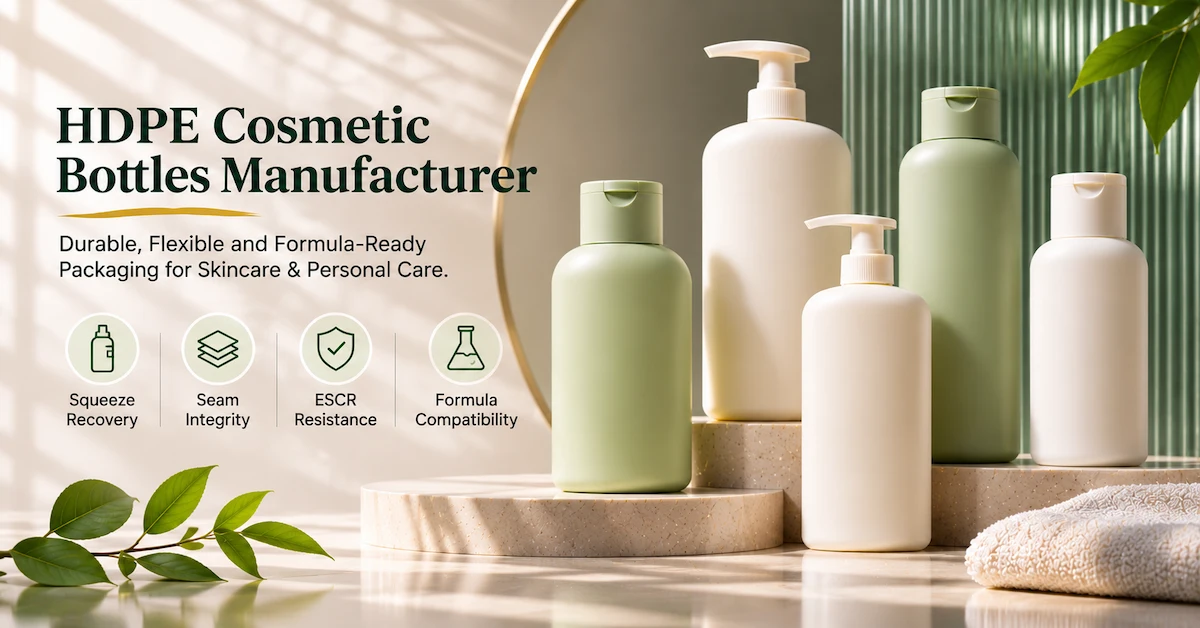
COSME's cosmetic bottle product range includes plastic, glass, refillable, foaming, dropper, and other specialized packaging categories.
Cosmetic Bottle Format Comparison
| Packaging format | Typical application | Main supplier evaluation |
|---|---|---|
| Plastic lotion bottle | Facial and body lotions | Resin, neck dimensions, pump compatibility |
| Airless pump bottle | Serums and selected skincare treatments | Internal mechanism, dispensing, sealing |
| Dropper bottle | Facial oils and liquid serums | Closure, pipette, and formula compatibility |
| Foaming bottle | Facial cleansers and personal-care products | Foam pump and formulation compatibility |
| Glass bottle | Premium skincare products | Neck finish, handling, breakage protection |
| Refillable bottle | Refill-oriented skincare | Replacement components and interface durability |
Why Materials Matter
PET, PETG, PP, PE, glass, and aluminum have different manufacturing and performance characteristics.
A supplier should explain the proposed material and provide relevant technical information.
However, the material designation alone does not establish compatibility with a finished cosmetic formula.
Buyers should consider the product-contact components, formulation properties, filling temperature, and intended storage conditions.
For specialized dispensing applications, review COSME's airless packaging collection.
What Quality Tests Should Cosmetic Bottle Suppliers Support?
Quality assurance should cover both individual components and the completed package.
The testing plan depends on the intended formula, bottle design, and commercial distribution requirements.
Recommended Cosmetic Bottle Quality Matrix
| Quality requirement | Recommended verification | Potential risk |
|---|---|---|
| Material identity | Confirm approved material specification | Formula incompatibility |
| Dimensional accuracy | Measure critical characteristics | Assembly problems |
| Pump and closure fit | Test complete assemblies | Leakage or dispensing failure |
| Package integrity | Evaluate relevant sealing requirements | Product loss |
| Dispensing performance | Test with the intended formula | Inconsistent user experience |
| Decoration | Check color, printing, and finish | Brand appearance variation |
| Transport resistance | Evaluate finished shipping configurations | Distribution damage |
| Batch traceability | Maintain lot identification and records | Difficult defect investigation |
Understanding Acceptance Sampling
ISO 2859-1:2026 provides an established framework for acceptance sampling by attributes.
Buyers and suppliers may use an appropriate agreed sampling plan for lot-by-lot inspection.
However, acceptance sampling does not guarantee that every unit in an accepted lot is defect-free.
Critical functional characteristics may require additional validation.
Distribution Testing
ASTM D4169-23e1 provides a framework for evaluating shipping containers and systems against relevant distribution hazards.
For cosmetic bottles, transportation testing should consider the completed shipping arrangement rather than the empty bottle alone.
These standards are technical references for developing procurement requirements. They do not establish that COSME or any other supplier has completed particular tests without supporting records.
How Can Buyers Compare Quotations From Different Suppliers?
Price comparisons are meaningful only when suppliers quote equivalent packaging configurations.
One supplier may quote the bottle body alone, while another includes the pump, protective cap, decoration, and export packing.
A lower advertised bottle price can therefore be misleading.
Cosmetic Bottle Quotation Comparison Checklist
| Quotation item | What to confirm |
|---|---|
| Bottle body | Material, capacity, design |
| Pump or closure | Included or separately priced |
| Decorative components | Included finish and materials |
| Printing | Number of colors, process, setup |
| Tooling | New molds, modifications, ownership |
| Sampling | Development and approval expenses |
| MOQ | Minimum quantity by configuration |
| Quality checks | Included testing and inspection |
| Export packing | Carton and protective packaging |
| Delivery terms | Incoterms rule and named location |
Compare Total Landed Cost
A practical purchasing calculation is:
Landed cost per accepted assembly = Total relevant procurement and delivery costs ÷ Accepted usable assemblies
Include relevant components, decoration, nonrecoverable import charges, freight, inspection, and appropriately allocated tooling costs.
The calculation should use comparable cost boundaries for every supplier.
Why Component Completeness Matters
Consider two hypothetical quotations:
Supplier A quotes the empty bottle at a lower price but excludes the pump, cap, and assembly.
Supplier B quotes a complete packaging configuration.
Neither offer can be considered cheaper until the missing components and other relevant costs are included.
The objective is to identify the most suitable total supply arrangement—not merely the lowest bottle-body price.
For a detailed approach to specifications and quotations, read COSME's Cosmetic Bottle Manufacturer RFQ-to-Production Guide.
How Can Buyers Prevent Component Changes and Supply Interruptions?
Packaging supply risk does not end after the first order is approved.
A supplier may change a resin grade, pump producer, closure design, or manufacturing process.
Some changes may affect the finished package even when the product appearance remains similar.
Component Change-Control Matrix
| Supplier change | Potential consequence | Recommended buyer action |
|---|---|---|
| Resin substitution | Different material behavior | Review material information and compatibility |
| Pump supplier change | Different dispensing or assembly performance | Revalidate the complete assembly |
| Closure modification | Fit or sealing variation | Approve revised samples |
| Tooling change | Dimensional differences | Review critical measurements |
| Decoration change | Appearance or adhesion variation | Approve finishing references |
| Manufacturing-site change | Process consistency differences | Review relevant production controls |
Establish a Change-Notification Agreement
Buyers should define which modifications require notification or written approval.
The supplier should maintain controlled drawings, component specifications, and approved samples.
For repeat orders, the buyer should confirm that the delivered packaging matches the currently approved configuration.
Should You Develop a Backup Supplier?
A second source may reduce certain supply risks, especially for high-volume or business-critical packaging.
However, alternative components cannot automatically be substituted.
A backup supplier must meet the same relevant technical, functional, and quality requirements.
It is useful to distinguish between a backup supplier that has only been identified and one whose packaging has already passed appropriate validation.
Application Example: Sourcing Packaging for a Three-Product Skincare Line
The following is a hypothetical purchasing scenario, not a documented COSME customer case.
Buyer Requirements
A skincare brand plans to launch three products:
-
Hydrating serum in an airless bottle.
-
Daily lotion in a conventional pump bottle.
-
Facial essence in a dropper bottle.
The brand wants coordinated decoration and a manageable purchasing process.
Purchasing Challenge
The three formats may use different bottle manufacturing methods and dispensing components.
A direct manufacturer might support the bottle bodies while sourcing pumps and droppers externally.
A distributor might offer existing packaging from several producers.
An integrated supplier might coordinate the various components under one project.
Recommended Evaluation
The purchasing team should compare:
-
Available packaging formats.
-
Complete assembly responsibility.
-
Material and component documentation.
-
Sample and filling validation arrangements.
-
Custom decoration consistency.
-
MOQ and commercial terms.
-
Replacement-component availability.
-
Repeat-order and change-control processes.
Sourcing Decision
The best choice is the supplier model that demonstrates acceptable technical compatibility, clear responsibility, and sustainable commercial terms.
A supplier offering coordinated sourcing may reduce communication complexity, but this benefit should be confirmed through its actual project management and quality procedures.
No supplier model should be approved solely because it promises one-stop service.
Why Consider COSME Packaging as a Cosmetic Bottle Supplier?
COSME Packaging is operated by Zhejiang Cosme Industry Co., Ltd., a China-based cosmetic packaging company established in 2015.
According to its published company information, COSME operates an approximately 15,000-square-meter factory with around 200 employees.
Its capabilities include:
-
Packaging R&D: Product development and design support.
-
Mold development: Engineering drawings, prototypes, and tooling.
-
Plastic manufacturing: Injection- and blow-molding operations.
-
OEM/ODM customization: Custom bottle designs, colors, printing, and decoration.
-
Quality management: Incoming material checks, dimensional inspection, leakage testing, and batch records.
COSME's portfolio includes cosmetic bottles, airless packaging, cosmetic jars, soft tubes, and coordinated packaging solutions.
The company's Cosmetic Packaging Set illustrates a potential approach to coordinated skincare bottle and jar presentation.
However, buyers should verify exact materials, available models, component sourcing responsibilities, production quantities, and functional specifications for their project.
Explore COSME's manufacturing and company information for more details.
COSME's published integrated manufacturing capabilities make it a potential partner for OEM/ODM cosmetic packaging projects, but the suitability of a specific supply arrangement should be confirmed through technical review and commercial agreement.
What Should You Include in a Cosmetic Bottle Supplier Inquiry?
When contacting cosmetic bottle suppliers, provide enough information for them to understand the full packaging scope.
Cosmetic Bottle Supplier RFQ Checklist
| Information | Details to provide |
|---|---|
| Buyer type | Skincare brand, OEM factory, distributor |
| Product application | Serum, lotion, cleanser, facial oil |
| Bottle types | Pump, airless, dropper, glass, plastic |
| Target capacity | Required fill volume for each SKU |
| Materials | Preferred resin or performance requirements |
| Components | Pumps, caps, closures, and accessories |
| Customization | Artwork, colors, printing, finish |
| Order quantity | Initial volume and repeat forecast |
| Technical requirements | Drawings, compatibility, testing |
| Supply responsibility | Complete assemblies or separate components |
| Delivery requirements | Destination, schedule, trade terms |
Ask for a Complete Sourcing Proposal
A useful supplier proposal should explain:
-
Which products and components are available.
-
Which operations are manufactured directly or externally sourced.
-
What technical information can be provided.
-
How sample approval and changes are managed.
-
Which costs and services are included in the quotation.
If you are developing a new skincare collection or reviewing your existing cosmetic bottle supply chain, contact COSME Packaging with your packaging requirements, target quantities, and preferred sourcing arrangement to discuss appropriate solutions and request a project-specific quotation.
Frequently Asked Questions About Cosmetic Bottle Suppliers
1. What is the difference between a cosmetic bottle manufacturer and a supplier?
A manufacturer directly operates relevant production processes, while a supplier may manufacture, distribute, or coordinate packaging from other producers. Buyers should verify actual responsibilities rather than rely only on the company description.
2. Is it better to buy cosmetic bottles directly from a factory?
Direct purchasing may offer advantages for custom tooling and technical communication. However, distributors and integrated suppliers may be useful for standard packaging or multiple product formats. The correct choice depends on the project requirements.
3. Can one supplier provide bottles, pumps, and caps?
Some suppliers can coordinate complete packaging assemblies. Buyers should confirm component availability, manufacturing sources, compatibility responsibilities, and quotation scope before purchasing.
4. How do I verify whether cosmetic bottle suppliers are reliable?
Review company information, manufacturing responsibilities, technical documents, relevant samples, quality procedures, and change-control practices. For critical projects, consider appropriate independent verification or a factory audit.
5. What is the typical MOQ for wholesale cosmetic bottles?
MOQ depends on the bottle design, material, color, pump, decoration, and tooling requirements. COSME does not publish one universal MOQ for every configuration. Request a product-specific quotation.
6. Can cosmetic bottle suppliers provide OEM/ODM customization?
Many packaging suppliers offer customization, but capabilities differ. Some support decoration of existing bottles, while others can develop new molds or coordinate structural changes. Buyers should confirm the available services and tooling responsibilities.
7. What should I do if a bottle and pump come from different manufacturers?
Use approved interface drawings and test the complete assembled package. Establish which supplier is responsible for compatibility, quality claims, and corrective action if problems arise.
8. Should I use multiple cosmetic bottle suppliers for one skincare collection?
Multiple suppliers may provide flexibility, but they also increase coordination requirements. For multi-source projects, maintain controlled specifications, sample approvals, and clear component responsibilities.
9. What quality standards should I discuss with a cosmetic bottle supplier?
Relevant requirements may include material verification, dimensional inspection, sealing performance, dispensing checks, and agreed lot acceptance procedures. ISO 2859-1:2026 can support sampling-plan development where appropriate.
10. How can I request a quotation from COSME Packaging?
Provide your intended bottle types, capacities, materials, dispensing requirements, branding specifications, initial order quantity, and delivery needs. COSME can then discuss suitable packaging options, customization, sample requirements, and commercial terms.
Conclusion
Selecting reliable cosmetic bottle suppliers requires more than finding attractive products or competitive unit prices.
For skincare brands, cosmetic OEM/ODM manufacturers, and packaging distributors, the most important decision is choosing a sourcing arrangement that provides appropriate technical capability, clearly defined component responsibility, dependable quality management, and sustainable commercial terms.
Direct manufacturers, distributors, and integrated packaging suppliers can each support different purchasing needs. The correct choice depends on whether the project requires existing packaging, new tooling, multiple dispensing formats, or coordinated supply of complete assemblies.
Before approving a supplier, buyers should verify manufacturing responsibilities, component specifications, compatibility testing, quotation completeness, and engineering change procedures.
A transparent supply relationship can help reduce packaging-related production interruptions and improve consistency across future orders.
With its published capabilities in cosmetic packaging R&D, mold development, manufacturing, decoration, and OEM/ODM services, COSME Packaging offers a potential sourcing partner for international beauty and personal-care businesses.
Whether you are launching a skincare collection, developing customized cosmetic bottles, or reviewing an existing packaging supply chain, contact COSME Packaging with your product specifications and purchasing requirements to discuss suitable packaging solutions and request a project-specific quotation.