
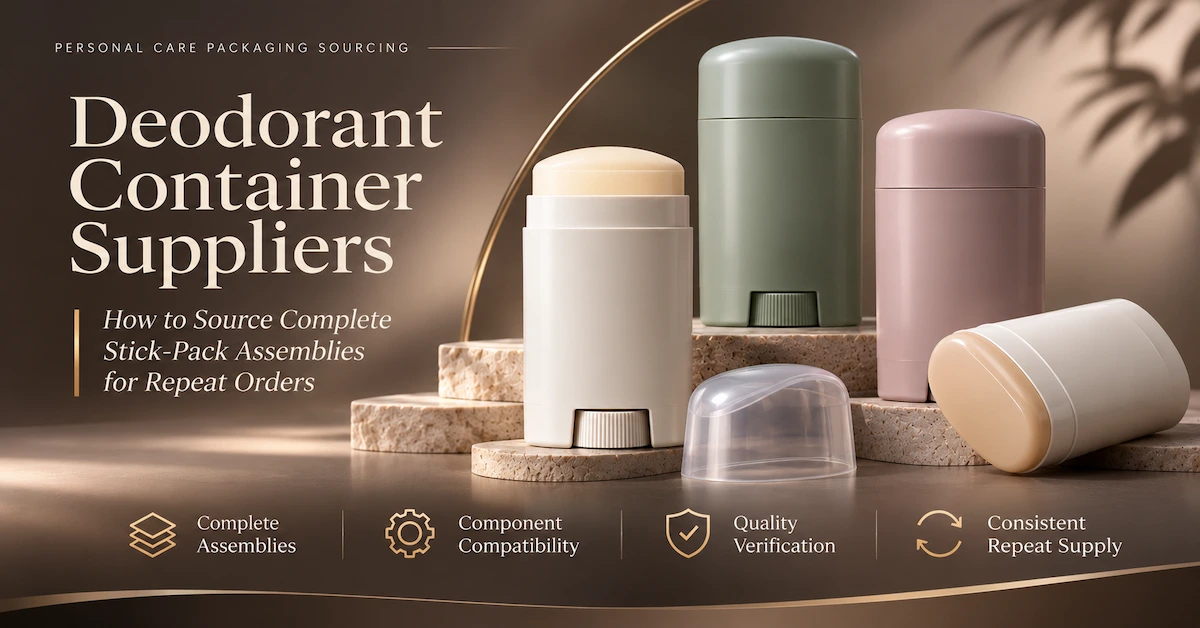
TL;DR: Reliable deodorant container suppliers should provide clearly specified packaging components, documented assembly responsibilities, compatible mechanisms, representative samples, and controlled repeat-order specifications. Personal care brands should evaluate the complete container system—including the body, cap, internal platform, rotating mechanism, and optional refill components—rather than comparing empty-container prices alone.
For personal care brands introducing solid deodorants, antiperspirant sticks, and private-label body-care products, packaging procurement is more complex than selecting an attractive container.
A deodorant stick package may contain several molded components that must work together. A small dimensional difference between the internal platform and outer body can affect dispensing. An incompatible screw mechanism may cause inconsistent product advancement. A replacement component from a different supplier may not fit an approved design.
These problems can create production delays, rejected packaging, and costly interruptions during repeat orders.
The most effective sourcing strategy is to establish one controlled packaging specification that identifies every critical component, its manufacturing responsibility, quality requirements, and replacement conditions.
COSME Packaging, operated by Zhejiang Cosme Industry Co., Ltd., provides cosmetic packaging development, mold development, plastic manufacturing, and OEM/ODM customization for international beauty and personal-care businesses.
This guide explains how to compare deodorant container suppliers, evaluate complete packaging assemblies, manage component-level purchasing risks, and establish a more reliable wholesale supply program.
Key Takeaways: What Should Buyers Verify Before Selecting a Supplier?
| Sourcing priority | Potential purchasing risk | Recommended verification |
|---|---|---|
| Complete component supply | Missing or incompatible parts | Approved bill of materials |
| Mechanical compatibility | Sticking or slipping mechanisms | Assembly and functional testing |
| Material consistency | Dimensional or compatibility variation | Material specifications |
| MOQ transparency | Unexpected minimum quantities | MOQ by component and color |
| Production responsibility | Unclear corrective-action ownership | Written responsibility agreement |
| Repeat-order continuity | Unapproved component substitutions | Engineering change control |
| Export delivery | Damaged or incomplete kits | Packing and shipping requirements |
For B2B procurement teams, a successful order means receiving complete, compatible packaging assemblies that meet approved specifications—not merely receiving the expected number of outer containers.
What Do Deodorant Container Suppliers Actually Provide?
Deodorant packaging suppliers may operate under different business models.
Some manufacture molded packaging components. Others distribute existing container designs or coordinate components from several production partners.
The available services may include standard containers, custom colors, logo decoration, mold development, assembly, and export packing.
However, these services should not be assumed from a supplier's company description alone.
Three Common Sourcing Models
| Sourcing model | Primary advantage | Main buyer responsibility |
|---|---|---|
| Complete packaging assembly | Potentially simplifies component coordination | Verify complete-kit specifications and quality responsibility |
| Separate component sourcing | Greater flexibility in selecting components | Manage compatibility, assembly, and incoming inspection |
| Custom packaging development | Supports proprietary packaging geometry | Control tooling, revisions, validation, and production approval |
When Is Complete-Assembly Sourcing Appropriate?
A complete-assembly arrangement can be useful when a brand needs a coordinated container body, cap, internal platform, and dispensing mechanism.
The buyer should confirm that the supplier accepts responsibility for delivering compatible components under the agreed specification.
When Is Separate Component Sourcing Appropriate?
Separate sourcing may suit established buyers with packaging engineering teams and established component specifications.
However, it increases the need for technical coordination.
If the body and mechanism come from different manufacturers, the buyer must establish who is responsible for verifying their compatibility.
The best supplier is not necessarily the company making the largest number of components. It is the supplier that can demonstrate appropriate control over the agreed finished package.
Which Components Must Be Included in a Deodorant Container Bill of Materials?
A Bill of Materials (BOM) identifies the individual parts needed to manufacture or assemble a packaging product.
For deodorant containers, BOM control is particularly important because several components may look similar while differing in dimensions or mechanical interfaces.
Deodorant Container Component Specification Table
| Component | Main function | Critical purchasing requirement |
|---|---|---|
| Outer body | Supports and protects the deodorant stick | Material, dimensions, geometry |
| Protective cap | Covers the product during storage and handling | Fit, retention, appearance |
| Internal platform | Supports and advances the solid product | Dimensions, retention, movement |
| Threaded spindle | Transfers rotation into platform movement | Thread geometry, material |
| Rotating base | Allows consumer operation | Fit, rotational resistance |
| Internal insert | Supports selected packaging architectures | Interface and material compatibility |
| Refill cartridge | Allows replacement in relevant designs | Repeated fit and replacement function |
| Decorative finish | Provides brand appearance | Artwork, color, adhesion |
| Export packaging | Protects components during shipment | Carton configuration, identification |
Not every container uses all these components.
For example, a push-up package may have a different mechanism from a twist-up system.
Buyers should request the actual BOM for the selected design instead of assuming that all deodorant stick containers share one structure.
Why Component Identification Matters
Each critical component should have an identifiable specification or drawing revision.
If a manufacturer changes a platform, cap, or rotating base, the buyer should be able to determine whether the new component remains compatible with the approved assembly.
This helps prevent unintended changes during repeat purchasing.
How Can Buyers Verify Twist-Up Mechanism Compatibility?
A twist-up mechanism is a functional system, not simply a decorative packaging feature.
Its performance depends on the interaction between molded components and the supported deodorant product.
Critical Mechanical Characteristics
Platform travel: The internal platform should move through the required dispensing range.
Rotational resistance: The base should operate without excessive force or uncontrolled movement.
Thread engagement: The spindle and corresponding mechanism must maintain appropriate engagement.
Component alignment: Parts should fit without unacceptable interference or instability.
Product retention: The finished stick must remain supported during normal use.
Suggested Functional Validation Matrix
| Test area | What to evaluate | Potential failure |
|---|---|---|
| Initial assembly | Component fit and alignment | Incorrect engagement |
| First rotation | Smooth mechanism activation | Excessive resistance |
| Platform movement | Consistent advancement | Sticking or uneven travel |
| Repeated operation | Function over intended use | Wear or slipping |
| Reverse movement | Behavior when rotated backward | Unexpected disengagement |
| Filled-product operation | Mechanism with the actual formulation | Jamming or product displacement |
| Storage conditioning | Function after relevant exposure | Dimensional interference |
Specific test limits should be established for the chosen design.
An empty container that advances smoothly does not automatically demonstrate acceptable performance after filling.
For a detailed discussion of filling temperatures, cooling shrinkage, and mechanism behavior, see COSME's Deodorant Container Hot-Fill Validation Guide.
How Do Plastic, PCR, and Refillable Deodorant Containers Compare?
Material and structure selection influence both packaging performance and procurement requirements.
COSME's Deodorant Containers category lists plastic deodorant containers, refillable packaging, and PCR deodorant packaging as product directions.
Deodorant Packaging Comparison
| Packaging direction | Main sourcing consideration | Verification priority |
|---|---|---|
| Conventional plastic container | Material and mechanism compatibility | Complete assembly specifications |
| PCR-containing container | Recycled material availability and consistency | PCR documentation and component suitability |
| Refillable container | Replaceable and reusable component interfaces | Repeated assembly and refill compatibility |
| Fully customized container | Structural design and tooling | Engineering validation and mold ownership |
Material Verification
Polypropylene and polyethylene are among the plastics commonly considered for personal-care packaging components.
However, suitability depends on the specific resin grade, geometry, manufacturing process, and formulation.
A supplier should identify the relevant materials rather than describe the entire assembly with a generic term such as "high-quality plastic."
PCR Packaging
For PCR-containing packaging, buyers should verify which components contain recycled material and the declared recycled-content percentage.
A recycled-content claim should not be applied to the entire package when it is supported only for one component.
Refillable Packaging
Refillable systems require coordination between the reusable housing and the replacement component.
Buyers should evaluate replacement fit, repeated-use durability, and future availability of compatible refills.
A refillable package creates a long-term component-supply requirement, not just an initial packaging order.
What Quality Tests Should Deodorant Container Suppliers Support?
Supplier qualification should evaluate both individual components and the complete assembled package.
Testing requirements depend on the selected packaging mechanism, formulation, and intended distribution environment.
Recommended Quality Control Checklist
| Inspection item | Recommended buyer requirement |
|---|---|
| Material identity | Confirm approved material specification |
| Component dimensions | Measure critical interfaces |
| Cap retention | Verify closure operation |
| Mechanism function | Assess advancement and rotational behavior |
| Platform retention | Confirm support of the filled product |
| Appearance | Inspect molding and decoration |
| Formula compatibility | Evaluate relevant product-contact materials |
| Repeated use | Assess the intended dispensing life |
| Transport protection | Inspect packed units after relevant testing |
| Batch identification | Maintain component and production traceability |
Incoming Quality Control
Incoming inspection should verify relevant components and materials before assembly or production.
For outsourced mechanisms, this may include checking critical dimensions and component identification.
In-Process Quality Control
Production inspection may focus on dimensions, appearance, component fit, and assembly characteristics.
Final Quality Control
The completed package should meet the agreed appearance and functional acceptance requirements.
ISO 2859-1:2026 provides an international framework for acceptance sampling by attributes and may be used when developing appropriate lot inspection plans.
However, acceptance sampling does not guarantee that every individual package is defect-free.
For distribution assessment, ASTM D4169-23e1 provides a framework for testing shipping containers and systems against representative distribution hazards.
The appropriate test methods and acceptance criteria should be agreed for the actual project.
These standards are purchasing references, not claims that COSME has completed specific deodorant-container tests or holds particular product certifications.
How Should Deodorant Container Samples Be Approved?
A professional sample approval process should progress from appearance review to technical and production validation.
Four Sample Approval Stages
| Stage | Main objective | Approval requirement |
|---|---|---|
| Initial sample | Review shape, appearance, and mechanism | Preliminary design acceptance |
| Technical sample | Verify material, dimensions, and component fit | Engineering review |
| Filled-product sample | Evaluate the actual formulation and filling process | Functional and compatibility results |
| Pre-production sample | Confirm production-representative configuration | Approved reference and specifications |
Why Production-Representative Samples Matter
Prototype components may be produced under different conditions from commercial manufacturing.
The final approval should therefore consider components representative of the intended production process.
This is especially important for molded interfaces and moving mechanisms.
Establish a Controlled Reference
The approved packaging configuration should be supported by drawings, material specifications, artwork, and relevant test criteria.
A physical reference sample is useful, but it does not replace measurable specifications.
How Do MOQ and Component Purchasing Affect Total Packaging Cost?
Minimum Order Quantity (MOQ) may differ between the container body, cap, mechanism, colors, and decorative components.
Therefore, a supplier's quoted MOQ for the outer container may not represent the minimum quantity for a complete finished assembly.
Complete-Kit Cost Comparison
| Cost element | What buyers should verify |
|---|---|
| Outer container | Material, size, color |
| Cap | Included or separately priced |
| Internal platform | Included specification and quantity |
| Screw mechanism | Included components and assembly |
| Custom decoration | Printing and finishing charges |
| Tooling | New molds and modifications |
| Assembly | Responsibility and labor charges |
| Inspection | Included or separately charged |
| Export packing | Protective packaging and carton configuration |
| Freight | Agreed delivery terms |
Calculate Cost Per Usable Complete Kit
A practical purchasing calculation is:
Cost per accepted complete kit = Total relevant packaging procurement costs ÷ Number of accepted complete kits
This provides a more meaningful comparison than bottle-body unit prices alone.
Why MOQ Should Be Confirmed by Configuration
A brand ordering three custom colors may face separate production minimums.
Similarly, a special cap or custom mechanism may have different purchasing requirements from the outer housing.
Buyers should therefore request MOQ information for every critical configuration.
COSME does not publish a verified universal MOQ for deodorant container projects. Available commercial terms must be confirmed through a project-specific quotation.
How Can Brands Prevent Component Shortages During Repeat Orders?
A successful first shipment does not guarantee uninterrupted future supply.
Packaging components can become unavailable because of material changes, production scheduling, tooling modifications, or supplier substitutions.
Repeat-Order Supply Controls
1. Maintain an approved BOM. Identify all required components and their current specification revisions.
2. Forecast component demand. Plan purchasing according to finished-product production schedules.
3. Confirm critical component lead times. Do not assume that every component follows the same production schedule.
4. Establish change-notification requirements. Important material or tooling modifications should be reviewed before supply.
5. Control replacement components. Alternative parts should be validated rather than substituted solely because they look similar.
Supplier Change-Control Matrix
| Proposed change | Potential risk | Recommended buyer action |
|---|---|---|
| Outer-body resin change | Dimensional or compatibility variation | Review material and sample information |
| Platform modification | Different product movement | Revalidate the mechanism |
| Screw component substitution | Engagement or travel differences | Test complete assembly |
| Cap redesign | Different retention behavior | Approve replacement samples |
| Color masterbatch change | Appearance variation | Confirm color reference |
| Tooling modification | Dimensional differences | Verify affected interfaces |
| Manufacturing-source change | Production and quality variation | Review relevant supplier controls |
For long-term private-label deodorant programs, component continuity can be as important as the initial unit price.
Application Scenario: Sourcing Packaging for Two Deodorant Product Lines
The following is a hypothetical procurement example, not a documented COSME customer project.
Buyer Requirements
A personal care brand plans to launch two deodorant products:
-
A conventional solid deodorant with twist-up packaging.
-
A refill-oriented deodorant range using replaceable components.
Both products need coordinated branding and dependable supply for future orders.
Main Purchasing Challenge
The initial designs may share visual features but require different internal components.
A supplier may quote the outer containers without including all dispensing and refill components.
Recommended Procurement Approach
The buyer should establish separate BOMs for each product, then determine whether any approved components can be shared.
For each configuration, the purchasing team should confirm:
-
Complete component specifications.
-
Assembly responsibility.
-
Available material and decoration options.
-
Technical and filled-product sample requirements.
-
MOQ and tooling charges.
-
Reorder and replacement-component arrangements.
Expected Decision
The buyer should select a supply arrangement that provides acceptable technical compatibility, clear commercial terms, and documented responsibility for the finished package.
The scenario illustrates a sourcing method. It does not establish actual defect rates, savings, or production outcomes.
Why Consider COSME Packaging for Deodorant Packaging Sourcing?
COSME Packaging, operated by Zhejiang Cosme Industry Co., Ltd., is a China-based cosmetic packaging company established in 2015.
According to its published company information, COSME operates an approximately 15,000-square-meter facility with around 200 employees.
Its general packaging capabilities include:
-
R&D and product development: Support for packaging concepts and engineering.
-
Mold development: 3D drawings, CNC prototypes, tooling, and trial samples.
-
Plastic manufacturing: Injection- and blow-molding operations.
-
OEM/ODM customization: Colors, logos, selected structures, and decorative finishing.
-
Quality management: Incoming inspection, dimensional checks, appearance control, and production records.
COSME's website includes categories for plastic, refillable, and PCR deodorant containers.
However, the main deodorant category currently does not display individually verified product listings. Therefore, buyers should confirm available designs, actual manufacturing scope, tooling feasibility, materials, component sourcing, and technical testing before assuming a particular configuration is available.
The published company-level manufacturing capabilities do not automatically establish that every deodorant mechanism is produced in-house.
You can learn more about COSME's company and manufacturing capabilities and review its Deodorant Containers product category.
What Should You Include in a Deodorant Container Supplier RFQ?
A detailed Request for Quotation helps manufacturers and suppliers evaluate the complete project.
Deodorant Packaging RFQ Checklist
| Information | Details to provide |
|---|---|
| Buyer type | Personal care brand, OEM factory, distributor |
| Product format | Solid stick, balm, gel, or another formulation |
| Container design | Twist-up, push-up, refillable, or custom |
| Target fill | Net product weight and relevant dimensions |
| Material | Preferred resin or performance requirements |
| Components | Body, cap, platform, screw, rotating base |
| Decoration | Colors, artwork, logos, finishes |
| Formula and filling | Relevant compatibility and processing conditions |
| Quantity | Initial order and annual demand forecast |
| MOQ requirements | Minimums by assembly and component |
| Quality requirements | Samples, dimensions, function, compatibility |
| Supply arrangements | Complete kits, separate components, or custom development |
| Delivery | Destination and target purchasing schedule |
Request a Complete Packaging Proposal
When comparing suppliers, ask whether the quotation covers the complete packaging assembly.
Clarify which components are manufactured internally, which may be externally sourced, and who is responsible for compatibility and quality.
For refillable designs, request separate commercial information for the initial complete package and future replacement components.
If you are sourcing deodorant stick containers for a personal care brand or OEM project, contact COSME Packaging with your specifications, expected quantities, and customization requirements to discuss available packaging options and request a project-specific quotation.
Frequently Asked Questions About Deodorant Container Suppliers
1. How do I choose reliable deodorant container suppliers?
Evaluate their relevant products, manufacturing responsibilities, component specifications, sample approval procedures, quality records, and repeat-order controls. A supplier should demonstrate that the proposed complete packaging system meets your requirements.
2. Can suppliers provide complete deodorant stick containers with all components?
Some suppliers can coordinate complete assemblies, including bodies, caps, platforms, and dispensing mechanisms. Buyers should confirm the exact component scope and manufacturing responsibilities before ordering.
3. What is the typical MOQ for wholesale deodorant containers?
MOQ depends on the design, material, colors, decoration, tooling, and component requirements. COSME does not publish one universal MOQ for every deodorant packaging configuration. Request a project-specific quotation.
4. What is the difference between twist-up and push-up deodorant packaging?
Twist-up systems use a rotating mechanism to advance the product, while push-up designs generally rely on manual movement of a support platform. The appropriate choice depends on the formula, user experience, and packaging requirements.
5. Can deodorant containers be customized with my brand logo?
Packaging customization may include color matching, logo printing, surface decoration, and selected structural changes. Available services should be confirmed for the proposed material and design.
6. What quality tests should I request for deodorant stick containers?
Relevant tests may include component fit, mechanism operation, material compatibility, filled-product stability, cap retention, repeated use, and transport evaluation. Acceptance criteria should be agreed before production.
7. Are PCR deodorant containers available for private-label brands?
PCR-containing packaging is a product direction listed by COSME. Specific available configurations, recycled-content percentages, component suitability, and commercial availability must be confirmed through inquiry.
8. How can I prevent mechanism problems in bulk deodorant packaging?
Approve complete assemblies, verify critical component dimensions, test the mechanism with the actual filled product, and control changes to internal components during repeat production.
9. What should I do if a supplier changes a deodorant container component?
Request the updated specification, identify the affected interface, and evaluate whether new testing or sample approval is necessary. Critical component substitutions should not be accepted without suitable review.
10. How can I request deodorant container samples from COSME Packaging?
Provide your product type, preferred packaging mechanism, target fill weight, material requirements, artwork, estimated purchasing quantity, and technical needs. COSME can then discuss available designs, development possibilities, and relevant sample arrangements.
Conclusion
Choosing reliable deodorant container suppliers requires more than comparing product appearance, quoted unit prices, or advertised customization capabilities.
For personal care brands, cosmetic OEM/ODM manufacturers, and packaging distributors, the real purchasing challenge is coordinating the complete packaging assembly and maintaining compatibility across production and repeat orders.
Outer bodies, protective caps, internal platforms, screw mechanisms, and optional refill components should be controlled through clear specifications, approved samples, and defined supplier responsibilities.
A structured sourcing process should also address MOQ by component, complete-kit costs, technical validation, quality inspection, and procedures for managing engineering changes.
By treating deodorant packaging as a coordinated component system, buyers can reduce avoidable sourcing problems and establish more dependable long-term supply arrangements.
With its published capabilities in cosmetic packaging development, mold manufacturing, plastic processing, customization, and quality management, COSME Packaging is a potential partner for international personal care packaging projects.
Whether you are developing conventional twist-up deodorant packaging, exploring refillable container concepts, or sourcing customized packaging for repeat orders, contact COSME Packaging with your component specifications, design references, and purchasing forecast to discuss suitable packaging solutions and request a tailored quotation.