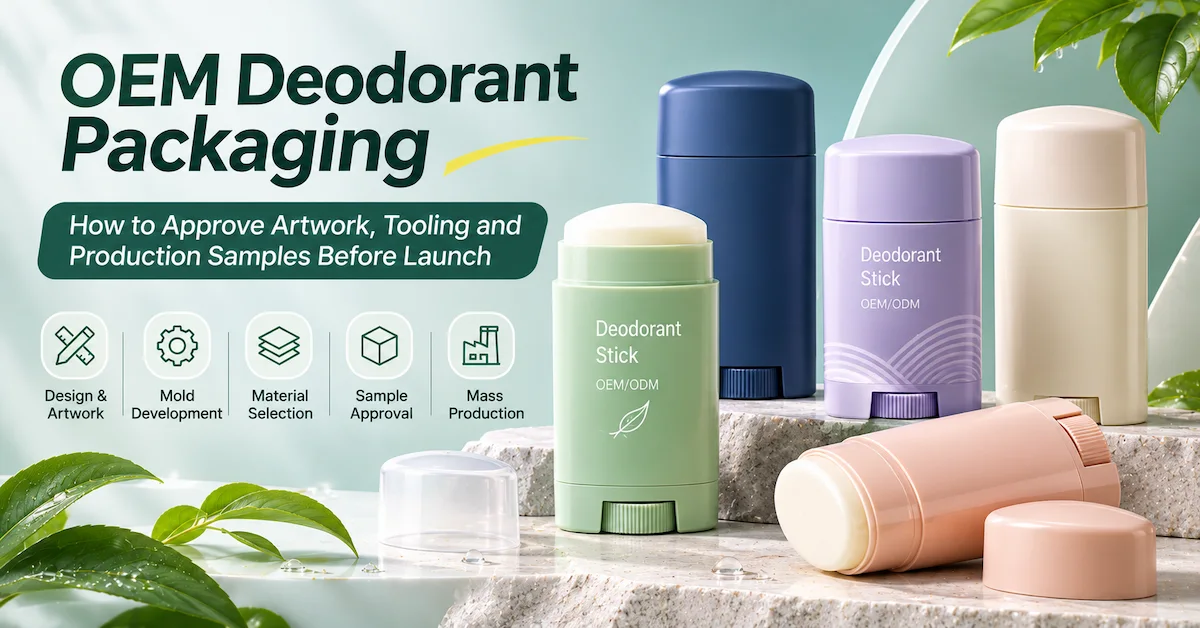

TL;DR: A reliable deodorant stick container manufacturer should help personal care brands evaluate how the complete dispensing mechanism performs throughout the product's intended use. Critical factors include rotation torque, elevator travel, platform alignment, product retention, and repeated-use durability. Before mass production, buyers should validate these characteristics using representative filled containers and agreed acceptance criteria.
A deodorant stick container may look simple from the outside, but its mechanical performance depends on several precisely interacting components.
For personal care brands, contract manufacturers, and private-label developers, one of the most frustrating packaging failures occurs when consumers cannot advance the remaining deodorant smoothly.
The rotating base may become difficult to turn. The internal platform may tilt or slip. The product may move unevenly, break away from its support, or remain trapped inside the container.
Such failures can affect consumer satisfaction, create complaints, and increase the cost of rejected packaging.
The key to dependable deodorant stick packaging is validating mechanical performance across the complete consumer-use cycle—not simply confirming that an empty container rotates correctly.
COSME Packaging, operated by Zhejiang Cosme Industry Co., Ltd., provides cosmetic packaging development, plastic manufacturing, mold development, and OEM/ODM customization services for international beauty and personal-care brands.
This guide explains the engineering principles behind twist-up deodorant packaging, identifies critical testing parameters, and helps B2B buyers prepare production-ready specifications.
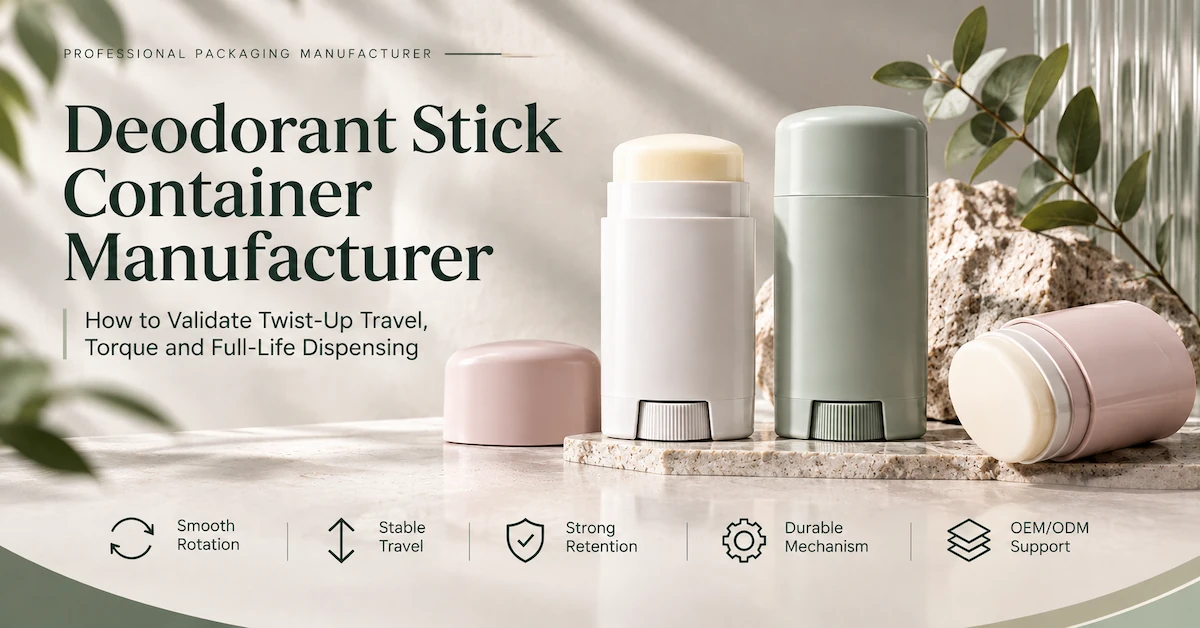
Key Takeaways: What Makes a Deodorant Stick Container Reliable?
| Engineering factor | Potential failure | Recommended validation |
|---|---|---|
| Rotation torque | Difficult or excessively loose twisting | Measure operating torque |
| Elevator travel | Inconsistent stick advancement | Verify axial movement |
| Thread engagement | Slipping or disengagement | Inspect the screw-platform interface |
| Platform alignment | Tilted or jammed stick | Check movement and dimensional fit |
| Product retention | Stick separates from platform | Evaluate filled-product support |
| Repeated-use durability | Premature mechanism failure | Perform representative use-cycle testing |
| End-of-life dispensing | Excessive remaining product | Evaluate usable product recovery |
Core engineering principle: A reliable twist-up container must convert consumer rotation into predictable product advancement while maintaining mechanical stability throughout the intended service life.
What Does a Deodorant Stick Container Manufacturer Need to Control?
A deodorant stick container manufacturer may participate in product design, mold development, molded-component production, assembly, and decoration.
However, the exact manufacturing responsibilities depend on the supplier and the proposed packaging design.
For a conventional twist-up system, the functional assembly may include:
-
Outer container body.
-
Rotating base.
-
Threaded spindle or drive mechanism.
-
Internal elevator platform.
-
Product-retention features.
-
Protective cap.
-
Relevant alignment and supporting components.
Each component must interact correctly with the others.
Why Component-Level Quality Is Not Enough
A threaded spindle may meet its individual dimensional specification, and the elevator platform may also appear acceptable.
However, the completed mechanism can still experience excessive friction or alignment problems.
This occurs because functional performance depends on the interfaces between components, not just isolated dimensions.
A professional packaging approval process should therefore include both component inspection and completed-assembly testing.
How Does a Twist-Up Deodorant Stick Mechanism Work?
A conventional twist-up mechanism converts rotation at the container base into vertical movement of an internal platform.
As the consumer rotates the base, the drive mechanism advances the platform and exposes more deodorant above the container opening.
The exact mechanical arrangement varies by design.
Rotation-to-Travel Relationship
For a conventional lead-screw mechanism, theoretical axial travel can be estimated using:
Platform travel = Number of revolutions × Screw lead
Screw lead is the axial movement corresponding to one complete revolution.
For a single-start thread, lead equals pitch. For a multi-start thread, the lead is the pitch multiplied by the number of thread starts.
Actual platform movement may differ because of backlash, deformation, engagement, or other mechanical effects.
Illustrative Engineering Example
Suppose a proposed mechanism has a theoretical lead of 1.0 mm per revolution.
Three complete rotations would produce a theoretical platform advancement of 3.0 mm.
This is only a mechanical illustration, not a specification for a COSME deodorant container.
Actual movement should be measured on representative assemblies.
Why Travel Rate Matters
If the platform advances too quickly, consumers may expose more product than intended.
If advancement is excessively slow, dispensing may feel inconvenient.
The appropriate movement rate depends on product dimensions, formulation behavior, and the intended application experience.
Buyers should request the proposed mechanism's travel characteristics rather than assume all twist-up containers behave identically.
Which Mechanical Specifications Should Buyers Confirm?
A production-ready technical specification should include both dimensional and operational requirements.
Deodorant Stick Mechanism Specification Table
| Parameter | What to define | Engineering importance |
|---|---|---|
| Container dimensions | Height, width, internal geometry | Product fit and handling |
| Platform travel | Required axial movement | Usable dispensing range |
| Screw lead | Theoretical movement per revolution | Advancement rate |
| Rotation torque | Permitted operating resistance | Consumer usability |
| Initial breakaway torque | Force needed to begin rotation | First-use experience |
| Platform alignment | Acceptable tilt or movement variation | Smooth advancement |
| Thread engagement | Required engagement and retention | Prevents mechanism failure |
| Reversal behavior | Movement during reverse rotation | Controlled operation |
| Product retention | Support of the actual deodorant stick | Prevents separation |
| End-of-travel behavior | Mechanism response near travel limits | Prevents jamming or damage |
Not every design will use all these parameters in the same way.
The supplier and buyer should establish measurable requirements appropriate to the chosen mechanism.
How Should Twist Torque Be Tested?
Twist torque is a key functional characteristic of rotating deodorant packaging.
It describes the rotational resistance encountered when operating the mechanism.
A container with excessive torque may feel difficult to use.
A mechanism with insufficient resistance may be more susceptible to unintended movement, depending on its construction.
Initial Breakaway Torque
Initial breakaway torque is the torque required to begin movement from rest.
It may differ from the torque needed to maintain continuous movement.
Buyers should evaluate whether the rotating base can be operated comfortably under the intended conditions.
Running Torque
Running torque is measured while the mechanism is moving.
It can help identify changes in friction or mechanical engagement across the travel range.
Torque Variation Across Platform Travel
Torque should not necessarily be evaluated at only one platform position.
A useful testing procedure can examine operation near the beginning, middle, and end of the intended movement range.
This can reveal differences that a single rotation test may miss.
Suggested Torque Testing Conditions
| Test condition | Evaluation objective |
|---|---|
| Empty assembly | Establish baseline mechanism behavior |
| Filled container | Evaluate resistance under actual product load |
| Initial platform position | Assess first-use operation |
| Mid-travel position | Assess normal repeated operation |
| Near end of travel | Detect end-range resistance |
| After storage conditioning | Evaluate relevant environmental effects |
| After repeated use | Identify possible wear or performance changes |
Use a suitable torque measurement method and define the gripping arrangement, rotational speed, sample conditioning, and reporting units.
There is no universal torque value that should be claimed as suitable for every deodorant stick container. Acceptance limits must be established through product-specific engineering and usability evaluation.
What Causes Twist-Up Deodorant Mechanisms to Jam or Slip?
Mechanical failure can result from several interacting factors.
Understanding the possible failure mechanisms helps brands select more useful tests.
Dimensional Interference
If the moving platform or internal mechanism does not have suitable clearance, friction may increase.
Relevant causes can include dimensional variation, deformation, or assembly misalignment.
Thread Engagement Problems
An incorrectly matched spindle and platform interface may create uneven movement, slipping, or disengagement.
These issues can become more apparent near the ends of the travel range.
Formula-Related Resistance
The actual deodorant formulation may influence the load applied to the moving platform.
A product that is firmly retained or experiences excessive friction against the container wall may require greater operating torque.
Component Wear
Repeated rotation may affect mechanical interfaces.
Wear or deformation can change the feel and reliability of the dispensing mechanism.
Failure Analysis Matrix
| Observed failure | Possible contributing factor | Recommended investigation |
|---|---|---|
| Difficult twisting | Excessive friction or product resistance | Measure torque and inspect clearances |
| Platform does not advance | Drive engagement failure | Inspect screw and platform connection |
| Irregular advancement | Alignment or dimensional variation | Measure travel across rotations |
| Platform tilts | Inadequate guidance or unequal loading | Inspect internal support |
| Stick becomes loose | Inadequate product retention | Evaluate filled-product interface |
| Mechanism fails near the end | End-stop interference or component damage | Review full-travel behavior |
These are possible engineering causes, not verified defects in any particular COSME product.
The actual cause should be established through inspection and repeatable testing before corrective action.
How Can Manufacturers Improve Dimensional Consistency?
Mechanical performance depends partly on maintaining appropriate dimensions across molded components.
For plastic container systems, material behavior, part geometry, tooling condition, and processing can affect dimensional accuracy.
Critical-to-Quality Dimensions
Particular attention may be required for:
-
Spindle diameter and thread geometry.
-
Elevator platform engagement.
-
Internal body clearance.
-
Alignment and guide features.
-
Rotating-base interface.
-
Mechanical travel limits.
ISO 20457:2026, Plastics Moulded Parts — Tolerances and Acceptance Conditions, provides a framework for dimensional and geometrical tolerances for specified plastic molding processes.
It can support engineering discussions about functionally necessary tolerances and realistic manufacturing capability.
However, the standard is not a substitute for validating the finished dispensing mechanism.
Why Tolerance Stack-Up Matters
Several components may each meet their individual dimensions while their combined variation affects assembly performance.
Consequently, manufacturers should evaluate the interaction between critical parts.
The appropriate approach depends on material flexibility, component geometry, and loading.
For plastic assemblies, simplified rigid-part tolerance calculations may not fully describe real behavior.
The objective is not to impose extremely tight tolerances everywhere, but to control the dimensions that materially influence dispensing.
Why Should Deodorant Stick Containers Be Tested Throughout Their Usable Life?
A consumer does not operate a deodorant container only once.
The mechanism may be adjusted repeatedly as the product is used.
A reliable package should therefore maintain acceptable function throughout its intended use.
Beginning-of-Life Testing
Evaluate initial rotation, cap operation, and first product advancement.
Confirm that the user can begin dispensing without unusual force or mechanism problems.
Middle-of-Life Testing
Evaluate repeated advancement and retraction where the design permits it.
Monitor operational resistance, platform stability, and product retention.
End-of-Life Testing
Examine whether the mechanism continues operating near its intended final position.
Record any jamming, slipping, product instability, or unusable residual product.
Full-Life Mechanism Testing Matrix
| Test stage | Main evaluation |
|---|---|
| First operation | Initial rotation and advancement |
| Early use | Mechanism engagement and product support |
| Mid-life operation | Torque consistency and platform stability |
| Repeated cycling | Wear and functional reliability |
| Near end of travel | Movement and end-stop behavior |
| Final usable position | Remaining product and dispensing access |
The number of test cycles should reflect the actual product design and expected user behavior.
An arbitrary cycle count does not automatically demonstrate durability.
Why Filled Samples Matter
An empty mechanism may operate differently from one containing the actual deodorant formulation.
For final validation, buyers should use representative filled containers whenever relevant.
How Do You Measure Usable Product Recovery?
Consumers may become dissatisfied when substantial deodorant remains inaccessible inside the container.
A packaging development team can evaluate the amount of product available through the intended dispensing process.
One possible calculation is:
Usable recovery (%) = Dispensed usable product mass ÷ Initial filled product mass × 100
The test protocol must define how dispensed and residual product are measured.
Results depend on the formulation, product geometry, user procedure, and mechanism.
Why Recovery Matters for Brands
Excessive residual product can affect perceived value and packaging efficiency.
However, a high recovery percentage should not come at the expense of unstable dispensing or inadequate product support.
The goal is a balanced design that provides reliable operation throughout the product's intended use.
How Should Buyers Approve OEM Deodorant Stick Packaging?
A custom project should progress through documented engineering and sample approval stages.
COSME publishes general capabilities in packaging design, 3D drawings, CNC sampling, mold development, and OEM/ODM manufacturing.
The specific development arrangements for deodorant stick packaging must be confirmed separately.
Recommended Development Workflow
| Stage | Main activity | Buyer approval |
|---|---|---|
| Concept selection | Confirm structure and desired consumer experience | Design brief |
| Engineering review | Evaluate components and mechanism geometry | Technical drawings |
| Prototype evaluation | Review rotation and physical appearance | Sample feedback |
| Tooling development | Prepare applicable production molds | Tooling approval |
| Trial assembly | Evaluate molded components | Dimensional and fit results |
| Filled-product validation | Evaluate the actual deodorant formula | Functional test results |
| Pilot production | Check production consistency | Approved reference samples |
| Bulk manufacturing | Apply agreed process and quality controls | Production records |
Approved Reference Samples
An approved sample should be linked to relevant drawings, materials, component specifications, and functional acceptance criteria.
A physical sample alone may not adequately define critical dimensions or mechanism requirements.
Production Quality Inspection
A quality plan should address relevant molded-component dimensions, visual defects, assembly performance, and mechanical operation.
ISO 2859-1:2026 provides acceptance sampling schemes for inspection by attributes and may be used when establishing agreed batch inspection procedures.
It does not establish universal torque or travel acceptance limits.
Specific mechanism-testing requirements should be documented separately.
Application Example: Evaluating a Twist-Up Stick for a New Personal Care Brand
The following scenario is illustrative and does not represent a documented COSME customer case.
Project Background
A personal care brand is developing a premium solid deodorant in a twist-up container.
The brand wants smooth adjustment, a stable stick, and a consistent consumer experience.
Engineering Challenge
The first empty samples rotate smoothly.
However, the purchasing team needs to determine whether the same performance will continue after the product is filled and repeatedly used.
Recommended Validation
The team requests:
-
Component drawings and material information.
-
Initial and running torque measurements.
-
Platform movement measurements across the usable range.
-
Filled-product retention evaluation.
-
Representative repeated-use testing.
-
Post-conditioning functional testing.
-
Approved production samples and inspection requirements.
Purchasing Decision
The packaging should be approved only after the relevant technical and commercial requirements have been satisfied.
An attractive empty prototype is not sufficient evidence of full-life dispensing performance.
This approach reduces uncertainty before tooling approval and bulk purchasing without assuming any unverified performance results.
How Do Mechanical Requirements Influence Packaging Costs?
Deodorant packaging cost depends on the complete design, not simply the outer container.
More complex mechanisms may involve additional components, tooling, assembly, and validation.
Cost and Performance Considerations
| Design factor | Cost consideration | Functional consideration |
|---|---|---|
| Screw mechanism | Component and tooling complexity | Travel and torque |
| Elevator platform | Mold and assembly requirements | Product support |
| Container geometry | Tooling and material usage | Ergonomics and stability |
| Material grade | Material and processing cost | Mechanical behavior |
| Decoration | Printing and finishing | Brand appearance |
| Quality testing | Development and inspection effort | Functional reliability |
| Production quantity | Manufacturing efficiency | Repeat-order planning |
For an existing design, some development activities may be reduced.
A new mechanism may require additional engineering and tooling investment.
Buyers should compare complete packaging proposals and validate the intended performance before making a final sourcing decision.
Why Consider COSME Packaging for Deodorant Stick Container Development?
COSME Packaging, operated by Zhejiang Cosme Industry Co., Ltd., is a China-based cosmetic packaging manufacturer founded in 2015.
According to its official company information, COSME operates an approximately 15,000-square-meter facility with around 200 employees.
Its published capabilities include:
-
Packaging R&D and product development.
-
3D engineering and mold development.
-
Plastic injection and blow molding.
-
Color customization and decorative finishing.
-
OEM/ODM packaging services.
-
Incoming material and manufacturing quality inspections.
-
Batch-related quality records.
COSME lists Plastic Deodorant Containers, Refillable Deodorant Bottles, and PCR Deodorant Bottles in its product catalog.
However, the Deodorant Containers category currently does not display verified individual product listings.
Therefore, buyers should confirm available designs, actual component manufacturing responsibilities, materials, tooling feasibility, and testing arrangements before proceeding.
Explore COSME's company and manufacturing information for more details about its published packaging capabilities.
What Should You Include in a Deodorant Stick Container RFQ?
A complete technical inquiry should communicate the intended dispensing performance as well as the packaging appearance.
Deodorant Stick Packaging RFQ Checklist
| Requirement | Information to provide |
|---|---|
| Product format | Solid deodorant or other stick formulation |
| Mechanism | Twist-up design or required dispensing architecture |
| Target fill | Net product weight and formula characteristics |
| Container dimensions | Desired height, width, and internal geometry |
| Rotation behavior | Desired consumer-use characteristics |
| Platform movement | Required usable travel |
| Materials | Preferred product-contact and structural materials |
| Filling process | Relevant filling and cooling conditions |
| Decoration | Color, logo, and surface finish |
| Testing | Torque, travel, retention, durability |
| Initial quantity | Expected first order |
| Annual demand | Estimated repeat purchasing volume |
| Commercial requirements | MOQ, tooling, samples, and delivery |
Request a Technical OEM Packaging Review
For a meaningful quotation, provide reference designs, relevant formulation data, target dimensions, and expected purchasing quantities.
Where possible, specify whether an existing mechanism can be considered or whether new structural development is required.
If you are developing a new solid deodorant range, contact COSME Packaging to discuss potential packaging options, design feasibility, sample requirements, and project-specific OEM/ODM terms.
Frequently Asked Questions About Deodorant Stick Container Manufacturing
1. What is the most important feature of a twist-up deodorant container?
The mechanism should advance the deodorant predictably while maintaining acceptable operating resistance, product support, and mechanical stability throughout intended use.
2. How is twist-up deodorant container torque measured?
Torque can be evaluated using a suitable rotational measurement instrument or validated test setup. Conditions should define rotational speed, sample preparation, platform position, and acceptable results.
3. What determines the amount of stick advancement per rotation?
For a conventional lead-screw mechanism, theoretical advancement depends on screw lead and the number of rotations. Actual movement must be verified because mechanical design and component behavior may affect performance.
4. Why does a deodorant stick container become difficult to twist?
Possible causes include excessive friction, dimensional interference, product resistance, component deformation, or thread engagement problems. The actual cause should be identified through testing.
5. Should twist-up mechanisms be tested with empty or filled containers?
Both can be useful. Empty-container testing establishes baseline mechanical behavior, while representative filled-product testing helps verify performance under the intended application conditions.
6. How can a manufacturer prevent an elevator platform from jamming?
Manufacturers should evaluate critical dimensions, component alignment, material behavior, and assembly conditions. Representative functional testing helps identify potential interference.
7. What is the typical MOQ for custom deodorant stick containers?
MOQ depends on design, materials, tooling, decoration, and production requirements. COSME does not publish one verified universal MOQ for every deodorant container configuration.
8. Can deodorant stick containers be customized with brand colors and logos?
COSME provides general OEM/ODM capabilities involving colors, printing, and packaging decoration. The availability of specific custom stick-container designs and finishes must be confirmed for each project.
9. How do I verify durability before bulk production?
Establish an agreed test program covering initial operation, repeated use, movement across the usable travel range, and relevant storage conditions. Use representative samples and documented acceptance criteria.
10. How can I request custom deodorant stick packaging from COSME?
Submit the desired packaging structure, product formulation, target fill weight, material preferences, functional requirements, artwork, expected quantity, and relevant testing needs through the company's contact page.
Conclusion
Selecting a reliable deodorant stick container manufacturer requires more than choosing an attractive packaging design or comparing quoted unit prices.
For personal care brands and cosmetic OEM/ODM manufacturers, the most important requirement is ensuring that the dispensing mechanism performs consistently throughout the product's intended life.
Rotation torque, screw lead, elevator travel, platform alignment, product retention, and repeated-use durability should be evaluated together rather than as isolated components.
A structured engineering process that includes controlled specifications, representative filled samples, appropriate mechanical testing, and documented production approval helps reduce avoidable packaging failures.
COSME Packaging provides published capabilities in cosmetic packaging R&D, mold development, plastic manufacturing, customization, and quality control that can support discussions about deodorant packaging development.
Whether you are developing a premium solid deodorant collection, improving a twist-up dispensing design, or preparing for bulk production, contact COSME Packaging with your packaging specifications and functional requirements to discuss feasible solutions, technical sampling, and a tailored quotation.