
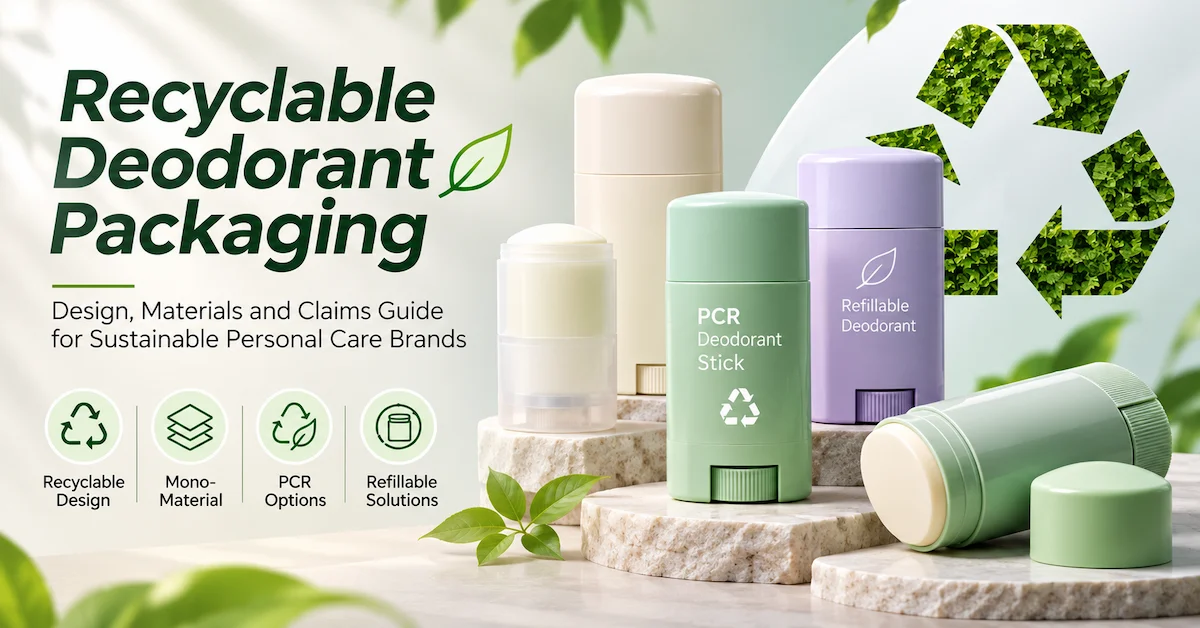
TL;DR: Effective recyclable deodorant packaging requires a complete packaging design that is compatible with relevant collection, sorting, and recycling systems. Personal care brands should evaluate the container body, cap, internal mechanism, labels, additives, and residual deodorant before making environmental claims. Mono-material construction, compatible components, and simplified decoration can support recycling-oriented design, but actual recyclability must be verified for the intended market.
For personal care brands, sustainable packaging is becoming an important consideration in product development and purchasing decisions.
However, designing a deodorant container for recycling is more complicated than replacing virgin plastic with recycled plastic.
A conventional twist-up deodorant container may include several molded components, a rotating base, an internal elevator platform, a threaded spindle, decorative finishes, and adhesive labels.
Even when the outer body is made from a commonly recycled polymer, other components may interfere with sorting or material recovery.
The most effective approach is to design the complete deodorant packaging system around a defined recycling pathway while maintaining formulation compatibility, dispensing performance, and manufacturing feasibility.
COSME Packaging, operated by Zhejiang Cosme Industry Co., Ltd., provides cosmetic packaging development, mold manufacturing, material selection, and OEM/ODM customization services for international beauty and personal care brands.
This guide explains how buyers can develop recycling-oriented deodorant packaging, evaluate different structural options, verify environmental claims, and prepare a technically complete sourcing inquiry.
Key Takeaways: What Makes Deodorant Packaging Suitable for Recycling?
| Design factor | Potential recycling concern | Recommended approach |
|---|---|---|
| Material composition | Incompatible polymer combinations | Evaluate mono-material or compatible structures |
| Internal mechanism | Difficult-to-separate components | Simplify component architecture |
| Container color | Sorting difficulties | Select suitable detectable pigments |
| Labels and adhesives | Contamination of recycling streams | Evaluate material and adhesive compatibility |
| Decorative finishes | Interference with sorting or reprocessing | Review coatings and metallic decoration |
| Product residue | Excess remaining deodorant | Improve usable product recovery |
| PCR content | Unverified environmental claims | Request recycled-content documentation |
| Market infrastructure | Limited collection or recycling access | Verify destination-market conditions |
Core design principle: A recyclable material does not automatically make the complete deodorant container recyclable.
1. What Is Recyclable Deodorant Packaging?
Recyclable deodorant packaging refers to packaging that can be recovered and processed through an appropriate established recycling system.
The assessment should consider more than the principal container material.
It includes the complete packaging configuration, its physical dimensions, component composition, decoration, and expected condition after consumer use.
Three Requirements for Practical Recyclability
A recycling-oriented packaging design should address three questions:
-
Can the empty package be collected through an available recycling program?
-
Can the package be correctly identified and sorted into an appropriate material stream?
-
Can its materials and components be reprocessed without unacceptable interference?
A container that satisfies material compatibility requirements may still face limitations if suitable collection or sorting infrastructure is unavailable.
Who Should Consider Recycling-Oriented Deodorant Packaging?
| B2B buyer | Main purchasing objective |
|---|---|
| Personal care brands | Develop packaging with substantiated environmental attributes |
| Private-label deodorant businesses | Introduce differentiated packaging designs |
| Cosmetic OEM/ODM manufacturers | Coordinate packaging materials with production requirements |
| Packaging distributors | Offer documented recycling-oriented packaging options |
| Sustainability and procurement teams | Evaluate material composition and environmental claims |
Brands seeking an immediate launch without material documentation or functional validation may need to reconsider their development schedule before introducing environmental claims.
2. Recyclable vs. Recycled vs. Refillable Deodorant Packaging
These three packaging concepts are frequently confused, although they describe different characteristics.
Recyclable Packaging
Recyclability concerns what happens to a package after use.
It depends on material compatibility, packaging construction, and available waste-management infrastructure.
Recycled-Content Packaging
Recycled-content packaging incorporates materials recovered from a waste stream.
Post-consumer recycled plastic, commonly known as PCR, is one example.
However, the presence of PCR does not automatically establish that the resulting container is recyclable.
Refillable Packaging
Refillable packaging is designed to support replenishment of the product while retaining selected packaging components.
For deodorant sticks, this may involve a reusable outer housing and replaceable internal cartridge.
Sustainable Packaging Concept Comparison
| Packaging concept | Primary objective | Critical verification |
|---|---|---|
| Recyclable packaging | Support material recovery after use | Collection, sorting, recycling compatibility |
| PCR packaging | Incorporate post-consumer recycled materials | Recycled content and traceability |
| Refillable packaging | Support repeated use of selected components | Refill availability and durability |
| Lightweight packaging | Reduce material consumption | Structural and functional performance |
| Mono-material packaging | Simplify material composition | Complete-system material compatibility |
These concepts may be combined, but each environmental attribute requires its own supporting evidence.
COSME's Deodorant Containers collection presents conventional plastic, PCR, and refillable packaging development directions.
3. Why Is Mono-Material Deodorant Packaging Important?
Mono-material packaging generally aims to use one principal material across relevant packaging components.
For certain plastic packaging designs, this approach can simplify material recovery by reducing incompatible material combinations.
Polypropylene (PP) is one material that may be considered for molded deodorant packaging components.
However, a mono-material design must still satisfy mechanical, thermal, and formulation requirements.
Conventional Multi-Material vs. Mono-Material Design
| Design consideration | Multi-material packaging | Mono-material packaging |
|---|---|---|
| Material composition | Several material types | One principal material |
| Component separation | May require additional sorting | Potentially simpler material recovery |
| Decorative options | Broad material combinations | Requires recycling-oriented finish selection |
| Mechanical performance | Materials selected for individual functions | Requires coordinated grade and geometry selection |
| Recycling assessment | Multiple material interactions | Fewer material families to evaluate |
| Development requirements | Component compatibility | Material and mechanism optimization |
Does Mono-Material Mean Every Component Is Identical?
Not necessarily.
Different components may use different grades of the same polymer family to achieve suitable stiffness, toughness, or dimensional behavior.
Additives, pigments, and other modifications can also affect recycling compatibility.
Therefore, buyers should request a detailed component-level material specification rather than rely only on a general mono-material claim.
4. Which Deodorant Container Components Affect Recyclability?
A deodorant stick container typically contains more components than a simple cosmetic bottle.
Each component should be assessed according to its function, material, and expected behavior during recycling.
Deodorant Container Material and Component Matrix
| Component | Main function | Recycling-oriented consideration |
|---|---|---|
| Outer container | Supports and protects the product | Principal polymer identification |
| Protective cap | Covers the deodorant stick | Compatibility with the main material stream |
| Elevator platform | Supports product advancement | Material suitability and recoverability |
| Threaded spindle | Transfers rotational movement | Compatible material selection |
| Rotating base | Enables consumer operation | Material and separation requirements |
| Inner insert | Supports selected container structures | Avoid unnecessary incompatible materials |
| Label | Displays product information | Sorting compatibility and removability |
| Adhesive | Secures decorative labels | Compatibility with recycling processes |
| Decorative coating | Creates brand appearance | Effects on sorting and material recovery |
Not every deodorant design uses every component.
The manufacturer should provide the actual Bill of Materials (BOM) for the proposed configuration.
Why the Internal Mechanism Matters
The internal dispensing mechanism may contain materials different from the outer housing.
These components can affect the recycling assessment even when consumers cannot see them.
A recycling-oriented design review should therefore consider both visible and hidden components.
Buyers should evaluate the entire package rather than specify only a recyclable outer body.
5. How Do Colors, Labels and Decoration Affect Deodorant Packaging Recycling?
Brand differentiation remains important for personal care products.
However, certain decorative features may affect the ability of recycling systems to identify and process packaging.
The RecyClass Design for Recycling Guidelines for Natural and White PP Containers, updated in March 2026, evaluate features including material composition, pigments, closures, labels, adhesives, additives, and product residues.
The guidelines illustrate why recycling compatibility must be assessed across the complete package rather than only its principal resin.
Color Selection
Certain dark pigments can interfere with optical sorting systems.
Brands should evaluate whether the proposed colorant remains detectable within the intended recycling infrastructure.
A black container should not automatically be considered recyclable or non-recyclable without reviewing its pigment technology and relevant sorting conditions.
Labels and Sleeves
A large label or full-body sleeve may obscure the material underneath.
Label material, surface coverage, inks, and adhesives should be considered during packaging development.
Metallic Decoration
Metallic coatings, foils, and decorative attachments may affect material compatibility or sorting.
Their suitability depends on the decoration method, component structure, and intended recycling stream.
Decoration Design Checklist
| Decoration option | Main issue to evaluate |
|---|---|
| Molded-in color | Pigment detectability |
| Printed graphics | Ink compatibility |
| Adhesive labels | Material and adhesive behavior |
| Full-body sleeves | Interference with sorting |
| Hot stamping | Metallic material and coverage |
| Decorative attachments | Separation and material compatibility |
For OEM projects, decoration should be reviewed before final artwork approval rather than after production has started.
6. Why Does Residual Deodorant Matter for Recycling?
Solid deodorant packaging can retain product near the internal platform or container walls after normal use.
Excessive residue may influence the condition of material entering a recycling system.
A well-designed dispensing mechanism should support access to an appropriate proportion of the original product while maintaining mechanical stability.
What Should Buyers Evaluate?
Relevant considerations include:
-
Elevator platform geometry.
-
Usable dispensing travel.
-
Product adhesion to container surfaces.
-
End-of-travel behavior.
-
Accessibility of remaining product.
-
Ease of emptying the package.
A practical development assessment can calculate:
Residual product percentage = Remaining product mass ÷ Initial filled product mass × 100
For example, if a hypothetical container initially holds 60 g of deodorant and retains 3 g after its defined use-cycle test, its residual product percentage is 5%.
This is an illustrative calculation, not a COSME performance specification or a formal recyclability rating.
Balance Product Recovery and Packaging Performance
Increasing usable dispensing travel should not compromise platform support, mechanism engagement, or normal consumer operation.
For additional mechanical design considerations, read COSME's Deodorant Stick Container Twist-Up Performance Guide.
7. How Should Brands Evaluate PCR Deodorant Containers?
Post-consumer recycled plastics may support a brand's recycled-content objectives.
However, PCR materials must be selected according to their actual technical characteristics and intended application.
PCR Material Purchasing Requirements
| Requirement | Evidence to request |
|---|---|
| Polymer family | PP, PE, or other approved material |
| PCR percentage | Declared recycled-content proportion |
| Component scope | Parts containing recycled material |
| Material origin | Available supplier traceability records |
| Resin grade | Relevant technical specifications |
| Product-contact suitability | Appropriate compatibility evidence |
| Appearance | Approved color and surface references |
| Mechanical performance | Representative functional test results |
Component-Level vs. Whole-Package Recycled Content
Consider a hypothetical deodorant package with a total packaging mass of 30 g.
Its outer body weighs 18 g and contains 50% PCR. All remaining components use virgin materials.
The total PCR mass is:
18 g × 50% = 9 g
The whole-package PCR proportion is therefore:
9 g ÷ 30 g × 100 = 30%
The package contains 30% PCR by weight, not 50%, under the stated assumptions and packaging boundary.
This example demonstrates the importance of defining which parts and materials are included in environmental claims.
It does not represent an actual COSME product.
Buyers exploring recycled-content packaging can review COSME's PCR Deodorant Bottles category and discuss project-specific material options.
8. Is Refillable Deodorant Packaging Better Than Recyclable Packaging?
Neither approach is universally preferable.
Recyclable packaging focuses on material recovery after disposal, while refillable packaging focuses on retaining and reusing selected components.
Recyclable vs. Refillable Packaging Comparison
| Purchasing factor | Single-use recycling-oriented design | Refillable design |
|---|---|---|
| Initial packaging | Complete container | Housing and refill assembly |
| Future purchasing | Replacement complete units | Replacement cartridges where available |
| Component complexity | May support simpler construction | Additional interfaces may be required |
| Validation priority | Recycling compatibility | Repeated use and replacement compatibility |
| Consumer requirements | Appropriate disposal | Continued use of the reusable housing |
| Environmental assessment | Material recovery conditions | Actual refill usage and lifecycle factors |
A refillable container may reduce repeated consumption of selected housing materials when consumers actually reuse the package.
However, overall environmental performance also depends on production, transportation, durability, refill availability, and end-of-life treatment.
What Should Buyers Confirm Before Developing Refillable Packaging?
The purchasing specification should address housing durability, cartridge fit, replacement instructions, future refill supply, and material identification.
Explore COSME's Refillable Deodorant Bottles category when discussing suitable packaging development directions.
9. How Can Brands Verify Environmental Marketing Claims?
Environmental claims should be based on relevant and verifiable evidence.
A packaging supplier's material description does not automatically establish that a finished product can be marketed as environmentally friendly.
The U.S. Federal Trade Commission's Green Guides explain the importance of substantiating and appropriately qualifying environmental marketing claims.
For recyclable claims, the federal guidance uses access to appropriate recycling facilities by at least 60% of consumers or communities where a product is sold as a threshold relevant to unqualified claims.
Other conditions, including the recyclability of the complete package, must also be satisfied. Additional state or destination-market requirements may apply.
Environmental Claim Verification Matrix
| Proposed claim | Evidence needed |
|---|---|
| Recyclable packaging | Complete-package assessment and relevant recycling access |
| Made with PCR plastic | Documented recycled-content percentage and scope |
| Mono-material packaging | Verified component-level material composition |
| Refillable packaging | Functional refill system and refill availability |
| Reduced plastic use | Documented comparison with a defined previous design |
| Lower carbon footprint | Appropriate lifecycle or emissions assessment |
| 100% recyclable packaging | Comprehensive evidence supporting the full claim |
Avoid Unsupported General Environmental Claims
Terms such as eco-friendly, zero waste, and fully sustainable can imply environmental benefits that extend beyond material selection.
Brands should communicate specific, documented packaging attributes rather than broad environmental promises.
Packaging artwork should receive an appropriate technical and regulatory review before commercial printing.
10. What Quality Tests Should Recyclable Deodorant Packaging Undergo?
Recycling-oriented design must not compromise the packaging's primary function.
A container still needs to support the deodorant formula, filling process, transportation, and consumer use.
Recommended Packaging Validation Matrix
| Inspection area | Main validation objective |
|---|---|
| Material identification | Confirm approved polymer and component composition |
| PCR verification | Confirm declared recycled content |
| Component dimensions | Maintain correct assembly |
| Mechanism testing | Verify rotation and platform movement |
| Product-contact compatibility | Evaluate the finished formulation |
| Filling validation | Confirm suitability for actual production conditions |
| Product recovery | Assess residual deodorant |
| Decoration inspection | Confirm appearance and finish consistency |
| Recycling evaluation | Assess the intended material recovery pathway |
| Batch traceability | Control approved specifications across orders |
Material substitutions, changes in additives, new pigments, and redesigned components should trigger appropriate review.
Functional Testing and Recyclability Testing Are Different
A container that passes mechanical testing has not necessarily demonstrated recycling compatibility.
Likewise, a packaging structure that satisfies selected recycling-design criteria must still undergo appropriate functional validation.
Both requirements should be considered during OEM development.
COSME publishes company-level material inspection, dimensional inspection, appearance checks, printing inspection, and batch-record practices. Project-specific deodorant and recyclability testing arrangements must be confirmed separately.
11. Application Example: Redesigning a Deodorant Stick Container for Recycling
The following is an illustrative development scenario, not a documented COSME customer project.
Project Background
A personal care brand uses a twist-up deodorant container with several different plastic components, a metallic decorative finish, and a full-body label.
The brand wants to improve the packaging's recycling compatibility while retaining its existing consumer experience.
Initial Design Challenges
The purchasing team identifies several areas requiring review:
-
Different materials in the outer housing and internal mechanism.
-
Decorative features that may affect sorting.
-
Limited documentation about component composition.
-
Remaining deodorant near the internal platform.
-
Unverified recyclability claims.
Recommended Development Approach
The brand should first obtain the complete component material specification.
Next, it should investigate whether compatible polymer grades can be used for more parts without affecting the dispensing mechanism.
Alternative colors and decoration processes should be reviewed, followed by prototype development, filled-product testing, and an assessment against the intended recycling pathway.
Procurement Lesson
Recycling-oriented packaging development should begin with structural and material decisions rather than simply changing the marketing artwork.
No environmental improvement, carbon reduction, or verified recycling rate is assumed in this illustrative example.
12. What Determines the Cost of Recyclable Deodorant Packaging?
The commercial cost depends on the complete design, material requirements, tooling, and validation scope.
Main Cost Factors
| Cost factor | Purchasing consideration |
|---|---|
| Polymer selection | Material grade and availability |
| PCR requirements | Recycled resin sourcing and documentation |
| Mono-material redesign | Engineering and component development |
| New tooling | Mold investment and trial samples |
| Decoration | Compatible colors, labels, and finishes |
| Functional testing | Filling, durability, and dispensing validation |
| Recycling assessment | Required technical evaluation |
| Order quantity | Manufacturing setup and MOQ |
| Refill components | Separate initial and repeat-order requirements |
Using an existing suitable packaging architecture may reduce development work.
However, a new structure may be necessary when existing components cannot satisfy the project's material or functional requirements.
MOQ, tooling costs, testing expenses, and lead times should be confirmed for the specific configuration.
For additional information about custom development and sample approval, see COSME's OEM Deodorant Packaging Design Guide.
13. Why Consider COSME Packaging for Recycling-Oriented Deodorant Projects?
COSME Packaging, operated by Zhejiang Cosme Industry Co., Ltd., is a cosmetic packaging manufacturer established in 2015 in Zhejiang, China.
According to its official company information, COSME operates a 15,000-square-meter facility with approximately 200 employees.
Its published manufacturing and development capabilities include:
-
Packaging research and product development.
-
Mold design, tooling, and prototype support.
-
Plastic injection and blow molding.
-
OEM/ODM customization.
-
Printing and decorative finishing.
-
Material inspection and production quality management.
The company identifies PP, PE, PCR, and other materials among its broader packaging development directions.
Its deodorant packaging catalog includes conventional plastic, refillable, and PCR categories.
These capabilities provide a foundation for discussing customized recycling-oriented packaging projects.
However, specific deodorant container structures, recycled-content percentages, material grades, recycling assessments, and commercial availability must be confirmed through technical review.
Learn more about COSME's manufacturing and sustainability capabilities.
Request a Custom Deodorant Packaging Quotation
For a meaningful technical and commercial proposal, prepare the following specifications:
| RFQ requirement | Information to provide |
|---|---|
| Product application | Solid deodorant, balm, or other stick product |
| Packaging structure | Twist-up, push-up, refillable |
| Target fill | Intended net product weight |
| Material preference | PP, PE, PCR, or defined performance |
| Recycling objective | Intended material recovery pathway |
| PCR requirement | Target percentage and component scope |
| Decoration | Color, artwork, labels, finish |
| Functional requirements | Dispensing, retention, durability |
| Target market | Intended sales countries |
| Environmental documentation | Required assessments and declarations |
| Order quantity | Initial order and repeat forecast |
| Development schedule | Sample approval and production milestones |
If your brand is developing recyclable or recycled-content deodorant packaging, contact COSME Packaging with your material requirements, design references, target market, and estimated purchasing quantities to discuss feasible OEM/ODM solutions.
Frequently Asked Questions About Recyclable Deodorant Packaging
1. Are plastic deodorant containers recyclable?
Some designs may be compatible with established recycling systems. Actual recyclability depends on the complete material composition, container size, internal components, product residue, and local recycling infrastructure.
2. What is mono-material deodorant packaging?
Mono-material deodorant packaging uses one principal polymer family across relevant components. This may simplify material recovery, although additives, decoration, and sorting compatibility still require evaluation.
3. Is polypropylene suitable for recyclable deodorant containers?
PP may be considered for suitable molded deodorant packaging. The complete assembly must still be evaluated for functionality and compatibility with the relevant PP recycling stream.
4. Does PCR plastic automatically make deodorant packaging recyclable?
No. PCR describes recycled material content, while recyclability describes the potential for recovery and reprocessing after use. These are separate environmental characteristics.
5. Can black deodorant containers be recycled?
Some dark pigments interfere with optical sorting. Recyclability depends on the actual pigment technology, package construction, and relevant recycling infrastructure.
6. Are refillable deodorant containers more sustainable?
Refillable designs may reduce repeated use of certain packaging materials when consumers reuse the housing. Overall environmental performance depends on actual use patterns, materials, logistics, and end-of-life treatment.
7. Do consumers need to disassemble deodorant containers before recycling?
Requirements depend on the packaging design and local recycling programs. Disposal instructions should reflect a verified recycling pathway rather than assume that every component must be separated.
8. Can recyclable deodorant packaging have custom printing?
Potentially, yes. Printing, labels, adhesives, and decorative finishes should be evaluated for compatibility with the intended material and recycling system.
9. What is the MOQ for custom recyclable deodorant packaging?
MOQ depends on materials, container geometry, decoration, tooling, and production requirements. Buyers should request a project-specific quotation from COSME.
10. How can I develop recyclable deodorant packaging with COSME?
Provide the intended formula, packaging mechanism, material preferences, recycled-content requirements, artwork, target market, and expected quantities. COSME can then discuss available development options, samples, and technical feasibility.
Conclusion
Developing recyclable deodorant packaging requires more than selecting a familiar plastic material or displaying an environmental symbol.
For personal care brands, cosmetic OEM/ODM manufacturers, and packaging procurement teams, the most important objective is to create a functional packaging system that is compatible with an appropriate material recovery pathway.
Mono-material construction, compatible internal components, suitable decoration, reduced product residue, and documented PCR content should all be considered during packaging development.
Recyclability, recycled content, and refillability are separate environmental characteristics. Each requires appropriate evidence before being communicated to consumers.
With its capabilities in packaging R&D, mold development, plastic manufacturing, OEM/ODM customization, and quality management, COSME Packaging can support discussions about recycling-oriented personal care packaging development.
Whether you are redesigning a conventional deodorant container, exploring mono-material packaging, or developing a PCR or refillable product collection, contact COSME Packaging with your technical specifications, sustainability objectives, and purchasing requirements to discuss suitable packaging solutions and request a project-specific quotation.