
Finding a reliable refillable airless bottle manufacturer is not simply a matter of selecting an attractive bottle and requesting a wholesale price. For skincare brands, contract manufacturers, and packaging engineers, the more important question is whether the proposed refillable system can protect the intended formula, dispense consistently, withstand repeated cartridge replacement, and remain commercially practical over multiple production orders.
A packaging sample may look impressive on a product-development desk. The real challenges often emerge later: an inner cartridge that does not fit consistently, a pump that loses prime, a reservoir that leaves excessive product behind, or a replacement component that becomes difficult to source after the initial launch.
These problems affect more than packaging quality. They can interrupt filling operations, increase rejected inventory, complicate consumer instructions, and undermine the economics of a refill program.
A successful OEM sourcing project therefore requires three separate approvals: a verified airless dispensing mechanism, a functional refill system, and compatibility with the finished cosmetic formulation.
This guide explains how to evaluate those requirements, compare refill structures, define technical specifications, control manufacturing risks, and prepare a detailed request for quotation (RFQ).
What Should Buyers Expect From a Refillable Airless Bottle Manufacturer?
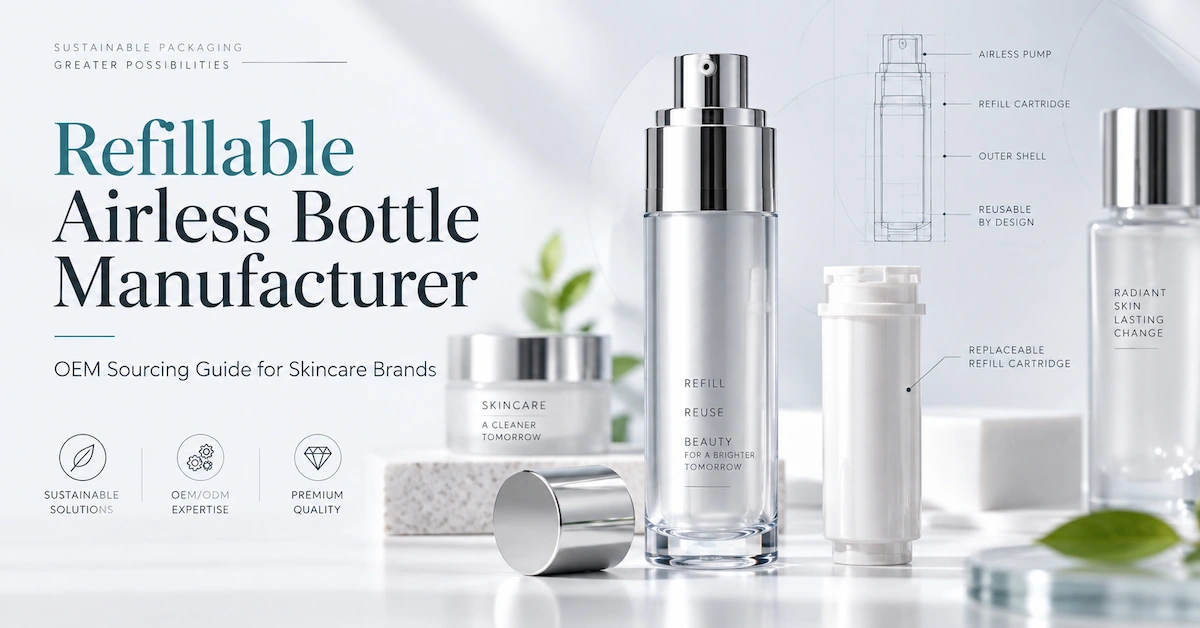
A refillable airless bottle manufacturer should be able to explain how the product chamber, dispensing pump, reusable components, and replacement reservoir work together as a complete packaging system.
The manufacturer should also clarify which components are manufactured internally, which are purchased from specialist suppliers, and who is responsible for validating the assembled package.
For professional skincare buyers, an effective supplier evaluation covers six areas:
-
Airless mechanism: Does the design use a functional piston, collapsible pouch, or another verified airless architecture rather than a conventional dip-tube pump?
-
Refill structure: Which components are retained, removed, replaced, or discarded during each refill cycle?
-
Formula compatibility: Are the product-contact materials suitable for the actual serum, lotion, cream, or other formulation?
-
Functional performance: Can dispensing, leakage, priming, and refill durability be evaluated against defined acceptance criteria?
-
Manufacturing control: Can the manufacturer maintain component dimensions, assembly quality, and replacement-cartridge compatibility across production batches?
-
Commercial feasibility: Are the tooling investment, minimum order requirements, refill supply arrangements, and delivery schedule appropriate for the brand's business model?
A supplier may offer strong plastic molding capabilities without manufacturing every pump component itself. That arrangement is not automatically a problem.
What matters is whether the supplier can identify the critical parts, explain their sources, control engineering changes, and take responsibility for the finished packaging specification.
For buyers exploring custom packaging, the COSME airless bottle product collection provides a starting point for reviewing available design directions.
However, the displayed appearance of a bottle should never replace a confirmed technical drawing or functional sample.
How Does a Refillable Airless Bottle Actually Work?
The term refillable airless bottle combines two different engineering concepts.
Airless dispensing refers to the mechanism used to deliver the formula while limiting the introduction of replacement air into the product chamber during normal dispensing.
Refillability refers to the ability to retain selected packaging components while replenishing or replacing the product-containing portion through an intended reuse process.
A package can be refillable without being airless. Similarly, a conventional airless bottle may be designed for a single fill and not intended for consumer refilling.
Understanding this distinction is essential when comparing manufacturers.
Piston-Based Airless Dispensing
In one common airless design, a movable piston sits beneath the product inside a reservoir.
When the user operates the dispensing pump, the mechanism draws product toward the outlet. As product leaves the reservoir, the piston advances to occupy the space created by dispensing.
In a properly designed system, this movement helps limit the need for outside air to enter the product chamber.
The manufacturer must manage piston geometry, seal contact, reservoir dimensions, and pump performance.
Potential problems include excessive piston friction, incomplete movement, air leakage past sealing surfaces, and inconsistent dispensing as the reservoir empties.
A piston-based structure should therefore be evaluated with the intended formulation rather than with water alone.
Collapsible Pouch or Bag Systems
Another airless architecture uses a flexible internal pouch.
As the product is dispensed, the pouch contracts while the external housing provides structural support.
This arrangement can separate the product-contact reservoir from a more durable outer shell.
For refillable applications, a replacement pouch or cartridge may offer a practical design route, provided that the refill interface is engineered for the intended replacement process.
However, the exact construction varies between manufacturers.
A pouch-based design is not automatically more compatible with every formulation, and neither design should be assigned a universal product evacuation percentage without test evidence.
Why a Conventional Pump Bottle Is Different
A standard lotion pump often uses a dip tube to draw liquid from a rigid container.
As product is removed, air may enter the bottle to replace the displaced volume.
This is not the same principle as a verified piston-based or collapsible-reservoir airless system.
An opaque outer shell or premium pump appearance does not establish the internal dispensing architecture.
Before approving a design, request an exploded drawing or cross-sectional diagram showing the product reservoir, pump path, sealing points, and refill interface.
Buyer takeaway: The word airless on a product title should initiate technical verification, not conclude it.
Which Refillable Airless Bottle Structure Is Best for Skincare Brands?
There is no universally suitable refillable design. The most appropriate construction depends on the formula, target price, refill distribution method, and consumer experience.
The following comparison describes possible industry configurations rather than confirmed specifications for any particular COSME product.
| Packaging configuration | How refilling works | Potential advantages | Main procurement risks | Suitable purchasing scenario |
|---|---|---|---|---|
| Replaceable inner cartridge | A prefilled inner reservoir is replaced while the outer shell remains | Clear separation between reusable and replaceable parts | Cartridge fit, seal integrity, replacement availability | Branded skincare refill programs |
| Cartridge with integrated pump | The reservoir and selected dispensing parts are replaced together | Potentially reduces reliance on a previously used pump | Higher component replacement cost, material complexity | Projects prioritizing a new dispensing pathway with each refill |
| Reusable pump with replaceable reservoir | The outer housing and pump are retained while the reservoir changes | May reduce the number of replacement components | Pump wear, connection hygiene, repeated assembly | Programs designed around durable dispensing components |
| Open-reservoir refill system | Product is transferred into an existing container | May offer flexibility in refill distribution | Hygiene, contamination, piston resetting, dispensing reliability | Only where the structure and refill procedure are specifically validated |
| Standard non-refillable airless bottle | The complete unit is replaced after use | Simpler consumer operation and replacement logistics | Does not provide a reusable outer-pack program | Brands without an established refill strategy |
The replacement cartridge is a particularly important purchasing decision.
If the cartridge is designed for a single packaging platform, future orders must remain compatible with the originally supplied outer bottle.
A design change that appears minor during manufacturing can become significant when customers attempt to install new cartridges into older packaging.
For that reason, refill compatibility should be treated as a long-term product specification, not merely an assembly detail.
Should the Pump Be Reused or Replaced?
This is one of the most consequential decisions in refillable packaging development.
Keeping the pump reduces the number of components purchased during each refill, but it also means that the pump must remain functional over the intended reuse period.
Replacing the pump with every cartridge may simplify some hygiene and reliability considerations, but adds material and cost to the refill unit.
Neither strategy is automatically better.
The packaging engineer should define the intended number of refills, how customers handle the components, what cleaning instructions are appropriate, and which parts will be available as replacements.
Only after those requirements are established can the manufacturer propose a suitable configuration.
Which Skincare Products Are Suitable for Refillable Airless Packaging?
Refillable airless packaging is commonly considered for skincare products where controlled dispensing, product presentation, and a reuse-oriented packaging concept are important.
Potential applications include facial serums, moisturizers, treatment lotions, facial creams, and selected personal-care formulations.
However, suitability depends on the formulation and the actual dispensing mechanism.
| Cosmetic application | Main packaging concerns | Recommended evaluation |
|---|---|---|
| Facial serums | Dispensing accuracy, air exposure, compatibility with actives | Product-contact materials, pump output, stability |
| Moisturizing lotions | Viscosity, smooth pump operation, consumer handling | Priming, dispensing consistency, leakage |
| Anti-aging creams | Formula compatibility, product recovery, pump performance | Full-life dispensing, residual product, storage |
| Vitamin C formulations | Formula stability and potential sensitivity to oxygen or light | Formula-specific stability testing and verified package protection |
| Retinoid skincare | Material compatibility and formulation stability | Stability testing with the complete finished package |
| Premium treatment products | Dose control, exterior quality, refill experience | Actuation force, dispensing, decoration, refill durability |
| Travel skincare | Accidental dispensing and changing transport conditions | Closure security, leakage and shipment testing |
These are potential applications, not proof that a particular stock bottle has passed all relevant tests.
For example, a vitamin C formulation cannot be assumed stable simply because it is filled into an airless container.
The formula may also be affected by light, temperature, material interactions, initial oxygen exposure, and other conditions.
Packaging can contribute to a product-protection strategy, but it cannot substitute for finished-product stability testing.
When Might Refillable Airless Packaging Be Unsuitable?
A refillable airless concept may be a poor choice when the formulation is incompatible with the proposed materials, the product is too difficult to dispense using the selected pump, or the brand cannot support reliable replacement-cartridge availability.
It may also be unsuitable for projects with an extremely short launch schedule if entirely new tooling and component validation are necessary.
Brands selling through multiple international markets should consider whether replacement units can be supplied consistently across those markets.
A refill system that works technically but is difficult for customers to purchase again may fail commercially.
Technical Specifications to Request Before Buying Refillable Airless Bottles
A professional RFQ should define the functional requirements before the discussion turns to exterior colors and pricing.
Without an agreed technical specification, two manufacturers may quote very different products under the same general description.
Essential Refillable Airless Packaging Specification Checklist
| Technical item | Information buyers should request | Why it matters |
|---|---|---|
| Nominal capacity | Available capacity for the selected design | Product positioning and fill planning |
| Actual fill volume | Usable fill quantity under defined conditions | Filling accuracy and label claims |
| Bottle dimensions | Height, diameter, and dimensional tolerances | Cartoning, handling and equipment compatibility |
| Airless architecture | Piston, pouch or other confirmed system | Verification of dispensing design |
| Refill configuration | Replaceable inner, pump-integrated cartridge or other structure | Consumer use and repeat supply |
| Product-contact materials | Polymer specifications and all relevant contact components | Formula compatibility |
| Dispensing output | Agreed mass or volume per actuation | Dose consistency |
| Priming requirements | Defined number of initial actuations under test conditions | First-use experience |
| Residual product | Product remaining after the agreed dispensing procedure | Product recovery and consumer value |
| Refill interface | Thread, snap fit, locking or other mechanism | Repeated assembly reliability |
| Actuation force | Acceptable operating-force range | Consumer comfort |
| Closure security | Fit, retention and accidental-actuation protection | Storage and transport |
| Decoration options | Available color, printing and surface finishing methods | Brand identity |
| Inspection criteria | Functional and visual acceptance limits | Batch-to-batch consistency |
These requirements should be defined for the actual product, not taken from an unrelated packaging specification sheet.
For example, the target pump output for a thin serum may differ from the output preferred for a rich cream.
The manufacturer should also clarify whether a measured dispensing volume refers to a single actuation, a series average, or a result measured after the pump is fully primed.
Those distinctions can materially affect how a packaging sample performs.
Why Component Drawings Matter
A useful drawing should identify more than the outer shape.
It may need to show the inner reservoir, mating surfaces, critical diameters, seals, closure engagement, dispensing components, and areas affected by replacement.
Buyers should ask which dimensions are critical to function and which are primarily cosmetic.
The purpose is to avoid paying for unnecessary tolerances while maintaining sufficient control over interfaces that affect leakage or cartridge installation.
Material Selection: PP, PETG, PET, PCR and Other Packaging Components
A refillable airless bottle normally consists of multiple components with different mechanical and cosmetic functions.
The outer shell may be selected for rigidity, appearance, decoration, or durability. The inner reservoir must be assessed as a product-contact component. The pump and sealing parts introduce additional compatibility and performance considerations.
Manufacturers may use PP, PET, PETG, PE, or other materials in cosmetic packaging, depending on the component design.
COSME Packaging identifies several of these materials in its published company and manufacturing information.
However, the exact material composition of a particular refillable airless bottle should always be confirmed through the applicable product specification.
Comparing Common Packaging Materials
| Material | Common packaging considerations | Questions for the manufacturer |
|---|---|---|
| PP | Moldability, rigidity, chemical compatibility and closure design | What grade is used, and does it meet the product's requirements? |
| PET | Appearance, dimensional design and compatibility | Is this material suitable for the intended formula and structure? |
| PETG | Transparency, appearance and formed-part requirements | How will environmental stress and formula compatibility be evaluated? |
| PE | Flexibility, sealing and component design | What grade and mechanical properties are required? |
| PCR plastic | Recycled-content specification and material consistency | What is the verified recycled content, source and applicable material grade? |
| Acrylic or other decorative materials | Premium appearance and exterior rigidity | Is the material product-contacting or used only for the outer shell? |
Material names alone do not establish suitability for every cosmetic formulation.
For example, a package that performs well with a water-based lotion may behave differently with a formulation containing certain oils, solvents, fragrance ingredients, or other challenging components.
The correct decision should be based on the actual formula, component specifications, and an agreed compatibility evaluation.
Should Brands Use PCR Plastic in Refillable Airless Bottles?
Post-consumer recycled materials may be considered for suitable packaging components, especially exterior parts that do not directly contact the formulation.
However, PCR materials can introduce additional procurement questions involving source consistency, color variation, odor, processing characteristics, and documentation.
A supplier should distinguish the recycled content of the outer shell from the composition of the entire package.
For example, using recycled material in one decorative component does not mean the complete airless mechanism contains the same recycled percentage.
Brands exploring this direction can review COSME's sustainable cosmetic packaging category and request project-specific confirmation of available materials.
Environmental claims should be supported by actual material evidence and the applicable requirements of the target market.
How to Validate Formula Compatibility Before Mass Production
The most important packaging performance test is often the one performed with the actual commercial formula.
A supplier's sample may function correctly with a simple reference liquid yet behave differently after being filled with a concentrated serum or high-viscosity cream.
The packaging approval process should therefore use representative formula batches and production-intended components.
Step 1: Define the Formula Profile
Before testing, the brand or contract manufacturer should provide relevant information about the formulation.
This may include viscosity, pH, ingredient categories, potential compatibility concerns, intended storage conditions, and any known sensitivity to air or light.
Confidential formulation information can be handled through an agreed technical review process.
The objective is not necessarily to disclose the complete commercial recipe to every supplier, but to communicate enough relevant information to evaluate packaging risks.
Step 2: Assess Product-Contact Components
The compatibility review should cover all parts that may come into contact with the cosmetic formula.
Depending on the design, those parts may include the inner reservoir, pump channel, valves, seals, and other dispensing components.
Potential concerns include swelling, deformation, discoloration, adsorption, changes in mechanical properties, and interactions that could affect product stability.
A generic material compatibility chart can be useful for initial screening, but it should not replace testing with the finished formulation.
Step 3: Evaluate Storage Conditions
The brand and packaging engineer should agree on appropriate storage and accelerated-testing conditions.
Testing may consider temperature changes, storage orientation, light exposure, and the expected duration of product contact with the packaging.
Accelerated testing can help identify potential problems, but results must be interpreted using a justified method. A short elevated-temperature study should not automatically be converted into a specific shelf-life claim.
Step 4: Repeat Dispensing Tests After Storage
A package may dispense smoothly immediately after filling but show changes after prolonged storage.
Pump output, actuation force, leakage, appearance, and residual product should therefore be checked at appropriate intervals.
This is particularly important when the packaging contains components with different material properties.
Practical recommendation: Obtain formula approval, packaging approval, and filling-process approval before treating the design as production-ready.
How Should a Refillable Airless Bottle Manufacturer Test Pump Performance?
A complete performance review should examine the packaging throughout its intended use, not merely during the first few pump strokes.
The following matrix provides a practical starting point for supplier qualification.
Refillable Airless Bottle Quality Testing Matrix
| Test | What it evaluates | Buyer acceptance question |
|---|---|---|
| Priming test | Initial dispensing behavior | Does the pump begin dispensing within the agreed operating sequence? |
| Dose consistency | Variation between repeated actuations | Is output within the agreed specification? |
| Full-life dispensing | Performance from full to nearly empty | Does the system continue working through the intended use period? |
| Residual-product test | Remaining product after a defined procedure | Is the retained amount acceptable? |
| Leakage evaluation | Sealing under defined conditions | Does the filled package meet the agreed leakage criteria? |
| Pump endurance | Repeated operation of the dispensing mechanism | Does the pump remain functional for its intended service life? |
| Refill-interface cycling | Repeated installation and removal | Do the mating components remain secure and functional? |
| Temperature conditioning | Performance after defined thermal exposure | Are important properties maintained? |
| Formula compatibility | Interaction between the formula and contact materials | Does the complete package remain suitable for the formula? |
| Decoration durability | Printed or coated exterior performance | Does the appearance meet the agreed handling requirements? |
| Transport testing | Resistance to relevant distribution conditions | Does the packed product survive the chosen shipping test plan? |
No single universal pump-output tolerance or refill-cycle count should be imposed on every cosmetic packaging project.
The acceptance criteria must reflect the proposed design, intended consumer behavior, and product requirements.
Measuring Pump Output Correctly
A useful dispensing test should define how the package is filled, primed, operated, and measured.
One approach is to measure the mass of product dispensed over a specified number of actuations.
Average output can then be calculated:
Average Output per Actuation = Total Dispensed Mass ÷ Number of Measured Actuations
If the project requires volume per actuation, the conversion from mass should use the relevant product density and test conditions.
Buyers should also examine variation, not just the average.
Two pumps can deliver the same average quantity while producing different levels of stroke-to-stroke consistency.
Evaluating Residual Product
Residual product is the quantity remaining after a defined dispensing procedure has been completed.
It is affected by the reservoir geometry, pump mechanism, formulation and test method.
A practical calculation is:
Residual Product Percentage = Residual Product Mass ÷ Initial Filled Product Mass × 100
The measurement should distinguish product that remains inside the packaging from product lost during testing or handling.
Do not compare advertised evacuation rates unless the suppliers use sufficiently comparable procedures and definitions.
Evaluating Transport Performance
Finished cosmetic packaging should also be reviewed in its intended shipping configuration.
ASTM D4169, Standard Practice for Performance Testing of Shipping Containers and Systems, provides a framework for evaluating shipping units under simulated distribution hazards.
It is a relevant reference when planning transport-package evaluations, but it does not establish the formula compatibility or airless functionality of an individual bottle.
The packaging team should select applicable distribution tests, conditions, and acceptance criteria based on the actual shipping route and packed-product configuration.
Refill Durability: The Risk Many Buyers Overlook
A refillable product must be designed around more than a successful first assembly.
Consider a consumer who retains the outer bottle while purchasing replacement cartridges over an extended period.
The cartridge interface will be opened, handled, and reassembled repeatedly.
A snap feature can gradually wear. A threaded connection may be misaligned. A seal can become damaged or contaminated. A pump intended for repeated reuse may eventually show changes in operation.
These risks should be addressed in the original design specification.
Four Refill-Interface Requirements
1. Secure engagement
The replacement component should connect reliably in its intended orientation.
The user should be able to determine when the cartridge has been installed correctly.
2. Controlled removal
The refill should be removable through the intended process without damaging the components designed for reuse.
Excessively difficult removal can create consumer frustration or unintended breakage.
3. Consistent alignment
The interface must position the cartridge relative to the pump and outer shell as required by the design.
A refill system that looks assembled but sits incorrectly may cause dispensing problems.
4. Repeatable performance
The reusable components should continue meeting the agreed functional criteria after the specified number of refill cycles.
The acceptance test should reflect the intended service life rather than an arbitrary cycle count.
How Many Refill Cycles Should Be Tested?
The required number should be derived from the brand's proposed reuse program.
A premium skincare brand expecting customers to retain the outer package over multiple repurchases may need a different durability specification from a short-term promotional program.
Buyers should define a target number of replacement cycles, a suitable safety margin, and failure criteria.
A cycle test should also consider foreseeable user handling, including incorrect installation attempts, reasonable variations in force, and repeated cap operation.
The test must reflect realistic use without claiming that every consumer will handle the product identically.
What About Cleaning and Hygiene?
Cleaning instructions depend on which components are retained and which contact the product.
A design that replaces the complete product reservoir and dispensing pathway may have different hygiene implications from one that retains a previously used pump.
The manufacturer and cosmetic brand should establish suitable handling instructions and assess contamination risks.
A bottle should not be advertised as safe for unlimited refilling unless the entire system and intended refill process support that claim.
Refillable vs Standard Airless Bottles: A Procurement Comparison
Choosing refillable packaging changes both the initial purchasing model and the long-term supply arrangement.
The decision should therefore account for more than unit price.
| Evaluation factor | Standard airless bottle | Refillable airless bottle |
|---|---|---|
| Initial packaging structure | Complete single-use unit | Reusable and replaceable components |
| Repeat purchase | Complete new package | Replacement system defined by the design |
| Engineering complexity | Primarily dispensing and container integration | Dispensing plus repeated refill-interface performance |
| Validation scope | Formula, pump, seal, shipment | Formula, pump, seal, refill cycling, replacement compatibility, shipment |
| Inventory planning | Finished bottle inventory | Outer components plus replacement-cartridge inventory |
| Consumer instructions | Relatively straightforward | Requires clear replacement guidance |
| Long-term supply | Consistent complete bottle supply | Compatibility between current and future replacement units |
| Environmental evaluation | Depends on actual material and disposal system | Depends on reuse rates, material quantities and system logistics |
| Cost analysis | Primarily complete-package costs | Initial shell costs plus recurring refill costs |
A refillable design can create a meaningful packaging strategy, but the benefit depends on customers actually using the refill pathway.
If buyers purchase a complete new outer bottle with every order, the intended reuse benefit may not materialize.
If the replacement cartridge costs nearly as much as the complete original package, the commercial incentive may also be weaker.
For that reason, a refillable packaging strategy should be evaluated as a complete operating model.
Can Refillable Airless Bottles Reduce Packaging Waste?
Potentially, yes—but the result must be demonstrated for the specific system.
When consumers retain a durable outer shell and replace only the intended refill components, less outer-pack material may be purchased over repeated uses.
However, the actual environmental result depends on several factors:
-
Material weight of the complete original packaging.
-
Material weight of each refill unit.
-
Number of successful reuse cycles.
-
Additional protective packaging and shipment requirements.
-
Material composition and end-of-life handling.
-
Consumer participation in the refill program.
-
Applicable collection and recycling infrastructure.
A refillable product should not automatically be described as carbon-neutral, biodegradable, or universally recyclable.
ISO 18603:2013, Packaging and the Environment — Reuse, provides a recognized framework for assessing packaging reuse requirements and the associated system.
Its existence does not establish that a particular cosmetic bottle is certified or compliant.
A brand making environmental claims should evaluate the actual product and obtain documentation appropriate to the intended markets.
For marketing teams, the distinction is important: “designed for cartridge replacement” is a description of a structure, while “reduces environmental impact by a specified percentage” is a measurable claim requiring supporting evidence.
OEM and ODM Customization: Stock Designs vs New Tooling
An experienced refillable airless bottle manufacturer should help buyers select the appropriate development route.
For some projects, an existing packaging design may provide the required structural functions and only need exterior customization.
Other projects require a new outer shape, different cartridge mechanism, or substantial engineering changes.
Route A: Customizing an Existing Packaging Style
Using an existing suitable design can reduce the amount of new structural development required.
Potential customization options include colors, printed logos, selected decorative finishes, and coordinated exterior components.
However, the supplier must confirm which changes are actually available for the chosen model.
A change in material, pump, cartridge dimensions, or connection geometry may require additional validation even when the bottle appears similar.
COSME's published OEM/ODM process for existing styles includes:
-
Confirming style and capacity.
-
Confirming colors and printing.
-
Preparing the quotation.
-
Confirming the order.
-
Preparing pre-production samples.
-
Proceeding to mass production and delivery.
This workflow provides a useful framework for buyers considering an existing design.
Route B: Custom Mold Development
A more distinctive packaging concept may require new tooling.
COSME describes a custom tooling process covering design confirmation, 3D drawings, CNC samples, mold opening, T1/T2 tooling samples, mass production, and delivery.
This process is outlined in its OEM/ODM cosmetic packaging information.
For refillable packaging, design approval should cover both appearance and functionality.
An attractive CNC prototype can demonstrate the visual direction but may not represent the material properties or tolerances of injection-molded production parts.
Similarly, a first tooling sample should not automatically be treated as the final production standard.
Recommended OEM Development Approval Gates
| Project stage | Main objective | Required decision |
|---|---|---|
| Requirements | Define application, refill model and technical needs | Approve initial product specification |
| Concept design | Review outer and inner component architecture | Approve structural direction |
| Prototype | Evaluate dimensions, assembly concept and appearance | Decide whether to proceed with tooling |
| Tool trial | Assess production-intended components | Review dimensions and required corrections |
| Functional validation | Test formula, pump, leakage and refill cycling | Approve or revise the complete system |
| Pre-production | Verify finish, components and quality requirements | Approve production reference sample |
| Mass production | Manufacture against controlled specifications | Monitor conformity and deviations |
| Shipment release | Verify agreed outgoing requirements | Authorize delivery |
These are recommended purchasing controls, not a claim that every project automatically follows an identical schedule.
Protecting Custom Tooling Investments
Buyers investing in new molds should clarify tooling ownership, maintenance, permitted use, modification rights, and what happens if the supplier relationship changes.
For refillable systems, component continuity deserves particular attention.
If the outer shell is intended to remain in consumer use, the brand should define how compatible replacement cartridges will be supplied in the future.
A long-term refill program can become difficult if a critical inner component is changed without engineering approval.
How Much Does Custom Refillable Airless Bottle Manufacturing Cost?
A meaningful quotation depends on the selected structure, materials, volume, decoration, testing and development requirements.
There is no reliable universal unit price for all refillable airless systems.
A low price for an empty decorative shell cannot be compared directly with a quote for a complete validated package that includes the product reservoir, pump, seals, and refill components.
Main Cost Drivers
Packaging architecture: The number and complexity of components influence tooling, molding, assembly and inspection costs.
Pump and cartridge configuration: A replacement reservoir alone may have a different cost structure from a cartridge that includes a dispensing mechanism.
Materials: Material selection affects resin costs, appearance, performance requirements and sourcing.
Decoration: Custom colors, printing and finishing may require additional setups, artwork approval and quality checks.
Order quantity: Production economics depend on the actual model, tooling and order volume.
Engineering and tooling: New structural development may introduce mold investment, trials and design-revision costs.
Testing: Formula compatibility, dispensing, refill-cycle and distribution verification can require additional samples and project resources.
Logistics: Packaging weight, carton design, shipment size and destination affect delivered costs.
Understanding Total Cost Over Multiple Refills
A brand should compare the refillable system against its existing packaging over the same number of product purchases.
A simplified comparison is:
Refillable Packaging Cost = Reusable Outer Components + All Replacement Units + Relevant Program Costs
Single-Use Packaging Cost = Number of Product Purchases × Complete Single-Use Packaging Cost
The complete analysis may also include tooling amortization, warehousing, assembly, transportation, rejected units, and other relevant costs.
This calculation helps identify whether the refill program makes commercial sense at the expected customer participation level.
It does not automatically establish an environmental benefit, which requires a separate evaluation.
What Is the MOQ for Custom Refillable Airless Bottles?
Minimum order quantities depend on the model, component structure, customization, tooling and procurement arrangements.
For example, an existing design with standard components may have different ordering conditions from a project requiring new molds or a specialized cartridge.
Buyers should request separate commercial details for:
-
Complete initial bottle sets.
-
Replacement cartridges.
-
Custom-colored components.
-
Decorated components.
-
Sample orders.
-
New tooling or development projects.
-
Repeat orders after the initial launch.
Do not assume that the MOQ for complete bottles is automatically the same as the MOQ for replacement cartridges.
The supplier should confirm the applicable conditions in writing.
How to Evaluate Refillable Airless Bottle Manufacturers Before Ordering
A supplier's website can provide useful introductory information, but procurement decisions should be supported by appropriate documents and samples.
An effective evaluation combines engineering evidence with manufacturing and commercial information.
Manufacturer Qualification Checklist
| Evaluation area | Important questions | Evidence to request |
|---|---|---|
| Company and production | What manufacturing processes does the supplier operate? | Company and manufacturing information |
| Component responsibility | Who makes the reservoir, pump and refill interface? | Component sourcing explanation |
| Engineering | Can the supplier provide controlled drawings? | Drawings and component specifications |
| Airless mechanism | Is the dispensing architecture verified? | Structural documentation and samples |
| Refillability | Which parts are replaced or reused? | Replacement instructions and interface design |
| Materials | What contacts the formula? | Material specifications |
| Quality management | How are incoming, process and final inspections handled? | Inspection procedures and applicable records |
| Functional testing | How will performance be validated? | Test methods and agreed acceptance criteria |
| Tooling | Who owns and controls the molds? | Tooling agreement |
| Supply continuity | Will future cartridges fit existing outer bottles? | Engineering-change and compatibility controls |
| Commercial conditions | What are the actual MOQ, cost and schedule? | Project-specific quotation |
A company should not automatically be considered unsuitable because it sources specialized pump components from another manufacturer.
The important issue is accountability.
The purchasing contract should identify who is responsible for component conformity, change approval, final assembly, corrective actions, and the complete delivered system.
For a wider discussion of factory capability and sourcing controls, buyers can review COSME's airless bottle manufacturer factory audit guide.
Why Manufacturing Quality Control Matters More for Refillable Systems
Quality control becomes especially important when packaging components must remain compatible across multiple orders.
A refill cartridge produced six months after the original launch may need to fit an outer shell manufactured in the first production batch.
That places additional importance on critical dimensions, tooling consistency, and engineering change management.
According to the company's published information, COSME Packaging uses incoming material inspection, in-process dimensional and appearance checks, finished-product leakage inspection, printing adhesion and color checks, and batch traceability.
These general manufacturing quality practices provide a foundation for project-specific discussions.
However, buyers should request confirmation of the applicable tests and acceptance criteria for their particular refillable airless packaging configuration.
Three Approval Points That Should Not Be Combined
Structural approval: The bottle, pump, reservoir and refill components are verified against the agreed design.
Formula approval: The finished cosmetic formulation is evaluated with the intended product-contact packaging components.
Production approval: Production-intended samples, inspection criteria and supply arrangements are agreed upon.
A satisfactory result in one area does not automatically establish approval in the others.
Separating these decisions helps the packaging engineer identify problems before the project reaches commercial production.
How COSME Packaging Supports Custom Cosmetic Packaging Projects
COSME Packaging is the brand of Zhejiang Cosme Industry Co., Ltd., a cosmetic packaging company established in 2015.
The company focuses on cosmetic primary packaging, including bottles, jars, tubes, airless packaging categories, and OEM/ODM customization.
According to its company profile, the business reports a manufacturing facility of approximately 15,000 square meters, around 200 employees, molding and printing operations, a research and development center, and mold development capabilities.
Its published customization services include packaging shape, capacity, materials, colors, branding and decoration options.
These capabilities make the company relevant to brands exploring existing-style packaging customization or a more specialized OEM/ODM development project.
Reviewing COSME's Refillable Airless Bottle Presentation
COSME's Refillable Airless Bottles product page presents a refill-oriented cosmetic packaging design with a coordinated cylindrical appearance and pump-style dispensing component.
The public description discusses potential skincare applications, exterior design and customization considerations.
Importantly, the available product information does not independently confirm the internal airless mechanism or provide a complete SKU-level technical specification.
Buyers requiring verified airless performance should therefore request confirmation of the actual reservoir structure, pump assembly, refill method, product-contact materials, available sizes and relevant test results.
This distinction is essential for an accurate technical sourcing discussion.
COSME's general customization and quality-control capabilities can support an initial project assessment, while the exact product configuration must be confirmed for the intended application.
When Should You Contact COSME?
A packaging inquiry is most useful when the buyer has already identified the application, intended fill volume, preferred refill concept and commercial requirements.
Brands can discuss an existing design or ask whether a new custom structure is feasible.
The objective of the initial consultation should be to determine the appropriate development route and identify the documents and samples required for technical approval.
Discuss Your Refillable Airless Packaging Project With COSME
RFQ Checklist: What to Send a Refillable Airless Bottle Manufacturer
A well-prepared RFQ helps the manufacturer provide a more relevant proposal and reduces unnecessary clarification during sampling.
Instead of asking only, "What is your price for a refillable airless bottle?", define the project in sufficient detail.
Essential RFQ Information
| RFQ field | Recommended information |
|---|---|
| Company and brand | Buyer company and intended brand |
| Product application | Serum, lotion, cream or other formulation |
| Target markets | Countries or regions of sale |
| Capacity | Target nominal and fill volume |
| Formula profile | Relevant viscosity, pH and compatibility concerns |
| Airless requirement | Confirmed mechanism and performance expectations |
| Refill strategy | Replaceable cartridge, pump-and-cartridge unit or other system |
| Reusable components | Which parts the consumer should retain |
| Materials | Preferred external and product-contact materials |
| Appearance | Color, surface finish, decoration and logo |
| Initial purchase | Forecast quantity for launch |
| Refill forecast | Expected replacement-cartridge demand |
| Testing | Pump, leakage, formula, refill durability and shipping requirements |
| Engineering | Existing design, modification or new tooling |
| Timing | Target sample and launch schedule |
| Destination | Shipping country and applicable logistics requirements |
| Commercial terms | MOQ, tooling cost, payment, delivery terms and repeat supply |
Example OEM Packaging Inquiry
The following is an illustrative buyer inquiry, not a confirmed COSME product specification or commercial quotation.
"We are developing a refillable skincare packaging program for a premium facial lotion.
We would like to evaluate an airless dispensing system with a reusable outer bottle and replaceable product reservoir. Our packaging team requires confirmation of the actual airless mechanism, product-contact materials, pump performance and refill-interface durability.
Please advise whether an existing design can meet these requirements or whether custom tooling would be necessary.
We can provide our target capacity, formulation characteristics, decoration requirements, forecast quantities and intended markets.
We would also appreciate information about available samples, component specifications, relevant testing, MOQ, tooling arrangements and the long-term supply of compatible replacement cartridges."
An inquiry at this level gives the supplier a clearer basis for an engineering discussion.
It also helps prevent quotations that appear competitive but refer to incomplete or technically different packaging systems.
Request Samples and an OEM/ODM Packaging Quotation
Frequently Asked Questions About Refillable Airless Bottle Manufacturers
1. What is the difference between a refillable airless bottle and a regular airless bottle?
A regular airless bottle uses a dispensing mechanism designed to limit replacement air entering the product chamber during use, but it may be intended for only one fill. A refillable airless bottle adds a defined method for retaining selected components while replacing or replenishing the product reservoir. Buyers need to verify both the airless mechanism and the refill structure.
2. Can every airless pump bottle be refilled?
No. Some conventional airless bottles are not designed to be reopened or refilled. Disassembly may damage seals or components, and a piston may not be intended to reset. Refillability should be an approved design feature supported by suitable instructions and testing.
3. Are refillable airless bottles suitable for vitamin C or retinol serums?
They may be considered for certain formulations, but suitability depends on the actual dispensing mechanism, product-contact materials, stability requirements and packaging performance. Brands should conduct appropriate formula compatibility and stability testing rather than relying on the word airless alone.
4. What materials are commonly considered for refillable cosmetic packaging?
PP, PE, PET, PETG and other materials may be considered for relevant components, depending on the packaging design. The material of the reusable exterior may differ from that of the product-contact reservoir. Buyers should request exact component specifications and evaluate compatibility with the intended formulation.
5. How can buyers confirm that an airless bottle uses a genuine airless mechanism?
Request a technical drawing showing the reservoir, pump and air-management principle. The supplier should explain whether the design uses a movable piston, collapsible pouch or another validated mechanism. Representative samples should be evaluated for dispensing performance, leakage and other relevant requirements.
6. What tests should be included before a bulk refillable bottle order?
The test plan may include formula compatibility, priming, dose consistency, residual product, leakage, pump endurance, refill-interface cycling, decoration durability and distribution performance. The applicable procedures and acceptance criteria should be agreed upon before testing.
7. Can I customize the bottle color, logo and outer shape?
Many cosmetic packaging projects allow customization of selected exterior features. However, available options depend on the exact design and manufacturing process. Changes to structural parts or materials may require additional tooling or validation. Confirm the approved customization scope with the supplier.
8. What affects the MOQ and production lead time?
The model, component configuration, decoration, tooling requirements, order quantity and availability of critical components can affect MOQ and lead time. A custom structural development project usually has different requirements from a repeat order of an approved design. Request a written quotation and schedule for the exact project.
9. Are refillable airless bottles automatically more sustainable than single-use bottles?
Not necessarily. A refillable system may reduce repeated use of certain outer components, but the overall result depends on material quantities, actual refill cycles, logistics, consumer behavior and end-of-life handling. Environmental claims should be based on appropriate evidence rather than the packaging format alone.
10. How should skincare brands choose a refillable airless bottle manufacturer in China?
Evaluate the supplier's engineering and tooling capabilities, component sourcing transparency, refill-interface design, quality control, formula compatibility support, and ability to maintain consistent replacement-cartridge supply. Compare production-representative samples and documented requirements before approving a bulk order.
11. Can a refillable airless bottle manufacturer support private-label skincare packaging?
A manufacturer with suitable OEM/ODM capabilities may support private-label packaging through color matching, decoration, selected component customization or new design development. The buyer should confirm which existing packaging formats are available, what changes are technically feasible, and whether the commercial terms meet the intended launch requirements.
Conclusion
Selecting a refillable airless bottle manufacturer requires a broader evaluation than choosing a standard cosmetic bottle supplier. The right packaging partner must be able to connect structural design, dispensing performance, refill durability, formula compatibility, manufacturing quality and long-term commercial supply into one clearly defined project.
For skincare brands, the most important starting point is to confirm what is genuinely airless, what is genuinely refillable, and which components will remain in use after the original product is consumed.
Those answers determine the testing program, tooling requirements, consumer instructions and replacement-cartridge supply strategy.
A premium appearance can support a brand's market positioning, but dependable performance comes from appropriate engineering and documented validation. Similarly, a refillable concept can support a reuse-oriented packaging strategy, but its commercial and environmental advantages must be assessed against the actual product design and expected customer behavior.
COSME Packaging provides cosmetic packaging development, manufacturing and OEM/ODM customization services for beauty and personal-care projects. Brands interested in refillable airless packaging can begin by reviewing the available designs and discussing the specific dispensing, material and replacement-system requirements with the team.
Whether you are developing a new skincare line, upgrading an existing cosmetic bottle, or planning a long-term refill program, a well-defined specification and a production-representative sample are more valuable than an unsupported performance promise.