
Choosing reliable airless bottle suppliers is a critical purchasing decision for skincare brands, cosmetic manufacturers, private-label companies, and packaging distributors. While airless packaging is often associated with premium skincare and controlled dispensing, not every bottle marketed as "airless" uses the same internal technology or delivers the same functional performance.
For professional buyers, the challenge goes beyond choosing an attractive bottle. The packaging must be compatible with the formulation, dispense consistently, resist leakage, support the filling process, and maintain acceptable quality throughout storage, transportation, and consumer use.
A supplier may offer several visually similar bottles with different internal pump mechanisms, materials, assembly methods, and customization options. These differences can influence product protection, dispensing reliability, development costs, and the long-term consumer experience.
The most effective sourcing strategy is to evaluate the complete airless packaging system—not simply the bottle's appearance, advertised benefits, or unit price.
This guide explains how to identify suitable airless packaging manufacturers, compare dispensing structures, assess technical specifications, evaluate material compatibility, verify quality control, manage OEM/ODM development, and prepare an effective request for quotation.
It is designed for international B2B buyers who need practical purchasing guidance rather than unsupported marketing claims.
What Makes a Reliable Airless Bottle Supplier?
Reliable airless bottle suppliers should be evaluated according to their ability to provide technically suitable packaging, consistent manufacturing quality, clear documentation, and responsive project support.
A competitive price is important, but it should not be the only selection criterion.
An inexpensive bottle that performs inconsistently, leaks during shipping, or is incompatible with the product formulation can generate additional costs through production delays, rejected inventory, customer complaints, and product returns.
Before selecting an airless bottle supplier, buyers should investigate six fundamental areas.
1. Verified dispensing technology
The supplier should explain how the selected packaging system functions and whether it uses a piston, collapsible pouch, or another appropriate airless dispensing mechanism.
2. Formula compatibility
All relevant product-contact materials should be evaluated for compatibility with the intended cosmetic formulation.
3. Functional performance
Buyers should verify dispensing output, priming behavior, sealing performance, product evacuation, and repeated-use reliability.
4. Manufacturing and quality control
The supplier should demonstrate appropriate control over materials, component dimensions, molding, assembly, decoration, and final inspection.
5. Customization capability
The company should explain which design changes can be made using existing components and which require new tooling or engineering development.
6. Commercial transparency
Clear information about sample arrangements, minimum order quantities, tooling responsibility, quality acceptance, production schedules, and shipping terms is essential.
For professional procurement, a supplier's reliability should be demonstrated through relevant evidence rather than broad claims about product quality.
What Is an Airless Bottle, and How Does It Work?
An airless bottle is a dispensing package designed to minimize the entry of replacement air into the product reservoir as contents are dispensed.
In a conventional liquid pump bottle, liquid is commonly drawn through a dip tube. As the liquid leaves the bottle, air generally enters the reservoir to replace the dispensed volume.
A properly designed airless system operates differently.
Instead of relying on replacement air entering the product chamber, it uses a mechanism that reduces the volume occupied by the stored product as dispensing occurs.
Depending on the design, this may involve a moving piston, a collapsible internal pouch, or another engineered dispensing structure.
This distinction matters because the internal architecture determines how the package behaves during filling, dispensing, storage, and product evacuation.
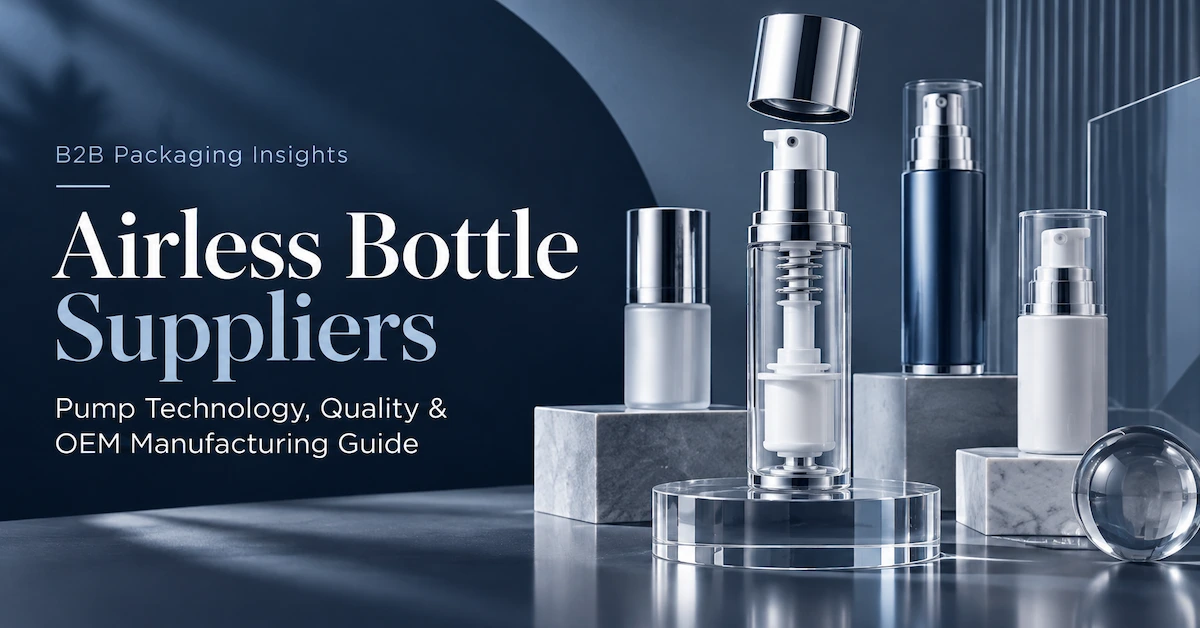
How a Piston-Type Airless Bottle Works
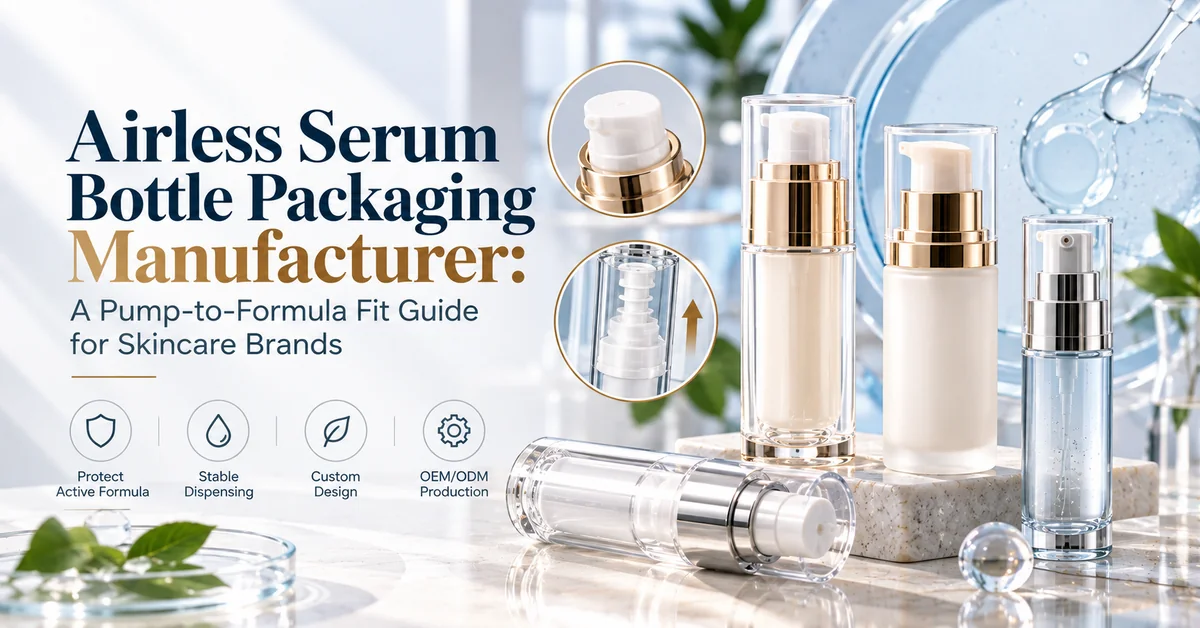
A piston-type airless bottle typically includes a rigid container, a movable piston, and an upper dispensing assembly.
As the consumer presses the pump actuator, product is dispensed through the outlet.
The resulting pressure difference allows the piston to advance, reducing the volume of the product reservoir.
Instead of allowing replacement air to enter the product chamber, the moving piston helps compensate for the dispensed volume.
The system's performance depends on the relationship between the piston, container wall, pump mechanism, and sealing components.
Potential failure points include piston misalignment, excessive friction, poor sealing, dimensional variation, and unsuitable product viscosity.
A poorly designed piston system may leave excessive residual product or fail to move consistently.
How a Bag-in-Bottle Airless System Works
Another airless packaging approach uses a flexible internal pouch or collapsible bag.
The cosmetic formulation is stored inside the flexible reservoir.
As the pump dispenses product, the inner pouch gradually contracts.
This allows the occupied product volume to decrease without requiring ordinary replacement air to enter the formulation chamber.
Bag-in-bottle packaging can be useful for particular product designs, but the pouch material, attachment points, filling method, and dispensing assembly require careful evaluation.
Potential concerns include incomplete collapse, material compatibility, damage during filling, and inconsistent evacuation.
Does Airless Mean Completely Oxygen-Free?
No.
Airless packaging does not automatically mean oxygen-free, sterile, completely airtight, or preservative-free.
Airless dispensing can help limit repeated air entry during product use, but the formulation may still encounter oxygen during manufacturing, filling, or initial package assembly.
Depending on the materials and construction, gases may also pass through packaging components over time.
Furthermore, the degree of protection depends on the complete system's design and verified performance.
Brands should not assume that an airless bottle eliminates oxidation, prevents all microbial contamination, or guarantees a longer shelf life.
Any such claims require appropriate evidence from finished-product testing.
Airless Bottles vs Regular Pump Bottles: Which Is Better for Skincare?
Choosing between an airless dispenser and a conventional lotion pump should begin with the formulation's needs and the intended consumer experience.
| Comparison Factor | Airless Bottle | Regular Pump Bottle |
|---|---|---|
| Reservoir operation | Designed to reduce replacement air entering the product chamber | Typically allows air into the reservoir as product is dispensed |
| Common dispensing mechanism | Piston, collapsible pouch, or another airless structure | Often uses a dip tube |
| Product protection | May reduce repeated air exposure during use | More frequent air exchange may occur |
| Product evacuation | Depends on reservoir and pump engineering | Depends on dip tube, bottle geometry, and pump |
| Formula suitability | Must match viscosity, materials, and pumping structure | Must match pump and dip tube performance |
| Engineering complexity | Can involve more specialized components | Often mechanically simpler |
| Filling requirements | May require specific filling and priming procedures | Generally familiar filling approaches |
| Cost | Depends on design and component requirements | Depends on material, pump, and decoration |
| Typical applications | Serums, lotions, selected creams, skincare treatments | Lotions, cleansers, body care, and general liquids |
Neither packaging format is automatically superior.
A conventional pump may be sufficient for a stable lotion with no particular requirement for reduced reservoir air exposure.
A suitable airless system may provide advantages for certain skincare products where controlled dispensing and reduced air entry are important.
However, the performance difference must be assessed using actual packaging configurations and the intended formulation.
Brands should compare functional evidence rather than assuming that all airless packaging performs identically.
Buyers exploring different structures can review COSME's airless bottle packaging category as a starting point for discussing available design options.
Types of Airless Bottles for Cosmetic and Skincare Packaging
Airless bottles are available in different materials, exterior designs, and functional configurations.
Importantly, the appearance or exterior material does not necessarily identify the internal dispensing mechanism.
For example, a package with a transparent acrylic outer shell may contain a separate plastic reservoir and pump assembly.
Similarly, a metallic-looking exterior does not establish that the product chamber is made of aluminum.
Plastic Airless Bottles
Plastic airless packaging is frequently considered for skincare applications because polymer components allow flexibility in molding, shape development, color customization, and assembly design.
Different plastic materials may be used for the outer container, internal reservoir, actuator, and other components.
Material selection should depend on the actual engineering requirements.
Plastic packaging may be attractive for everyday skincare products, private-label brands, and products where weight and transportation efficiency matter.
However, buyers should evaluate material compatibility, dimensional stability, appearance, and pump performance before approving a design.
Acrylic Airless Bottles
Acrylic-style airless packaging is often associated with premium cosmetic presentation.
A clear or thick-walled outer shell can create visual depth and a more substantial retail appearance.
This style may suit premium serums, moisturizers, and treatment products.
However, the acrylic component may function primarily as an exterior shell rather than the product-contact reservoir.
The supplier should identify the material of every relevant product-contact component.
Acrylic appearance alone does not guarantee improved barrier performance or a more reliable dispensing system.
Glass Airless Bottles
Glass can provide a premium visual presentation and may be considered for selected skincare packaging concepts.
However, a glass exterior does not automatically mean the product is stored directly against glass.
Some designs may use an internal plastic chamber with a glass outer shell.
These configurations can offer different advantages and limitations.
Glass packaging also introduces considerations involving weight, breakage, assembly, and transportation.
Buyers should confirm the internal construction and determine whether the design is appropriate for the filling line and intended market.
Aluminum Airless Bottles
Aluminum and metallic-finish packaging can support a distinctive premium aesthetic.
However, metallic-looking packaging components may be manufactured from different materials or finished using decorative processes.
An aluminum exterior should not be confused with confirmation of the product-contact material.
Likewise, an aluminum bottle should not automatically be considered a true airless system.
Buyers should request material specifications and a clear explanation of the internal dispensing mechanism.
Refillable Airless Bottles
Refillable airless packaging is intended to support repeated use of selected components through a designed replacement system.
Depending on the configuration, the consumer may retain an exterior housing and replace an inner cartridge or reservoir.
This format can support refill-oriented skincare product strategies.
However, refillability introduces additional requirements involving cartridge replacement, hygiene, compatibility, assembly reliability, and consumer instructions.
A refillable design should be evaluated across multiple replacement cycles.
Brands interested in this direction can explore refillable airless packaging options and confirm the actual component structure before proceeding.
Which Skincare Formulations Benefit From Airless Packaging?
Airless packaging is commonly considered for facial serums, lotions, treatment products, and selected creams.
The most suitable application depends on formulation properties rather than marketing category alone.
| Skincare Product | Potential Packaging Benefit | Important Technical Consideration |
|---|---|---|
| Facial serum | Controlled dispensing and reduced repeated air entry | Formula viscosity, material compatibility, oxidation sensitivity |
| Face moisturizer | Convenient dispensing and limited direct hand contact with remaining product | Pump output and cream consistency |
| Anti-aging skincare | Premium presentation and appropriate product delivery | Stability of active ingredients |
| Eye treatment | Small-dose dispensing and application convenience | Dosing consistency and actuator control |
| Brightening serum | Controlled packaging format | Ingredient stability and light sensitivity |
| Facial lotion | Repeatable pumping and clean appearance | Formula flow behavior |
| Sensitive-skin skincare | Convenient contact-limited dispensing | Preservation strategy and finished-product safety |
| Premium travel skincare | Compact product presentation | Leakage, accidental actuation, shipping durability |
Airless Packaging for Vitamin C Serums
Vitamin C skincare products vary considerably in formulation chemistry.
Certain forms may be sensitive to environmental conditions, but the stability of a finished formula depends on many factors, including its composition, pH, solvents, antioxidants, and packaging.
An airless system may help manage repeated air exposure during use.
However, it does not guarantee that a vitamin C serum will remain stable.
Brands should evaluate the exact formulation under appropriate storage and use conditions.
Airless Packaging for Retinol Products
Retinol and related ingredients may present formulation stability challenges depending on the finished product.
Packaging selection should account for light exposure, ingredient compatibility, and the product's overall stability strategy.
A transparent airless bottle may not provide sufficient protection when light exposure is an important concern.
An opaque or otherwise suitable protective design may be more appropriate.
The correct solution should be determined through formulation and packaging evaluation rather than assuming that the term "airless" guarantees protection.
Airless Packaging for Thick Creams
Some creams can be dispensed through appropriate airless systems.
However, high viscosity, yield stress, and product texture may influence priming, pump recovery, dispensing force, and evacuation.
A system that functions well with a light serum may perform poorly with a thick cream.
Buyers should request samples suitable for the intended viscosity range and test them with production-representative formulations.
For products where bottle dispensing is unsuitable, COSME's cosmetic jar packaging range provides another category to consider during format selection.
Important Technical Specifications When Comparing Airless Bottle Suppliers
A professional purchasing specification should include the bottle structure, dispensing assembly, product-contact materials, and relevant performance requirements.
A supplier quotation that lists only bottle capacity and color is usually insufficient for final technical approval.
Airless Bottle Technical Specification Checklist
| Specification | Information to Request | Why It Matters |
|---|---|---|
| Nominal capacity | Advertised container capacity | Product range planning |
| Recommended fill volume | Suitable commercial filling volume | Filling process and headspace |
| Dispensing mechanism | Piston, pouch, or other verified structure | Understanding actual airless operation |
| Bottle materials | Exterior and product-contact materials | Compatibility and appearance |
| Pump materials | Relevant internal and external components | Formula-contact evaluation |
| Overall dimensions | Height, diameter, base dimensions | Filling-line and carton compatibility |
| Pump output | Quantity dispensed per actuation | Consumer dosing |
| Priming performance | Initial strokes required | First-use experience |
| Product evacuation | Amount dispensed compared with initial fill | Product waste and usability |
| Actuation force | Force required for operation | Consumer ergonomics |
| Leakage resistance | Performance under agreed test conditions | Storage and shipping reliability |
| Decoration | Printing, coating, colors, finishes | Brand requirements |
| Assembly | Component configuration and fit | Manufacturing consistency |
| MOQ | Order requirement for the selected configuration | Procurement planning |
| Lead time | Sample, tooling, production, and delivery timing | Product launch planning |
This is a recommended buyer checklist, not a published specification for every COSME model.
The supplier should provide the actual values and available supporting documentation for the selected configuration.
How to Evaluate Pump Output
Pump output is commonly expressed as the amount of product delivered per actuation.
However, buyers should confirm whether the specification describes mass or volume and which liquid was used during testing.
Output can vary with formula viscosity, temperature, priming condition, and the completeness of each actuator stroke.
For meaningful comparison, different samples should be evaluated under consistent conditions.
Buyers should record both average output and variation across repeated actuations.
A single successful pump stroke does not establish reliable dispensing performance.
How to Evaluate Product Evacuation
Product evacuation describes how much of the original fill can be dispensed from the package under defined conditions.
An illustrative calculation is:
Product Evacuation Rate (%) = Total Product Dispensed ÷ Initial Product Fill × 100
The result depends on how the test is performed.
The initial fill mass, dispensing procedure, test orientation, termination criteria, and formula properties should all be specified.
For example, one test may stop when the pump no longer delivers a meaningful quantity of product, while another may use a defined maximum number of additional strokes.
These approaches can produce different results.
Therefore, buyers should not compare evacuation percentages from different suppliers unless the test conditions are equivalent.
Claims such as "99% product evacuation" should be treated as product-specific performance claims requiring evidence.
How to Verify Whether a Bottle Is Truly Airless
Not every cylindrical pump bottle with a premium finish is a true airless package.
Some products marketed using the word "airless" may resemble ordinary pump bottles or use structures that cannot be verified from exterior photographs.
This makes mechanism verification an essential step in supplier evaluation.
Request an Internal Structure Diagram
The most direct starting point is a technical drawing or sectional diagram identifying the dispensing mechanism.
For a piston-type system, the diagram should show the relationship between the product chamber, piston, actuator, and relevant air pathways.
For a pouch-type system, it should identify the collapsible reservoir and dispensing components.
The drawing should help buyers understand how the system compensates for the volume of product dispensed.
Inspect a Representative Sample
Samples can provide useful mechanical evidence.
Where practical and appropriate, an engineering or packaging team may inspect a sample to understand the internal construction.
However, disassembly can damage components and may not fully demonstrate normal operation.
Non-destructive testing, technical documentation, and controlled functional evaluations should be considered together.
Verify Functional Behavior
The supplier should explain the expected behavior of the packaging system during use.
Depending on the design, relevant observations may include piston movement, pouch collapse, pump priming, repeated dispensing, and product evacuation.
The system should be evaluated with the intended formulation.
Do Not Use Appearance as Proof
Clear walls, metallic finishes, thick acrylic housings, and protective caps may contribute to a premium appearance, but they do not establish airless performance.
Similarly, a bottle with a pump head is not automatically a reduced-air-entry dispenser.
The internal dispensing mechanism must be confirmed before the package is specified for applications where air exposure is a meaningful concern.
Formula Compatibility: What Skincare Buyers Must Test
Packaging compatibility is one of the most important technical requirements in skincare development.
A formulation and packaging component may each perform well independently but create problems when combined.
A reliable supplier evaluation should consider the complete formulation and all relevant product-contact components.
Chemical Compatibility
Skincare formulations can contain water, oils, emulsifiers, solvents, fragrances, preservatives, and active ingredients.
These ingredients may interact differently with plastic resins, seals, internal pump parts, and decorative materials.
Potential compatibility concerns include swelling, cracking, stress damage, discoloration, deformation, and changes to dispensing performance.
Buyers should request sufficient material information to allow their formulation and quality teams to assess these risks.
A material's general reputation for chemical resistance does not replace testing with the actual finished formula.
Viscosity Compatibility
The pumping mechanism must be suitable for the formulation's flow characteristics.
Viscosity can affect priming, pump recovery, output consistency, and evacuation.
Some formulations also exhibit non-Newtonian flow behavior, meaning their apparent viscosity changes under different shear conditions.
As a result, a single viscosity value may not fully describe how a product behaves inside a dispensing mechanism.
Buyers should communicate relevant rheological characteristics where available.
Stability During Storage
Packaging compatibility should be assessed over conditions relevant to the expected product lifecycle.
These may include controlled room-temperature storage, elevated-temperature studies, and other conditions justified by the brand's development protocol.
Testing should investigate both formula changes and packaging performance.
An acceptable package should continue to function after storage, not only when freshly filled.
Preservative and Microbiological Considerations
Airless dispensing can reduce certain forms of direct consumer contact with the remaining product.
However, it should not be treated as a substitute for appropriate preservation and microbiological safety assessment.
The finished product must remain suitable for its intended use.
Packaging performance should be considered within the broader formulation safety and stability program.
Quality Control Tests Every Airless Bottle Buyer Should Understand
High-quality airless packaging requires control over the individual components and the assembled system.
A supplier may have a visually attractive product range, but buyers should still request suitable quality evidence.
Recommended Airless Packaging Testing Matrix
| Quality Test | Primary Purpose | Typical Evaluation |
|---|---|---|
| Incoming material inspection | Confirm material and component suitability | Supplier documents, appearance, selected material checks |
| Dimensional inspection | Verify manufacturing consistency | Bottle, neck, piston, pump dimensions |
| Visual inspection | Detect cosmetic defects | Scratches, bubbles, deformation, surface defects |
| Priming test | Evaluate start-up performance | Number of initial strokes |
| Pump output test | Verify dispensing consistency | Repeated measured actuations |
| Actuation force test | Evaluate pump usability | Force required under defined conditions |
| Evacuation test | Measure accessible product | Product dispensed and residual amount |
| Leakage test | Assess package integrity | Orientation, handling, and agreed conditioning |
| Compatibility test | Identify formula-material interactions | Storage observations and functional retesting |
| Repeated-use test | Evaluate mechanism reliability | Pump performance after repeated operation |
| Decoration adhesion test | Verify printing durability | Agreed adhesion or abrasion method |
| Transportation test | Evaluate distribution risks | Relevant shipping configuration and hazards |
| Batch release inspection | Confirm conformity before shipment | Sampling against agreed acceptance criteria |
The exact test methods, acceptance limits, and sampling plans should be chosen for the specific product.
The table provides a procurement framework, not a claim that all listed tests are automatically performed by every manufacturer.
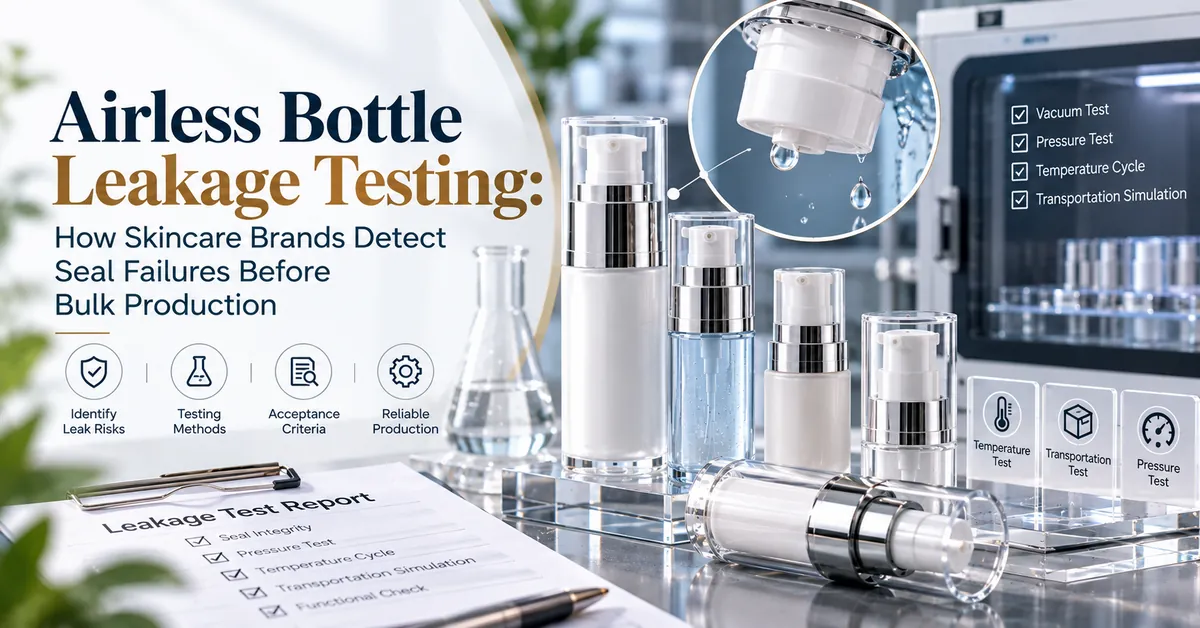
Why Leakage Testing Is Essential
Leakage can occur due to sealing defects, dimensional inconsistency, damaged components, assembly errors, or formula interaction.
Testing should consider realistic product orientation and distribution conditions.
A package that remains sealed while standing upright may behave differently when subjected to pressure changes, vibration, or impact.
The buyer should define acceptable leakage performance and agree on appropriate test conditions.
Why Repeated Pump Testing Matters
A pump may perform correctly during the first few actuations but deteriorate after prolonged use.
Repeated operation can reveal inconsistent output, actuator sticking, unusual force changes, or incomplete recovery.
Testing should use representative samples and a defined procedure.
Where the product will be used daily over an extended period, the expected number of consumer actuations should inform the durability assessment.
Why Batch Consistency Matters
A successful prototype does not guarantee that every later production lot will perform identically.
Production quality depends on material consistency, tooling condition, molding parameters, assembly control, and inspection practices.
For repeat procurement, buyers should require traceable production records and clear methods for handling nonconforming products.
How to Evaluate an Airless Bottle Manufacturer's Production Capability
When sourcing airless packaging, understanding the supplier's manufacturing scope helps clarify technical responsibility.
Some companies manufacture bottle bodies and selected molded components internally while sourcing specialized pump mechanisms from qualified partners.
Others may integrate a broader range of production processes.
Neither arrangement automatically guarantees superior performance.
What matters is whether the supplier can control the complete approved packaging system.
Mold Development and Engineering
Custom bottle development may require 3D modeling, prototype creation, mold design, trial production, and engineering revisions.
The supplier should explain the stages of development and the acceptance criteria for each stage.
Buyers should also clarify responsibility for mold maintenance, tool ownership, and future modifications.
Injection and Blow Molding
Depending on the component, plastic manufacturing may involve injection molding, blow molding, or other appropriate processes.
Critical dimensions, surface condition, wall thickness, and structural integrity should be controlled.
Process selection should match the design and material requirements.
Printing and Decoration
Cosmetic packaging often includes customized colors, screen printing, hot stamping, and other decorative finishes.
Buyers should approve the intended appearance before production.
Decoration must also be appropriate for the selected substrate and expected handling conditions.
Component Assembly
The assembled airless system must maintain the required fit between its reservoir, piston or pouch, pump, actuator, closure, and decorative components.
Incorrect assembly can compromise performance even when individual parts meet their specifications.
Suppliers should have suitable methods for checking assembly conformity.
Finished Product Inspection
Before shipment, production units should be assessed against approved drawings, reference samples, and agreed quality criteria.
The supplier should explain how inspection results are recorded and how rejected batches are managed.
OEM and ODM Airless Bottle Customization
OEM and ODM services can help skincare brands create a distinctive packaging identity while addressing functional and manufacturing requirements.
However, customization may range from changing the decoration of an existing package to developing a new bottle structure.
These project types have different commercial and technical implications.
Existing Design Customization
Using an available packaging design may allow brands to modify exterior colors, logos, printed graphics, or compatible decorative components.
This approach can reduce development complexity when the existing structure meets the formulation and dispensing requirements.
However, customization should be evaluated against the actual design.
A particular pump or bottle may have restrictions involving colors, decoration methods, or component combinations.
New Mold Development
A brand requiring a unique bottle shape or specialized structure may need custom tooling.
The development process can involve:
-
Product concept and functional requirements.
-
Engineering review and 3D drawings.
-
Prototype or CNC sample evaluation.
-
Mold design and development.
-
Trial samples and revisions.
-
Technical and cosmetic approval.
-
Production preparation.
-
Mass production and quality inspection.
The specific sequence depends on the project and supplier capabilities.
What Should Be Confirmed Before Paying for Tooling?
Buyers should clarify who owns the mold, how design revisions are handled, who approves drawings, and what happens if trial samples fail to meet the agreed requirements.
Technical drawings should identify critical dimensions and tolerances.
Functional expectations should be documented before production approval.
The agreement should also define whether a design uses proprietary pump components or standard compatible parts.
These details can influence future sourcing flexibility and long-term packaging costs.
How MOQ, Lead Time, and Tooling Affect Airless Bottle Costs
Comparing quotations from airless bottle suppliers can be difficult because similar-looking products may use different materials, pump systems, and assembly methods.
A professional quotation comparison should include all relevant commercial assumptions.
Major Cost Drivers
Pump complexity: More specialized dispensing components can affect manufacturing and assembly costs.
Material selection: Resin type, component weight, decorative shells, and finishes influence material and processing expenses.
Tooling requirements: Custom molds and engineering work can create upfront investment.
Decoration: Color matching, printing, plating, coating, and inspection requirements may affect unit cost.
Order quantity: Production setup and component procurement requirements influence commercial pricing.
Quality verification: Additional testing or documentation may create project-specific costs.
Transportation: Product weight, carton dimensions, protection, and shipping destination affect landed cost.
Minimum Order Quantity
There is no universal MOQ for all airless packaging products.
Standard designs may have different quantity requirements from custom colors, unique decorations, or new tooling projects.
Brands should request the MOQ for the exact approved configuration.
It is also useful to distinguish between prototype samples, pre-production samples, initial commercial orders, and repeat orders.
Production Lead Time
Lead times depend on component availability, tooling, decoration, testing, order quantity, and production scheduling.
Custom mold development should not be assumed to follow the same timeline as an existing packaging design.
Buyers should request a written schedule covering development, sample approval, production, inspection, and shipment.
Transportation time should be distinguished from manufacturing lead time.
Sustainable and Refillable Airless Packaging
Sustainable packaging decisions require evaluating materials, design, replacement systems, and the actual end-of-life pathway.
Airless packaging can offer functionality, but the label "airless" does not automatically establish any environmental advantage.
PCR Materials
Post-consumer recycled materials may reduce reliance on virgin plastic when appropriately used.
However, PCR availability, composition, and suitability vary by resin and component.
Brands should verify the recycled-content percentage and any necessary material documentation.
Not every pump component or internal reservoir is suitable for the same recycled-material approach.
Refillable Systems
A refillable airless system may use a replaceable inner cartridge or another purpose-designed refill arrangement.
The exterior package can potentially be reused while selected internal components are replaced.
However, buyers must evaluate compatibility, replacement reliability, hygiene, and consumer instructions.
The environmental outcome also depends on how the system is actually used and disposed of.
Recyclability
Airless packaging can contain several different materials.
Mixed-material assemblies may present recycling challenges, depending on the collection and processing systems available in the target market.
Claims such as "100% recyclable" or "carbon neutral" should not be made without appropriate supporting evidence.
For sustainable product development, the best approach is to request actual material and component information and assess the complete packaging system.
International Cosmetic Packaging Compliance Considerations
Packaging buyers serving overseas markets should distinguish between packaging component specifications and finished-product regulatory compliance.
For cosmetic products placed on the European Union market, Regulation (EC) No 1223/2009 establishes relevant cosmetic safety requirements.
The Cosmetic Product Safety Report includes information about the packaging material, including characteristics relevant to purity and stability.
This makes suitable material documentation and formulation compatibility important parts of the product development process.
For the United States, cosmetic products are regulated under applicable FDA requirements.
Ordinary cosmetic products generally do not require FDA premarket approval, apart from applicable exceptions such as certain color additives.
An empty airless bottle should therefore not be marketed as "FDA approved" merely because it is intended for cosmetic use.
ISO 22715:2006 addresses cosmetic packaging and labeling.
Its existence should not be confused with evidence that a specific airless mechanism has passed performance testing.
Buyers should request the actual documents needed for their intended product and market.
Regulatory compliance, pump functionality, and product stability are related purchasing concerns, but they are not interchangeable forms of evidence.
Shipping and Storage Risks for Airless Packaging
International supply chains expose cosmetic packaging to handling, transportation, and environmental conditions.
Potential risks include impact, vibration, compression, abrasion, and temperature changes.
Airless containers may also need protection against accidental actuator movement during distribution.
Brands shipping filled products through e-commerce channels should consider the requirements of individual parcel delivery.
ISTA testing procedures can provide useful approaches for evaluating packaged-product distribution risks when an appropriate procedure is selected.
The buyer should define the intended distribution environment and suitable acceptance criteria before testing.
A packaging system that works during laboratory evaluation still requires appropriate consideration of commercial transportation conditions.
Common Mistakes When Selecting Airless Bottle Suppliers
Several sourcing mistakes repeatedly create avoidable project risks.
Mistake 1: Assuming Every Pump Bottle Is Truly Airless
A pump head and premium bottle appearance do not establish the internal dispensing mechanism.
Better approach: Request a structure diagram and functional evidence.
Mistake 2: Selecting Packaging Before Confirming Formula Compatibility
A bottle suitable for one skincare formula may not be appropriate for another.
Better approach: Test the actual intended formulation.
Mistake 3: Believing Airless Packaging Eliminates the Need for Preservatives
Reduced air entry does not guarantee microbiological safety.
Better approach: Maintain an appropriate formulation safety and preservation strategy.
Mistake 4: Accepting Unverified Evacuation Claims
A high product evacuation percentage is meaningful only when supported by a defined test method.
Better approach: Request comparable test conditions and results.
Mistake 5: Comparing Prices Without Matching Specifications
Different suppliers may quote products with different materials, mechanisms, and inspection requirements.
Better approach: Use a standardized RFQ.
Mistake 6: Ignoring Assembly and Filling Requirements
An airless system may require particular filling or priming procedures.
Better approach: Evaluate compatibility with the intended production process.
Mistake 7: Approving Only an Attractive Prototype
Appearance does not prove long-term functionality.
Better approach: Approve production-representative samples after appropriate testing.
Mistake 8: Making Unsupported Sustainability Claims
Refillability, recycled content, and recyclability are different concepts.
Better approach: Verify the actual material composition and intended reuse or recycling pathway.
How COSME Packaging Supports Skincare Packaging Development
For buyers comparing cosmetic packaging manufacturers, company capabilities are most useful when they can be connected to specific project requirements.
COSME Packaging is the packaging brand of Zhejiang Cosme Industry Co., Ltd., a China-based cosmetic packaging company founded in 2015.
The company describes an approximately 15,000-square-meter manufacturing facility, around 200 employees, an internal research and development center, molding equipment, printing operations, and mold development capabilities.
Its product portfolio includes cosmetic bottles, jars, tubes, airless packaging categories, and customized packaging projects.
According to the company's published information, its quality control activities cover incoming materials, dimensional inspections during molding, surface defects, finished-product leakage checks, printing adhesion, color inspection, and batch traceability.
Buyers can review the COSME company and manufacturing overview for additional background.
Airless Packaging Options and Technical Confirmation
COSME's public product range includes airless packaging categories for plastic, acrylic, glass, aluminum-style, and refillable packaging.
The company also presents a product described as an Airless Bottle for Skincare and Cosmetic Dispensing.
However, the public product description does not confirm every detail of its internal dispensing structure, material grade, or capacity.
Therefore, professional buyers should request additional technical information before treating any specific product as a verified piston-type or pouch-type airless system.
The appropriate next step is to discuss the intended formula, bottle capacity, dispensing requirements, product design, and testing expectations.
OEM/ODM Development Support
COSME describes packaging customization processes involving product selection, color and printing confirmation, quotations, pre-production samples, and mass production.
For new mold projects, its published development sequence includes engineering drawings, CNC samples, mold opening, trial samples, and production.
These capabilities are relevant to brands planning packaging customization.
However, exact availability, pump configurations, MOQ, tooling requirements, and production lead times must be confirmed for each project.
Suppliers should not be evaluated solely on general manufacturing descriptions; the proposed product and development plan must match the buyer's technical requirements.
A Practical Airless Bottle Supplier Evaluation Scorecard
Professional purchasing managers can use a weighted evaluation method to compare candidate suppliers.
The following scorecard is an illustrative procurement tool, not a recognized industry certification system.
| Evaluation Dimension | Suggested Weight | Evidence to Evaluate |
|---|---|---|
| Dispensing technology and compatibility | 25% | Structure drawings, samples, formula evaluation |
| Quality control and testing | 20% | Inspection standards, test reports, traceability |
| Manufacturing and engineering | 15% | Equipment, development capability, component control |
| OEM/ODM customization | 10% | Design process, tooling, decoration capability |
| Commercial terms | 15% | Price, MOQ, lead time, quotation transparency |
| Documentation and communication | 10% | Technical responses, specification completeness |
| Sustainability and packaging options | 5% | Material data, refill design, supporting evidence |
A brand developing a technically sensitive formula may place greater weight on compatibility testing.
A packaging distributor sourcing established designs may prioritize supply reliability and commercial consistency.
The weighting should reflect the actual project.
Importantly, a supplier with missing technical evidence should not receive full marks simply because its sales presentation is persuasive.
How to Prepare an Effective Airless Bottle RFQ
A detailed RFQ helps suppliers identify suitable options and reduces unnecessary quotation revisions.
Before contacting manufacturers, define the project as clearly as possible.
Recommended RFQ Checklist
| Information | Details to Provide |
|---|---|
| Product category | Serum, moisturizer, eye treatment, lotion, or another product |
| Target market | Intended sales countries or regions |
| Formulation | Relevant ingredients, viscosity, compatibility concerns |
| Capacity | Desired fill volume and acceptable alternatives |
| Dispensing technology | Required airless mechanism or performance objective |
| Pump output | Desired amount per actuation, if established |
| Material | Preferred exterior and product-contact materials |
| Appearance | Colors, transparency, finish, logo, printing |
| Order quantity | Sample quantity, initial order, annual forecast |
| Development type | Existing design, customization, or new tooling |
| Testing | Compatibility, leakage, evacuation, durability |
| Documentation | Drawings, material information, inspection records |
| Delivery | Target schedule and destination |
| Commercial terms | MOQ, tooling fees, payment and shipping terms |
Example RFQ for a Skincare Brand
A skincare brand developing a new facial serum might send the following inquiry:
"We are developing a premium facial serum and are evaluating airless packaging options for an initial commercial launch. Our preferred fill volume is approximately 30 mL, and we require controlled dispensing, suitable formula compatibility, and a premium retail appearance. We would like to compare standard and customizable packaging designs, including possible refillable options.
Please confirm available airless dispensing mechanisms, product-contact materials, sample arrangements, pump performance documentation, applicable MOQ, customization possibilities, and estimated development and production timelines. We can provide further formulation information for compatibility evaluation."
The 30 mL capacity in this example represents a hypothetical buyer requirement, not a confirmed specification of a particular COSME product.
A complete RFQ improves the quality of supplier responses and helps identify technical risks earlier.
For a project-specific discussion, buyers can contact COSME Packaging to request available options and a quotation.
Frequently Asked Questions About Airless Bottle Suppliers
1. How do I identify reliable airless bottle suppliers?
Evaluate suppliers based on verified dispensing technology, product compatibility, quality control, development capability, technical documentation, and commercial reliability.
Request relevant drawings, production-representative samples, material information, and test results where applicable.
A reliable supplier should explain the limitations of its proposed design rather than claiming that every airless bottle suits every cosmetic formulation.
Compare multiple suppliers using the same specification and acceptance criteria.
2. Are airless bottles better than regular pump bottles?
Airless packaging may be advantageous when the product benefits from reduced replacement air entering the reservoir and controlled dispensing.
However, conventional pumps can be appropriate for many cosmetic formulations.
The better option depends on formulation requirements, filling compatibility, cost, consumer use, and validation results.
Neither format is universally superior.
3. Can airless bottles extend the shelf life of skincare products?
An appropriate airless system may support a product's overall stability strategy by limiting certain forms of air exposure during use.
However, shelf life depends on formulation chemistry, manufacturing conditions, preservation, packaging materials, storage, and other factors.
An airless bottle does not automatically extend shelf life.
Any shelf-life claim should be supported by suitable finished-product stability testing.
4. Are all airless bottles completely airtight?
No.
The term airless usually describes the dispensing architecture and its approach to reducing replacement air entering the product reservoir.
It does not guarantee zero oxygen exposure, zero gas permeability, or complete protection from environmental factors.
Buyers should evaluate the actual mechanism, materials, sealing performance, and product-specific stability requirements.
5. What materials are commonly used for airless cosmetic packaging?
Depending on the design, airless packaging may incorporate PP, PE, PET, acrylic-style exterior components, glass outer shells, metallic finishes, and other materials.
The exterior appearance does not necessarily identify the product-contact materials.
Buyers should request appropriate material information for the selected reservoir, pump, seals, and related components.
6. How can I verify product evacuation performance?
Use a defined test method that records the initial product fill and the total amount dispensed.
Calculate the evacuation percentage using consistent conditions and an agreed endpoint.
Testing should use a representative formula and sample quantity.
Avoid comparing supplier claims when the test procedures, formula viscosities, or termination criteria differ.
7. What is the MOQ for wholesale airless bottles?
MOQ depends on the actual packaging configuration, component sourcing, decoration, production requirements, and tooling.
Existing designs may have different requirements from custom-colored or newly developed products.
Buyers should request a quotation for the exact specification rather than relying on a general MOQ published for another model.
8. Can airless bottles be customized for a skincare brand?
Many cosmetic packaging projects can include exterior color changes, logo printing, decorative finishes, and selected component variations.
More extensive structural customization may require engineering development and new tooling.
Available customization options depend on the selected product.
Buyers should approve production-representative samples before authorizing mass production.
9. Are refillable airless bottles more sustainable?
Refillable designs may reduce replacement of certain packaging components when consumers actually reuse the system.
However, environmental performance depends on materials, replacement frequency, transportation, product compatibility, and end-of-life handling.
Refillability alone does not prove that a package has a lower environmental impact.
Brands should evaluate the full packaging configuration and support any environmental claims with appropriate evidence.
10. What information should I provide when requesting an airless bottle quotation?
Provide the product application, target capacity, intended formula characteristics, preferred dispensing requirements, desired appearance, estimated quantity, target market, and delivery expectations.
If possible, include artwork, technical requirements, and relevant testing needs.
Ask the supplier to confirm available products, materials, sample options, MOQ, tooling requirements, lead time, and the additional information needed for technical qualification.
Conclusion
Selecting reliable airless bottle suppliers requires more than comparing designs and prices. Skincare brands should prioritize verified dispensing mechanisms, formulation compatibility, pump consistency, product evacuation, quality control, and clearly documented OEM/ODM requirements. The right packaging choice is the one that performs reliably with the intended formula and supports commercial production.
For brands sourcing custom skincare packaging, COSME Packaging offers a starting point for discussing bottle design, manufacturing, and customization needs. Contact COSME Packaging to share your product specifications, formulation requirements, target capacity, and order plans, and request an evaluation of suitable packaging options.